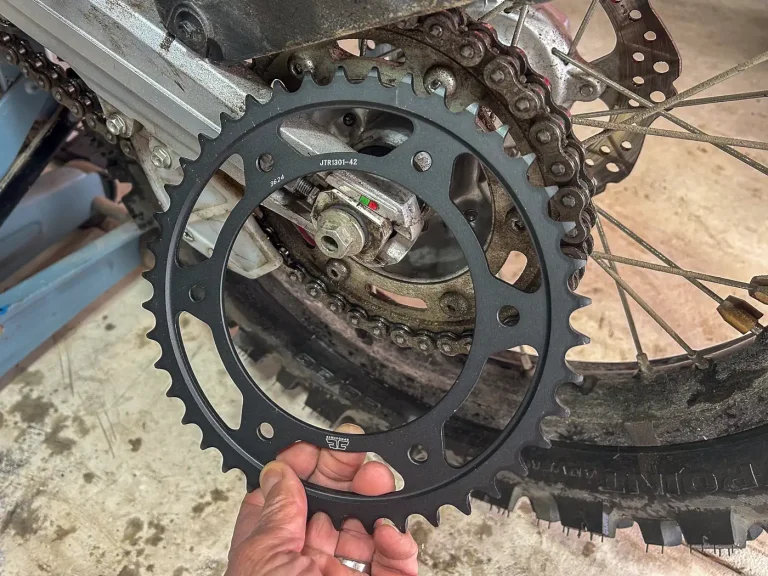
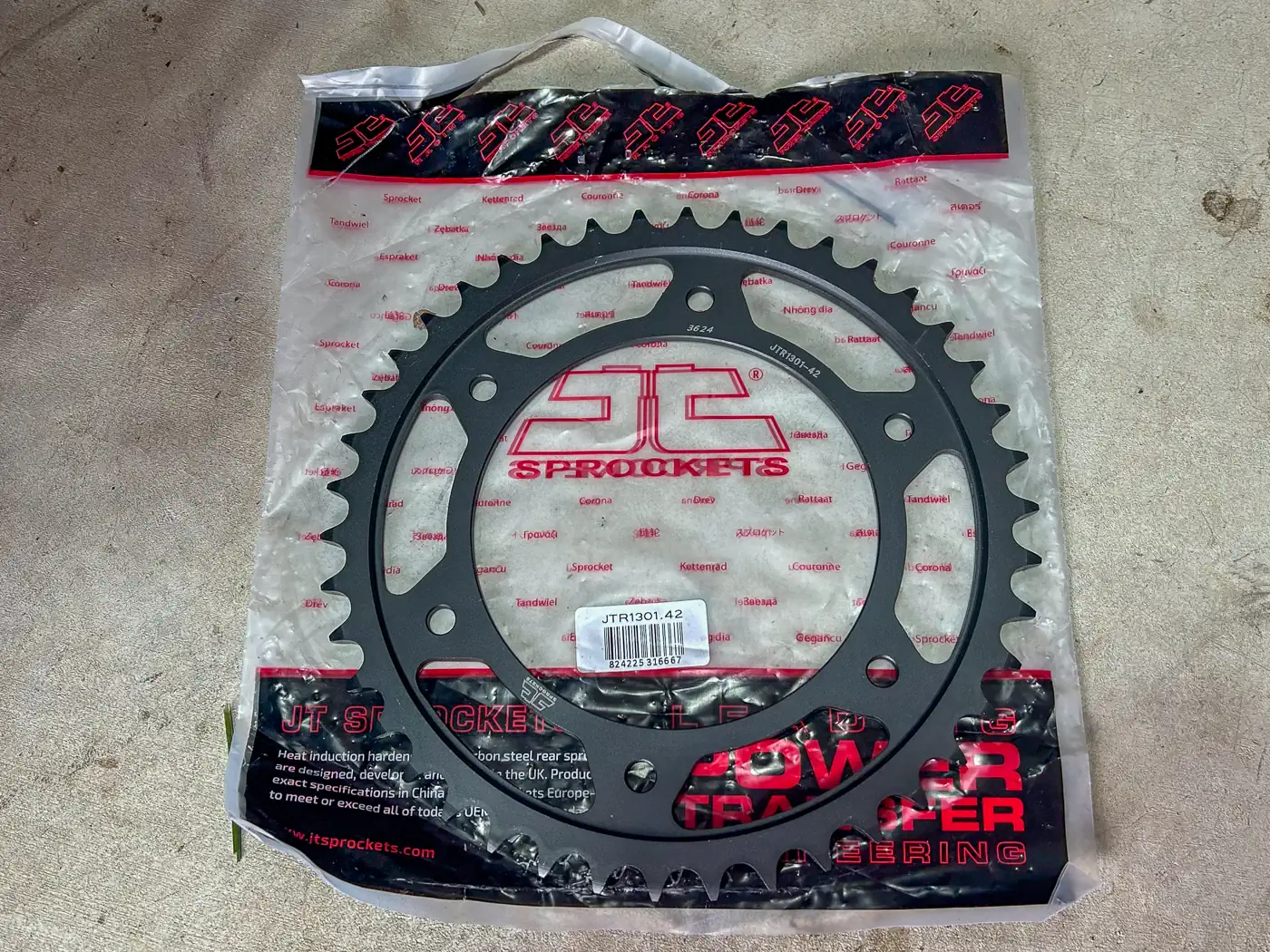
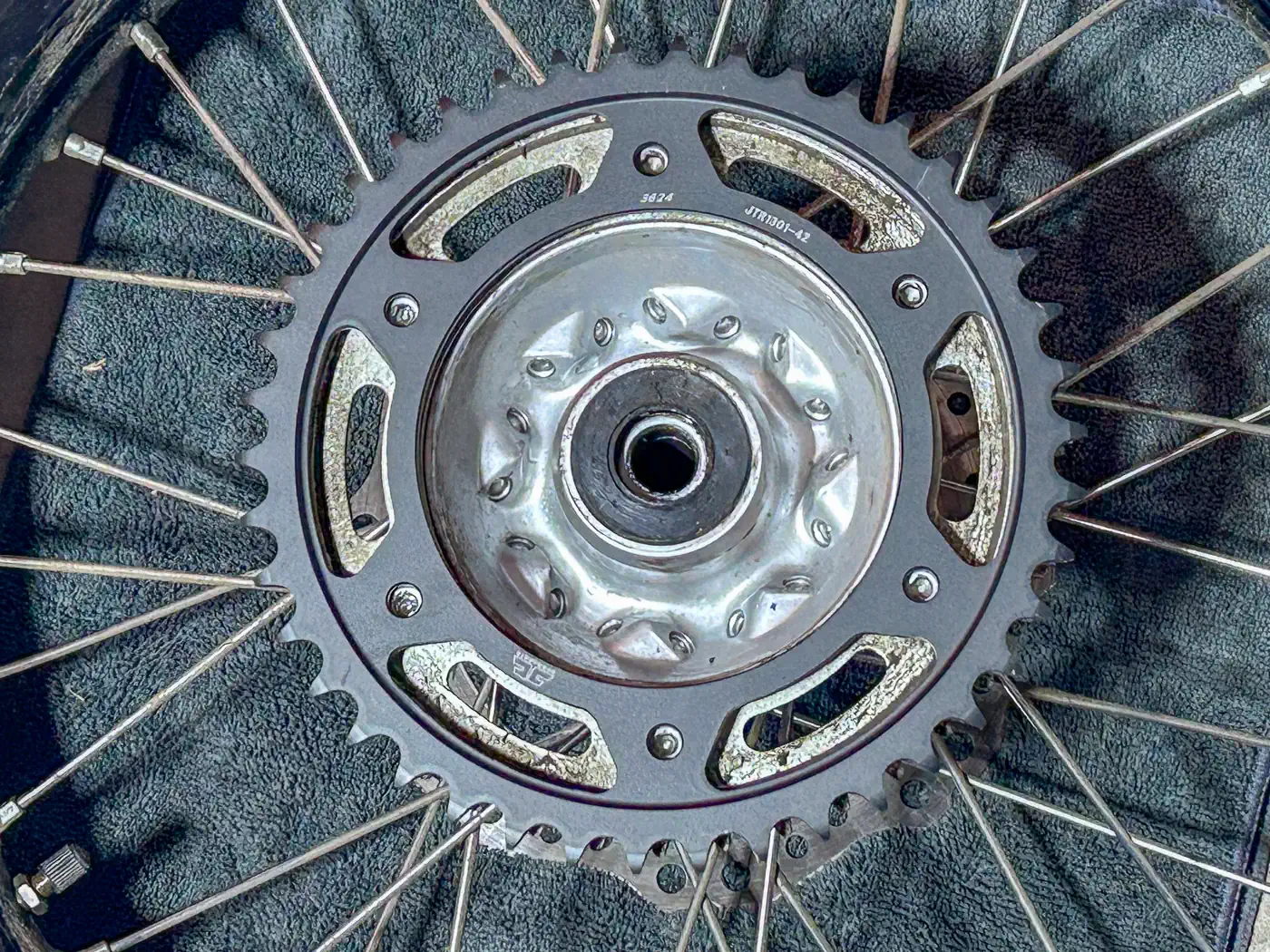
A JT Sprockets steel rear sprocket review is something I’ve been looking forward to writing for nearly a year. Before I even picked up the Ultimate Motorcycling Honda CRF300L Rally Project Bike, I had already ordered replacement sprockets from JT Sprockets: a 13-tooth countershaft and 42-tooth rear, both steel. The stock gearing is 14 teeth up front and 40 teeth in the rear.
I knew changing the gearing would alter the bike’s character; I just didn’t know by how much, or whether I’d even like the results. I wanted to wait until I had completed all the power mods before adding the gear ratio changes.
I wanted to tackle the gearing issue one step at a time, so I left the stock 14-tooth countershaft sprocket in place and installed only the 42-tooth rear sprocket.
Installation tip
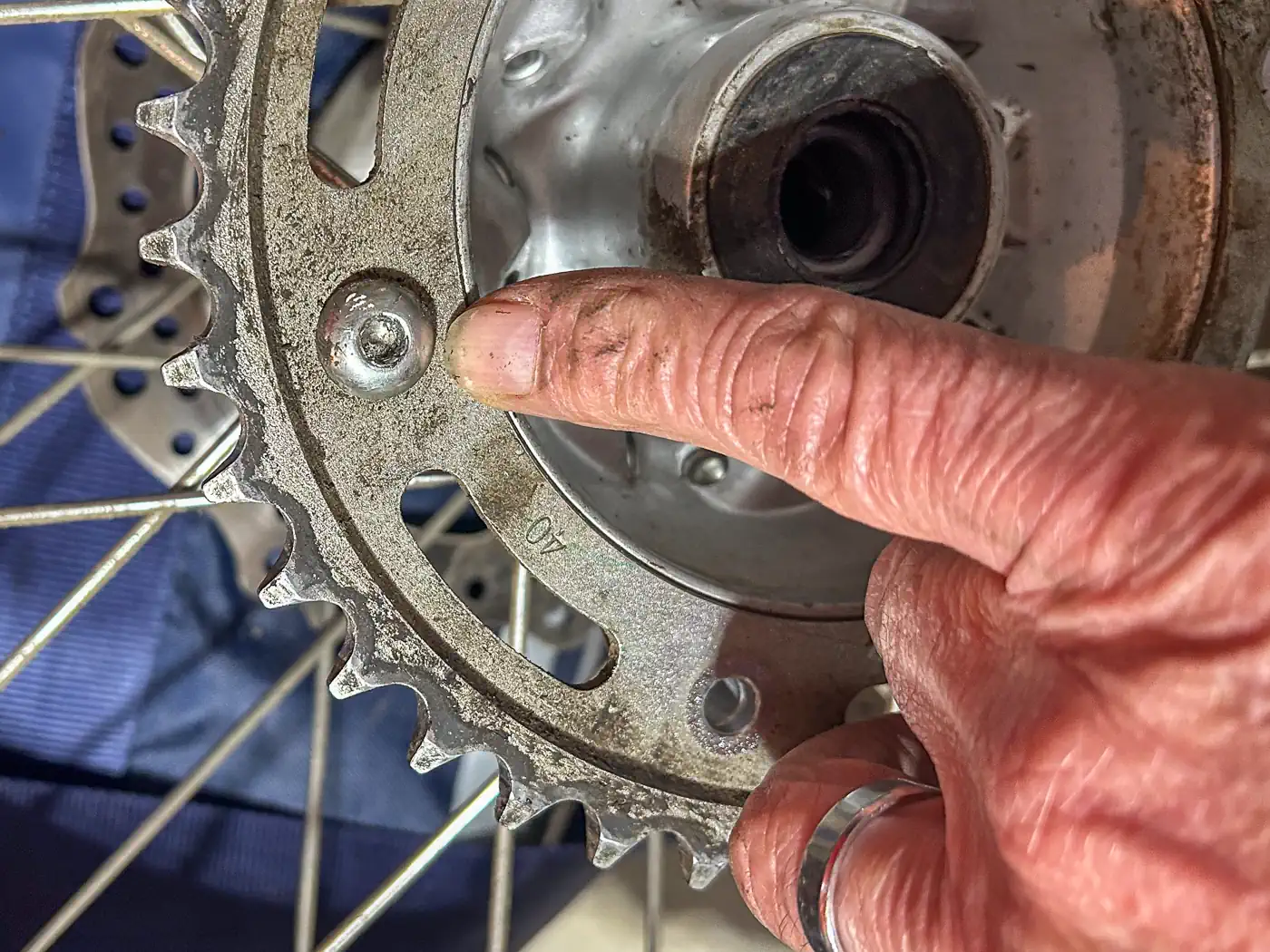
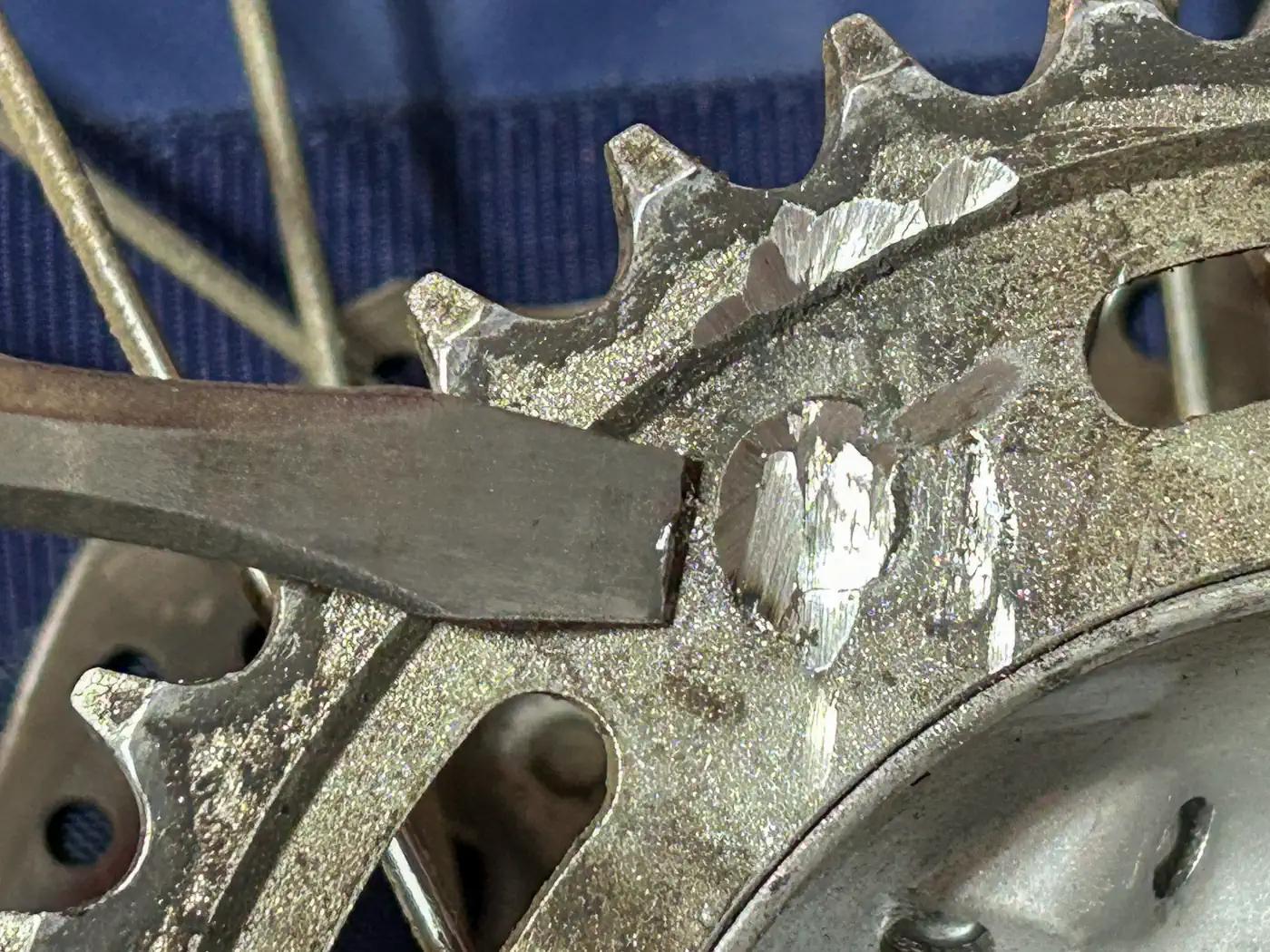
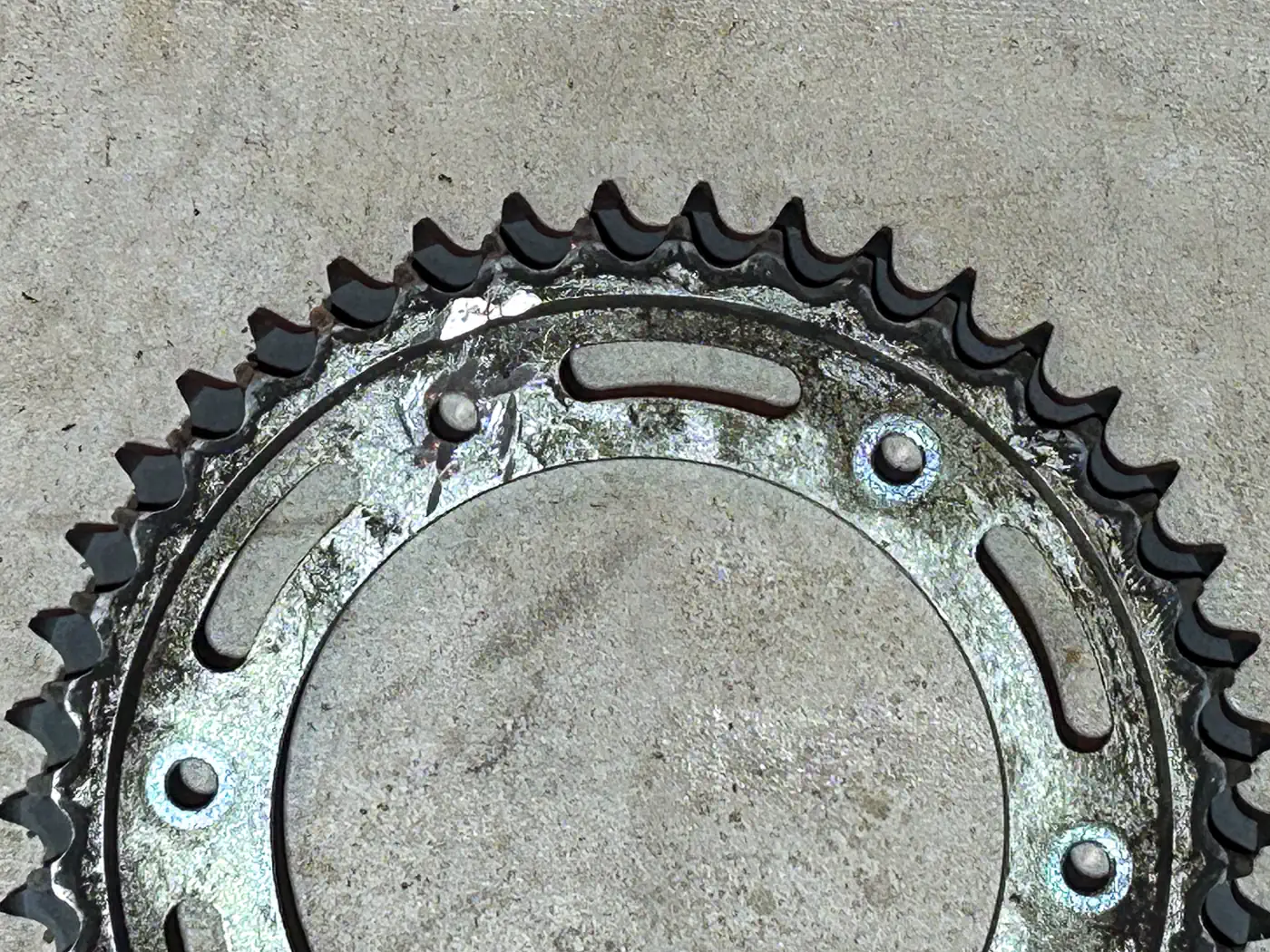
Installation should have been a simple remove-and-replace, except that I mistakenly tried to turn the hex socket bolt instead of the backing nut. I rounded out one of the soft OEM bolt heads and had to grind the bolt off. Don’t make that mistake.
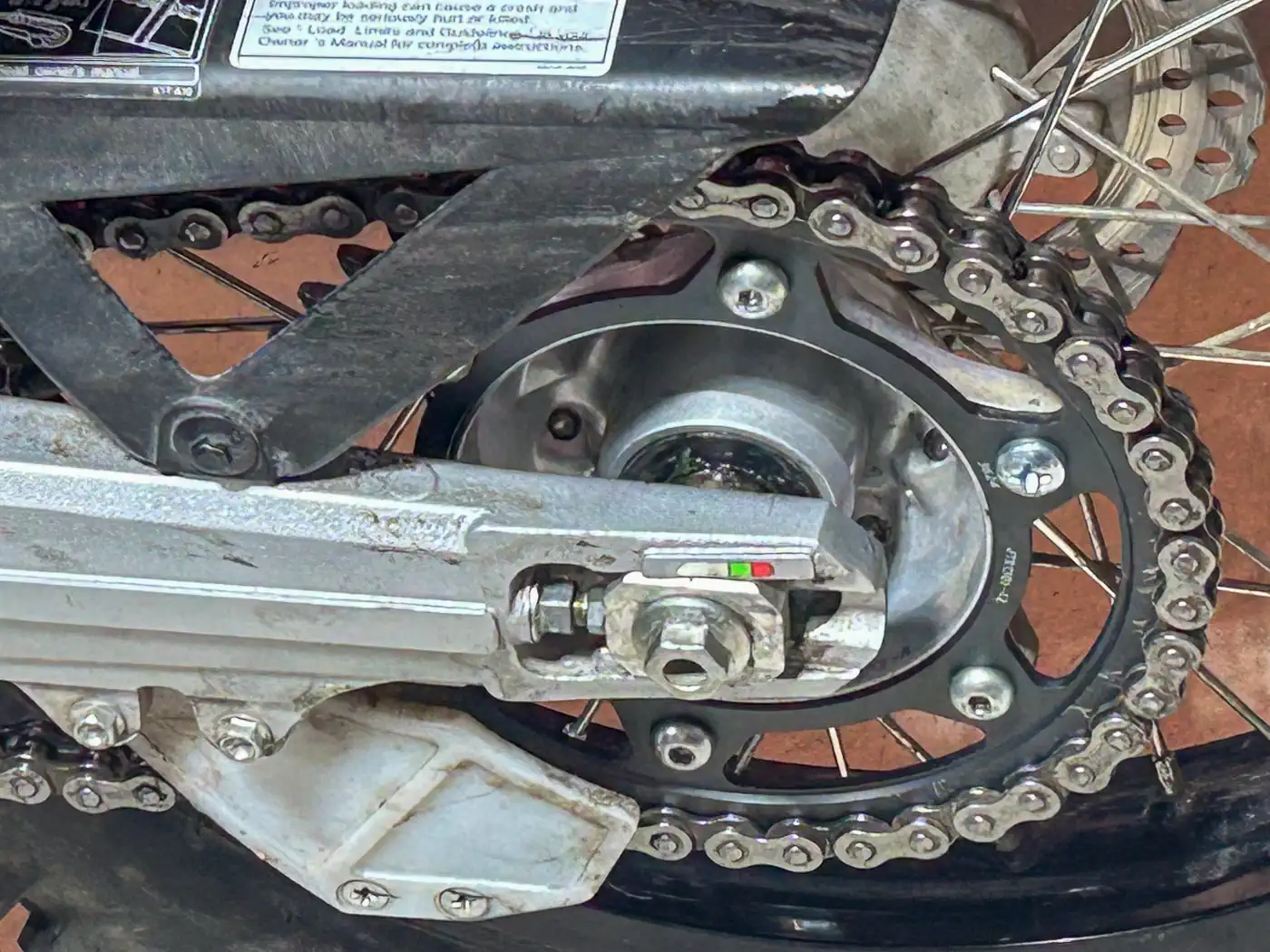
The sprocket needed no modification or persuasion. It fit exactly as an OEM replacement should. With the larger rear sprocket, the stock chain still fits, though it requires the rear wheel to be adjusted far forward. While that can cause some tire clearance issues with knobbies, I didn’t experience any rubbing with the Tusk Waypoint Adventure tire I am running.
JT Sprockets has been manufacturing replacement and OEM motorcycle sprockets for decades, putting every sprocket through dozens of production stages and rigorous quality-control checks. The company cuts its steel sprockets by hobbing, machining, and drilling to produce accurate tooth profiles and consistent dimensional tolerances. JT states that its rear sprockets are manufactured from C49 high-carbon steel and heat-treated for durability.
Those manufacturing claims were supported by what I found during installation. The machining is clean, the finish is uniform, and the mounting holes aligned perfectly with the Honda hub.
Based on my research, I expected the 42-tooth sprocket to move the engine into a more effective operating range at highway speeds. By turning slightly higher rpm at cruising speed, it spends more time where the engine produces stronger, more usable power.
That proved to be exactly what I experienced. The 42-tooth JT rear sprocket made the CRF300L Rally’s power much easier to use.
New CRF300L Gearing Results
With the stock gearing, maintaining freeway speeds often depended on perfect conditions. A modest headwind, a gentle uphill grade, or simply sitting upright enough to catch more wind would cause the bike to lose momentum. The taller stock gearing left little performance in reserve.
With the JT 42-tooth rear sprocket installed, the difference was immediately noticeable. The Rally now comfortably maintains 73 mph (per GPS) in sixth gear, even on moderate grades. The engine feels more responsive because it is closer to its horsepower peak, giving it enough reserve to handle changing road conditions rather than being overwhelmed.
Off pavement, the benefits are even more apparent. First gear is more useful on technical terrain, and the Rally pulls with noticeably more authority through the gearbox. The motor tractors better through difficult sections, reducing the need for excessive clutch work and making slow-speed riding less fatiguing.
The tradeoff is a reduction in top speed. Gearing down 5% means a commensurate reduction in top speed, depending on conditions. However, the bike maintains highway speeds with greater confidence and requires fewer downshifts on grades or into headwinds. That is a compromise I gladly accept because it makes the CRF300L Rally perform better at the speeds I ride.
Another side effect is speedometer accuracy. The Honda CRF300L Rally measures speed by a crankcase sensor, not the front wheel. So, changing the gearing also affects the speedometer’s accuracy, which is about 4% optimistic in the stock configuration. The 42-tooth sprocket pushes that to about 9% over actual speed.
I’m not going to put the 13-tooth JT Sprockets countershaft sprocket on the bike with the 42-tooth rear sprocket. That would lower the gearing by another 7.7%, which would lift the highway rev count higher than I’d like. However, next time I change the rear tire, I will try the 13-tooth countershaft sprocket with the 40-tooth stock sprocket. The 13/40 combo drops the gearing by 2.6% compared to this 14/42 pairing, and I’m curious how that will feel on- and off-road.
For my riding, the JT Sprockets 42-tooth steel rear sprocket turned out to be the icing on the CRF300L Rally Project Bike’s engine modifications cake for just $31 MSRP. While it doesn’t transform the engine or create horsepower that wasn’t there, it fundamentally changes how accessible that power feels. Whether cruising on flatland freeway, climbing mountain grades, whipping through the twisties, or crawling through rocky trails, the Rally is simply easier and more enjoyable to ride. Sometimes the best performance upgrade isn’t adding power; it’s making better use of the power you already have.
Our bike review this episode is the Yamaha MT-03. Do not underestimate this bike; you get a lot of motorcycle for your money! Associate Editor Kelly Callan rode the smallest MT for several weeks, and that included commuting on it. One of the things that impressed her, was how the MT-03 acted like a larger motorcycle. Kelly also spent some time chasing Editor Don Williams through the canyons when he was on the Yamaha MT-07—obviously a much larger machine. She tells us about how it all went.
* * * * *
We’re closing in fast on the 34th annual Biketoberfest, October 15–18, when all roads will lead to Teddy Morse’s Destination Daytona—the more than 100-acre motorcycle playground in Ormond Beach Florida. This week we get to hear all about it from Teddy Morse himself. With his trademark high energy and enthusiasm, he tells us all about his recently established Triketoberfest that happens the week before, and how the Destination Daytona complex turns into a full-throttle hub of demo rides, vendors, custom builds, live music, food trucks, shops, and nonstop pavilion energy. So, whether you’re on two wheels or three, whether you’re hunting parts or lining up a test ride; grab a cold one and soak up the energy and gorgeous Florida fall weather. This is one of the many Daytona Beach places where Biketoberfest feels like home. So don’t forget: make sure you download the Biketoberfest mobile App from Apple or Google Play or visit www.biketoberfest.org and we’ll see you there!
* * * * *
Our guest this episode is Greg Arnold, Mecum’s motorcycle auction director. He bought his first bike at eleven, joined the company in 2011, and has spent more than a decade helping turn this incredible event into the place collectors, consignors, and dreamers all show up. Next February 3rd through 6th, Mecum will—for the 36th time, bring the world’s largest vintage motorcycle auction back to South Point, Las Vegas. That’s over two thousand bikes over four days. Board-track racers, barn finds, customs, race iron, and especially, those incredible machines that make the room go quiet. Greg gives us insight into what it takes to make this event work so incredibly well, and if you’re interested in selling your pride and joy, what steps you have to take to make it happen.
* * * * *
Here’s quick reminder to check out our monthly digital magazine. It’s filled with everything you want to read on motorcycling, including some things you’ve probably not seen elsewhere. It’s absolutely free and you will find it on the Apple App Store and of course on Google Play as well.
Don’t forget to leave us your comments on our social media—we’re on all the usual platforms at Ultimate Motorcycling. We love hearing your feedback… so good or bad, please let us know what you think. If there’s something you’d like us to cover, we’d love to hear those ideas too!
We use cookies and browser activity on this website
Functional
Always active
The technical storage or access is strictly necessary for the legitimate purpose of enabling the use of a specific service explicitly requested by the subscriber or user, or for the sole purpose of carrying out the transmission of a communication over an electronic communications network.
Preferences
The technical storage or access is necessary for the legitimate purpose of storing preferences that are not requested by the subscriber or user.
Statistics
The technical storage or access that is used exclusively for statistical purposes.The technical storage or access that is used exclusively for anonymous statistical purposes. Without a subpoena, voluntary compliance on the part of your Internet Service Provider, or additional records from a third party, information stored or retrieved for this purpose alone cannot usually be used to identify you.
Marketing
The technical storage or access is required to create user profiles to send advertising, or to track the user on a website or across several websites for similar marketing purposes.