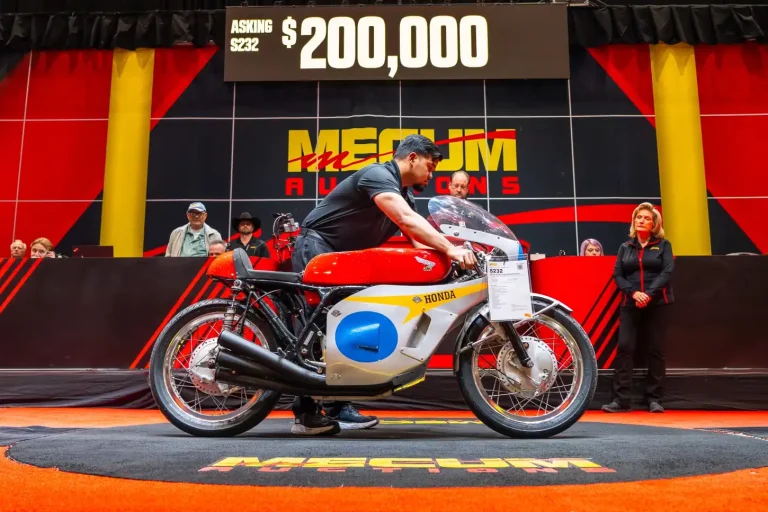
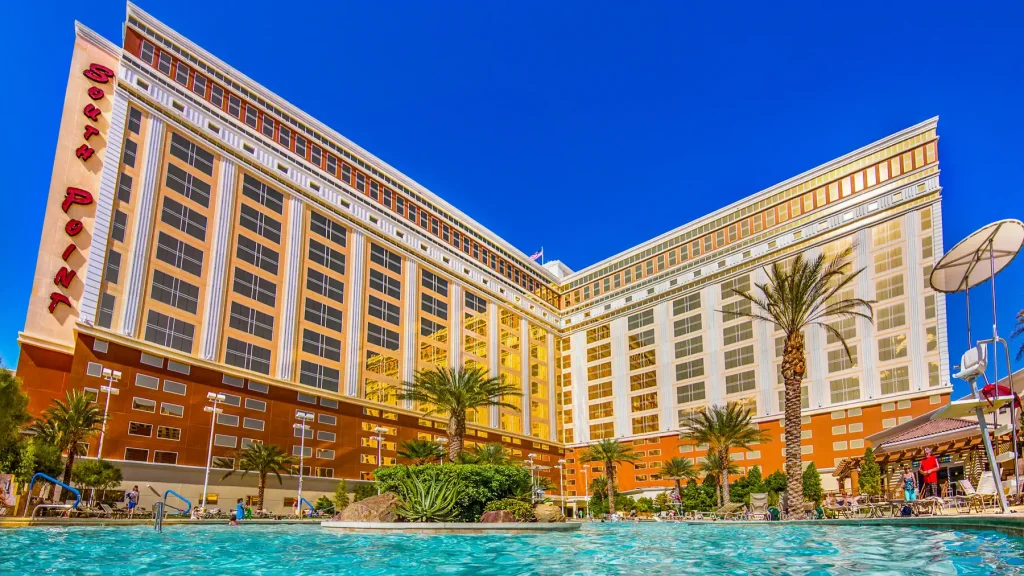
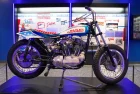
It’s that time of year when we start thinking about the amazing motorcycles coming up for sale at the annual Mecum Las Vegas Motorcycles Auction running February 3-6, 2027, at South Point Hotel, Casino & Spa. The upcoming edition features several fascinating collections, including Gem State, Sinless Cycles, Dan Ray, Rick Williams TT Special, and Ed Van Rossen.
To get things started, I’ve compiled a list of 20th-century motorcycles from the 1990s to the 1910s that caught my eye. Mecum is still adding bikes for LV Motorcycles 2027, as it is known, so this is just an appetizer of the 2,000 motorcycles that Mecum expects will be available for sale. Let’s start with the newest and work backward in time.
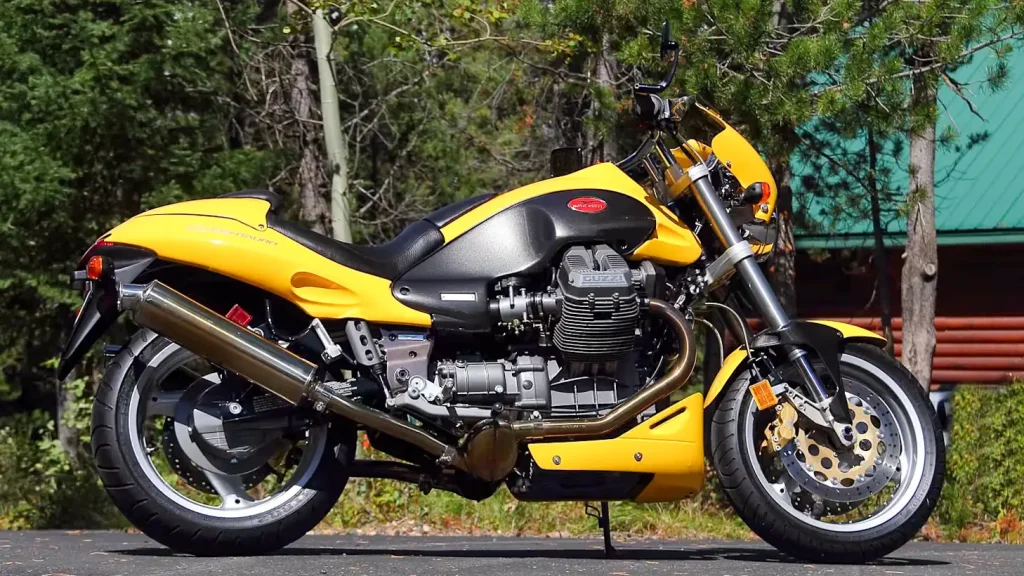
Moto Guzzi built the V10 Centauro to mark its 75th anniversary, and the 1998 example offered as Lot N12 shows 512 miles on its odometer. Luciano Marabese styled the Centauro, and Moto Guzzi powered it with the 992cc, four-valve-per-cylinder, fuel-injected V-twin from its Daytona sportbike, detuned slightly for stronger midrange. A five-speed gearbox and shaft final drive send the power to the rear wheel. This Centauro has been personalized with a one-piece chrome T-bar on a custom aluminum riser, replacement bar-end mirrors, and Progrip gel grips. The cockpit carries Veglia instruments, including a 140 mph speedometer, a tachometer with an 8,000 rpm redline, and a five-digit mechanical odometer. The Centauro sells with no reserve on Thursday, Feb. 4.
Laverda introduced the RGS 1000 in 1982 as a smoother, more touring-friendly version of its big triple, and the 1983 example offered as Lot R158 shows 30,681 miles on its odometer. The RGS uses a 981cc DOHC air-cooled inline-three with a 120-degree crankshaft rather than the 180-degree layout of earlier Laverda triples. That change, along with rubber engine mounts, made it tamer than the Jota. Laverda built an estimated 2,500 RGS-series bikes before the SFC 1000 replaced it in 1985. This RGS wears its original paint, and Scott Potter rebuilt it in 2010, with documentation. It keeps the stock exhaust of mild-steel headers and chrome-finished mufflers. The RGS has Veglia Borletti instruments, a steel duplex cradle frame, disc brakes front and rear, and hard saddlebags. Part of the Dan Ray Collection, the Laverda runs, comes with keys, and is offered with no reserve on Friday, Feb. 5.
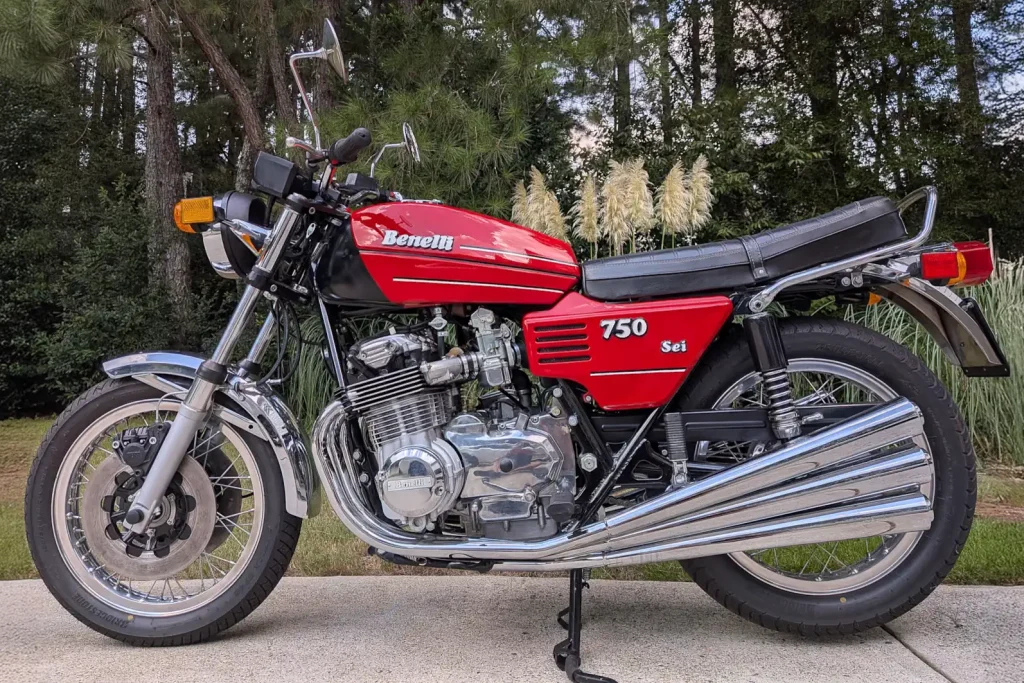
The Benelli 750 Sei was the first production six-cylinder motorcycle, and it held that title until Honda’s CBX arrived in 1978. Alejandro De Tomaso, who bought Benelli in 1971, unveiled the Sei in 1972. Its air-cooled, single-overhead-cam inline-six was based on Honda’s CB500 Four, plus two cylinders. Mecum reports fewer than 80 of the 283 Series 2 Seis built in 1977 came to the US. This Series 2 bike, Lot N528, stayed with its original owner until March 2025. It is unrestored, apart from new paint on the tank and side panels, and a new 6-into-6 exhaust. Recommissioning included a valve adjustment and balanced carburetors. Fresh Bridgestone Battlax tires went on in 2025. The factory Borrani wire-spoke wheels and rare US-model turn signals are original, and the owner’s manual, warranty card, and service records are included. Mecum has scheduled the Sei for Saturday, Feb. 6.
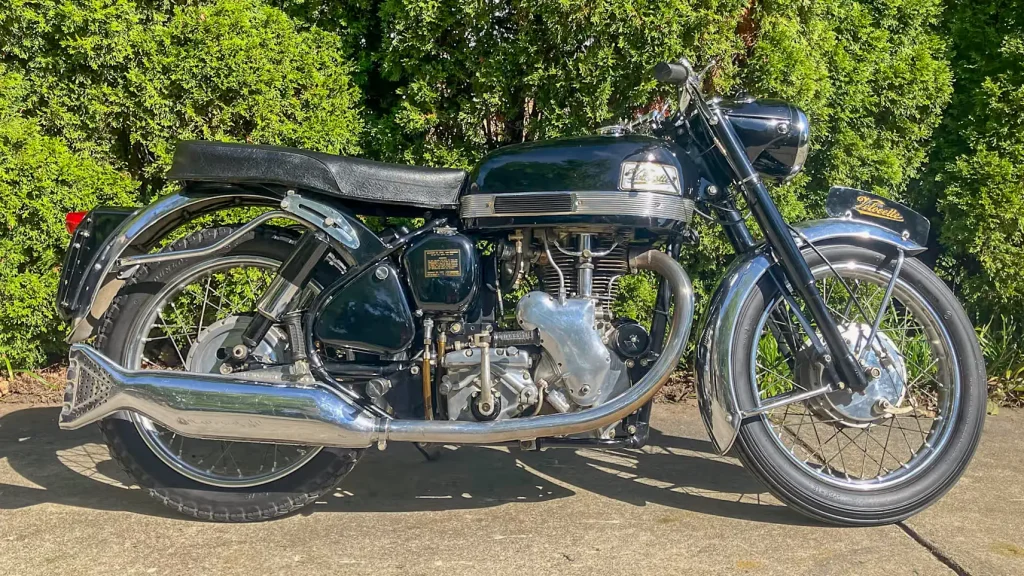
Velocette built the Venom from 1955 to 1970. Eugene Goodman conceived it, and Charles Udall designed it. The Venom uses a 499cc overhead-valve single with a square 86mm bore and stroke. Its clutch sits between the gearbox and the final-drive sprocket, an unusual layout that makes gearing changes easy. In March 1961, a factory-prepared Venom averaged 100.05 mph for 24 hours at Montlhéry, near Paris, becoming the first motorcycle of any size to top 100 mph over 24 hours. The record remains unbeaten in the 500cc class. Velocette Venom production totaled 5,721. This 1966 Venom is offered as Lot N56 without reserve on Thursday, Feb. 4.
BMW introduced the R 67 in 1951 as a 600cc sister to the 500cc R 51/3, and the two look almost identical. The R 67’s 594cc overhead-valve boxer twin drives the rear wheel by shaft, and the chassis pairs a telescopic fork with plunger rear suspension. The R 67 was a popular sidecar hauler, and BMW updated it as the R 67/2 for 1952 through 1954 and the R 67/3 for 1955 and 1956, with output rising from 26 horsepower in the original to 28 horses in the later versions. This 1955 R 67, Lot N508, sells with no reserve on Saturday, Feb. 6.
In 1948, Indian president Ralph Rogers and Britain’s Vincent HRD agreed to develop an Indian powered by a Vincent Rapide V-twin. This factory prototype came from that effort. Mecum credits the concept to Rogers and Vincent chief engineer Phil Irving, and describes the machine as a Rapide engine in a 1948 Indian Chief frame. Indian halted motorcycle production in 1953, and the Indian-Vincent never reached showrooms. According to Mecum, the bike became a retirement gift to Irving, who took it home to Australia. Phil Pilgrim of Union Jack Motorcycles restored it. The 998cc overhead-valve V-twin breathes through an Amal carburetor and drives a four-speed gearbox. The prototype has hand-fabricated linkage, a prewar Indian front fender light, a 12-volt electrical system, and a Western-style handlebar. From the Sinless Cycles Collection, it is up for bid Saturday, Feb. 6, as Lot R313.
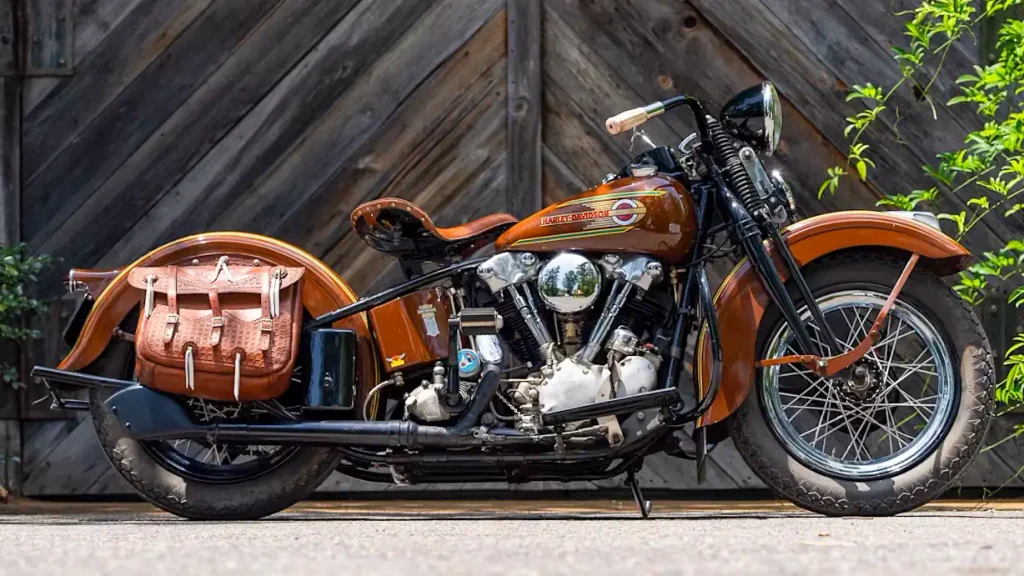
Harley-Davidson introduced the 61-cubic-inch EL in 1936 as its first overhead-valve big twin. This 1937 example is a second-year Knucklehead. The EL brought a recirculating dry-sump oiling system and a four-speed gearbox to The Motor Company’s big twins. The Knucklehead nickname, taken from the look of the engine’s rocker boxes, came into use after World War II, and H-D built the engine through 1947. Mecum says this bike is one of about 1,829 produced for 1937. It earned an Antique Motorcycle Club of America Junior First award with a score of 99.5, and Mecum also bills it as a Senior First winner. This EL appeared in the 2009 Harley-Davidson calendar. Its specification includes a tank shifter and foot clutch, a springer fork, and leather saddlebags. The Knucklehead, also from the Sinless Cycles Collection, sells Saturday, Feb. 6, as Lot R310.
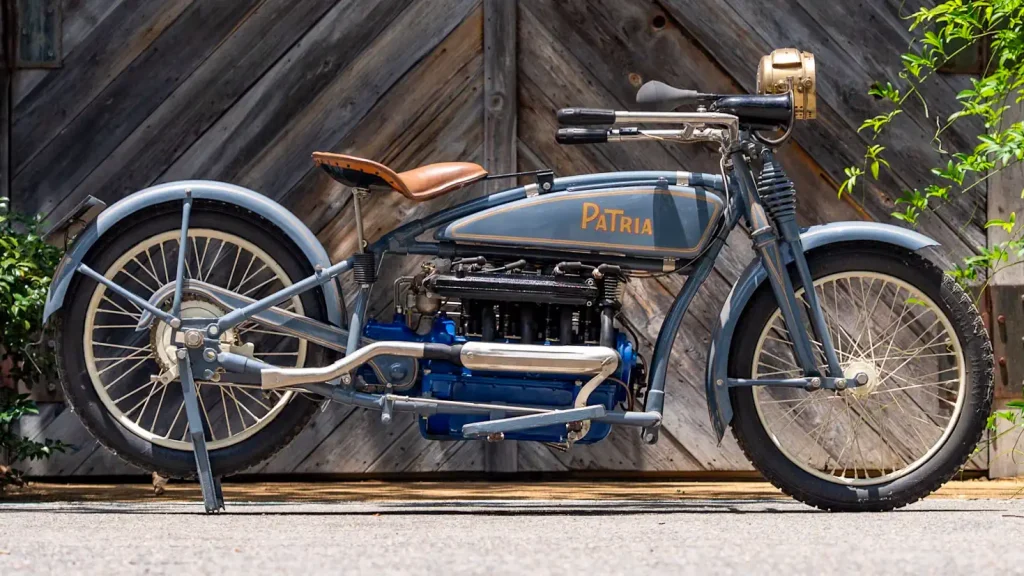
Mecum bills this 1924 Patria, Lot R305, as the lone survivor of a dozen built. Antoni Serra’s FNM factory near Barcelona built the four-cylinder Patria after the Spanish government sought a reasonably priced machine for military sidecar use. The military passed, and all 12 are believed to have gone to civilian buyers. Serra used an engine from Philadelphia’s Ace Motor Corporation, which William Henderson founded in 1919 after leaving Henderson, the company he started with his brother. In 1923, Red Wolverton rode a specially prepared Ace to 129 mph. Indian bought the Ace rights in 1927, leading to the Indian Four. This 1263cc Patria features a hand-shifted four-speed gearbox, a tubular steel downtube frame, and a band-type rear brake. Part of the Sinless Cycles Collection, the Patria crosses the block Saturday, Feb. 6.
Joseph Merkel began building motorcycles in Milwaukee in 1902. The Light Manufacturing Company later bought the business and moved production to Pottstown, Pennsylvania. In 1911, the Miami Cycle and Manufacturing Company bought Merkel and moved production to Middletown, Ohio. The Flying Merkel, recognizable in its signature orange, was among the costliest American motorcycles of its day. Maldwyn Jones won the 1913 Savannah 300-mile road race on one, yet the brand was gone by 1917. This unrestored 1914 Merkel, Lot R301, is powered by its original 61-cubic-inch V-twin with a single-speed transmission and final-drive chain. Its fork, based on Merkel’s patented spring design, uses two coil springs inside a leather sheath; the chassis also features cantilever rear suspension and a sprung seat. The Merkel comes with its original Wisconsin registration cards from 1916 to 1919 and 1922 to 1923, and it is up for bid Saturday, Feb. 6.
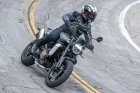
Our bike review this episode is the Yamaha MT-03. Do not underestimate this bike; you get a lot of motorcycle for your money! Associate Editor Kelly Callan rode the smallest MT for several weeks, and that included commuting on it. One of the things that impressed her, was how the MT-03 acted like a larger motorcycle. Kelly also spent some time chasing Editor Don Williams through the canyons when he was on the Yamaha MT-07—obviously a much larger machine. She tells us about how it all went.
* * * * *
We’re closing in fast on the 34th annual Biketoberfest, October 15–18, when all roads will lead to Teddy Morse’s Destination Daytona—the more than 100-acre motorcycle playground in Ormond Beach Florida. This week we get to hear all about it from Teddy Morse himself. With his trademark high energy and enthusiasm, he tells us all about his recently established Triketoberfest that happens the week before, and how the Destination Daytona complex turns into a full-throttle hub of demo rides, vendors, custom builds, live music, food trucks, shops, and nonstop pavilion energy. So, whether you’re on two wheels or three, whether you’re hunting parts or lining up a test ride; grab a cold one and soak up the energy and gorgeous Florida fall weather. This is one of the many Daytona Beach places where Biketoberfest feels like home. So don’t forget: make sure you download the Biketoberfest mobile App from Apple or Google Play or visit www.biketoberfest.org and we’ll see you there!
* * * * *
Our guest this episode is Greg Arnold, Mecum’s motorcycle auction director. He bought his first bike at eleven, joined the company in 2011, and has spent more than a decade helping turn this incredible event into the place collectors, consignors, and dreamers all show up. Next February 3rd through 6th, Mecum will—for the 36th time, bring the world’s largest vintage motorcycle auction back to South Point, Las Vegas. That’s over two thousand bikes over four days. Board-track racers, barn finds, customs, race iron, and especially, those incredible machines that make the room go quiet. Greg gives us insight into what it takes to make this event work so incredibly well, and if you’re interested in selling your pride and joy, what steps you have to take to make it happen.
* * * * *
Here’s quick reminder to check out our monthly digital magazine. It’s filled with everything you want to read on motorcycling, including some things you’ve probably not seen elsewhere. It’s absolutely free and you will find it on the Apple App Store and of course on Google Play as well.
Don’t forget to leave us your comments on our social media—we’re on all the usual platforms at Ultimate Motorcycling. We love hearing your feedback… so good or bad, please let us know what you think. If there’s something you’d like us to cover, we’d love to hear those ideas too!
We use cookies and browser activity on this website
Functional
Always active
The technical storage or access is strictly necessary for the legitimate purpose of enabling the use of a specific service explicitly requested by the subscriber or user, or for the sole purpose of carrying out the transmission of a communication over an electronic communications network.
Preferences
The technical storage or access is necessary for the legitimate purpose of storing preferences that are not requested by the subscriber or user.
Statistics
The technical storage or access that is used exclusively for statistical purposes.The technical storage or access that is used exclusively for anonymous statistical purposes. Without a subpoena, voluntary compliance on the part of your Internet Service Provider, or additional records from a third party, information stored or retrieved for this purpose alone cannot usually be used to identify you.
Marketing
The technical storage or access is required to create user profiles to send advertising, or to track the user on a website or across several websites for similar marketing purposes.