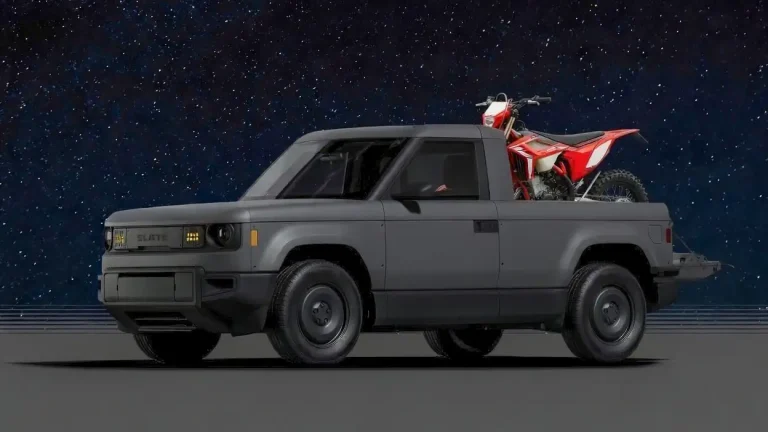
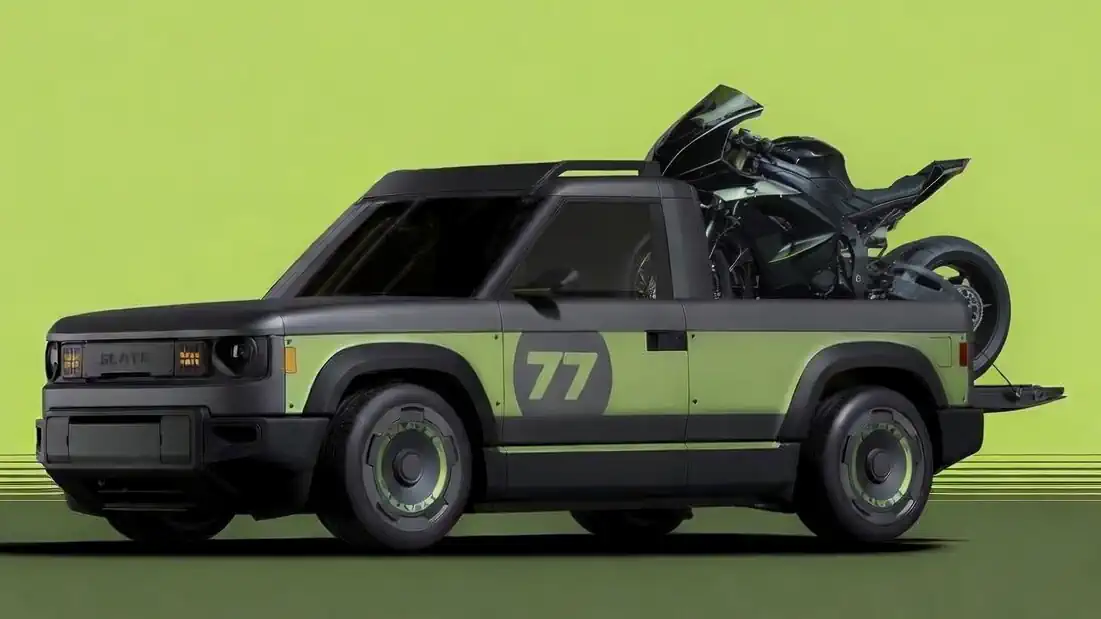
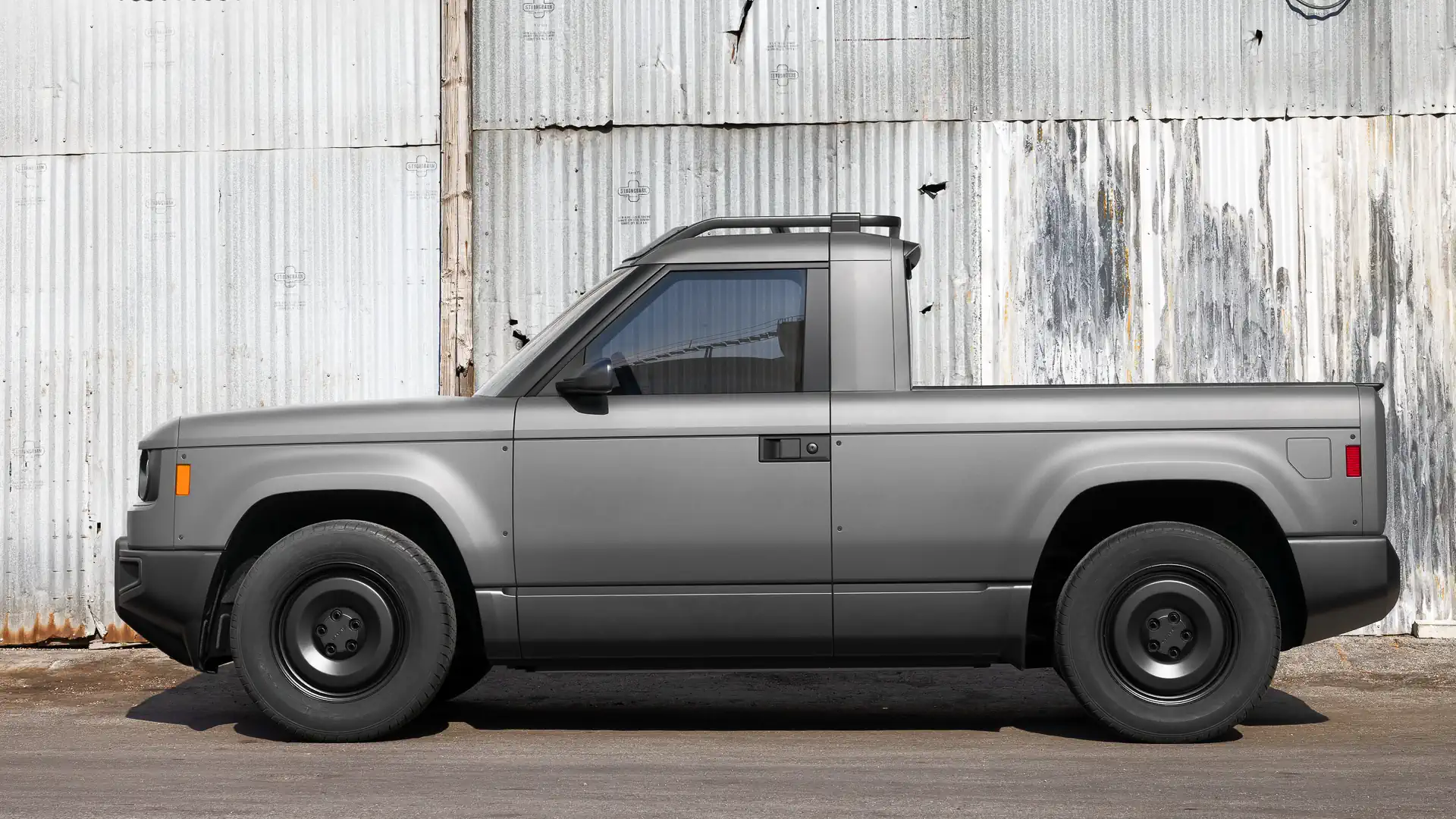
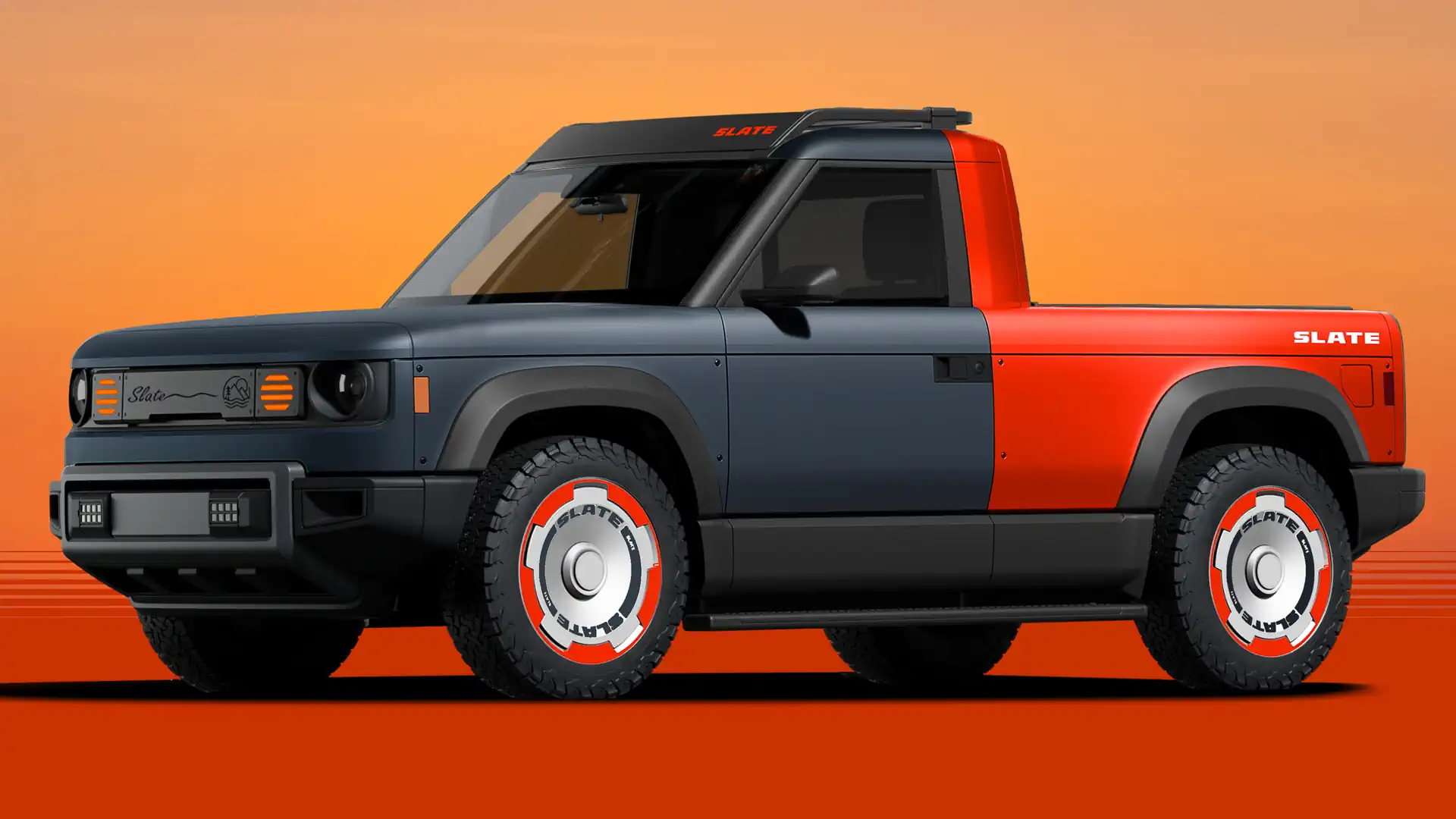
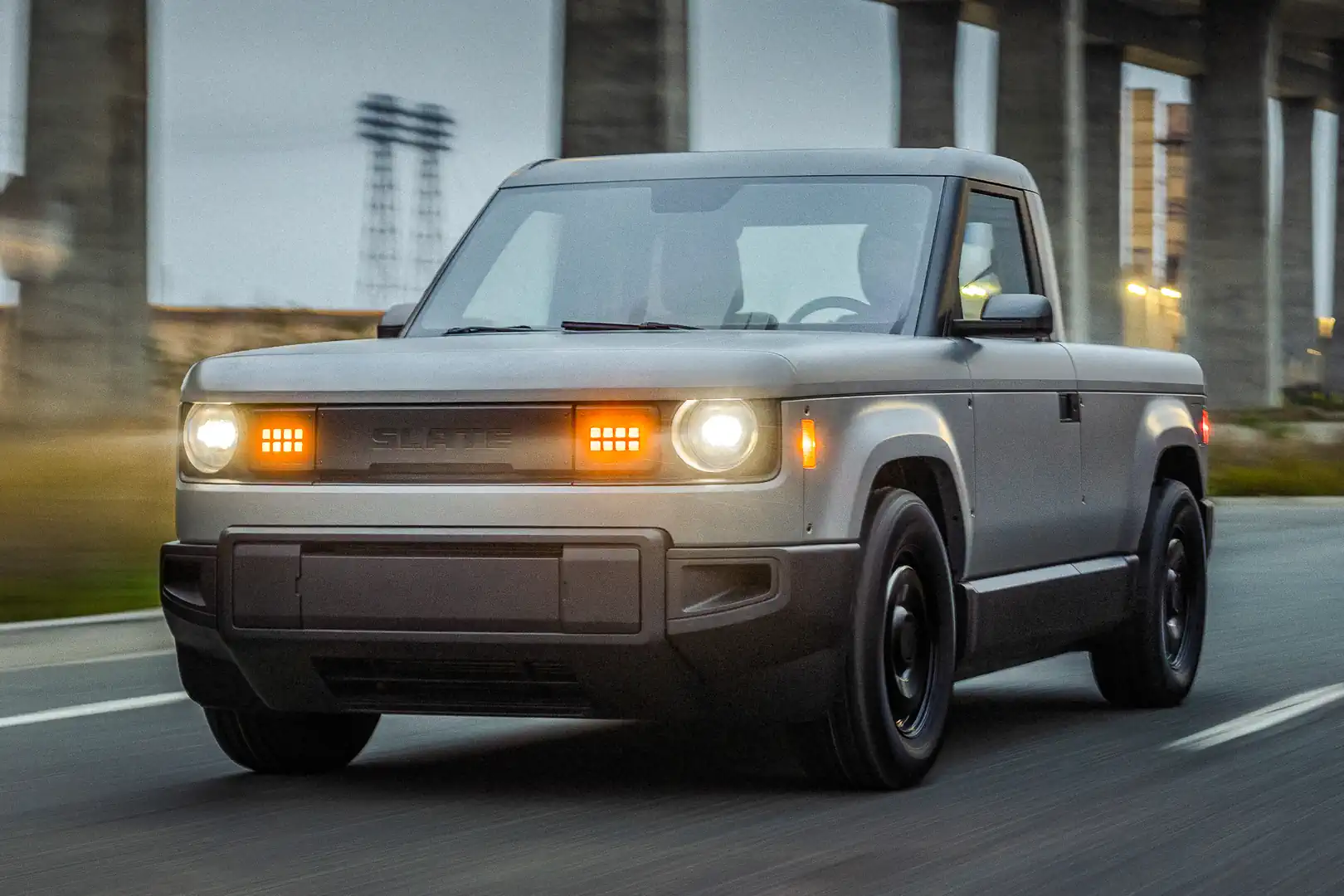
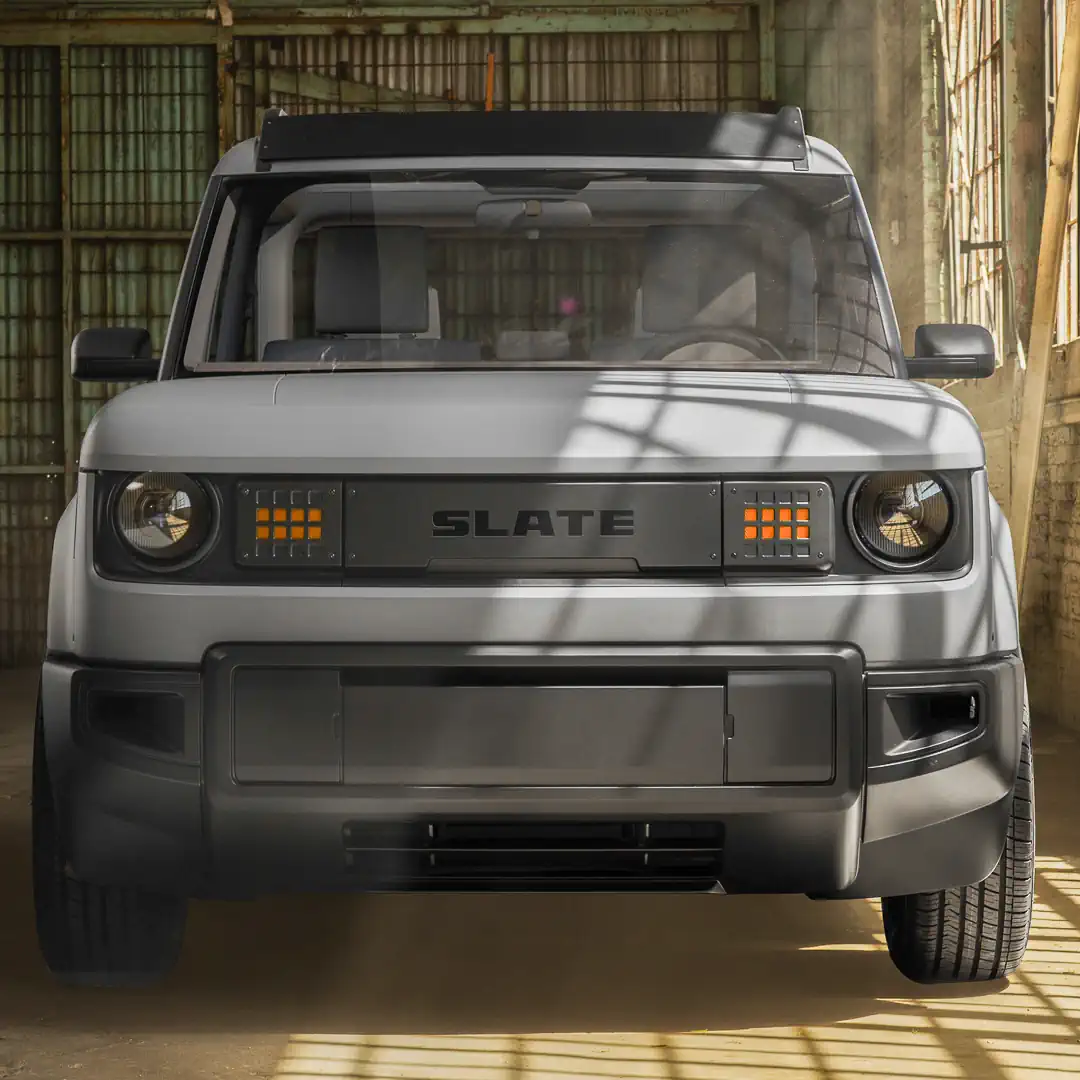
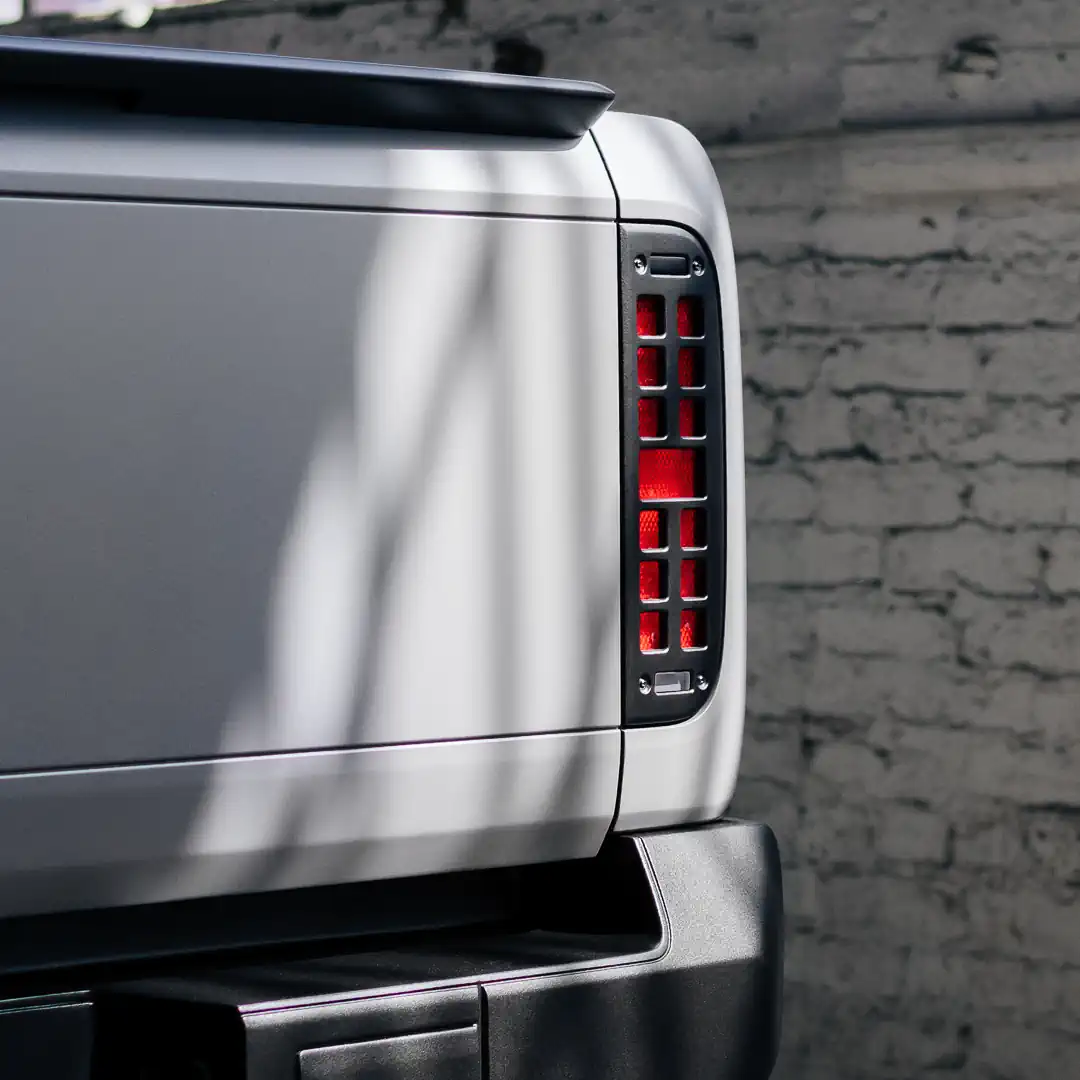
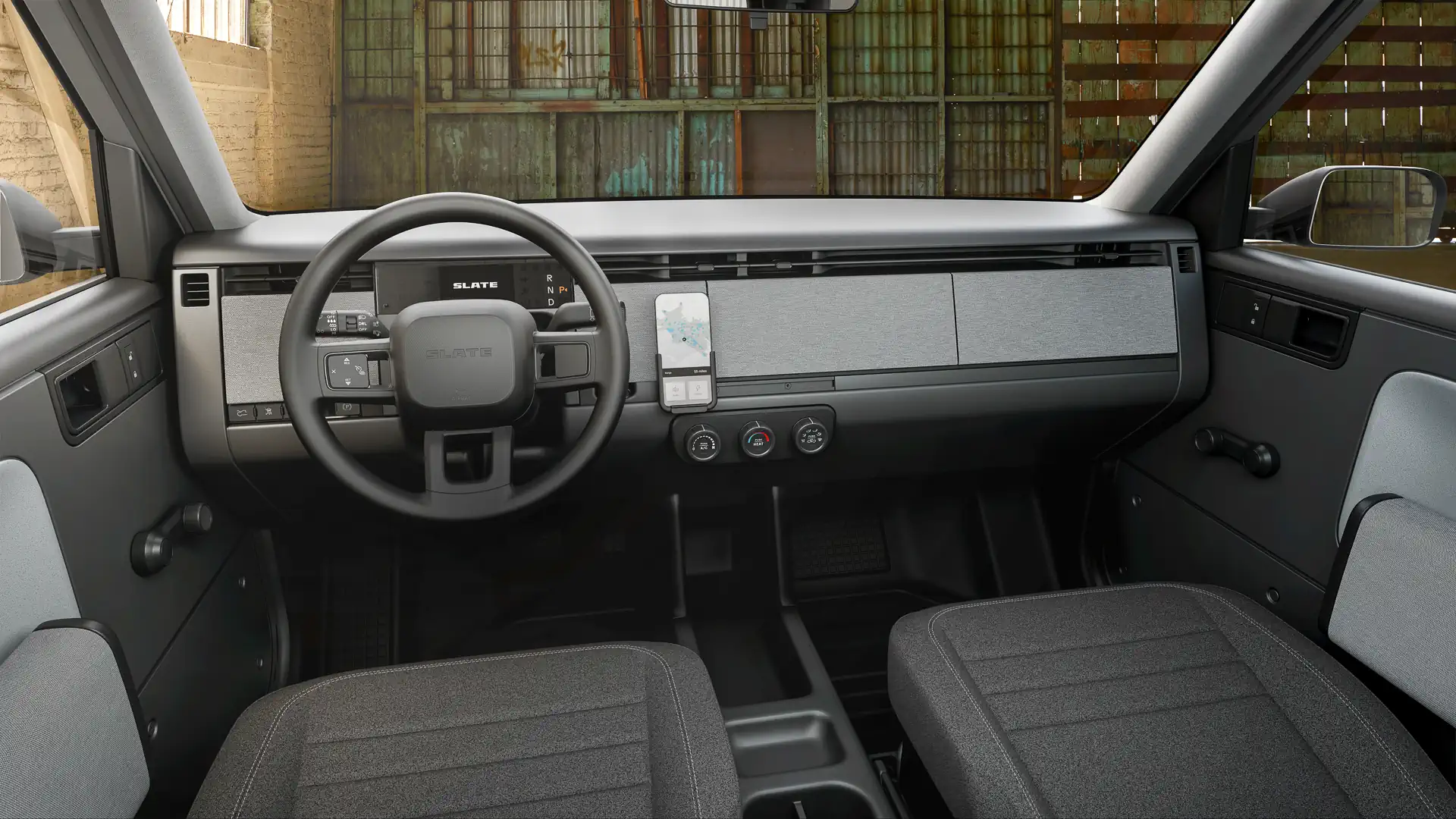
AI-generated image created with Grok (xAI), based on official Slate truck references
0:00
▶
When the Slate Auto truck was announced in April 2025, the teaser price was $20,000 after the $7,500 federal EV tax credit, and two battery options were available. The standard 52.7 kWh battery had an estimated range of 150 miles, while the 84.3 kWh upgrade was rated for 240 miles. I have a 2001 Toyota Tundra 4×4 with nearly 400k miles, so the Slate truck caught my eye. Sure, the Tesla Cybertruck is appealing due to its 325-mile range from its 123 kWh battery and Dual Motor. However, the $60k price tag for a vehicle I beat on pretty hard was a strong deterrent. The production version of the Slate truck, marketed as the Blank Slate, has been revealed. So, let’s evaluate how well it’s likely to work as a bike hauler.
AI-generated image created with Grok (xAI), based on official Slate truck references.
How Big Is the Slate Truck?
The Slate is a compact pickup, shorter and lighter than a Toyota Tacoma or Ford Ranger. The truck’s payload rating is 1550 pounds, so it will easily handle any motorcycle, and most pairs of motorcycles.
The Slate’s bed is 60.5 inches long with the tailgate closed, so most motorcycles will not fit in it with the tailgate up and the bike loaded straight in. Drop the tailgate, and you gain another 20.2 inches of flat, semi-load-bearing surface, bringing the front-to-back distance to 80.7 inches.
The bed is 59 inches wide at its widest above the wheel wells and narrows to 43.9 inches at wheel-well level. If you have done the geometry on a standard short-bed full-size pickup, the Slate’s bed is smaller, though not by as much as you expect.
Let’s look at two types of motorcycles that are often trucked: dirt bikes and superbikes.
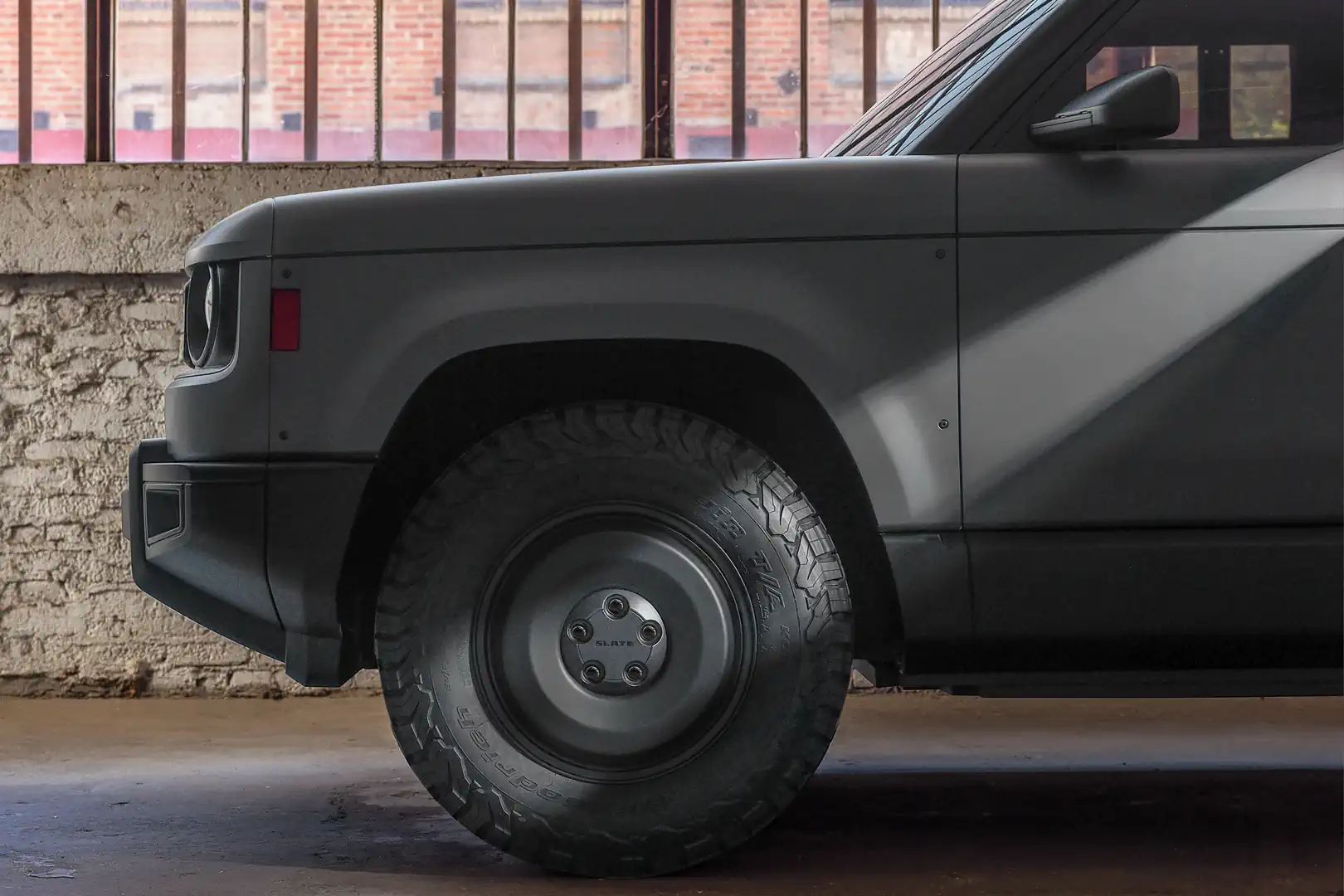
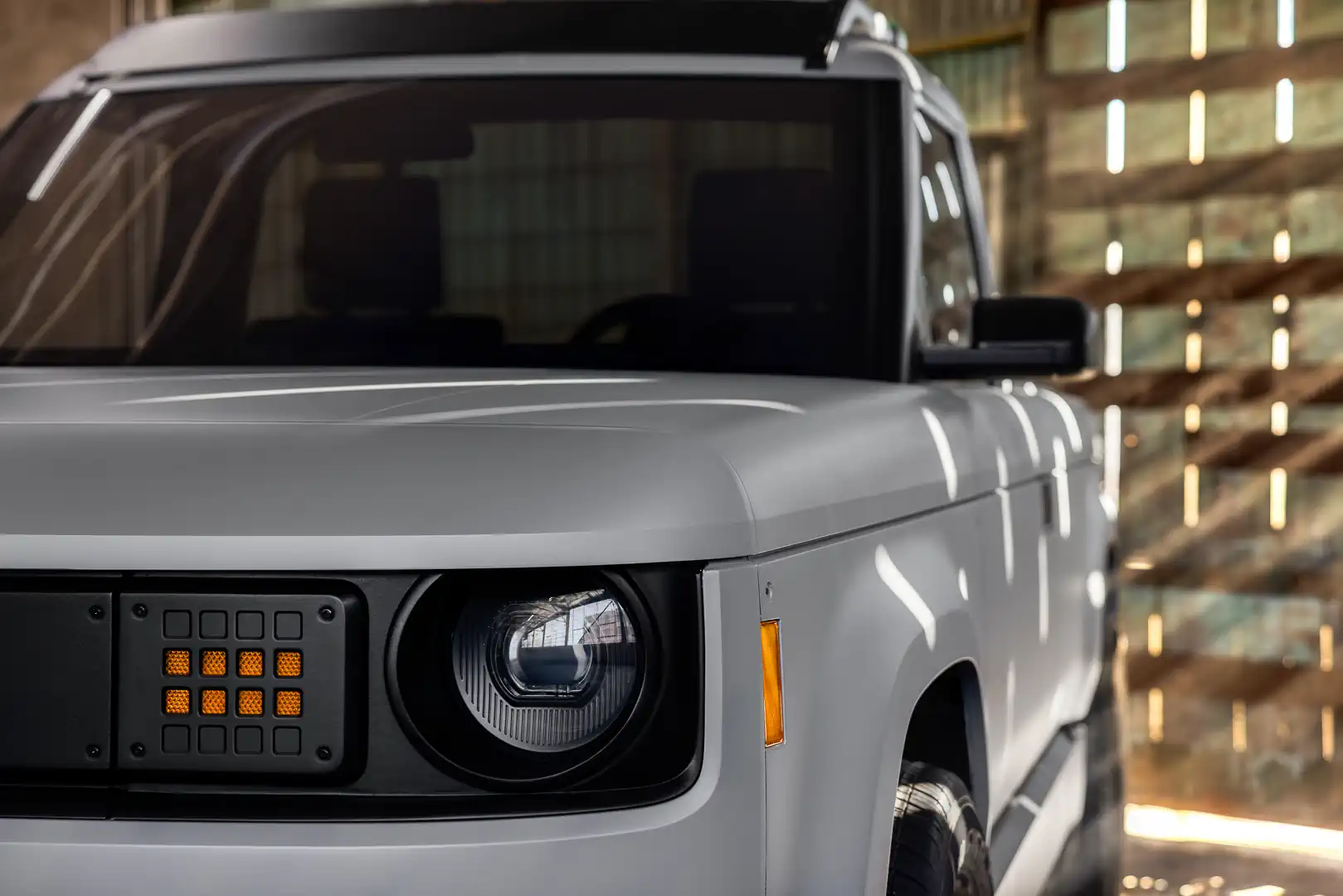
Official Blank Slate truck images courtesy of Slate Auto.
Dirt Bikes
The Ducati Desmo450 MX has a wheelbase of 58.8 inches, the longest of any MX bike. The overall length, front knobby to rear knobby, is roughly 87 inches, so it’s nowhere near fitting in the bed with the tailgate down.
So, the issue becomes where the rear wheel will be resting. It’s no more than 72.5 inches from the front knobby to the rear axle on a full-size dirt bike. The Slate’s bed/tailgate distance of 80.7 inches gets the job done with over 8 inches to spare.
Superbikes
The Ducati Panigale V4 is the longest superbike right now, with a 58.5-inch wheelbase. When loaded nose-in with the front tire against the front of the bed, the rear axle sits about 70.3 inches back. That puts the rear wheel about 10 inches out on the tailgate. The Panigale V4 puts about 190 pounds on the rear wheel, and that shouldn’t be a problem for the tailgate, despite it being about 75 pounds heavier than the Desmo450 MX at the rear wheel.
As with the dirt bike, a superbike should fit in the back of a Slate truck with the tailgate down. The extra weight of the Panigale V4 strains the tailgate about 35% more than the Desmo450. Of course, if you head into the dirt and the bike starts bouncing, the dynamic forces from a bouncing Desmo450 MX will be significant.
The Limit
A Honda Gold Wing has a wheelbase of nearly 67 inches and measures roughly 79.5 inches from the front of the front tire to the rear axle. That is pushing the limit of the Slate truck, as it’s 80.7 inches from the front of the bed to the end of the tailgate. Even though it likely fits, you’re putting about 575 pounds of Gold Wing on the end of the tailgate. We don’t know the tailgate rating for the Slate yet, though the Ford Maverick’s tailgate is rated at 500 pounds. Either way, you’re going to be over the limit if you want to haul a Gold Wing in a Slate truck.
Can Two Motorcycles Fit?
Possibly, for dirt bikes, at least. However, we won’t know that until we see a Slate truck in person.
The Slate truck’s bed is 59 inches wide above the wheel wells, compared to 56.4 inches at deck-rail level on a 2026 Toyota Tacoma short bed. That’s not much of a practical difference. The Slate truck measures 43.9 inches between the wheel wells. That should leave plenty of room for two dirt bikes side by side. I used to put two dirt bikes in the back of a tiny pre-Tacoma Toyota truck in the 1980s, and they fit. So, there’s a good chance hauling two dirt bikes in a Slate will be doable. It’s also unlikely there will be any issues with the weight of the two dirt bike rear wheels on the tailgate, though that won’t be confirmed until Slate releases that specification.
If you’re taking two Panigale V4s to the track, they should fit due to the V4’s much narrower handlebars. The main concern will be the tailgate’s weight rating. The two V4s can exceed the tailgate weight rating on some trucks, while other tailgates can handle the pair of bikes. Slate will have to let us know.
An issue with bringing two motorcycles is that usually means two riders. With no storage space behind the seats for a gear bag, both gear bags will have to find a home in the bed. That’s doable, but not ideal if the weather turns bad or when parking in a dicey area. There is a frunk where the ICE motor would typically be. However, it doesn’t look like it’s shaped to accommodate one motorcycle gear bag, let alone two.
Calculating the Range
Range is the inflection point for EVs. If the range is farther than you typically go, it means charging up along the way, which takes time. We don’t know how far your riding area or track is from home, so we can only give you a ballpark figure.
Slate’s claimed 205-mile range figure is Slate’s own estimate of what the truck would score on the EPA test cycle, which combines moderate city and highway speeds. City driving is surprisingly easy on an electric vehicle because the motor barely works at low speeds and regenerative braking puts some energy back into the battery. However, if you’re just cruising on the highway and not braking, don’t expect much range boost from regenerative braking. Anyone planning a highway trip should treat regen as a modest bonus rather than a significant range recovery tool.
At highway speeds, nearly all of the motor’s effort goes into pushing the truck through air. The faster you go, the more air you have to push aside, and the force required to do that does not grow at a constant rate. While driving at 80 mph is only one-third faster than at 60 mph, it requires over three-quarters more energy. The more energy expended, the shorter your EV’s range. That’s true for gasoline and diesel vehicles, but gearing and the nature of internal combustion engine power make the mpg hit smaller than the EV range penalty.
Here is an approximation of what the Slate’s range looks like at different steady highway speeds with nothing in the bed:
55 mph: 190-200 miles
65 mph: 170-185 miles
70 mph: 155-170 miles
75 mph: 140-155 miles
80 mph: 125-140 miles
These are estimates derived from standard electric vehicle performance data. Slate Auto has not published speed-specific range figures for the truck, and independent tests have not yet been conducted, as deliveries do not begin until late 2026 at the earliest. Actual range will vary with temperature, elevation, wind, and tire pressure. Cold weather can reduce range by 20 to 40 percent compared to mild-weather figures.
Range with a Motorcycle in the Bed
Two separate forces work against your range when you have a bike loaded in the bed: the motorcycle’s weight and the aerodynamic disruption it causes at highway speeds.
Adding a dirt bike to a truck that weighs about 4,048 pounds empty increases the total rolling weight by about 6%. Rolling heavier requires more energy at every speed, and especially during acceleration. The range penalty from weight alone is between 4 and 6 percent.
A superbike weighing 440 pounds increases the total weight by about 11%. The weight penalty from a superbike is approximately 5 to 7 percent of range.
At highway speeds, the aerodynamic effect of cargo in an open truck bed becomes more significant than the weight. An open truck bed already creates turbulence, as air spills over the cab and churns in the bed rather than flowing cleanly over the truck. A motorcycle sitting upright in that space further changes the airflow; at 70 or 80 miles per hour, the battery notices.
This is where dirt bikes and superbikes differ in a meaningful way.
A dirt bike has a tall, open profile. Its handlebars sit high. The frame has large open spaces rather than smooth bodywork. This creates a turbulent, irregular shape that catches and disrupts air as the truck moves forward. A dirt bike in the bed of a compact truck is not unlike a large, irregular signboard placed where smooth airflow would prefer to be.
A superbike is lower and has a fairing designed to slice through air efficiently on the racetrack. Unfortunately, those aerodynamic surfaces do not help when the bike is stationary in a truck bed—the fairings were shaped for air coming straight at the front of the bike, not swirling around it from the sides and above. On the upside, the superbike’s lower overall height means it sits less prominently above the bed rails and creates somewhat less total frontal disruption than a tall dirt bike.
From a real-life standpoint, a dirt bike’s taller profile likely costs you slightly more highway range than a superbike. The superbike’s extra weight partially offsets this by increasing rolling resistance. On balance, the two types of bikes incur a similar overall range penalty, though for different reasons.
Combined weight plus aerodynamic loss means you can expect a loaded Slate to give approximately 10 to 20 percent less range at a given speed than when empty. Toward the worse end of that range if you are traveling fast; toward the better end at lower speeds where aerodynamics matter less.
Range estimates at steady speed with one motorcycle loaded:
55 mph: 165-180 miles
65 mph: 145-165 miles
70 mph: 130-150 miles
75 mph: 115-135 miles
80 mph: 100-122 miles
These figures are working estimates for trip planning. They are not guarantees, and they do not account for wind, hills, or temperature. If any of those three are working against you, the range drops further.
Range with Two Dirt Bikes (If They Fit)
If two dirt bikes do fit side by side—and as discussed above, the geometry suggests they will—the range picture changes noticeably.
Two bikes roughly double the weight penalty and increase the aerodynamic disruption in the bed. Combined, you would likely see range losses of 20 to 35 percent beyond the speed penalty alone. At 70 miles per hour, that places realistic range somewhere between 100 and 130 miles on a full charge. That is a short leash, and any destination beyond 80 to 90 miles would require a charging stop on the way.
Charge Times
There are three charging options.
DC fast charging is the method you will use on the road. The Slate accepts up to 120 kW from a fast charger. Plugged into a fast charger on the NACS network — the connector standard now shared by Tesla, Ford, GM, and most new EVs — the Slate goes from 20 percent charge to 80 percent in approximately 30 minutes. That recovers 60 percent of the Slate’s total range, with the number of miles dependent upon use.
Charging slows considerably above 80 percent. Battery chemistry requires a gentler approach as the pack fills, to avoid heat buildup and premature wear. A full charge from near-empty via fast charger takes 60 to 90 minutes, not a simple doubling of the 30-minute figure. For long trips, the common practice among EV drivers is to charge to 80 percent, drive to 20 percent, and charge again—rather than waiting for a full charge at each stop.
Level 2 charging uses 240-volt power, the same voltage as most home clothes dryers. The Slate accepts up to 11 kW of Level 2 charging, which is toward the higher end for a vehicle of its price point. With a dedicated home charging unit at 48 amps, you can fully recharge from empty in as few as 5 hours. Plug in when you pull into the garage after a ride, and the truck is ready again by morning. At the lower end, such as when you’re using a NEMA 14-50 outlet like the one behind a dryer, you can expect 15 percent of range added per hour of charging.
Standard 120-volt household outlets add about 2 percent of range per hour. This is useful for a quick top-off when you have no better option, but recovering from a depleted battery on a household outlet can take 40 hours or more. It is not a viable primary charging method for anyone who uses the truck regularly.
What This Means in Practice
The Slate can be a legitimate tool for hauling a single motorcycle to a track, a trailhead, or a practice facility. Its bed fits virtually every production motorcycle built, its payload capacity handles even heavy cruisers comfortably, and its charging system—particularly with a home Level 2 unit—makes overnight recovery simple and inexpensive.
The deal-breaker can be the distance to the ride spot. Driving no faster than 70 mph with a motorcycle in the bed, you are working with an estimated 130 to 150 miles on a full charge. If your destination is more than 75 miles away and fast-charger availability along that route is limited, you must plan ahead. Keep in mind that sometimes you’ll have to wait for access to a charger, especially on a popular road.
The jury is still out on whether it’s possible to carry two dirt bikes side by side. If it’s possible, which seems likely, the range will take another hit. That means your riding destination will have to be even closer unless you want to make a mid-trip charging stop.
Is the Slate Truck Right for You?
For the rider who makes regular solo runs to the track or the trails, who charges at home between trips, and whose destinations fall within reasonable range of the charging network, the Slate offers a capable and unusually affordable solution. Its usage constraints are specific and worth knowing before you commit to one. The interior is also bare-bones, with hand-crank windows and no radio. The name Blank Slate is appropriate.
I looked at my numbers, and it’s just not going to work, to my dismay. The range with two dirt bikes just won’t get it done, considering where I live and where I ride. Also, the lack of interior storage is a disincentive. I’ll be crossing my fingers that Slate builds a version of the truck with an extended cab and larger battery. While that will push the price above $30k, it will still be a solid deal.
2027 Slate Auto Blank Slate Truck Specifications
MOTOR
Motor: Single interior permanent magnet AC motor
Drive wheels: Rear-wheel drive
Peak power: 181 horsepower (135 kW)
Peak torque: 195 lb-ft (264 Nm)
0-60 mph: 8.0 seconds
Top speed: 90 mph
Transmission: Single-speed, direct drive
BATTERY
Type: LFP (Lithium Iron Phosphate)
Maximum capacity: 65 kWh
Usable capacity: 63 kWh
Onboard charger: 11 kW, NACS
Charge time, Level 1 (1.9 kW), 20-80%: 17 hours
Charge time, Level 2 (11 kW), 20-100%: 4 hours
Charge time, DC Fast (120 kW), 20-80%: 30 minutes
Claimed range: 205 miles
CHASSIS
Front suspension: MacPherson strut
Rear suspension: De Dion axle, coil spring
Wheels: 17 x 7-inch steel
Tires: 245/65R17
Turning circle: 37 feet
BED
Bed length, tailgate up: 60.5 inches
Bed length, tailgate down: 80.7 inches
Bed width, between wheel wells: 43.9 inches
Bed width, above wheel wells: 59.0 inches
Bed height: 19.5 inches
Tailgate height from ground: 47.3 inches
Bed volume: 35.1 cubic feet
Frunk volume: 7.0 cubic feet
DIMENSIONS and CAPACITIES
Wheelbase: 108.9 inches
Overall length: 174.6 inches
Width, without mirrors: 70.6 inches
Width, with mirrors: 78.1 inches
Height: 68.0 inches
Ground clearance: 7.8 inches
Track, front/rear: 60.4 / 60.8 inches
Curb weight: 4,048 pounds
GVWR: 5,689 pounds
Max payload: 1,550 pounds
Max towing: 2,000 pounds
2027 Slate Auto Blank Slate truck price: from $24,950 MSRP
Hello and welcome again to the Motos and Friends Podcast. This episode is brought to you by Leod Escapes.
* * * * *
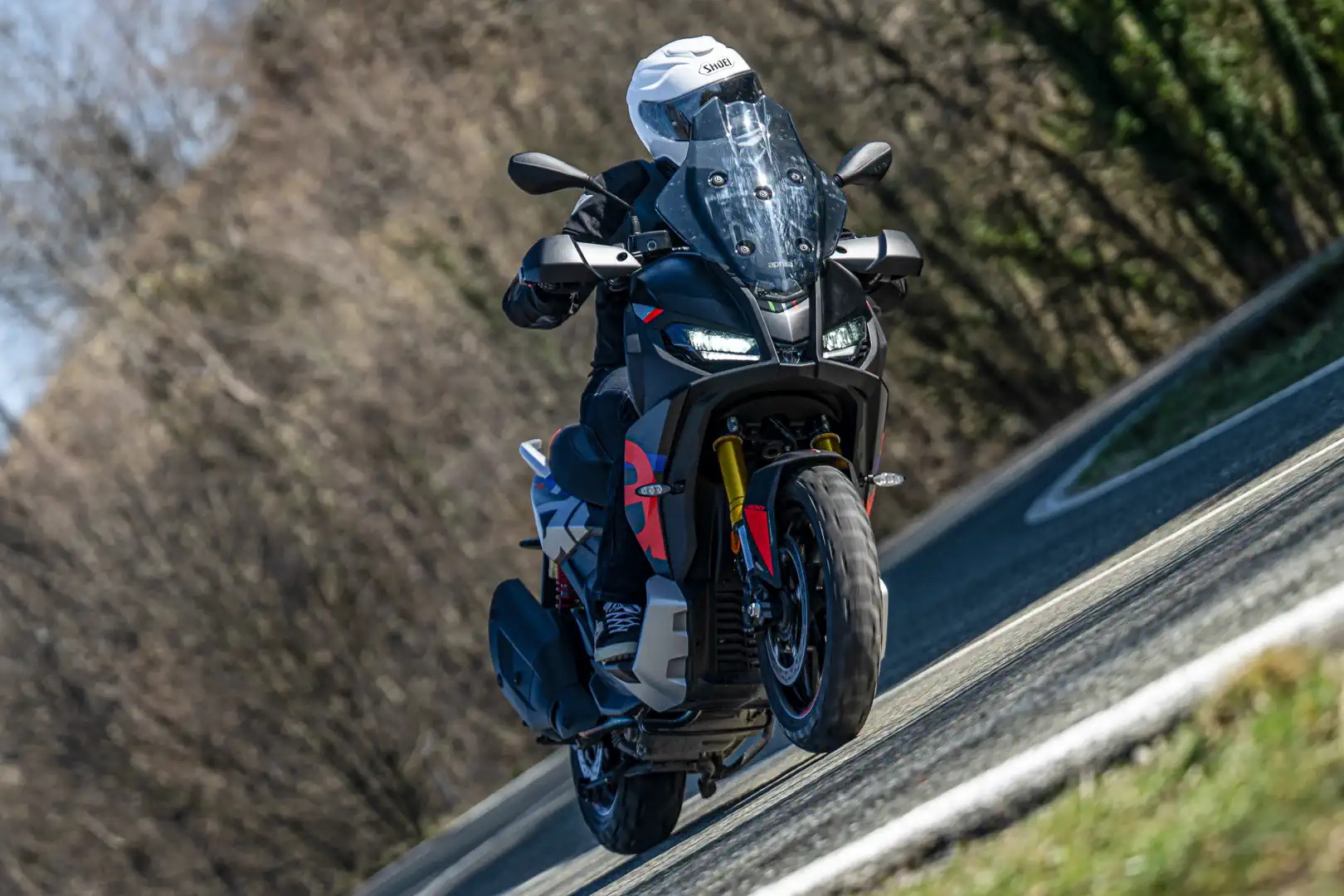
Aprilia is bringing a scooter to North America, and it’s one designed to appeal to adventure motorcyclists. The SR GT 400 is a mid-size scooter built around a steel motorcycle-style frame, a 399cc single, and off-road-ready hardware. It reaches US dealers as soon as this month. Don Williams and Kelly Callan spent some time riding the Aprilia and were surprised by what they discovered. Is this a real motorcycle or just a good-looking urban scooter?
* * * * *
Cat McLeod is founder and owner of Leod Escapes, the ultimate tour company for sport-minded motorcycle riders. Cat talks to us this segment about some of his amazing European experiences and tours that include of course, riding some amazing MotoGP tracks on new BMW S1000RRs. If you like what you hear, now is the time to book your trip of a lifetime, so visit LeodEscapes.com to find out more.
* * * * *
Our guest this episode is Terry Vance, the multiple Motorcycle and Motorsports Hall-of-Famer. Terry is of course the former professional motorcycle drag racer, team owner, and co-founder of the high-performance parts company Vance & Hines. Teejay Adams chats with Terry about his incredible career that includes being the first rider to hit 200 mph in the standing quarter-mile.
Having won this year’s MotoAmerica Mission King of the Baggers championship with Hayden Gillim riding the Vance & Hines factory Indian Challenger, and with Harley-Davidson’s recent withdrawal, Terry gives us his thoughts on where the series might go from here.
* * * * *
Here’s quick reminder to check out our monthly digital magazine. It’s filled with everything you want to read on motorcycling, including some things you’ve probably not seen elsewhere. It’s absolutely free and you will find it on the Apple App Store and of course on Google Play as well.
Don’t forget to leave us your comments on our social media—we’re on all the usual platforms at Ultimate Motorcycling. We love hearing your feedback… so good or bad, please let us know what you think. If there’s something you’d like us to cover, we’d love to hear those ideas too!
We use cookies and browser activity on this website
Functional
Always active
The technical storage or access is strictly necessary for the legitimate purpose of enabling the use of a specific service explicitly requested by the subscriber or user, or for the sole purpose of carrying out the transmission of a communication over an electronic communications network.
Preferences
The technical storage or access is necessary for the legitimate purpose of storing preferences that are not requested by the subscriber or user.
Statistics
The technical storage or access that is used exclusively for statistical purposes.The technical storage or access that is used exclusively for anonymous statistical purposes. Without a subpoena, voluntary compliance on the part of your Internet Service Provider, or additional records from a third party, information stored or retrieved for this purpose alone cannot usually be used to identify you.
Marketing
The technical storage or access is required to create user profiles to send advertising, or to track the user on a website or across several websites for similar marketing purposes.