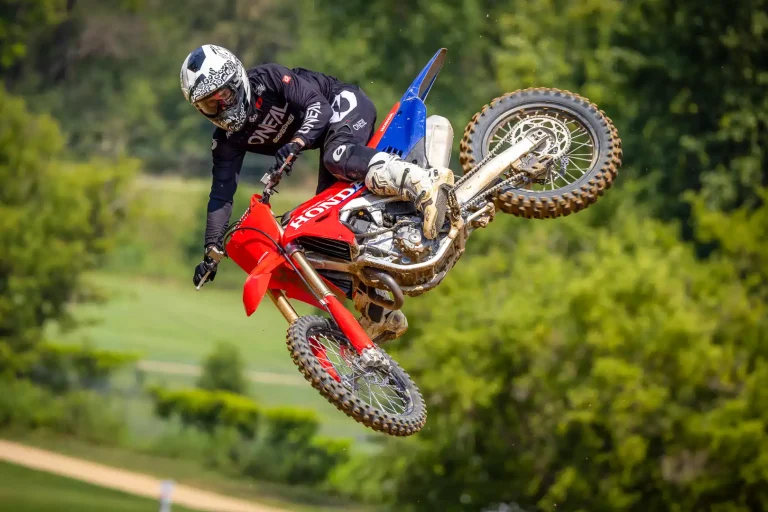
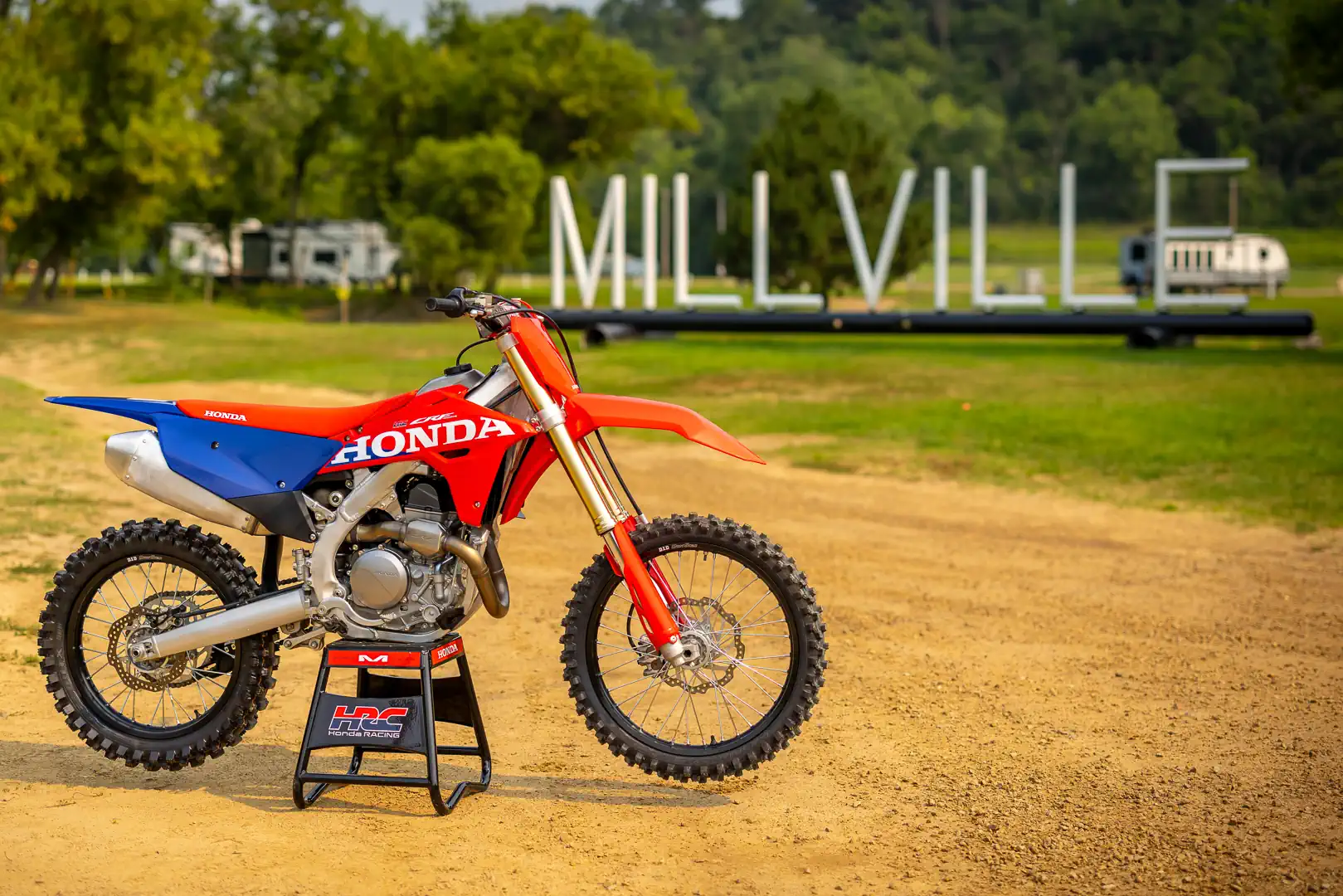
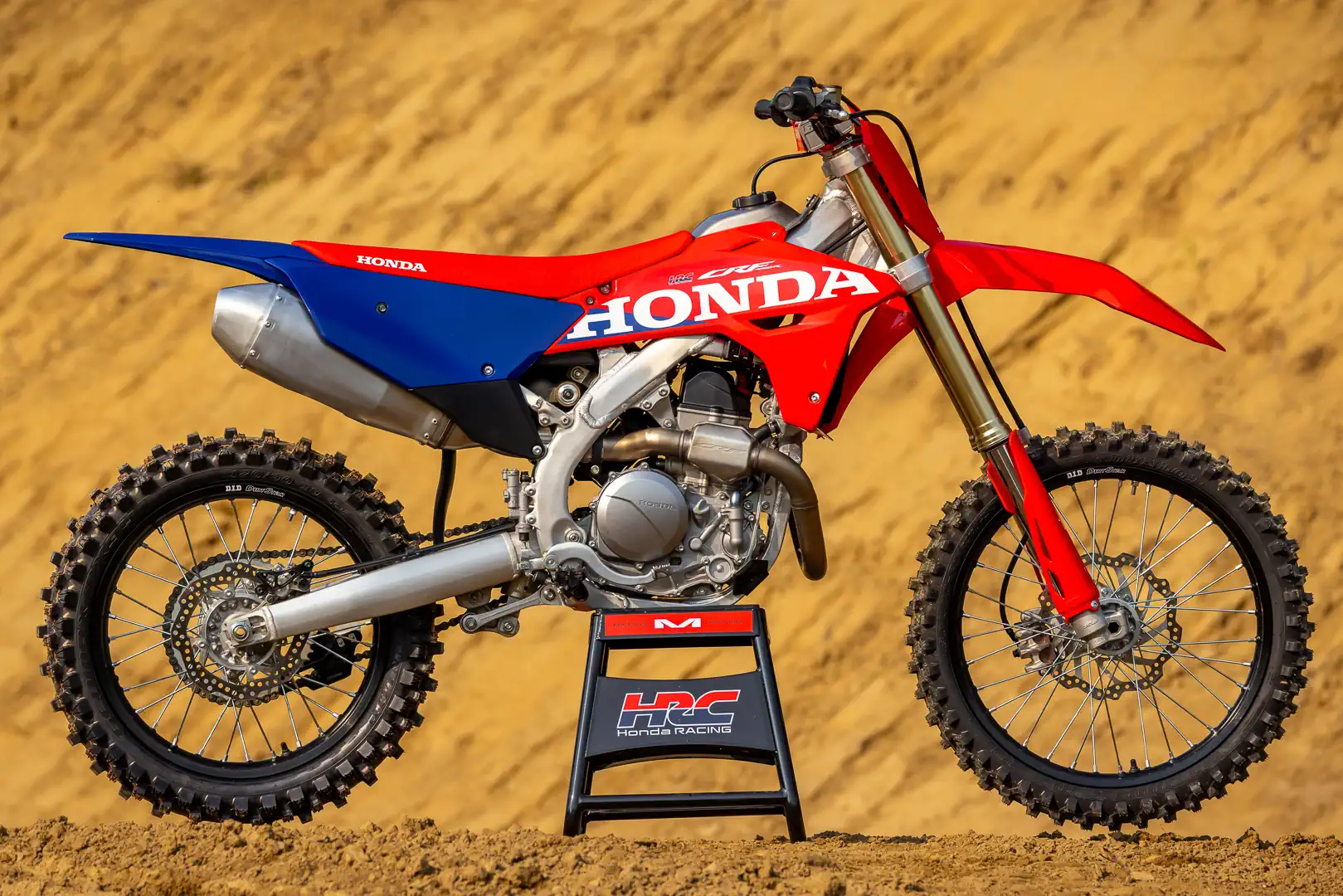
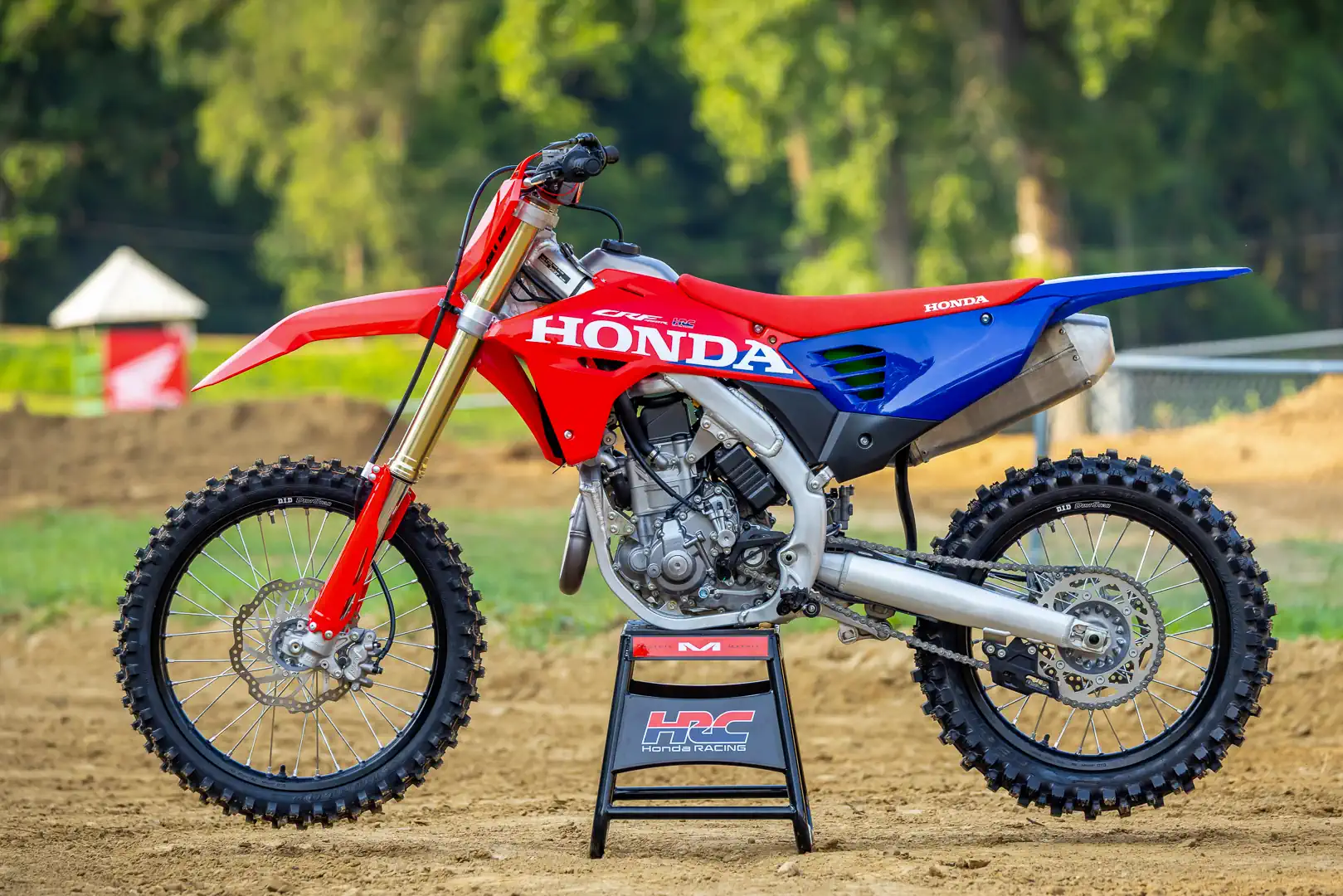
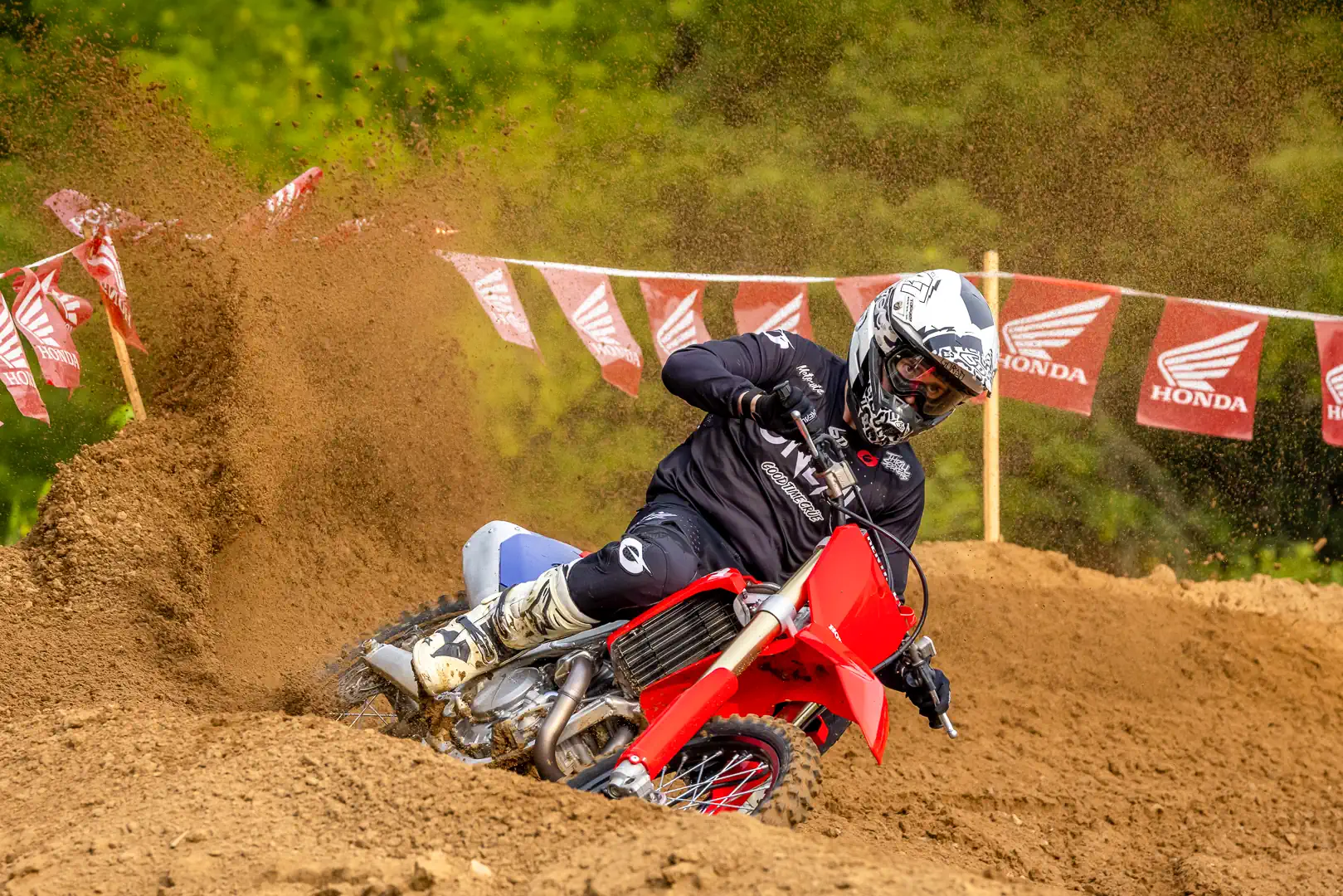
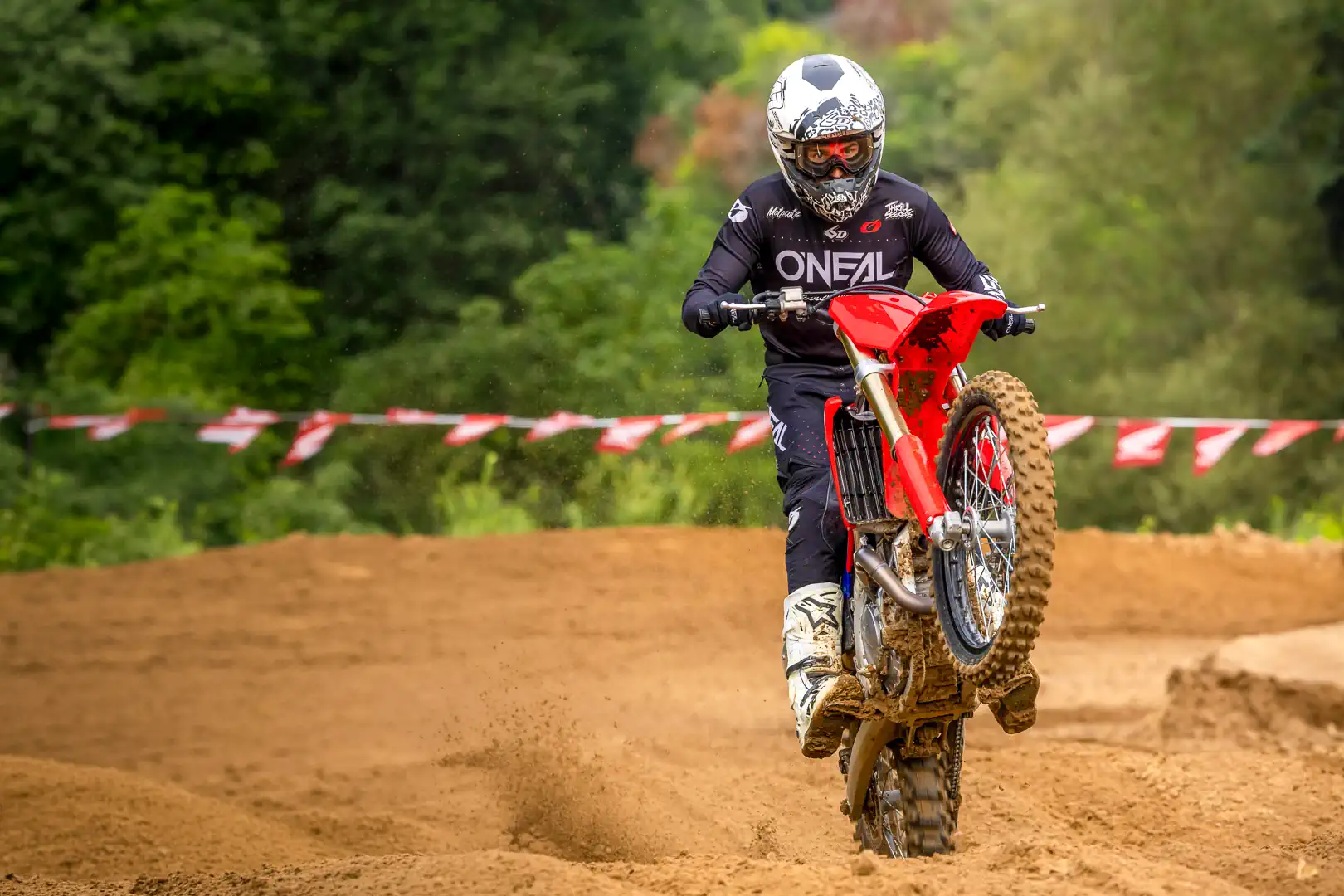
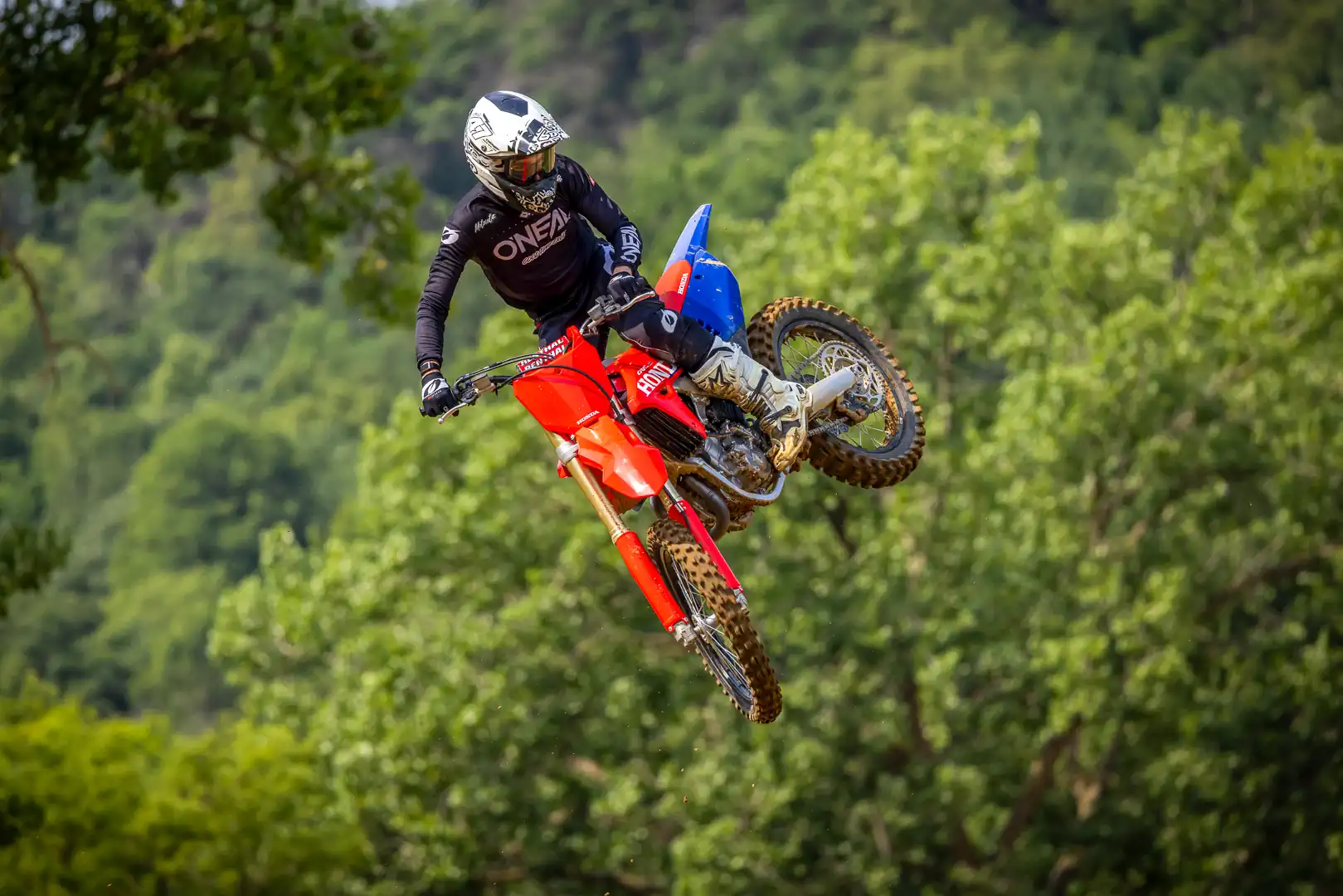
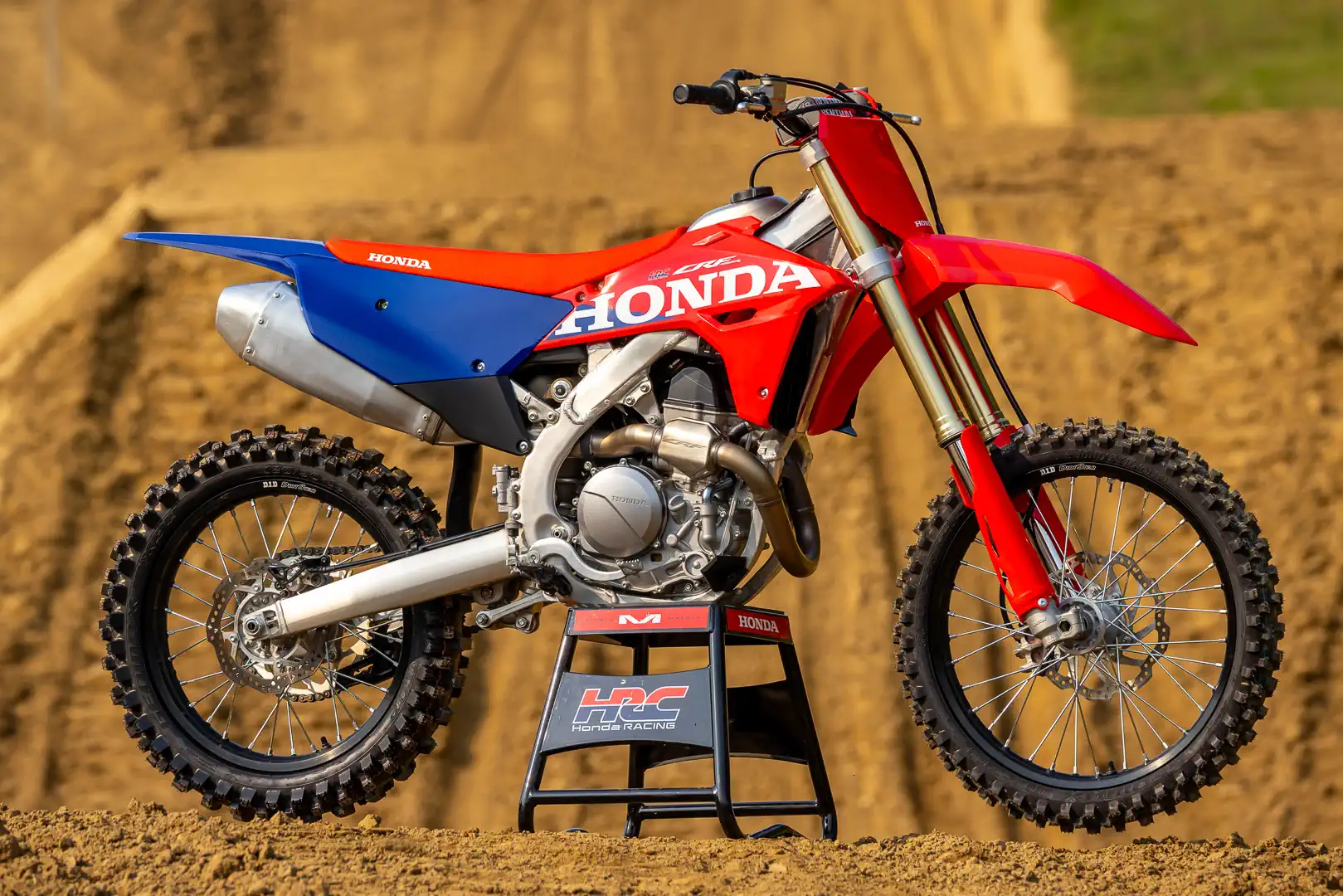
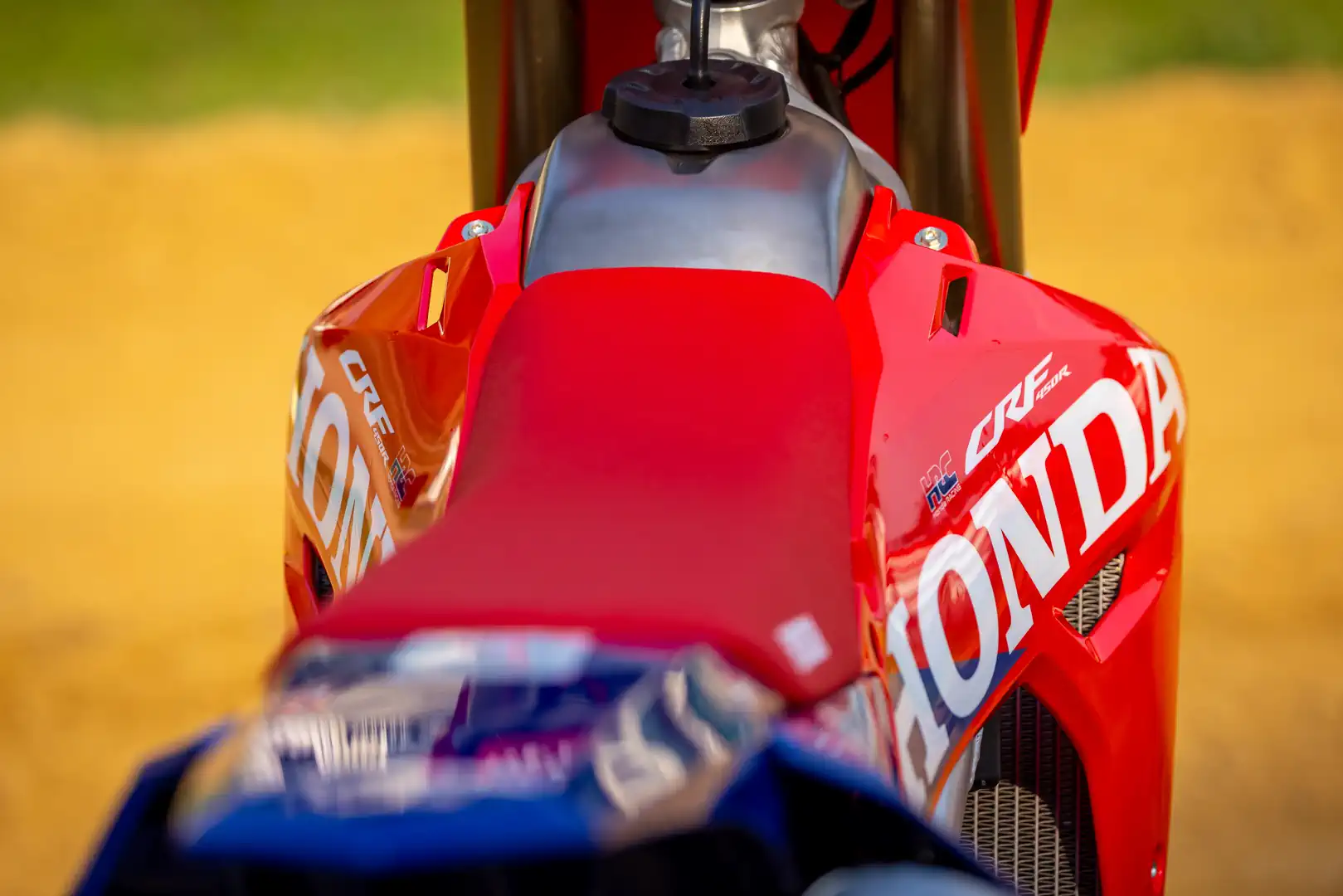
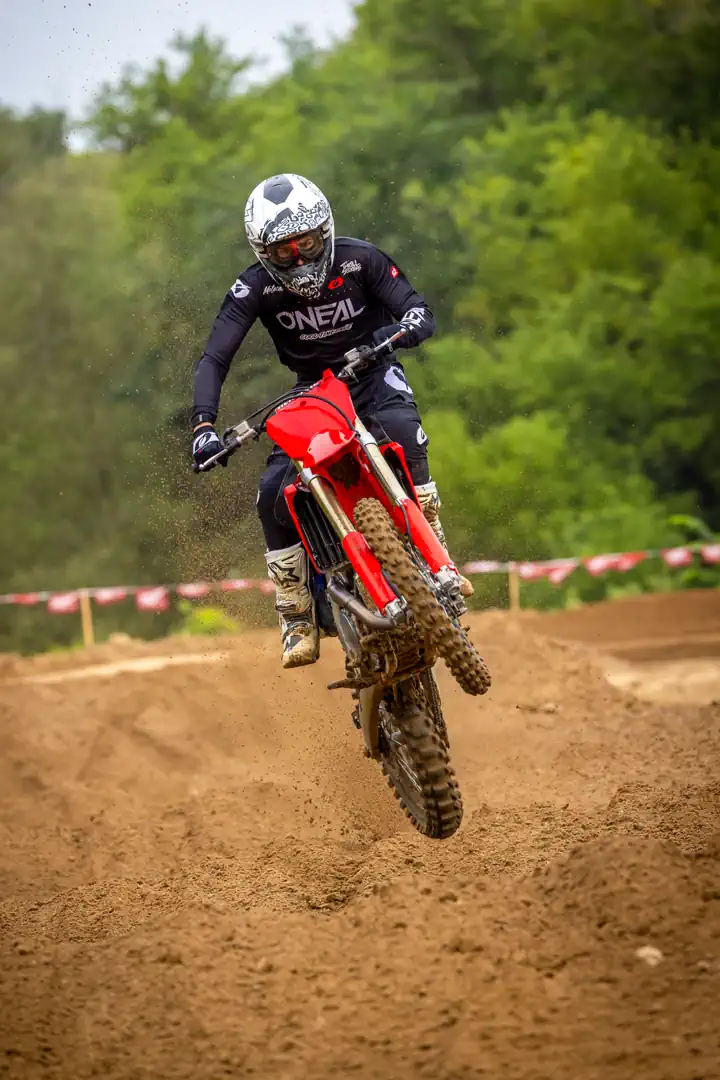
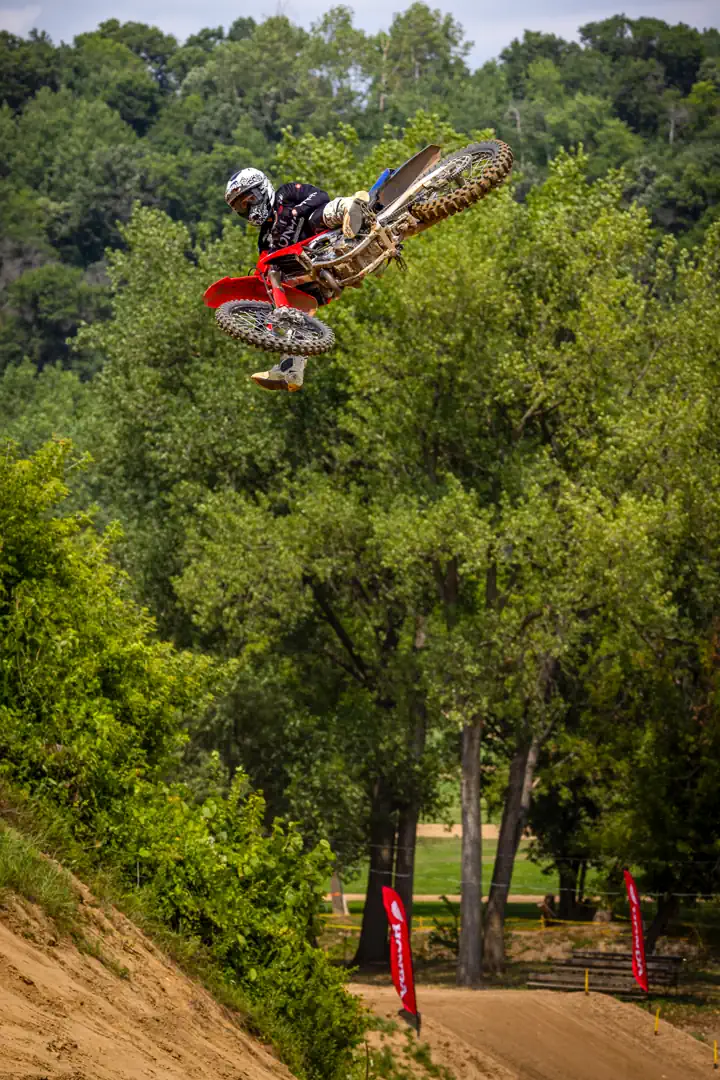
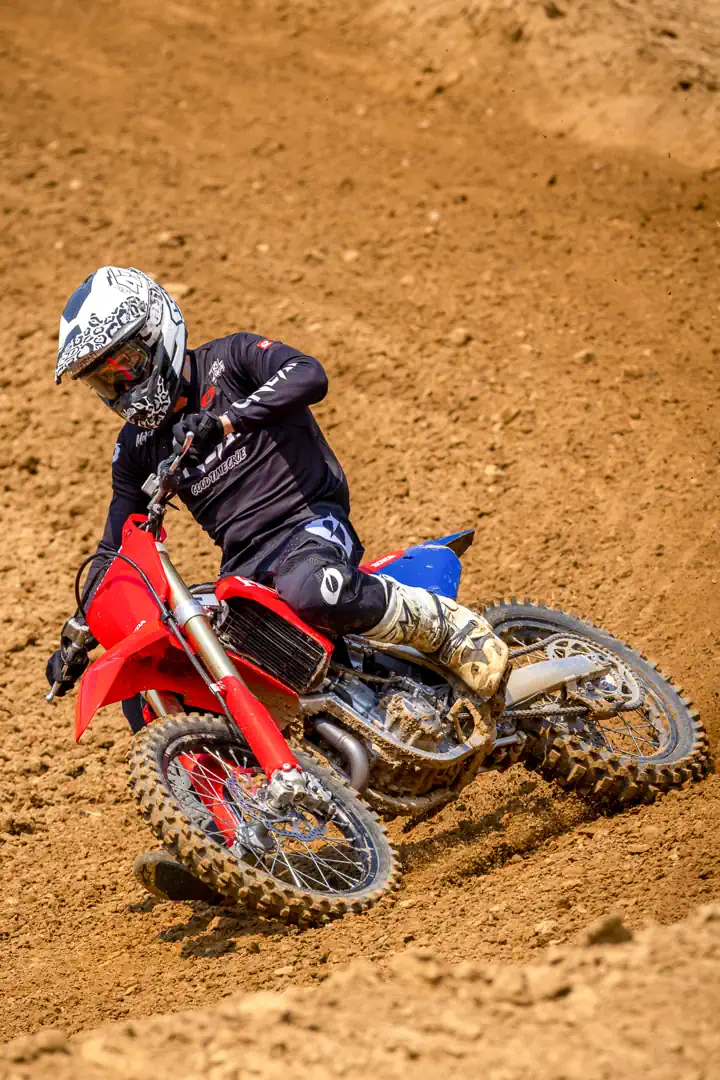
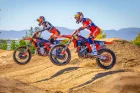
Honda‘s 2027 CRF450R is the most significant update to its flagship motocrosser in a decade. The engine, frame, suspension internals, clutch, and bodywork are new, developed with input from the HRC factory teams racing Supercross, Pro Motocross, and MXGP. The result is a 450 that is 9.9 pounds lighter and makes 10% more peak horsepower than the 2026 model. The price rises $400, to $10,099. We rode the 2027 CRF450R back-to-back with the 2026 version at Spring Creek Motocross Park in Millville, Minnesota, home to the Spring Creek National. Let’s find out how those changes feel on the track.
Lighter. The 2027 Honda CRF450R is 9.9 pounds lighter than last year, weighing in at 238 pounds with a full tank. The new engine accounts for 6 pounds of the savings. The swingarm is 0.9 pounds lighter, the rear wheel drops 0.6 pounds not counting the tire, and aluminum cylinder-head hangers replacing steel ones save 0.3 pounds. The electric starter is more than a pound lighter, and Honda says it is more reliable. Riding the 2027 bears this out, and the 2026 feels heavy in comparison.
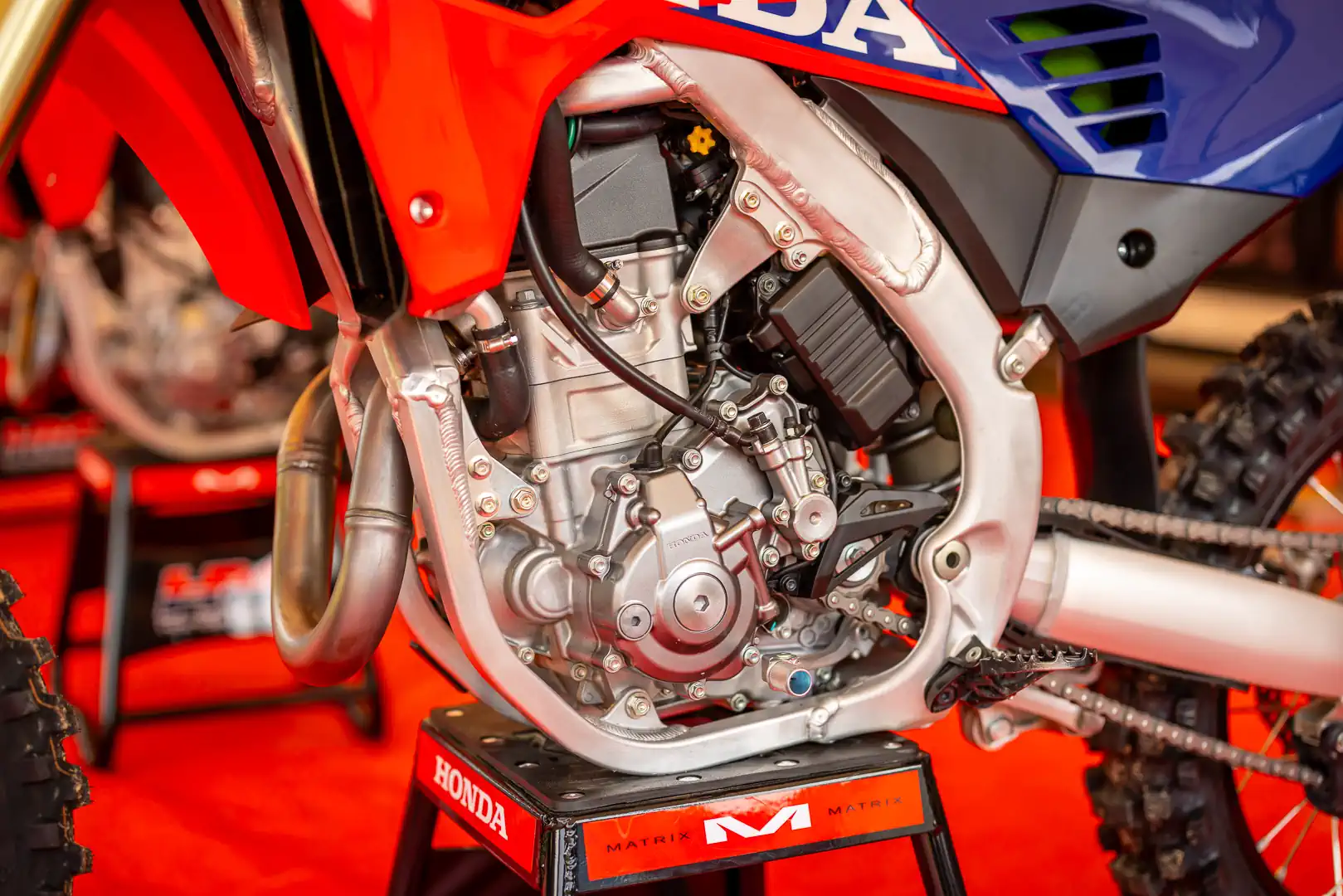
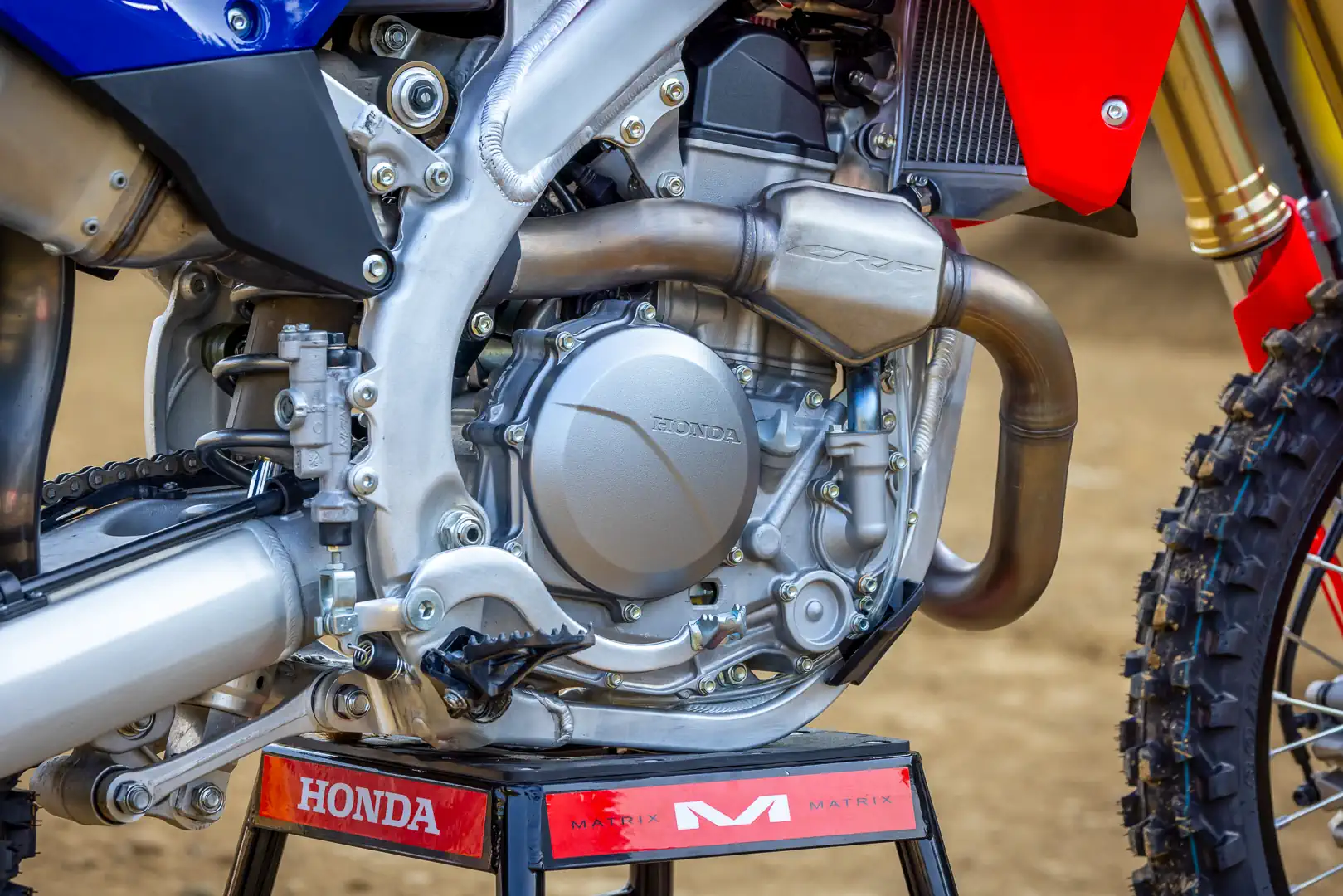
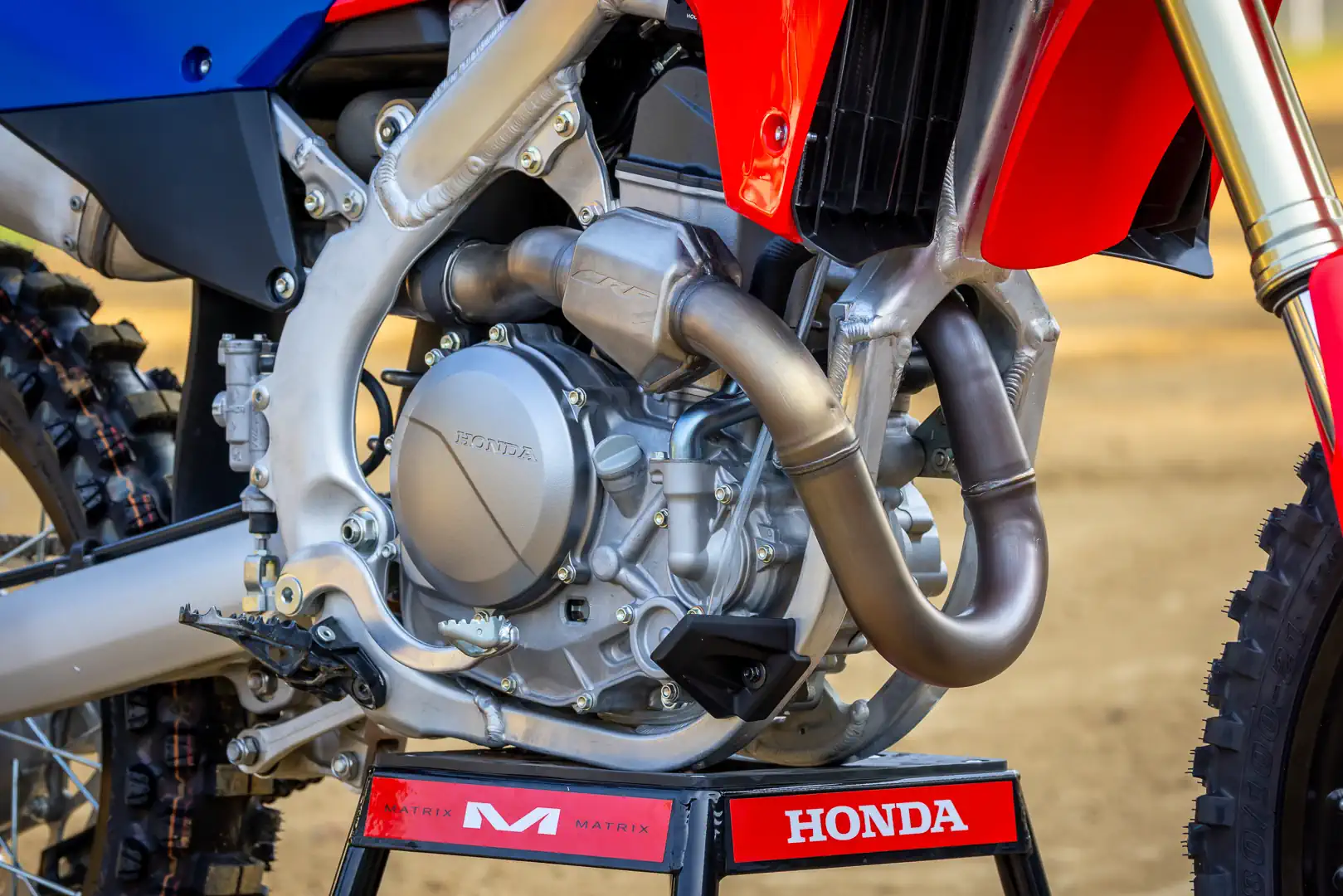
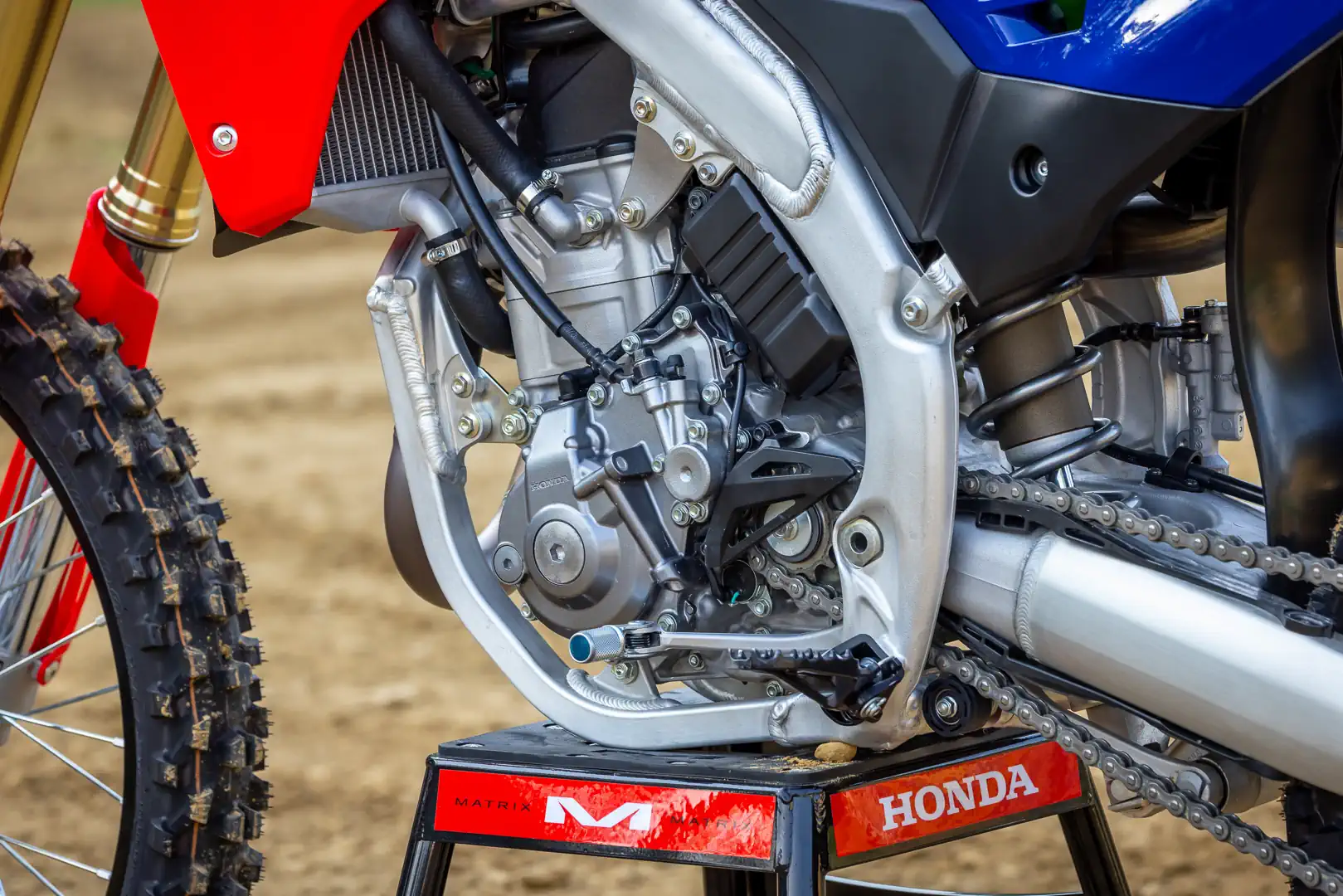
More powerful. Peak horsepower climbs 10%, and peak torque is up 3.7%. The all-new engine is 17mm narrower at its widest point. The bore grows 1.0mm and the stroke shrinks 1.3mm, to 97.0 x 60.8mm, keeping displacement at 449.5cc. Compression rises from 13.5:1 to 13.8:1, intake valves are 2mm larger and exhaust valves 1mm larger, and all four valves are now titanium (the exhaust valves were steel). A more aggressive cam profile, a round crankshaft in place of the anchor-shaped one, and roller bearings on both crank journals round out the major changes. The result is extremely smooth power delivery.
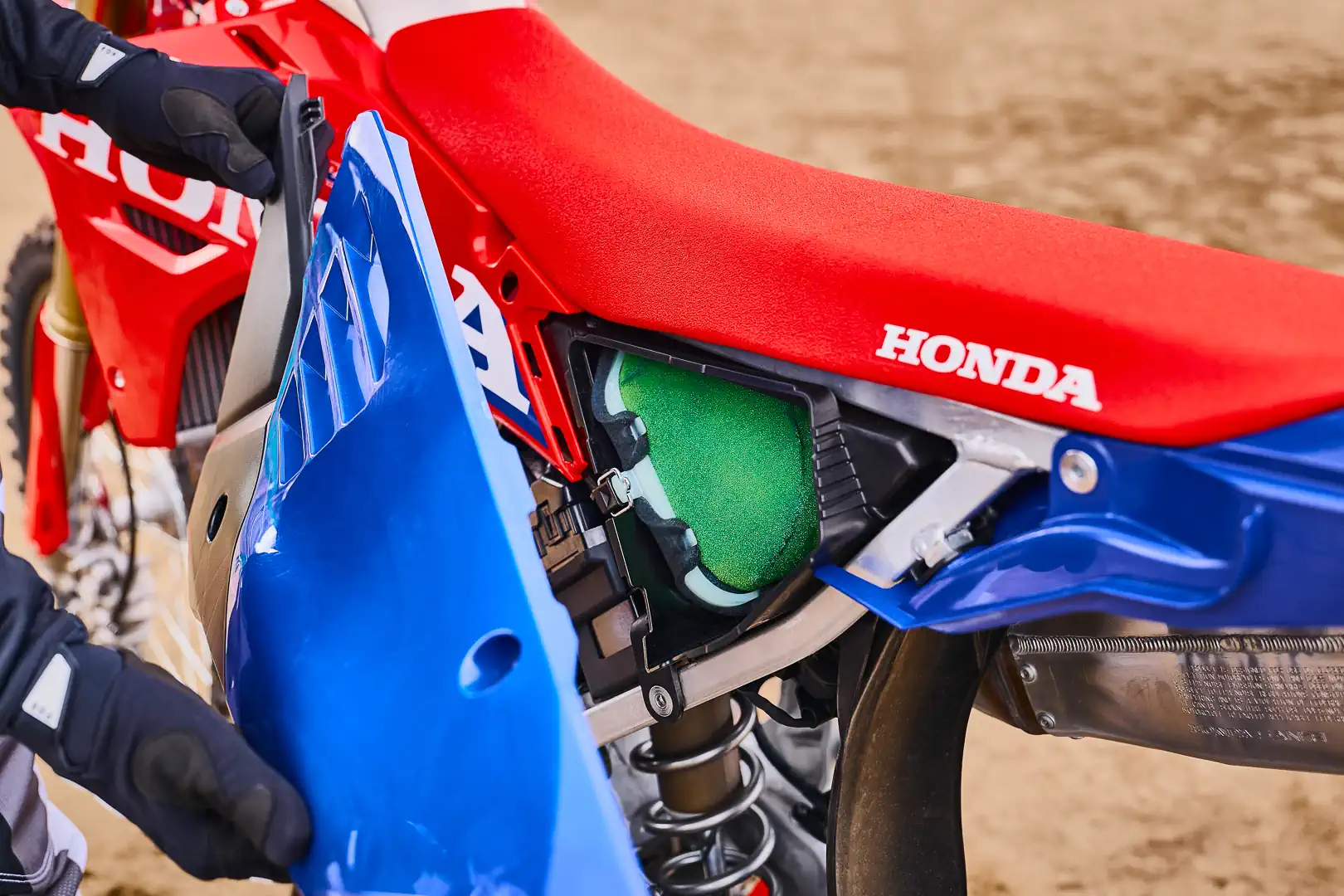
Better breathing. A redesigned intake cuts airflow resistance by 10%. The air filter sits more directly in the path of incoming air and has a revised density and rounder shape. A new rear duct feeds the airbox, the secondary airbox cover is gone, and the intake port is steeper than before. Throttle response and power delivery are both improved over last year, with no delay when you twist the throttle.
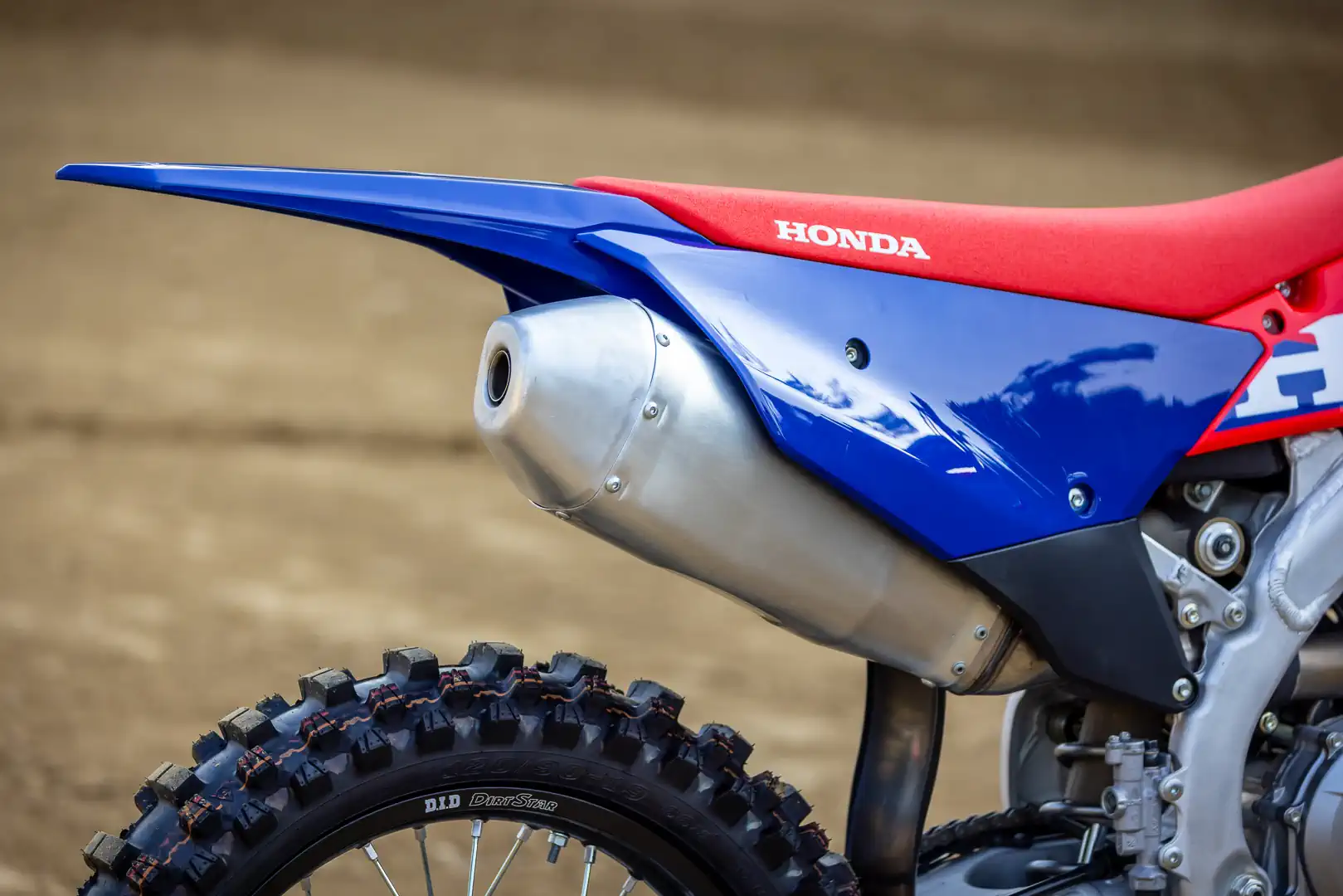
Quieter exhaust. The exhaust is longer and quieter, meeting the AMA’s 109 dB limit for pro racing in 2027 and sharing the Euro spec. The header is 3.5 inches longer and the muffler 3.4 inches longer, and a dual-resonator design controls noise while protecting power. A straight, oval exhaust port in the center of the head is intended to deliver usable low-to-mid power. The header and muffler are tucked closer to the bike to stay out of the rider’s way.
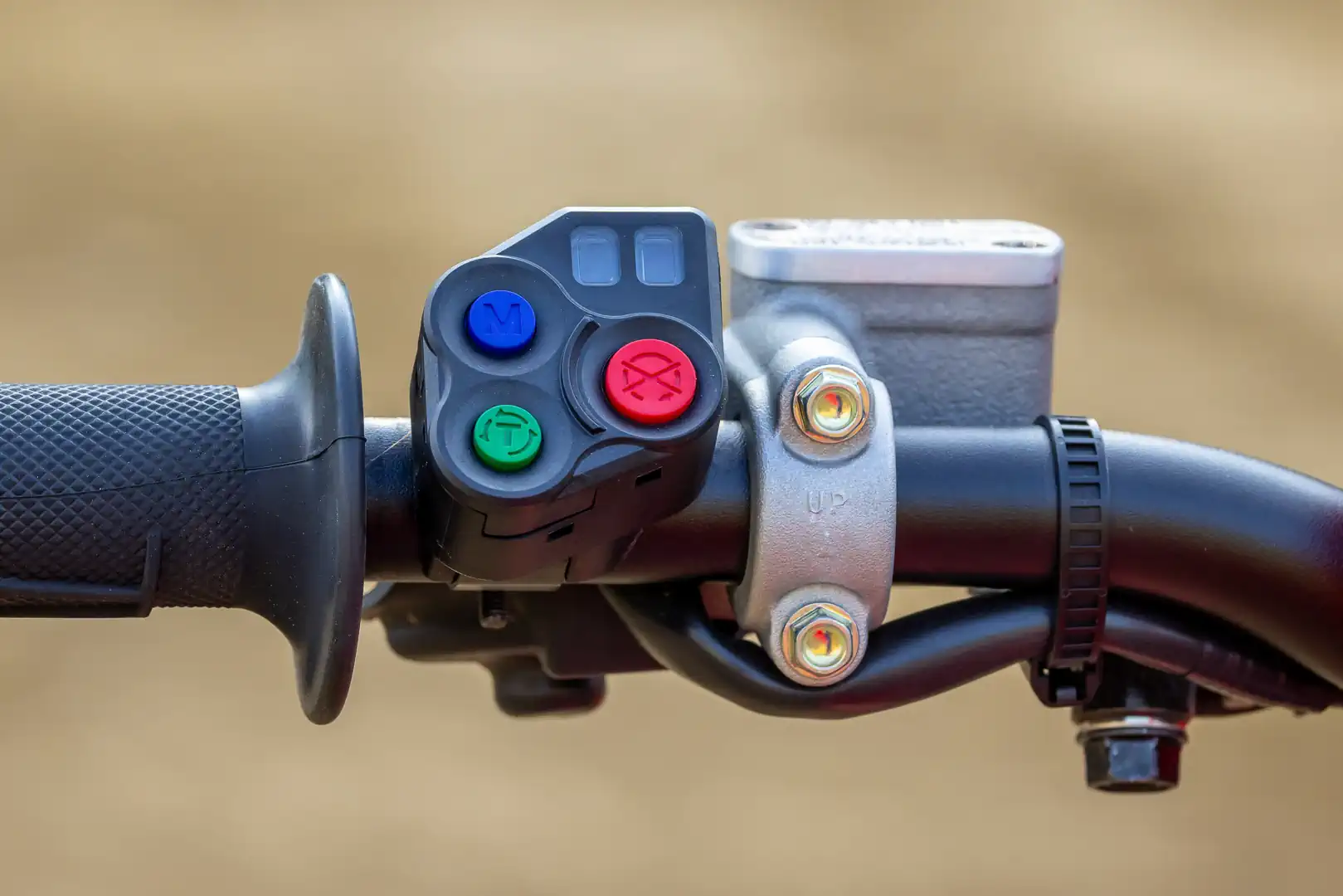
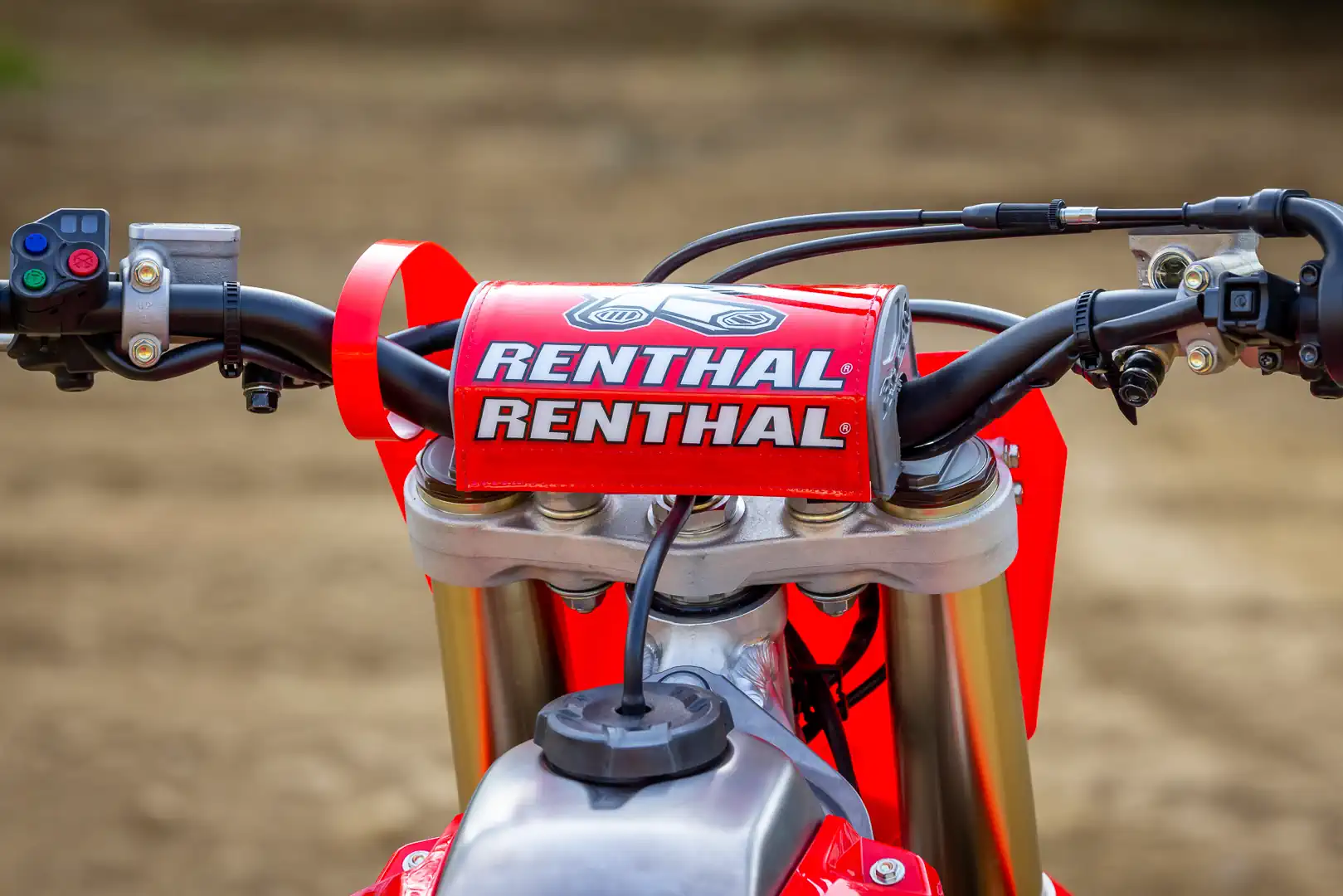
Revised controls. Engine maps, traction control, and launch control are retuned for the new engine, each with three settings. The maps are Aggressive, Standard, and Smooth, selected from a switch on the left side of the handlebar. Changing maps requires holding the button with the engine near idle, so it can’t effectively be done on the fly, reducing the usefulness of an essential feature. Pick the tune you want before the moto starts and live with it until the checkers. Launch control received the most attention, reworked with significant feedback from factory teams.
Slipper clutch. The clutch adds a slipper function using a rubber damper, which Honda calls a first-of-its-kind design. Instead of the cam-type mechanism of most slipper clutches, the rubber damper deforms under back torque to reduce clutch capacity, smoothing deceleration into corners. The basket diameter shrinks 7mm, to 132mm, the primary driven gear is a lighter ring-type design, and the clutch uses a new diaphragm-style spring. If you think the action at the lever might feel odd, it doesn’t. The system calms the chassis through braking bumps by reducing the effect of engine braking.
Taller gears. All five gears are taller to match the added power. This means fewer shifts and the ability to run a gear higher than you might expect. The transmission is one of the places weight was saved. It is 1.1 pounds lighter, a 15% reduction, thanks to a narrower shift drum made of higher-strength material, needle bearings on the main shaft, revised gear shapes, and a main shaft that is 14mm shorter.
New frame. The frame is about 70% new and 10% stiffer, longitudinally and torsionally, with no added weight. The head-pipe gusset is larger and cast in one piece, the down tube is optimized, and the pivot plates and top shock mount are reshaped. Last year’s CRF450R had a front end that was hesitant entering ruts, requiring the rider to stay on top of the bike. With the new chassis, the 2027’s front end is much more predictable.
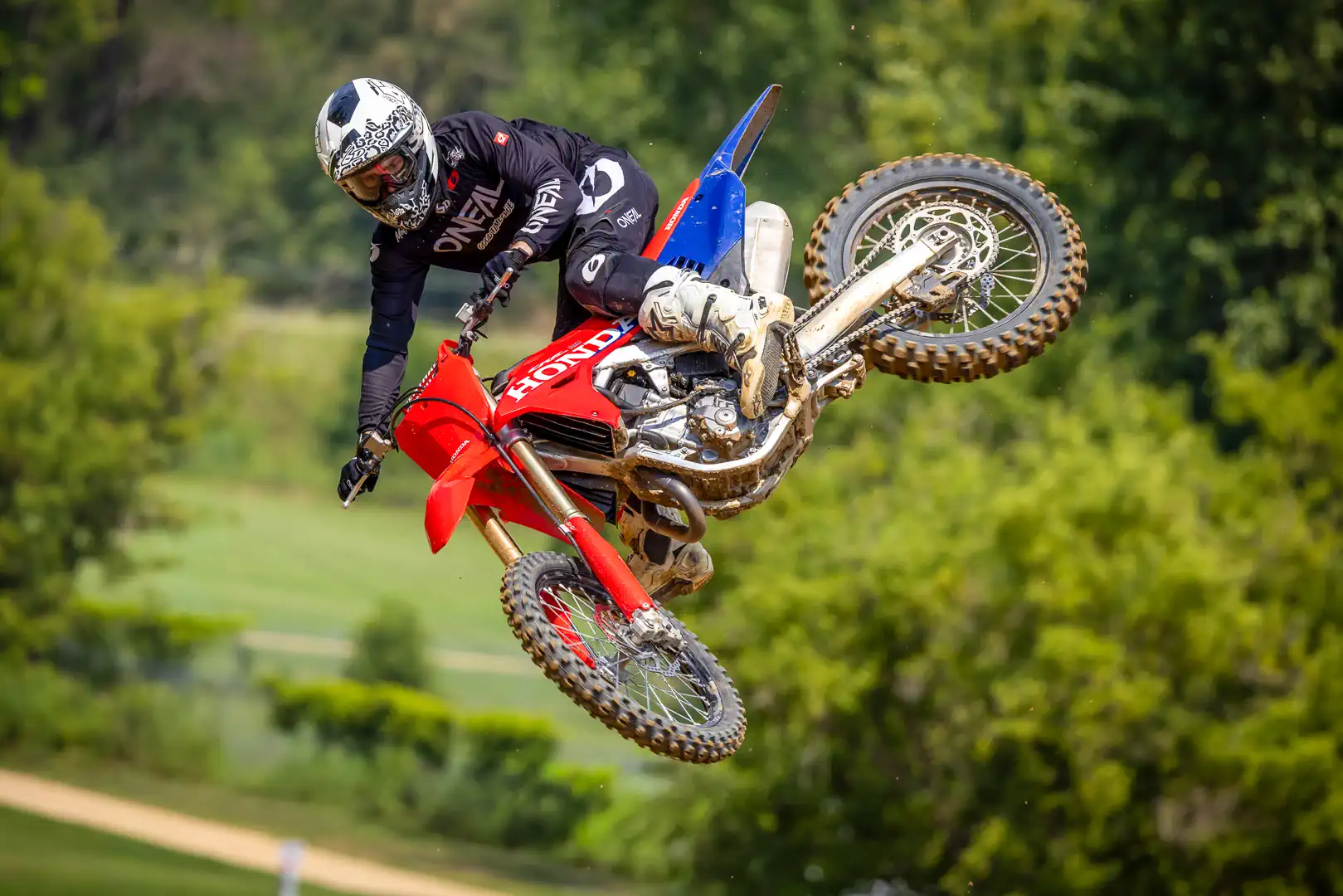
New geometry. Honda revised the geometry and ergonomics for stability. The footpegs move 5mm rearward, rake increases 0.2 degrees to 27.5 degrees, trail is 1.4mm longer at 117mm, the wheelbase stretches 0.3 inches to 58.7 inches, and the rear axle sits 0.5 inches higher. The 2027 CRF450’s suspension rides higher, so the bike feels much more level. In the air, there’s no need to overcorrect with body position to keep the bike level.
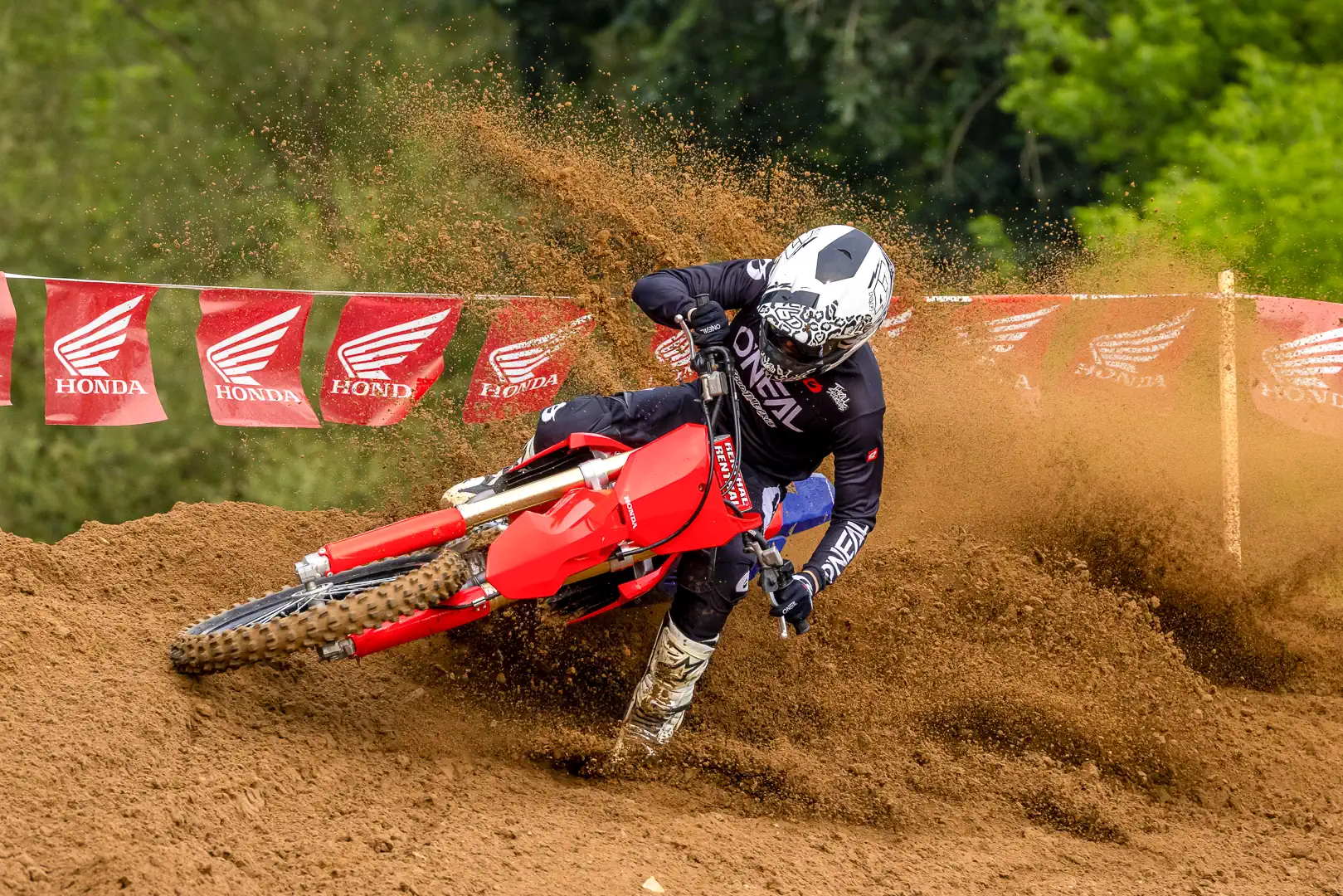
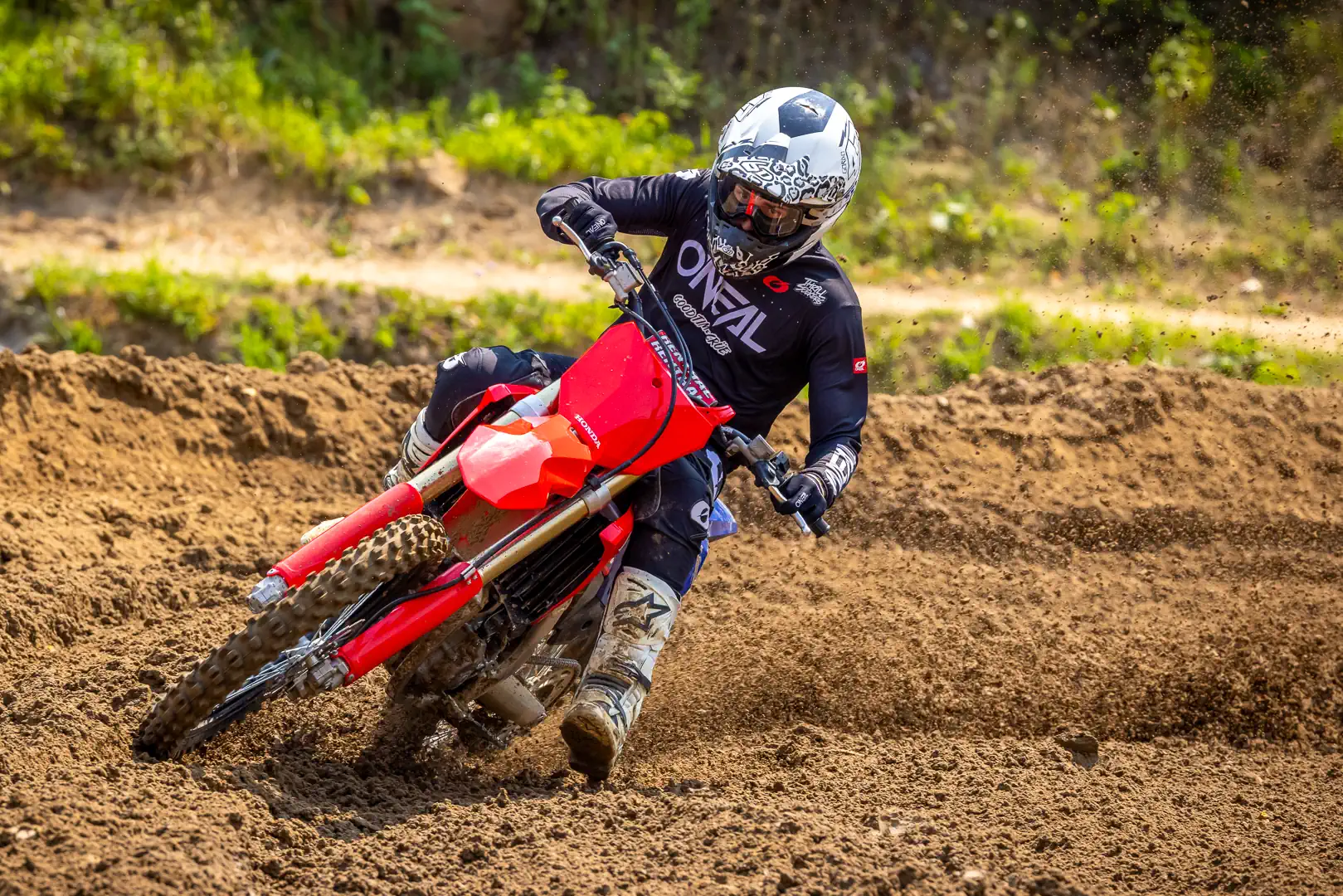
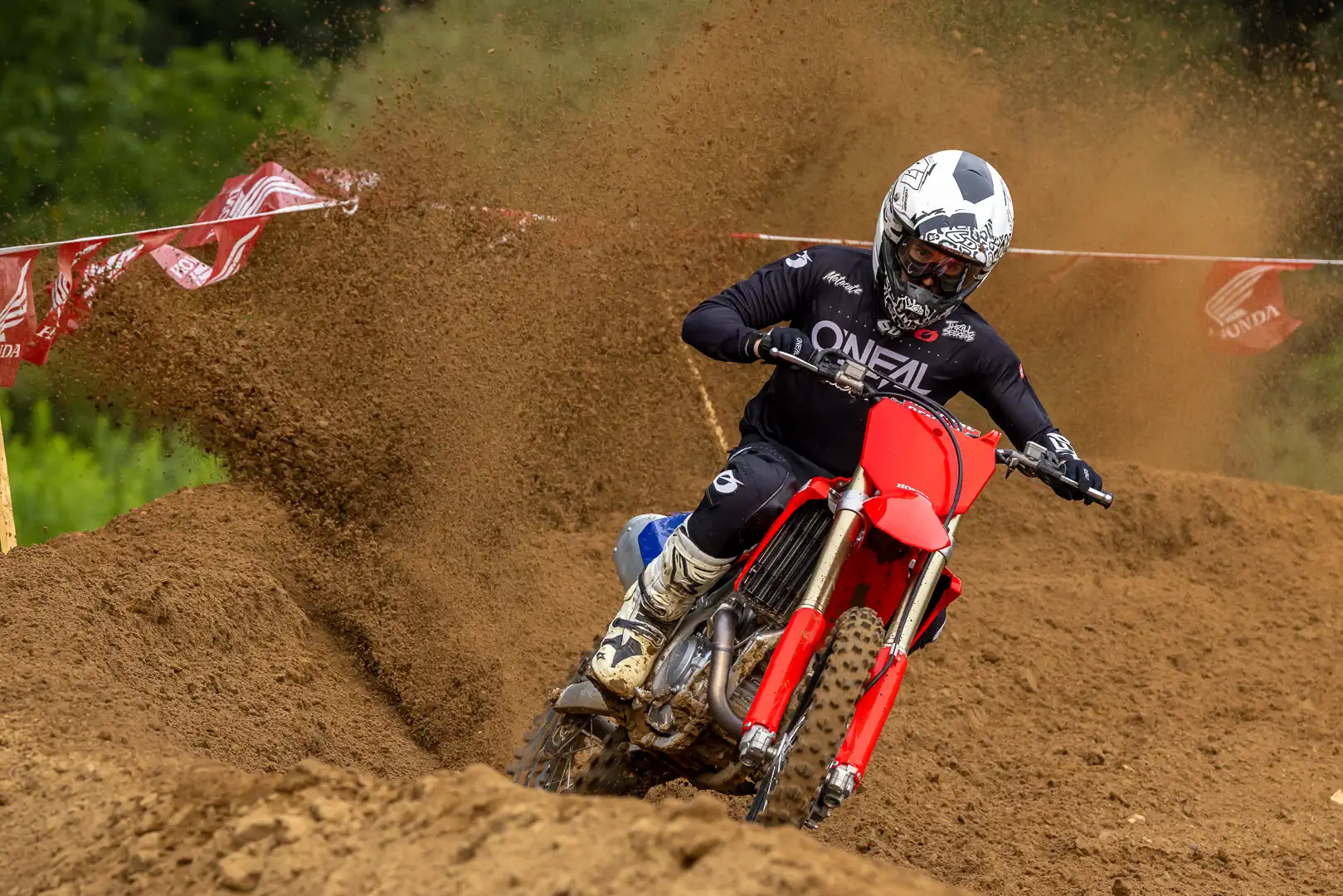
Active riding. The added stability calls for a more committed cornering style. The 2027 has to be leaned into corners with more commitment than usual and put down into ruts deliberately. Because the bike is very stable, it asks for a more active ride.
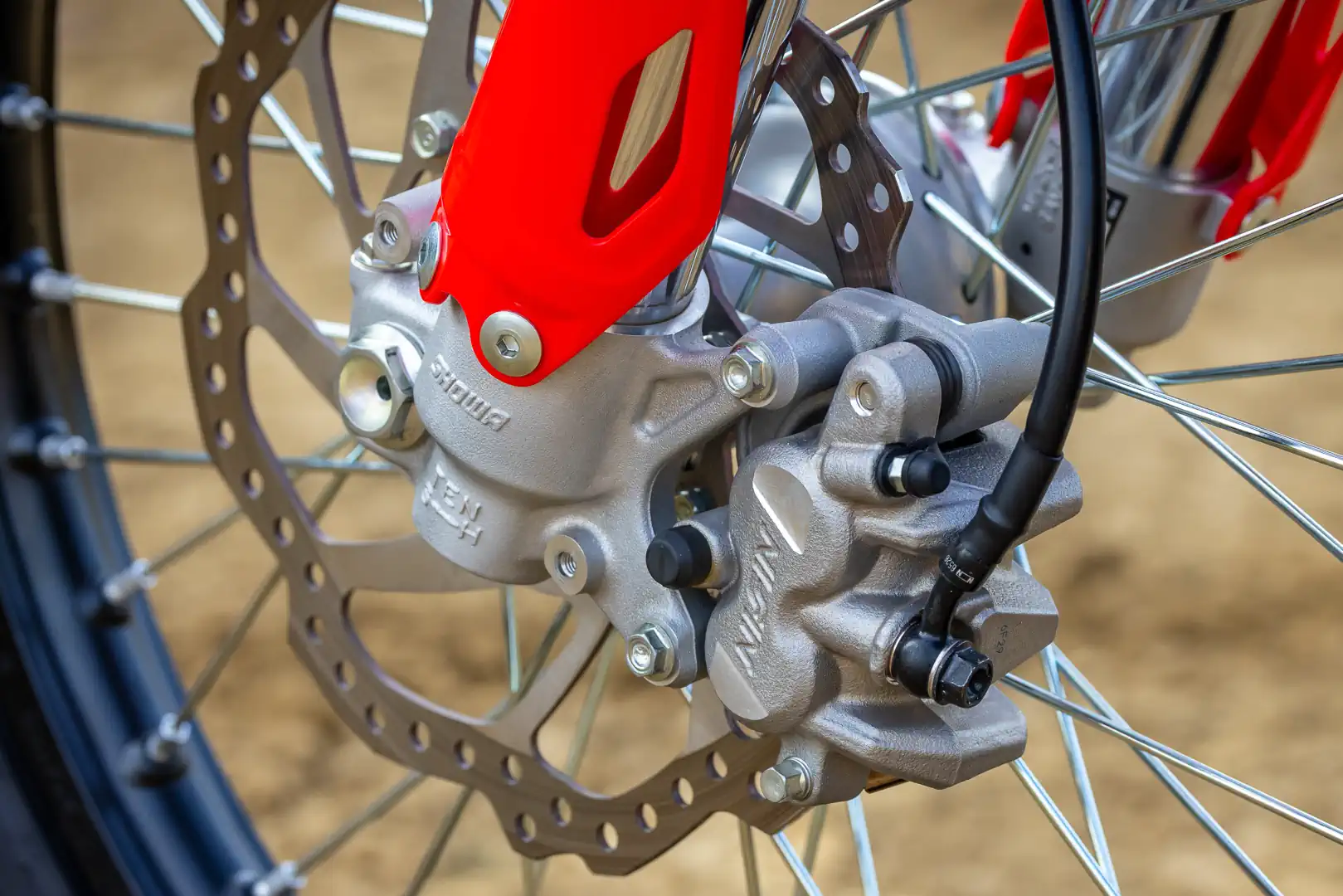
Revised fork. The Showa fork’s internals are new. Showa’s Dynamic Blow System valving replaces the previous design, the spring rate rises from 5.0 to 5.2 N/mm, internal sliding parts get Kashima coating, and an aluminum spring seat replaces the resin one to reduce step-like sensations in the stroke. Compression damping is increased in the low-speed range. Backing the fork’s rebound damping out one click turned that sticky feel into a free one. The new Showa fork setup works great on jumps, with none of the 2026’s kick-back.
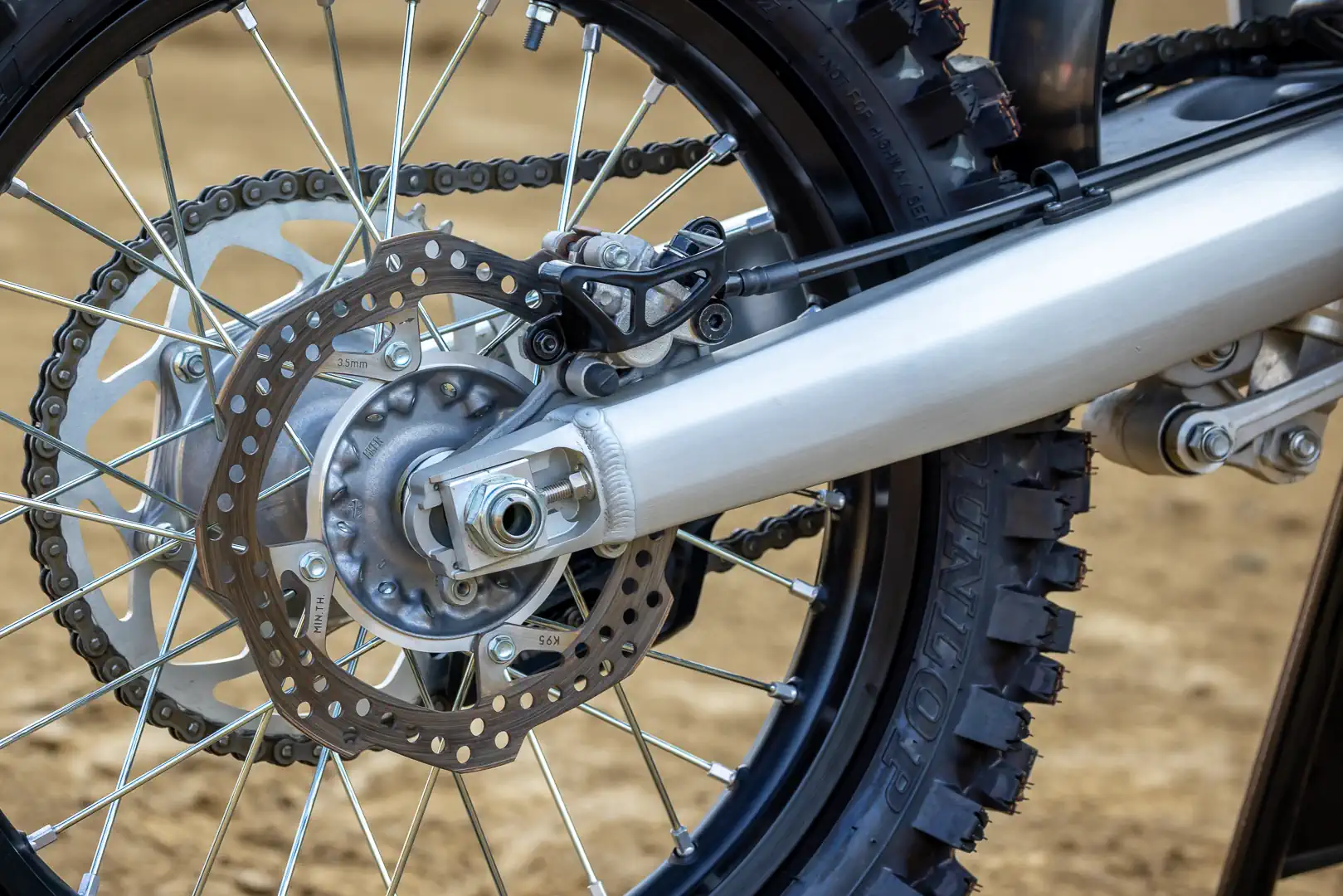
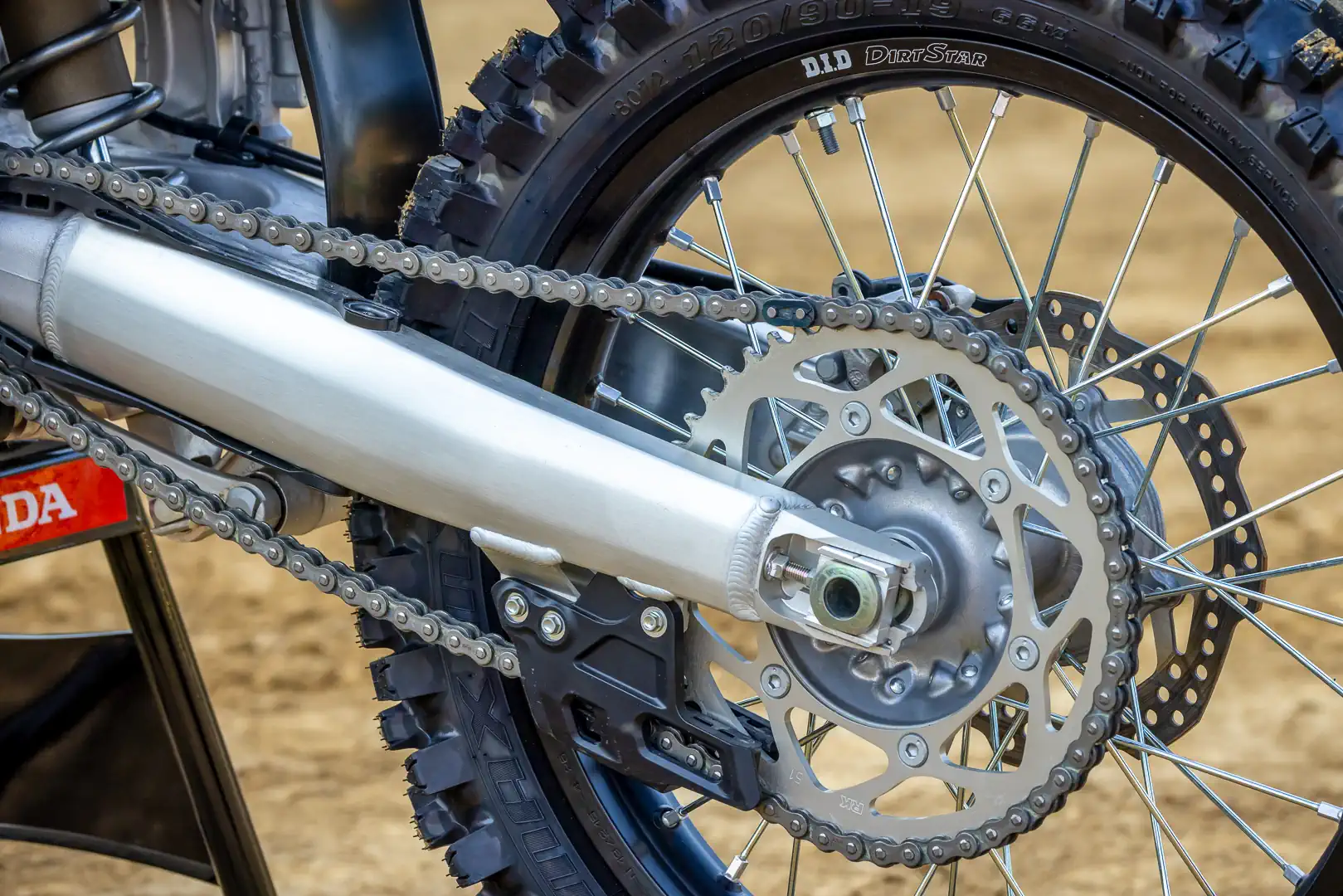
Revised rear suspension. The shock, linkage, and swingarm were reworked to match. The shock gets more compression and rebound damping, a reshaped bladder for better response, a stiffer compression-adjuster spring for better low-speed feel, a smaller bump rubber, and the same SS37 oil as the fork for consistent feel front to rear. A revised linkage ratio smooths the ride under acceleration, and a thrust needle bearing replaces a thrust washer to cut friction. The new swingarm uses larger-diameter, thinner-walled tubes with a D-shaped cross-section that reduces drag in ruts, and it is hand-polished.
New hub and tires. The rear hub is new, with a wider span between the axle bearings. A machined RK rear sprocket has a 7mm larger mounting diameter, so existing CRF450R rear sprockets won’t fit. Dunlop Geomax MX34 tires replace the MX33s, and the rear grows from a 120/80-19 to a 120/90-19.
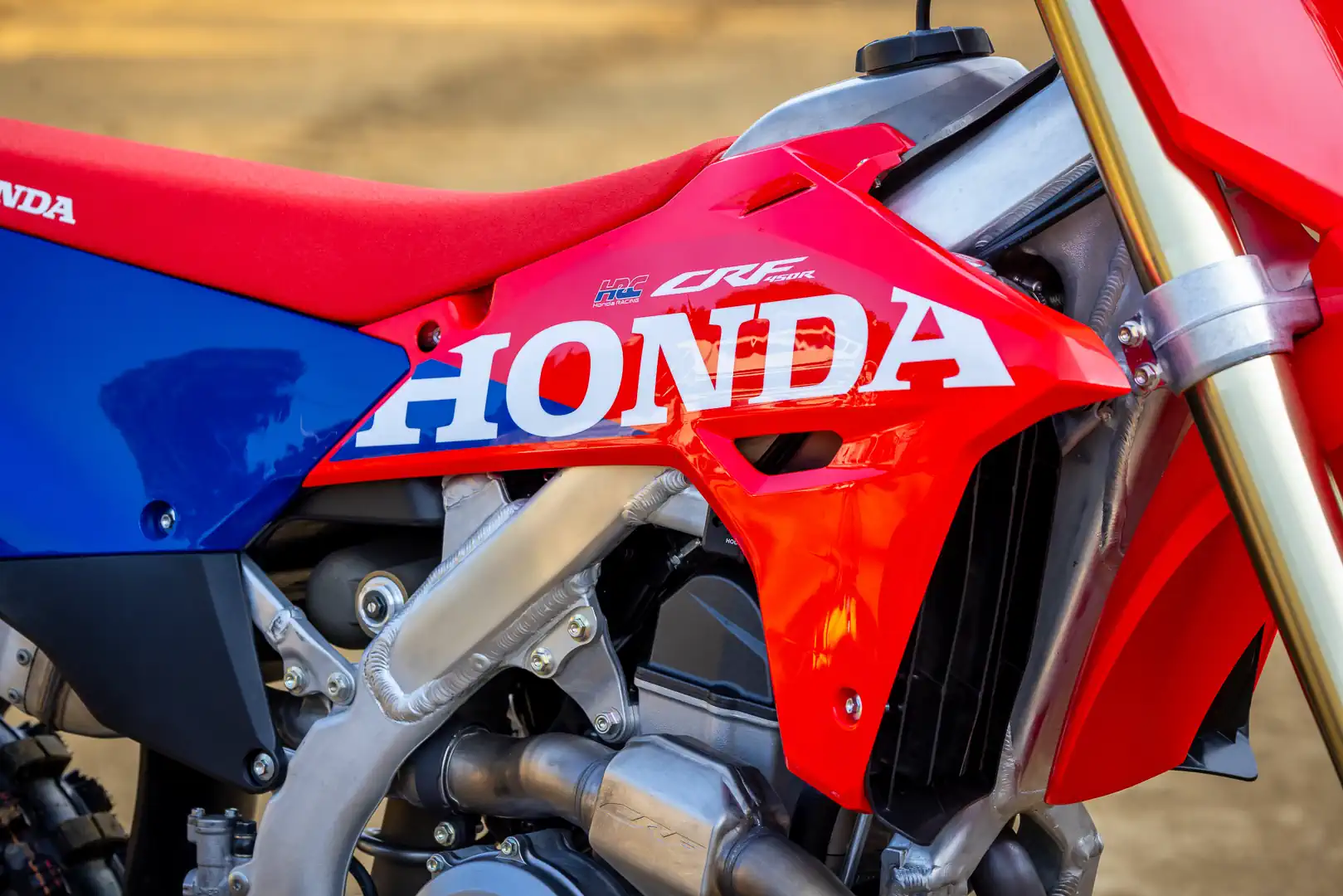
New bodywork. New bodywork makes the CRF450R easier to grip. It is 2mm wider at the radiator shrouds and 7mm wider at the seat, with flatter sides and symmetrical side panels that give the legs a better hold when the rider is at the back of the bike. The slightly wider ergonomics make it easier to grip with the knees through sand rollers. The seat is on the slippery side. The red, white, and blue livery matches the Honda HRC Petronas MXGP team bikes. Initial reactions about it were generally negative, though people seem to have gotten used to it.
Bigger tank. The titanium fuel tank grows from 1.7 to 1.9 gallons. That’s enough to reliably finish an AMA Pro Motocross moto, and the tank remains slim. The skid plate is gone for 2027, replaced by a water-pump guard. If you need a skid plate, the CRF450RX unit bolts right on.
Simpler service. Routine service is simpler on the 2027. The shock comes out without removing the ECU, the air filter is behind a single cover, the rear brake disc mounts without nuts, and the chain-guide plate has press-fit nuts. The rear-axle collars are chamfered so they stay in place during wheel changes, and the clutch hose can be removed without pulling the fuel tank. Clearly, a lot of work was put into simplifying maintenance.
Bottom line. The 2027 Honda CRF450R trades some ease in corners for stability, smoother power, and a chassis that stays level. The 2027 is better at the front end, in the air, and on the throttle. In exchange, it asks you to adjust your technique a bit: commit to the corners and put the bike down into the ruts. At $10,099, it costs $400 more than the 2026 and is the first CRF450R priced above $10,000. Riders who value a planted, predictable 450 get a better Honda, while those who want a bike that drops into corners on its own will have to adapt their technique.
Honda CB1000F + Sabatino Moto at Mecum + Peter Egan
byMotos and Friends by Ultimate Motorcycle
Hello and welcome again to the Motos and Friends Podcast, my name is Arthur Coldwells. Our subjects this episode can best be described as ‘iconic’.
Honda motorcycles recently launched the all-new CB1000F, a retro-styled inline-4 roadster that created an absolute social media sensation when it was announced. The er… iconic(!) styling is of course an homage to Freddie Spencer’s 1980/81 AMA CB750 Superbike with its swooping lines and silver paint with blue accents. Freddie rode the superbike so ferociously that sometimes he’d bend the handlebars at high speed. Jonathan Handler rode the new bike recently, and although he didn’t quite do that, he did however have an apparently very spirited ride that left him impressed. The new CB1000F is clearly an outstanding motorcycle, and Jonathan gives us the lowdown on exactly why you’re going to have make space in your garage for one of them.
* * * * *
The annual Mecum Motorcycle auction in Las Vegas is now an ahem… iconic event, yet many people believe it’s aimed at only very serious buyers with very deep pockets. Of course the really expensive vintage motorcycles are the ones that grab the headlines, but interestingly, there is way more to the Mecum Vegas auction than you’ve probably heard. There are also hundreds much more modestly-priced bikes as well, with a strong chance you could pick up a dream bargain if you play your cards right. For this episode, I found Eric Sabatino, who started Sabatino Moto in Portland Oregon a few years ago. It rapidly became one of the top Royal Enfield dealers in the country. Eric went to mecum Las Vegas for the first time earlier this year and was blown away by what he found. The auction ended with him winning a classic BSA, and admits it was such a good deal he feels like he practically stole it. Clearly going to Mecum was an eye-opening experience for him and quite different from what he’d been led to expect. Eric tells us all about his experience and how you too might be able to have the bike of your dreams follow you home this coming February.
* * * * *
This episode’s guest is Peter Egan, the (dare-I-say) iconic American writer whose 40-year career specialized in motorcycle and automotive journalism with magazines Cycle World and Road & Track. I’m sure you’re familiar with Peter’s writing as he’s published many, many books. Peter is of course a natural story-teller, and he chats with Teejay Adams on how he got started, a look back at his amazing career, and some of his adventures along the way. Peter is also a pilot, and recently published another book, Landings in America: Two People, One Summer, and a Piper Cub, and his anecdotes from that are just as entertaining too.
* * * * *
Here’s quick reminder to check out our monthly digital magazine. It’s filled with everything you want to read on motorcycling, including some things you’ve probably not seen elsewhere. It’s absolutely free and you will find it on the Apple App Store and of course on Google Play as well.
Don’t forget to leave us your comments on our social media—we’re on all the usual platforms at Ultimate Motorcycling. We love hearing your feedback… so good or bad, please let us know what you think. If there’s something you’d like us to cover, we’d love to hear those ideas too!
We use cookies and browser activity on this website
Functional
Always active
The technical storage or access is strictly necessary for the legitimate purpose of enabling the use of a specific service explicitly requested by the subscriber or user, or for the sole purpose of carrying out the transmission of a communication over an electronic communications network.
Preferences
The technical storage or access is necessary for the legitimate purpose of storing preferences that are not requested by the subscriber or user.
Statistics
The technical storage or access that is used exclusively for statistical purposes.The technical storage or access that is used exclusively for anonymous statistical purposes. Without a subpoena, voluntary compliance on the part of your Internet Service Provider, or additional records from a third party, information stored or retrieved for this purpose alone cannot usually be used to identify you.
Marketing
The technical storage or access is required to create user profiles to send advertising, or to track the user on a website or across several websites for similar marketing purposes.
Advertising helps us keep our content available for free, so adjusting your ad blocking settings will help us.
We appreciate your support!
i
How to Allow Ads on This Site
Depending on your setup, ads may be blocked by a browser extension, VPN, antivirus software, or other application. Here are some common ways to allow ads:
Browser Extensions (e.g., Adblock, uBlock, etc.)
Click the extension icon in your browser toolbar.
Look for an option like "Don't run on pages on this site" or "Pause on this site".
Save the change and refresh the page.
VPNs with Ad Blocking (e.g., NordVPN, Proton VPN, etc.)
Open your VPN app.
Go to settings or features.
Disable any ad blocking or tracking protection features.
Refresh the page.
Antivirus Software or Other Privacy Tools
Check for web protection, ad filtering, or browser privacy settings.
Click the power button to disable it for this site.
Refresh the page.
Not sure what's blocking ads? Look for tools with privacy or filtering features, or check your browser extensions. We only use respectful, non-intrusive advertising.