Vespa has built nearly 20 million scooters since Piaggio patented the design on April 23, 1946. The scooter that Enrico Piaggio commissioned to get postwar Italy moving is now sold on five continents and produced at three plants: Pontedera, Italy; Vinh Phuc, Vietnam; and Baramati, India. Here is Vespa history, decade by decade.
1940s: Where Vespa History Begins
Piaggio did not start as a scooter maker. Rinaldo Piaggio founded the company in Genoa in 1884, at age 20, and began fitting out luxury ships. It moved into rail carriages, trams, and truck bodies, then began building airplanes and seaplanes during World War I. By World War II, Piaggio was one of Italy’s largest aircraft manufacturers. That made its plants in Genoa, Finale Ligure, and Pontedera targets for bombing. All were destroyed by the Allies.
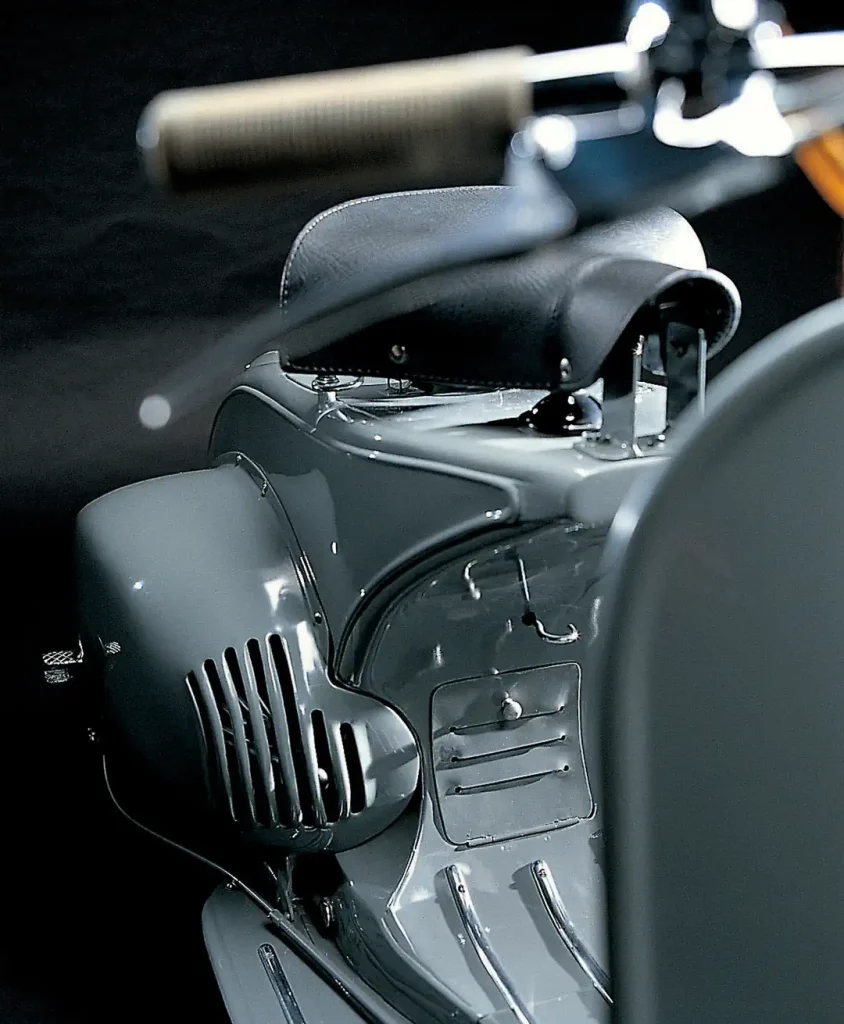
1945 Vespa MP6 Prototipo.
After the war, Rinaldo’s son Enrico took charge of rebuilding Pontedera. He bet on cheap personal transportation for a country in ruins. The first attempt, the prototype, was built at Biella. It was nicknamed Paperino (Italian for Donald Duck) because of its odd shape. Enrico rejected it and handed the project to aeronautical engineer Corradino D’Ascanio, who disliked motorcycles. He found them uncomfortable, dirty, and hard to work on when a tire went flat.
D’Ascanio’s fixes came from aviation. A stress-bearing steel body eliminated the frame, and direct drive replaced the oily drive chain. The shifter went on the handlebar. A single-sided support arm, modeled on aircraft landing gear, replaced the fork and made tire changes simple. Bodywork kept the rider clean. When Enrico Piaggio saw the narrow-waisted MP6 prototype, he said, “It looks like a wasp!” Vespa is Italian for wasp, and the name stuck.
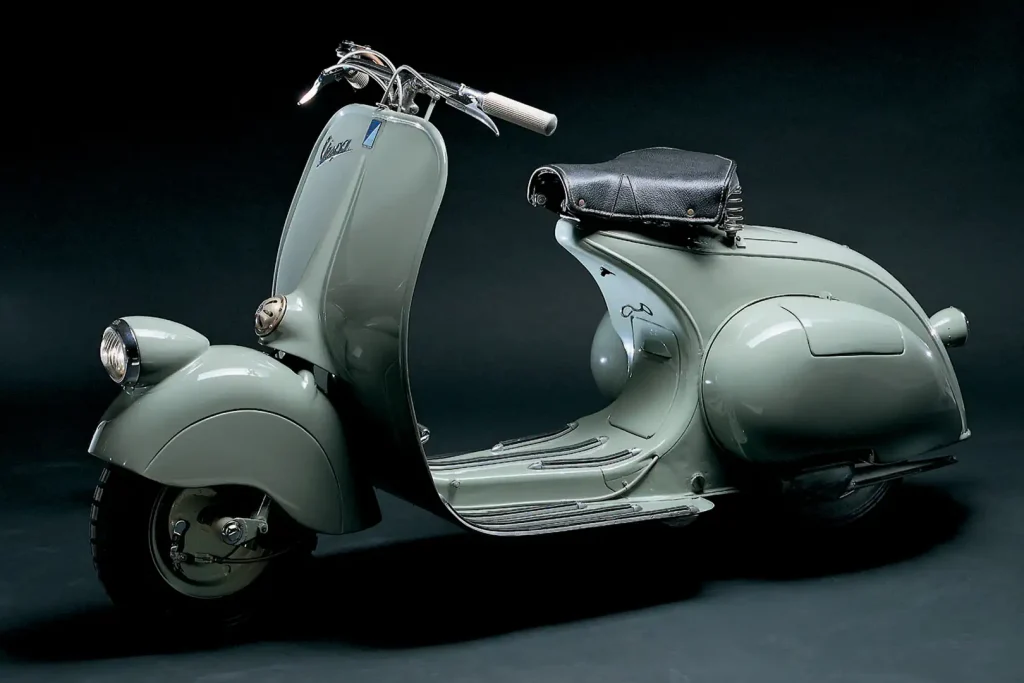
1946 Vespa 98.
Italians first saw the Vespa in the magazine Motor on March 24, 1946, and on the cover of La Moto three weeks later. Piaggio filed the patent in Florence on April 23 and put the Vespa 98 into production. The public debut came at the Rome Golf Club, followed by that year’s Milan show.
Two versions sold for 55,000 and 61,000 Italian lire, roughly $2300 and $2900 in today’s dollars. The pricier one added a speedometer, a side stand, and whitewall tires.
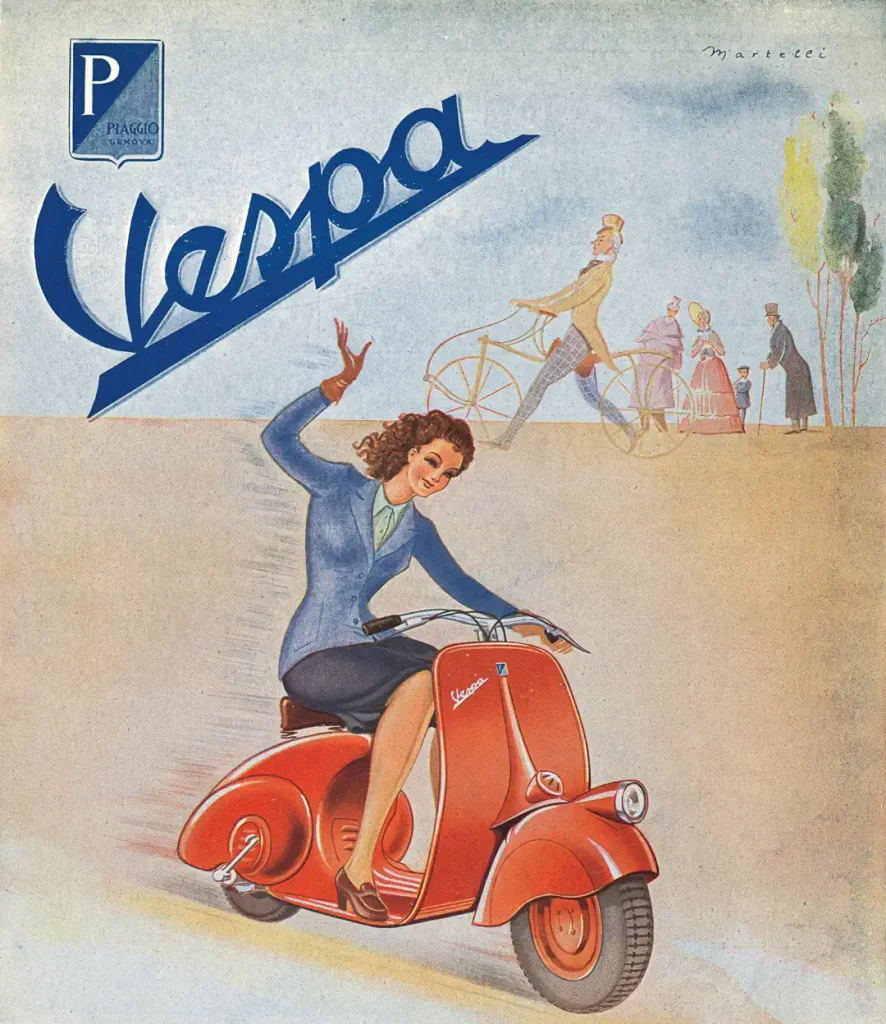
1946 Vespa advertisement.
Skeptics in the industry predicted failure. Production told a different story: 2,484 scooters in 1946, 10,535 in 1947, and 19,822 in 1948. The Times of London called it “a completely Italian product, such as we have not seen since the Roman chariot.”
The larger Vespa 125 replaced the 98 in 1948, the same year Piaggio spun off the three-wheeled Ape utility vehicle from the scooter’s design. Italian Vespa Clubs held the Silver Swarm in Milan that same year, its first big rally. The community surrounding Vespa had hit critical mass.
1950s: The Vespa Goes Global
The Vespa went global as World War II faded in the rearview mirror. Hoffmann-Werke began licensed production in Germany in 1950, followed by Douglas in Britain and ACMA in France in 1951, and Moto Vespa in Madrid in 1953. Output topped 60,000 units in 1950 and reached 171,200 in 1953. Vespas were eventually built in 13 countries and sold in 114.
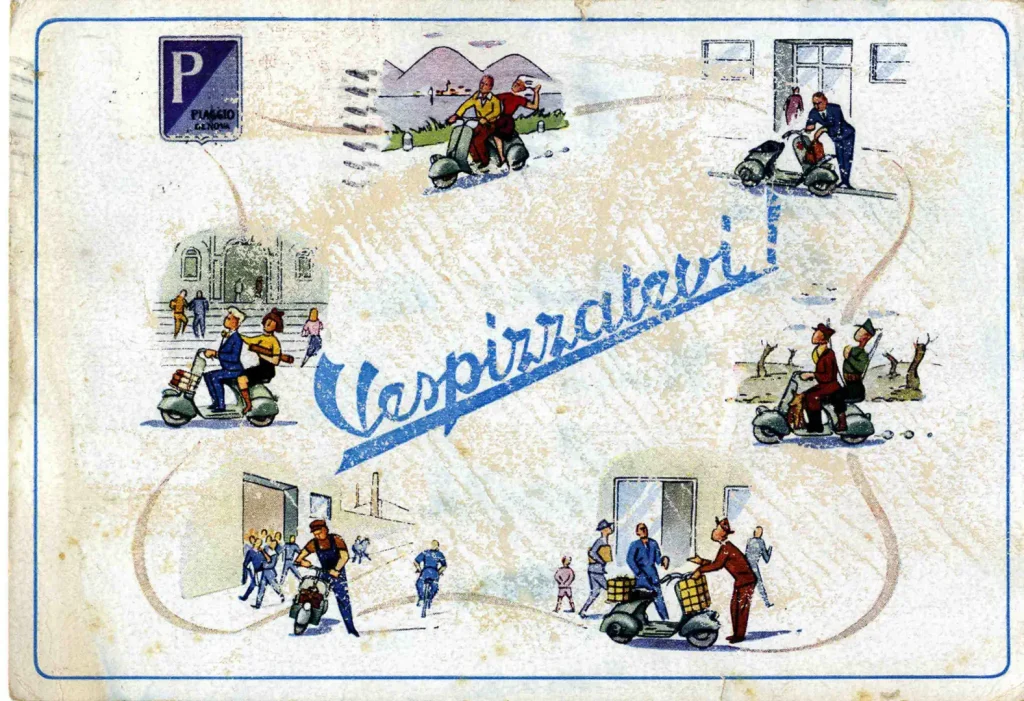
1952 Vespa postcard.
Some 20,000 riders showed up for Italy’s Vespa Day in 1951. By 1953, there were more than 10,000 Piaggio service points worldwide and over 50,000 Vespa Club members. The Vespa Club Europe formed in that same year.
The scooter also proved itself in competition. In 1951, a factory 125 prototype set a world record for the flying kilometer at 106.3 mph. The same year, Vespas won nine gold medals at the International Six Days Trial in Varese, the best result among Italian motorcycles.
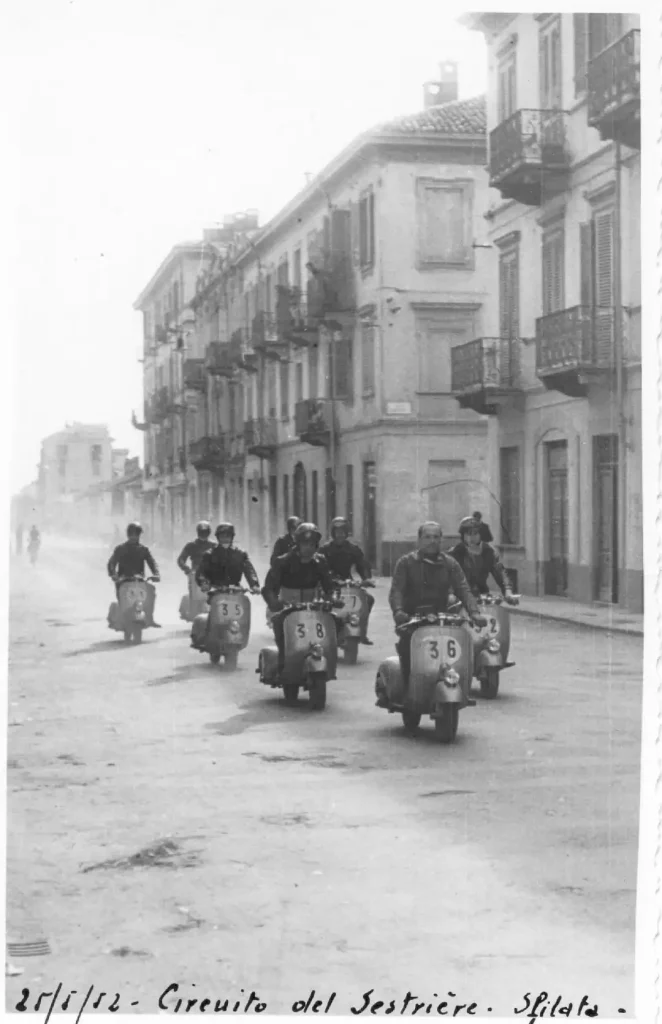
1952 Vespa Rally.
In 1952, Frenchman Georges Monneret crossed the English Channel on an amphibious Vespa he built for the Paris-London race. Long-distance riders took Vespas to the Arctic Circle, across the Andes, and from Milan to Tokyo.
The budget 1953 125 U was the first Vespa sold in Italy with the headlamp mounted on the handlebar.
Vespa production hit a half-million units in November 1953. Hollywood helped. Audrey Hepburn and Gregory Peck rode a Vespa through Rome in Roman Holiday in 1953, the first of more than 2,000 film appearances.
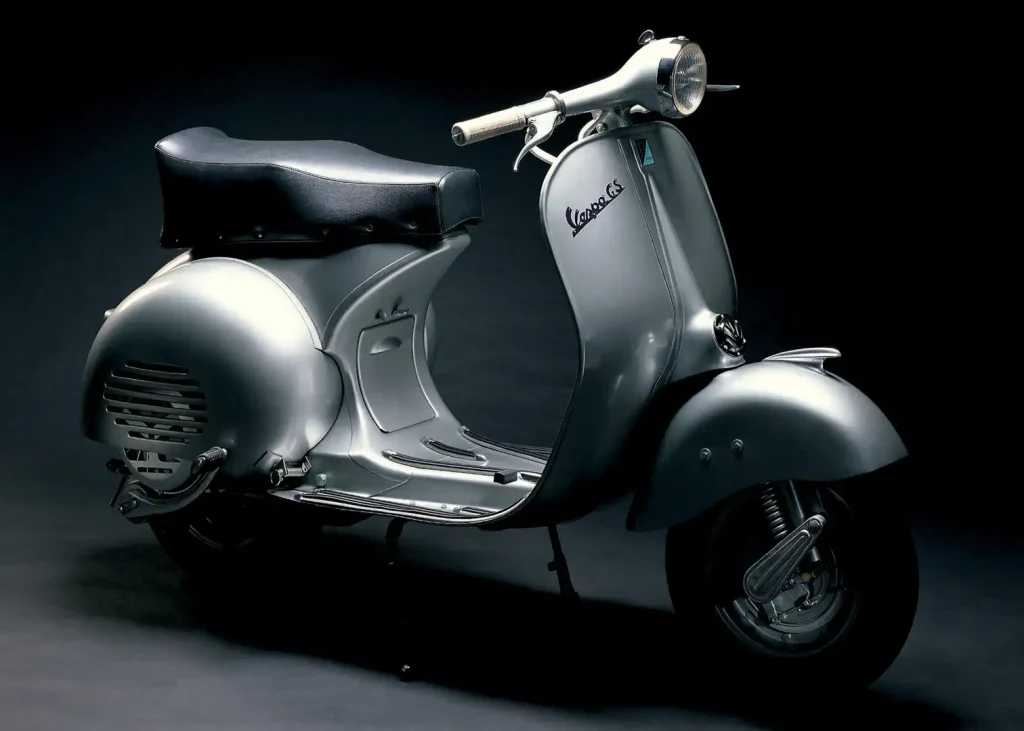
1955 Vespa 150 GS.
The decade’s landmark model was the 1955 Vespa 150 GS, regarded by many as the first sport scooter. It featured a 150cc engine, four-speed gearbox, long saddle, faired handlebar-headlamp unit, 10-inch wheels, and a top speed of 62 mph.
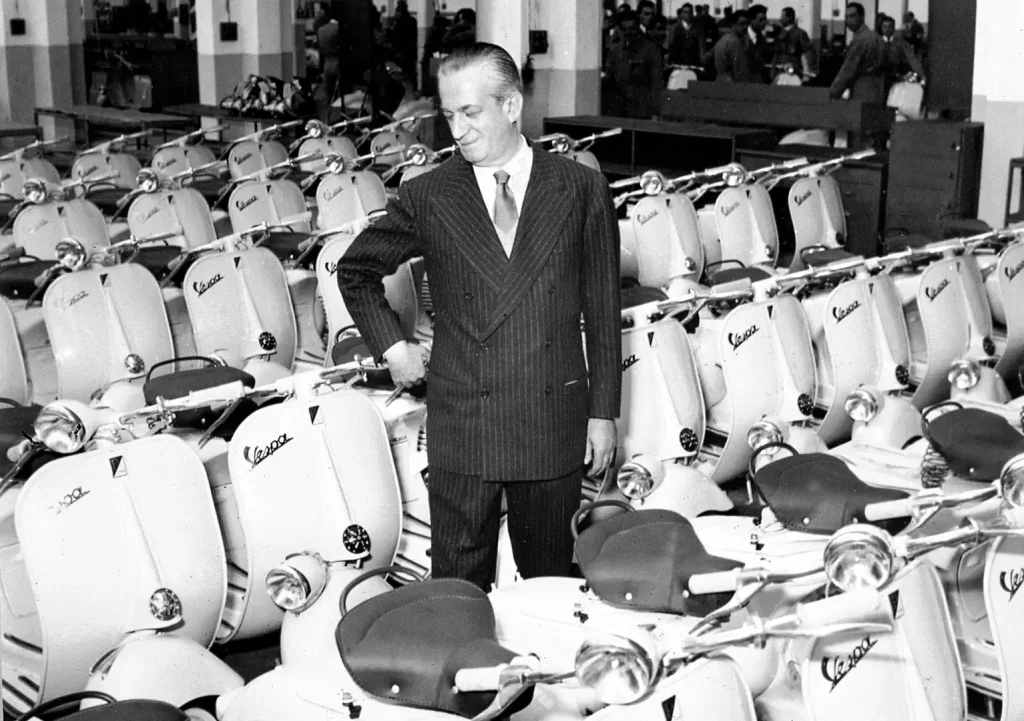
Enrico Piaggio in 1956.
By April 1956, one million Vespas had been produced. Vespa’s success also spawned pirated copies. The Soviet Viatka 150 was an almost exact clone, with production getting underway in 1957 in Kirov, Russia.
1960s: The Vespa 50 and a Company Split
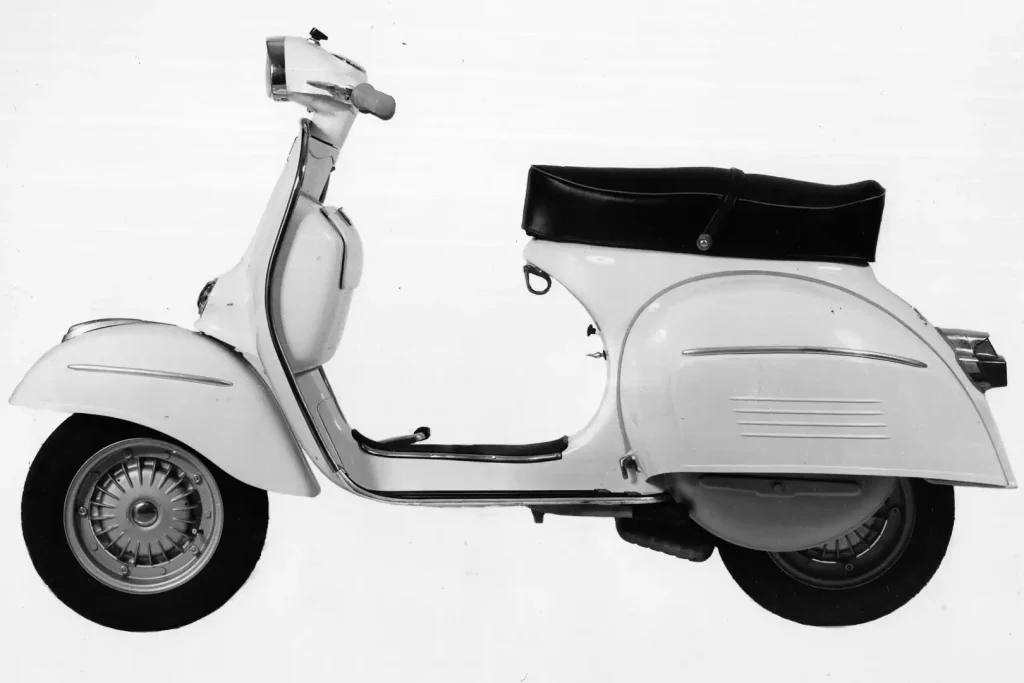
Vespa production passed the two-million mark in 1960. The 1962 160 GS and the following year’s 150 GL carried the sport line forward. When Italy began requiring license plates on two-wheelers over 50cc, Piaggio responded with the Vespa 50 in 1963. It was the last design from D’Ascanio’s drawing board, with its cylinder tilted forward 45 degrees. The plate-exempt Vespino was an immediate hit, and nearly 3.5 million Vespa 50s have been built since, in dozens of models and versions.
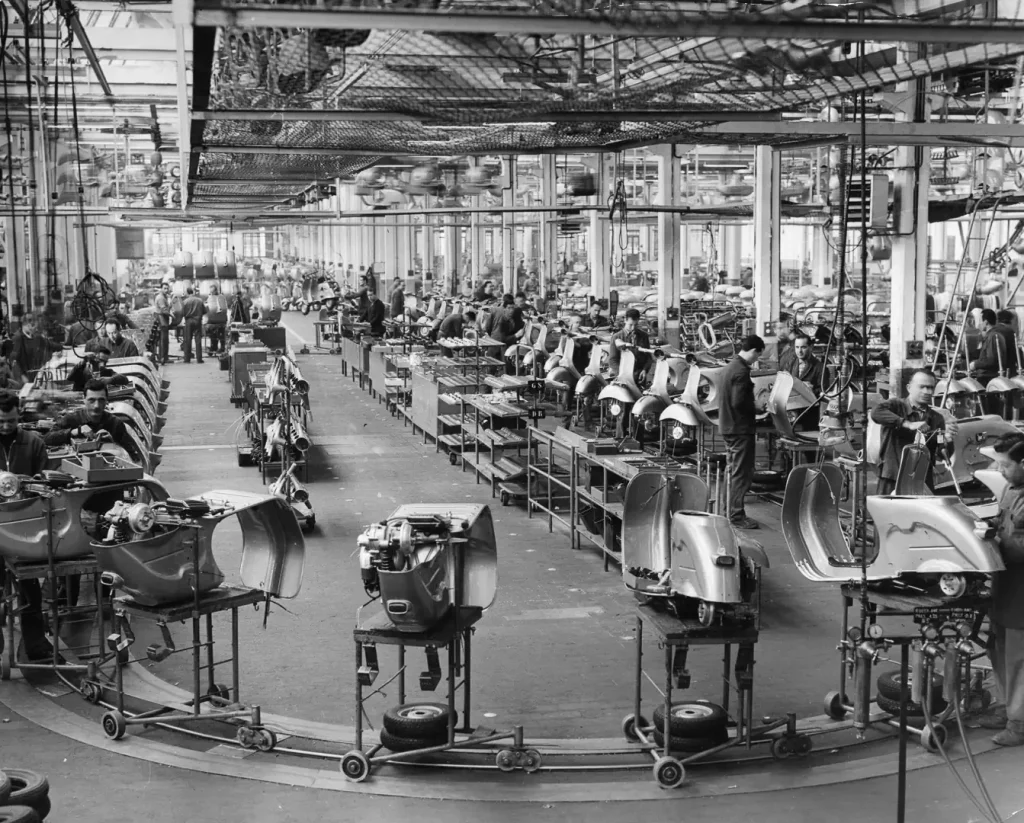
Vespa factory in the 1960s.
The French military ordered Vespas that could carry weapons and drop by parachute, and the Italian army requested a parachutable scooter in 1963.
The company split in 1964. Enrico Piaggio bought out his brother Armando, who took the aviation business and founded I.A.M. Rinaldo Piaggio.
1965 Vespa 180 SS.
The 180 SS of 1965 increased displacement to 181cc and top speed to 65 mph. The redesigned “new 125” arrived in 1966, along with the low-handlebar Super Sprint 90. The 1968 125 Primavera became one of the longest-lived Vespas ever. The 180 Rally of the same year spread rotary-valve intake technology across the range.
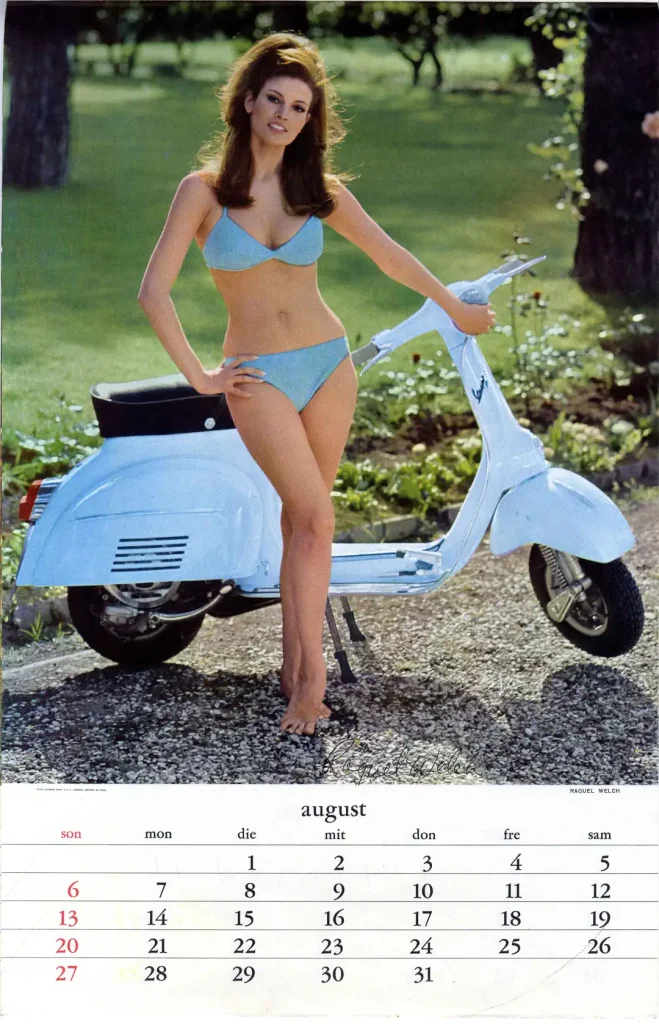
1966 Vespa Calendar, featuring Raquel Welch.
The annual Vespa calendar featured actresses Ursula Andress (January 1965), Joan Collins (December 1966), and Raquel Welch (August 1967).
For a 1967 Italian Bond spoof, Dick Smart 2.007, the British firm Alpha Willis built a movie Vespa that could fly, sail, and run underwater.
1970s: The PX Arrives
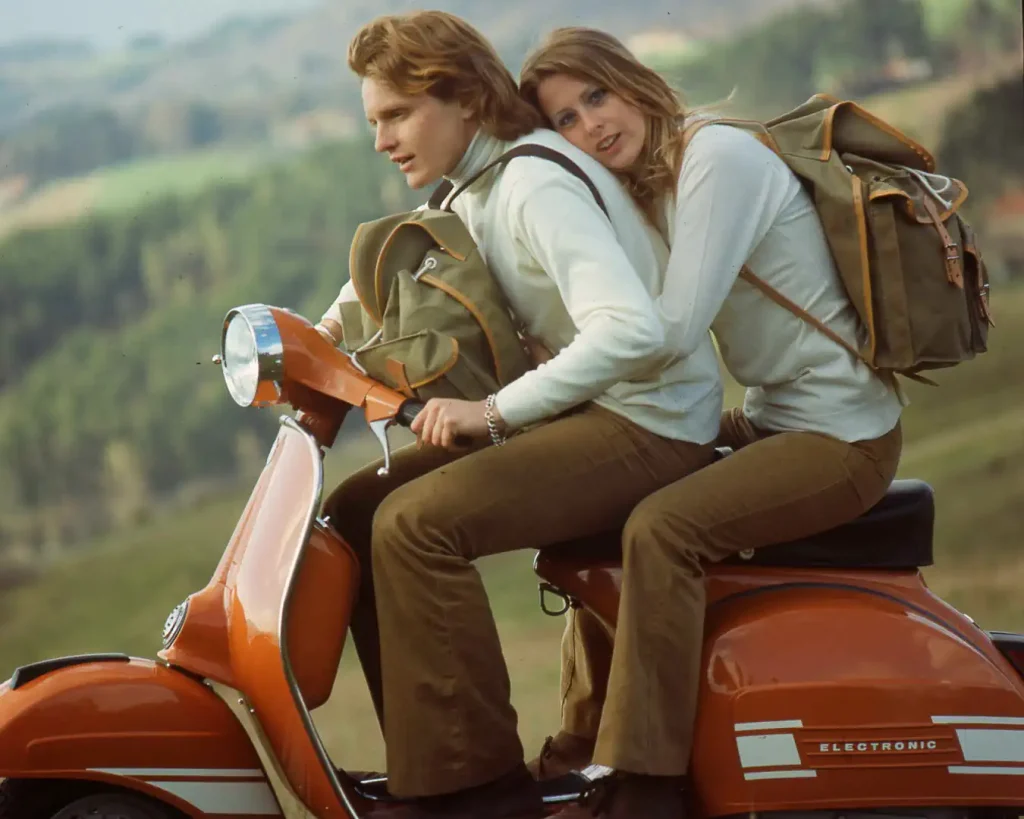
Vespa passed four million units in 1970. The 1972 200 Rally set a new displacement high of 198cc. The motor produced 12.35 horsepower, and the 200 Rally could hit 72 mph. The 1976 Primavera ET3 brought three ports to the two-stroke engine, along with electronic ignition.
1973 Vespa Rally 200.
1977 brought the most successful Vespa in history. The PX sold more than three million versions over a 30-year run. The P 125 X brought a fully redesigned chassis, joined by the P 200 E, which featured oil injection for the motor and turn signals built into the body. The intermediate PX 150 E followed three years later.
1980s: The Vespa Goes Automatic
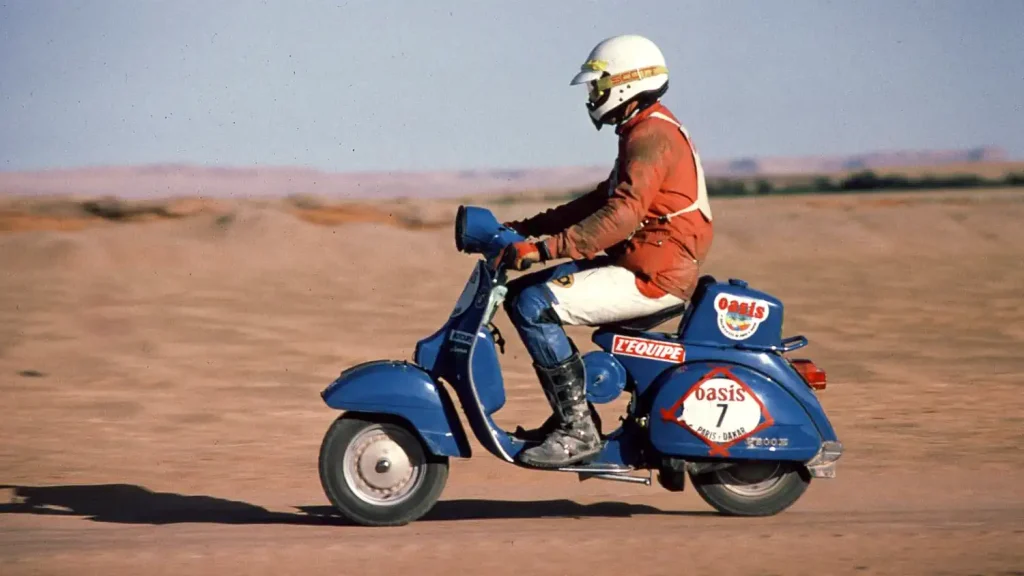
Vespa had not forgotten about competition. Two Vespa PX 200s, ridden by M. Simonot and B. Tcherniawsky, finished the second Paris-Dakar rally in 1980. The French squad was organized by Jean-François Piot and supported by four-time Le Mans winner Henri Pescarolo.
Vespa at the 1980 Paris-Dakar Rally.
The PK 50 and PK 125 replaced the Primavera line in 1983, featuring new bodies with integrated welds.
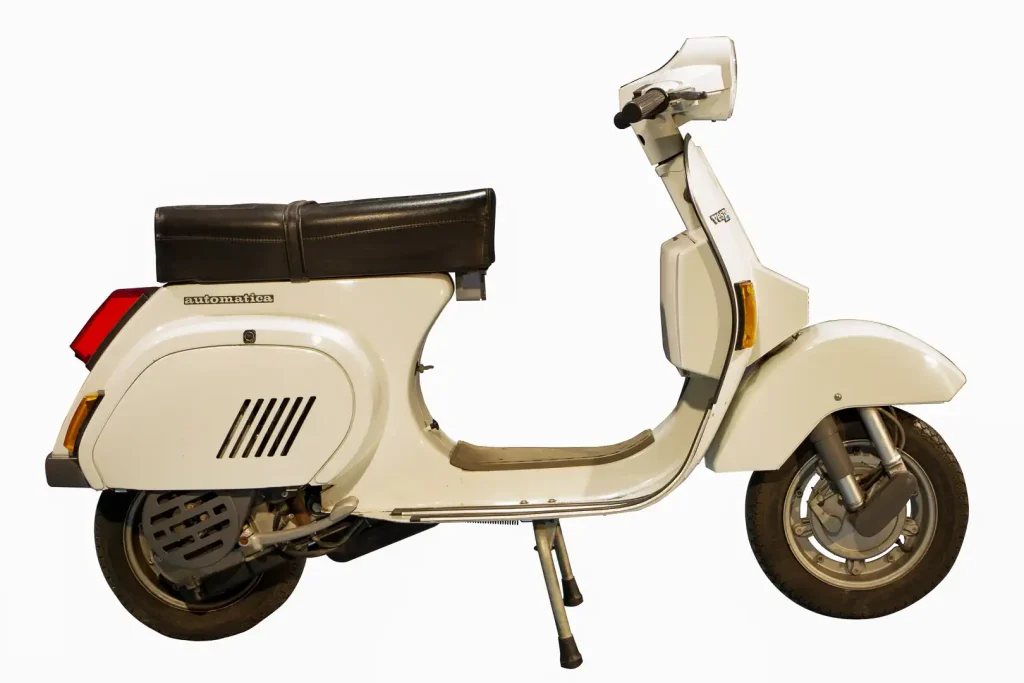
The 1984 PK 125 Automatica introduced automatic transmission, the now-familiar continuously variable transmission (CVT). It consists of two variable-width pulleys with a V-belt, centrifugal weights spreading the drive pulley as revs rise, and a centrifugal clutch. It’s the same basic system nearly every modern twist-and-go scooter uses.
1985 Vespa PK 125 Automatica.
The PK 125 Automatica was a clean break from the classic Vespa direct-drive, hand-shift gearbox. Perhaps the biggest change for riders since 1946, the Automatica replaced the foot brake pedal with a hand lever and eliminated the clutch lever.
The 1985 T5 Pole Position gave the PX platform a sport version with a five-port engine and aluminum cylinder. Total production passed 10 million in 1988. The higher-output Vespa 50 N arrived in 1989 after Italy lifted its 1.5-horsepower cap on 50s.
1990s: Long Hauls and the First Four-Stroke
Journalist Giorgio Bettinelli made the Vespa a long-haul machine. He rode from Rome to Saigon in 1992-93, then 22,000 miles from Alaska to Tierra del Fuego, followed by 32,000 miles from Melbourne to Cape Town. Starting in 1997, Bettinelli crossed 90 countries in three years and eight months. His lifetime Vespa total was about 155,000 miles.
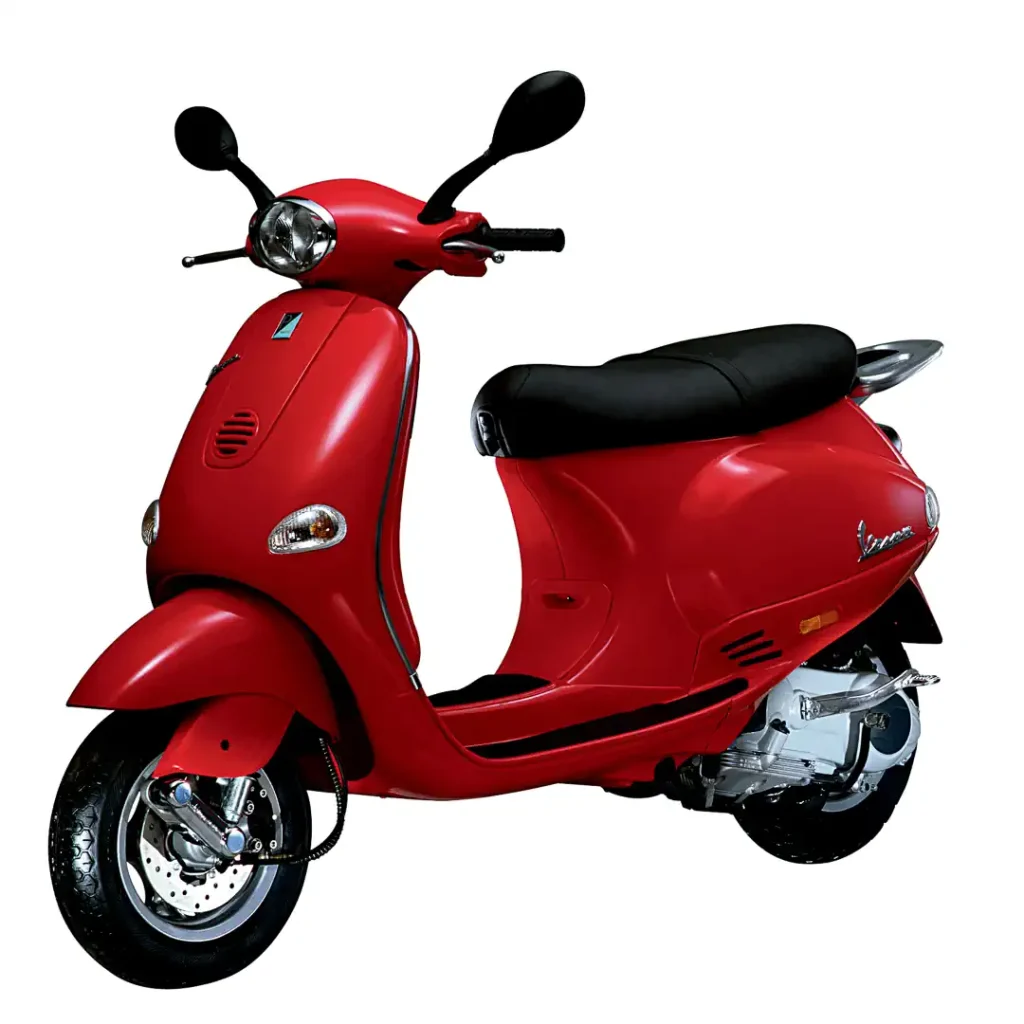
1996 Vespa ET4.
For the 50th anniversary in 1996, Piaggio launched the ET4 125, the first four-stroke Vespa. It was Europe’s best-selling plated two-wheeler, motorcycles included, in 1997 and 1998.
Despite the introduction of the four-stroke, two-stroke motors continued to develop. The ET2 50 followed, and the 1997 ET2 Injection carried the first direct-injection two-stroke engine in production. The ET4 150 arrived in 1999.
2000s: Fuel Injection and the GTS
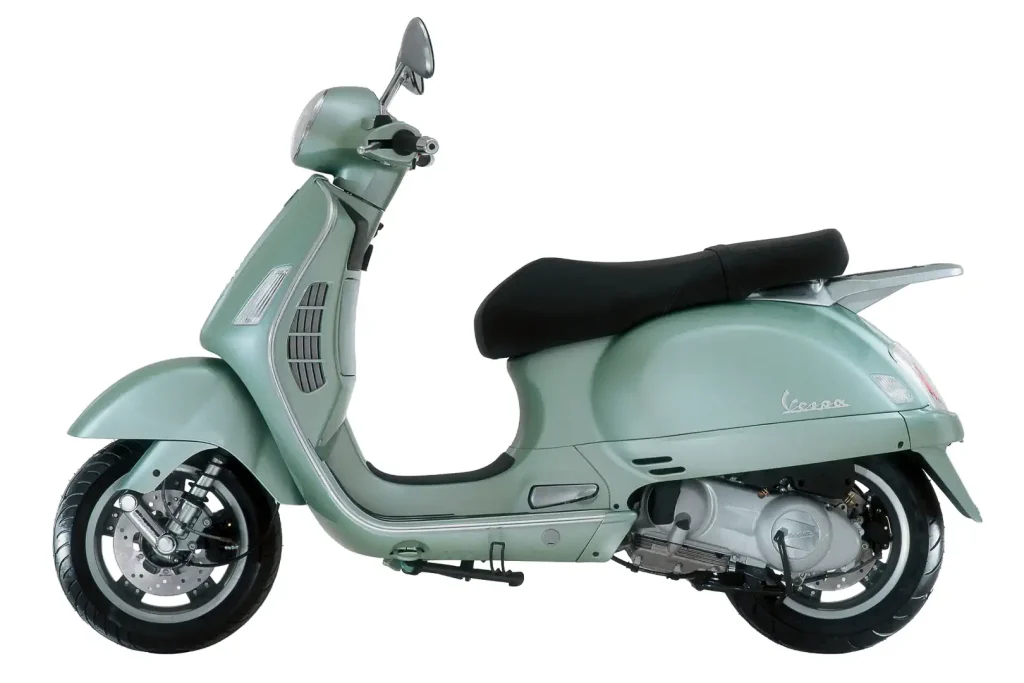
The 2000 ET4 50 was the first 50cc four-stroke scooter for Vespa and Europe. The ET4 50 was good for more than 310 miles on a tank. The PX gained a front disc brake in 2001. The 2003 Granturismo 200L and 125L were the most powerful Vespas yet. They were the first with four-stroke, four-valve, liquid-cooled engines, 12-inch wheels, and disc braking on both wheels.
2003 Vespa Granturismo.
In 2005, the LX replaced the ET line after 460,000 units were sold. The GTS 250 i.e. became the world’s first scooter with a fuel-injected 250cc engine, arriving 50 years after the GS 150 it honored. Annual production increased from 58,000 units in 2004 to over 100,000 in just two years.
2006 Vespa 60.
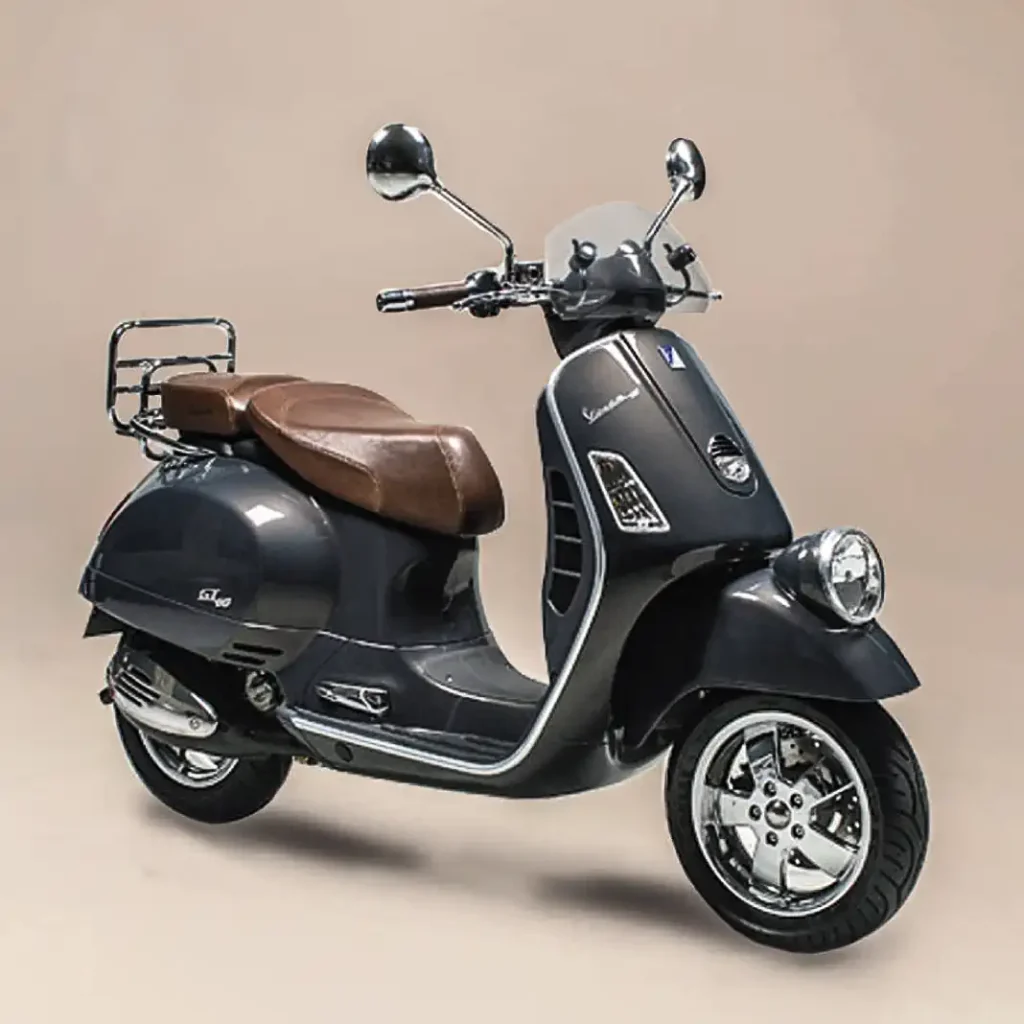
The 60th anniversary in 2006 brought the GTV, LXV, and 999-unit GT 60° scooters. The Vespa World Club was founded in March 2006. The retro-styled Vespa S followed in 2007. In May 2008, the GTS 300 Super became the 145th Vespa model and the most powerful to date. A four-valve, four-stroke 50cc engine arrived in 2009, producing 4.35 horsepower.
2010s: The 946, ABS, and Electric Power
The standard GTS dropped its 250 engine for the four-valve, liquid-cooled, fuel-injected 300 in November 2011, three years after the GTS 300 Super had introduced it. The PX was revived that same year in 125 and 150 forms. Piaggio opened the Baramati plant in India in April 2012 to build Vespas for that market, joining Pontedera and Vinh Phuc, Vietnam.
2013 Vespa Primavera.
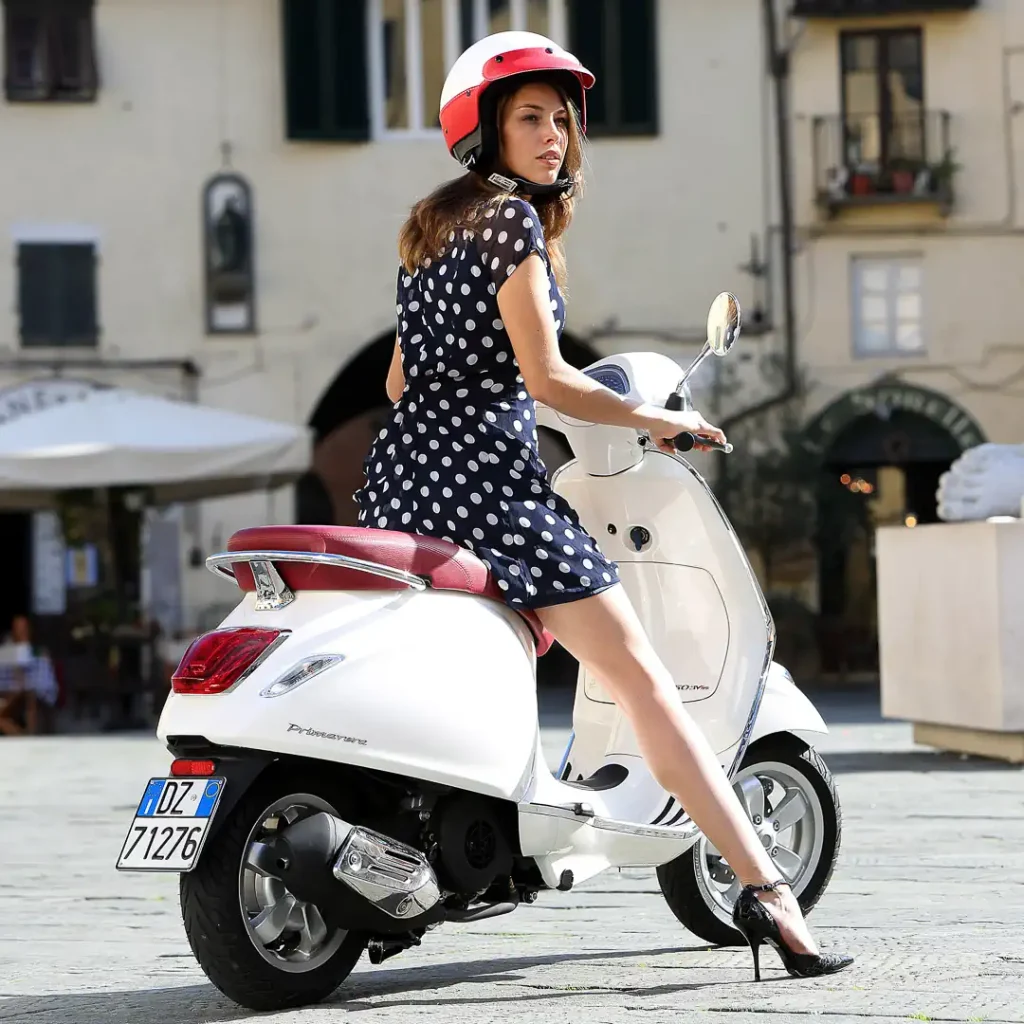
The Primavera name returned in 2013 with a new small-body model that replaced the LX, later joined by the sportier Sprint.
The Vespa 946, launched in 2013, drew directly on the 1946 MP6 prototype. It boasted hand-fitted aluminum parts on a steel monocoque built on its own dedicated line. The GTS added two-channel ABS and traction control in 2014. Annual production reached 180,000 in 2017 and passed 200,000 in 2018. More than two million Vespas were built during the decade.
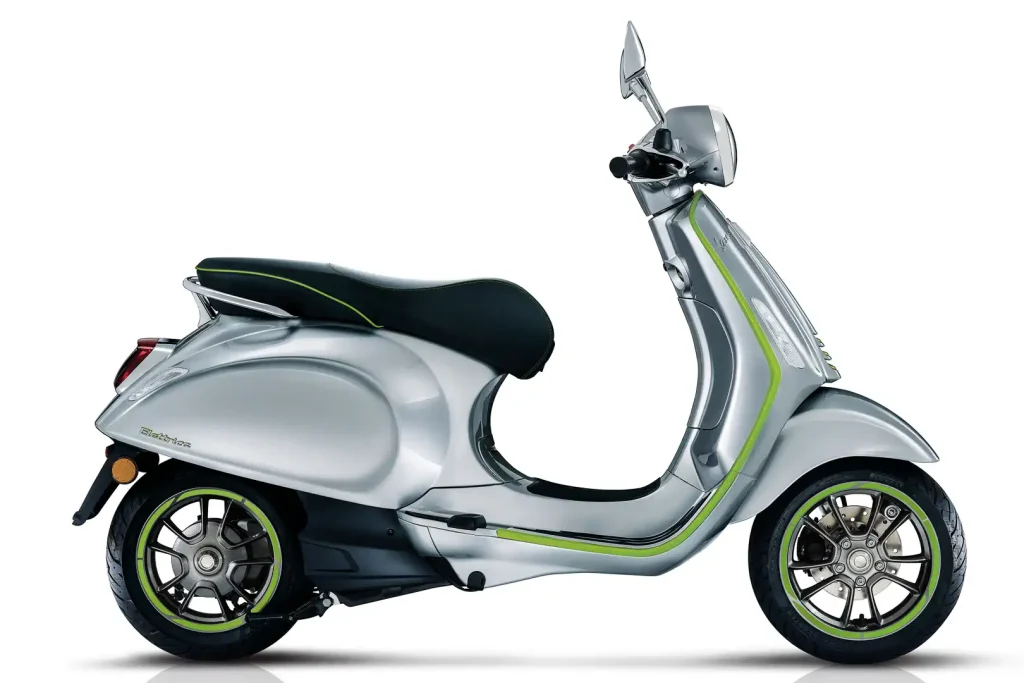
2018 Vespa Elettrica.
The 2018 Vespa Elettrica brought battery power to the Italian scooter brand that cut its teeth on two-strokes. The 4 kW motor was the equivalent of a four-stroke 50 and had a range of 62 miles.
2020s: The GTS 310 and the 80th Anniversary
Vespa made its Pixar debut in 2021 with Luca, in which the scooter has a starring role. The GTS range was renewed in 2022 as the GTS, GTS Super, GTS SuperSport, and GTS SuperTech, with ABS, traction control, and keyless ignition. The GTV variant revived 1950s styling cues with a headlight on the front fender and an exposed metal-tube handlebar.
The 946 platform became Vespa’s vehicle for Lunar New Year limited editions, including the Bunny (2023), Dragon (2024), and Snake (2025).
2025 Vespa GTS 310.
Vespa World Days 2024 brought club members to Pontedera, where their scooters had been built continuously since 1946.
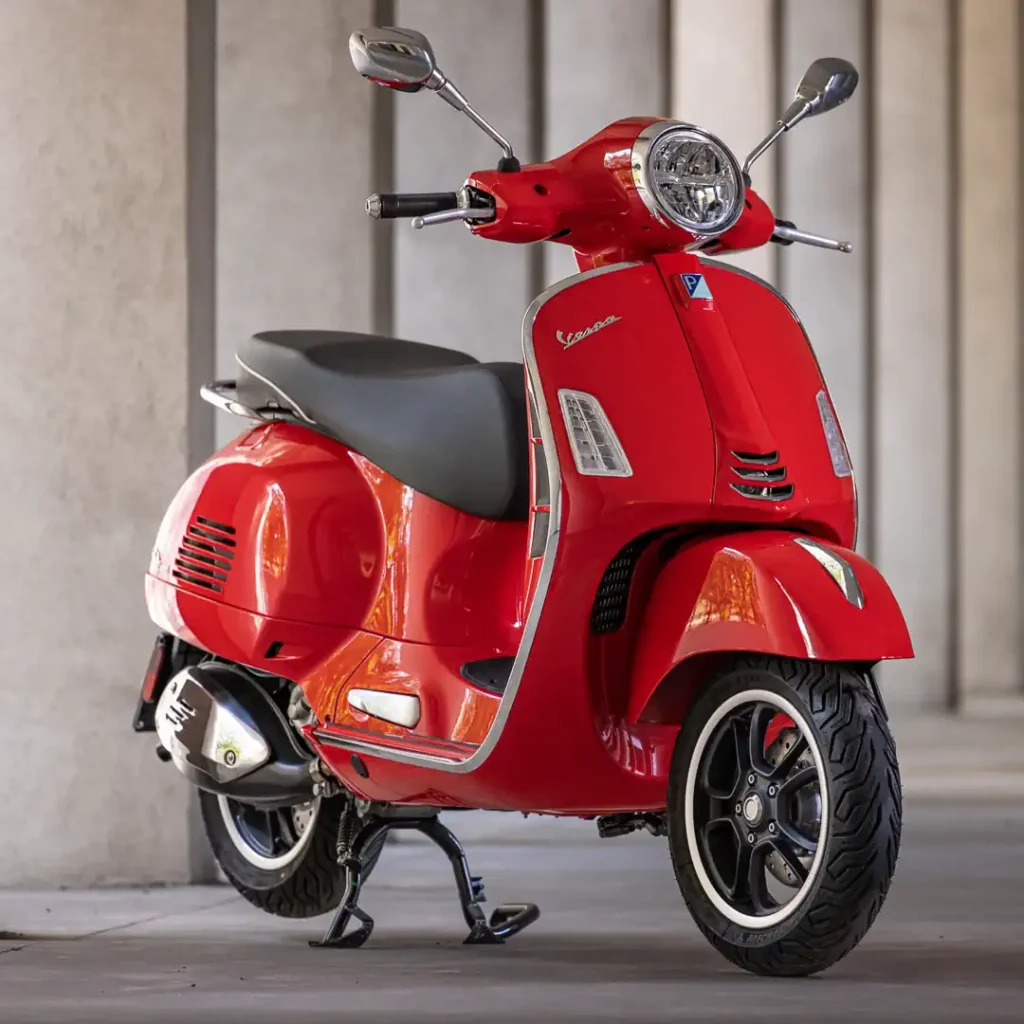
The biggest news of 2025 was the GTS 310. Unveiled at EICMA in late 2024, it carries an all-new 310cc single—the largest engine in Vespa history—making a claimed 25 horsepower.
2027 Vespa Edizione Ottantesimo.
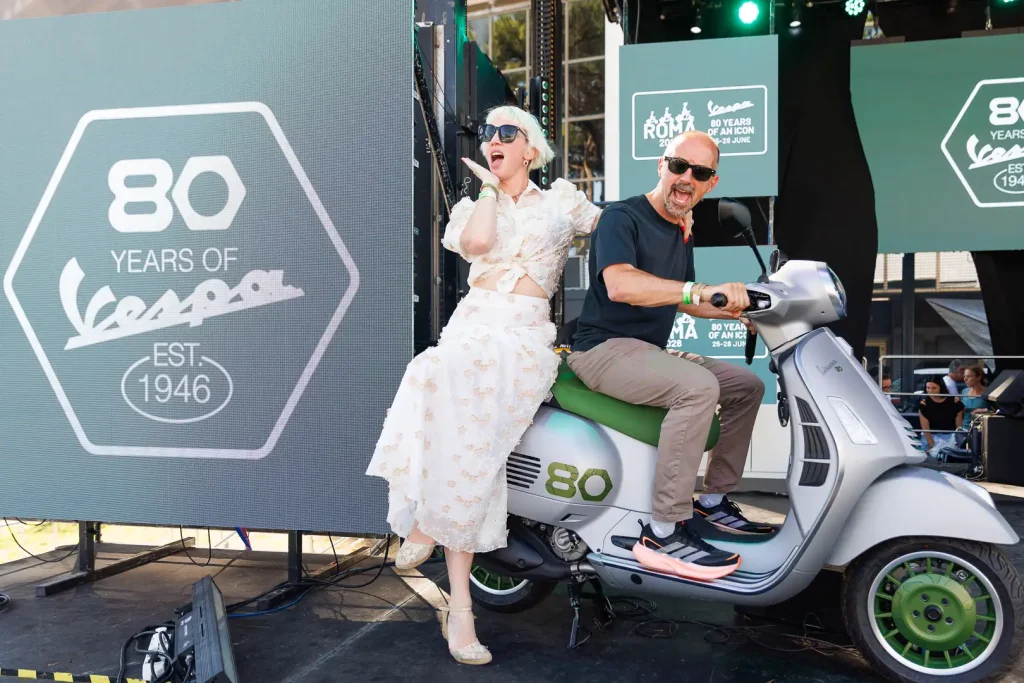
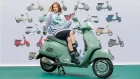
For 2026, Vespa’s 80th year, the Primavera and Sprint S small-body models received their first rear disc brake, a 220mm unit replacing the drum on 125 and 150 versions, plus a new instrument panel pairing an analog speedometer with a 3-inch LCD and keyless ignition above 50cc. Vespa marked the anniversary with an 80th-anniversary special series on the Primavera and GTS platforms in pastel green, including the Edizione Ottantesimo, based on the GTS 310 and limited to 1,946 units, with 25 of them for the United States. A 946 Horse edition continues the Lunar New Year series.
2026 Vespa Roma Rally.
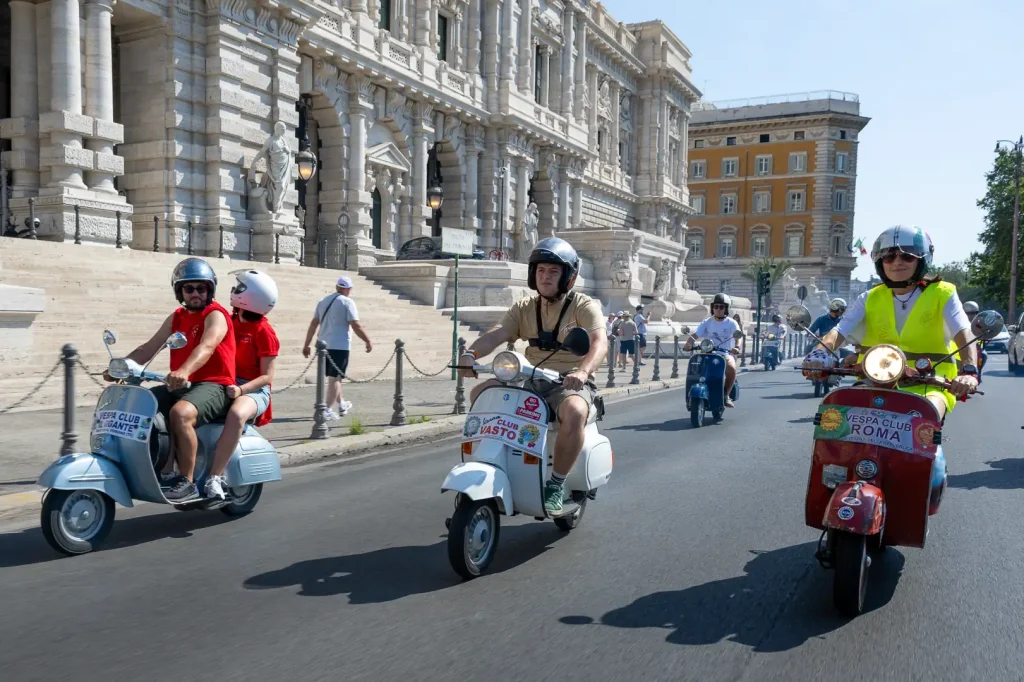
Vespa closed its 80th year with the biggest celebration in its history. Vespa Roma 2026 – 80 Years of an Icon drew more than 50,000 visitors over four days in June to the Vespa Village at Rome’s Foro Italico. Displays included rare machines from the Piaggio Museum collection. Saturday’s parade broke every attendance record, with 25,000 Vespas from 67 countries riding through the center of Rome, joined by six-time world champion Max Biaggi and Aprilia MotoGP rider Lorenzo Savadori. The event closed June 28 with the Elegance Contest and awards for the Vespa Trophy, a touring competition in which clubs documented their journeys to Rome. Eighty years after the first Vespa 98 rolled out of Pontedera, the wasp still draws a crowd.
Hello and welcome again to the Motos and Friends Podcast. This episode is brought to you by Leod Escapes.
* * * * *
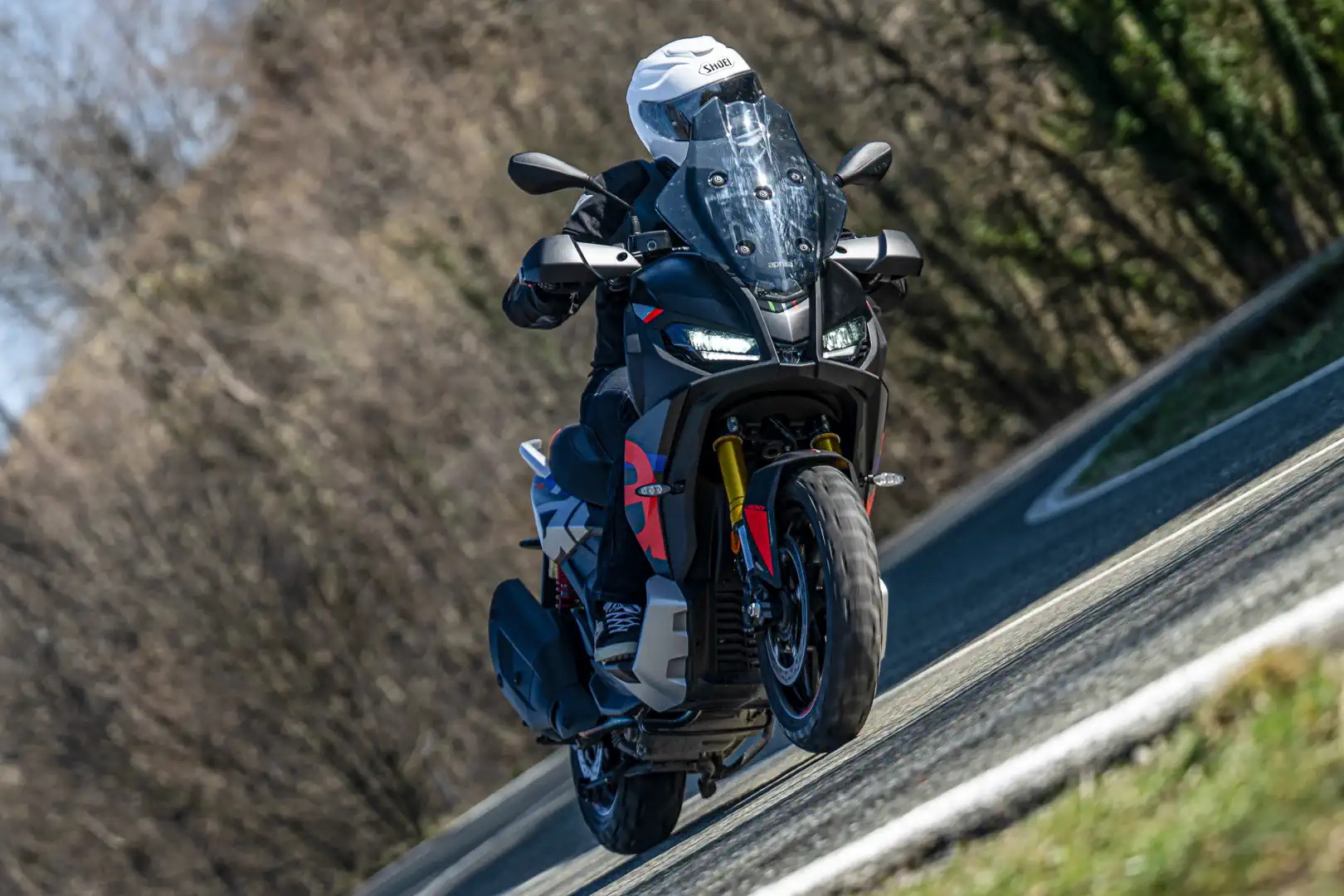
Aprilia is bringing a scooter to North America, and it’s one designed to appeal to adventure motorcyclists. The SR GT 400 is a mid-size scooter built around a steel motorcycle-style frame, a 399cc single, and off-road-ready hardware. It reaches US dealers as soon as this month. Don Williams and Kelly Callan spent some time riding the Aprilia and were surprised by what they discovered. Is this a real motorcycle or just a good-looking urban scooter?
* * * * *
Cat McLeod is founder and owner of Leod Escapes, the ultimate tour company for sport-minded motorcycle riders. Cat talks to us this segment about some of his amazing European experiences and tours that include of course, riding some amazing MotoGP tracks on new BMW S1000RRs. If you like what you hear, now is the time to book your trip of a lifetime, so visit LeodEscapes.com to find out more.
* * * * *
Our guest this episode is Terry Vance, the multiple Motorcycle and Motorsports Hall-of-Famer. Terry is of course the former professional motorcycle drag racer, team owner, and co-founder of the high-performance parts company Vance & Hines. Teejay Adams chats with Terry about his incredible career that includes being the first rider to hit 200 mph in the standing quarter-mile.
Having won this year’s MotoAmerica Mission King of the Baggers championship with Hayden Gillim riding the Vance & Hines factory Indian Challenger, and with Harley-Davidson’s recent withdrawal, Terry gives us his thoughts on where the series might go from here.
* * * * *
Here’s quick reminder to check out our monthly digital magazine. It’s filled with everything you want to read on motorcycling, including some things you’ve probably not seen elsewhere. It’s absolutely free and you will find it on the Apple App Store and of course on Google Play as well.
Don’t forget to leave us your comments on our social media—we’re on all the usual platforms at Ultimate Motorcycling. We love hearing your feedback… so good or bad, please let us know what you think. If there’s something you’d like us to cover, we’d love to hear those ideas too!
We use cookies and browser activity on this website
Functional
Always active
The technical storage or access is strictly necessary for the legitimate purpose of enabling the use of a specific service explicitly requested by the subscriber or user, or for the sole purpose of carrying out the transmission of a communication over an electronic communications network.
Preferences
The technical storage or access is necessary for the legitimate purpose of storing preferences that are not requested by the subscriber or user.
Statistics
The technical storage or access that is used exclusively for statistical purposes.The technical storage or access that is used exclusively for anonymous statistical purposes. Without a subpoena, voluntary compliance on the part of your Internet Service Provider, or additional records from a third party, information stored or retrieved for this purpose alone cannot usually be used to identify you.
Marketing
The technical storage or access is required to create user profiles to send advertising, or to track the user on a website or across several websites for similar marketing purposes.