Readers following the Ultimate Motorcycling Triumph Tiger 1200 Rally Pro Project Bike know that I’ve been systematically working through a list of upgrades to make this adventure motorcycle exactly what I want it to be. New tires, protection bars, luggage, and heated seats are sorted. However, there was one more upgrade that had been on my mind since I threw a leg over the big Tiger: the ECU tune. Triumph builds a genuinely great motorcycle. Still, like most modern bikes, the factory fuel mapping comes with compromises baked right in. I wanted to uncage the Tiger’s triple, and that led me to BT Moto.
Who Is BT Moto?
BT Moto is a 20-year-old California tuning shop with a 10,000-square-foot facility and software engineers based in both the US and Europe. The company’s ECU business started in 2010 with the BMW S 1000 RR. Now, BT Moto supports over 100 dealers in 25 countries and has served more than 20,000 bikes and 30,000 customers.
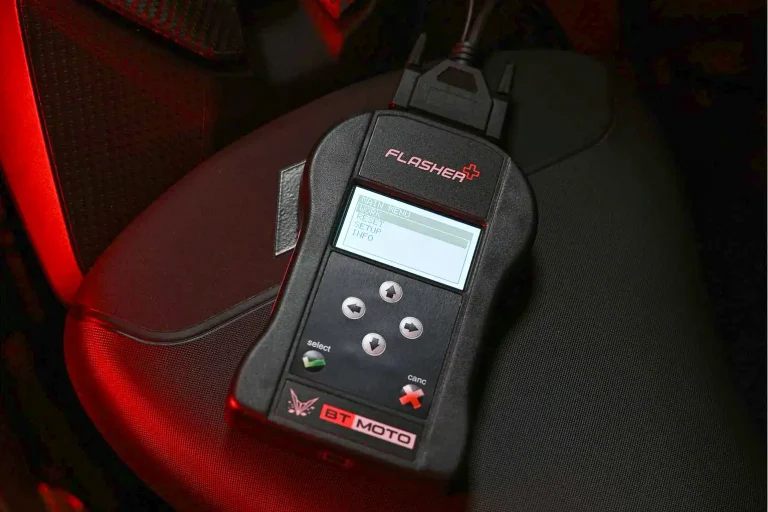
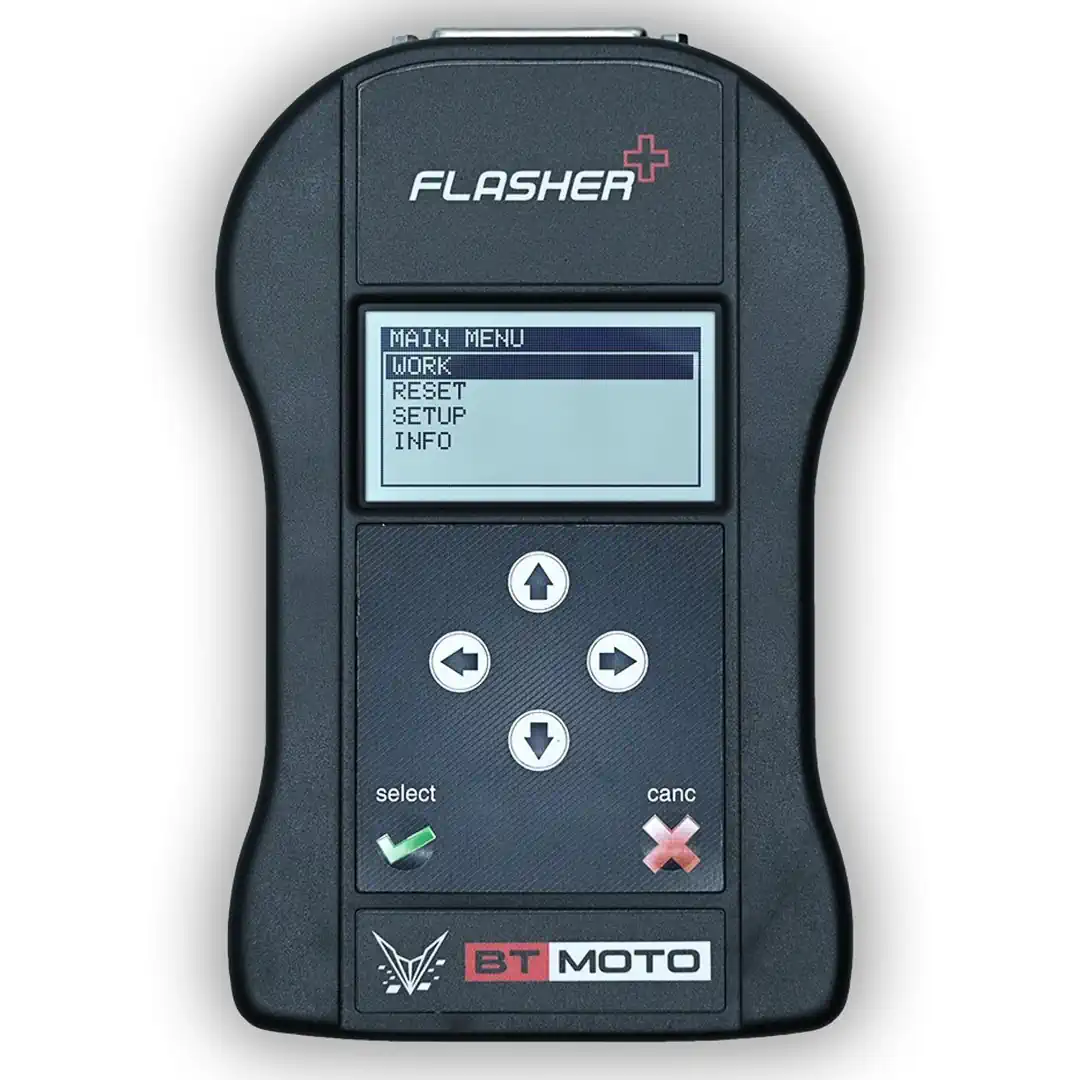
For the 2015–2023 Triumph Tiger 1200, BT Moto offers its Stage 1+ ECU Flash paired with its proprietary handheld tuner, the Flasher+. Priced at $799, the stated goal is an OEM+ solution with no piggybacks, no add-ons, and no deletion of emissions hardware. Instead, it’s about a cleaner, more capable version of what shipped from the factory.
What’s Wrong with the Stock Map?
Here’s something that might surprise you. According to BT Moto, the stock Tiger 1200’s throttle is restricted to only 38% at redline, with a maximum opening of 72% across the entire rev range. Basically, you’re riding around with a sizable chunk of that triple’s potential locked away by the software.
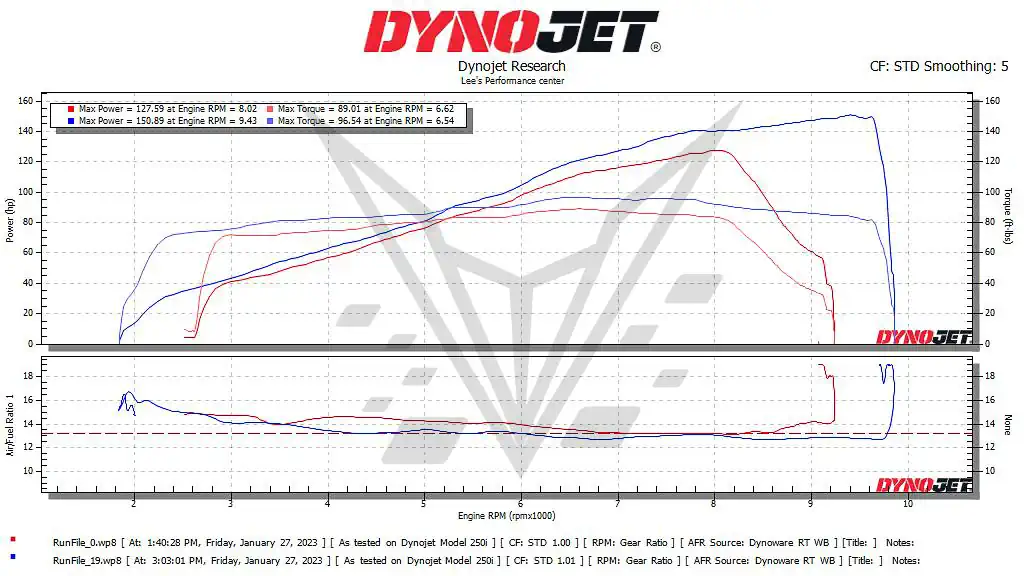
BT Moto’s Stage 1+ flash addresses this directly by removing the throttle restriction and recalibrating the fuel and ignition maps. An independent dyno test (see graph) conducted by Lee’s Performance on a stock 2022 Tiger 1200 on 91-octane fuel showed significant gains across all engine speeds, with nearly 30 additional wheel horsepower at redline.
The Tiger 1200 went from 128 hp at the rear wheel in stock trim to 151 hp with the BT Moto State 1+ flash. The torque figures improve as well, climbing from 89 lb-ft to 97 lb-ft at the rear wheel. Instead of signing off at 9250 rpm, the triple now spins up to 9750 rpm.
Additionally, the Dyno graphs show that power comes in more immediately and more smoothly than stock, which suggests improved snatchiness in the bike. The BT Moto-modified engine starts producing power at 1800 rpm, compared to 2600 rpm in stock trim.
The Setup Process — A Few Speed Bumps
I’ll be straight with you: the process isn’t completely plug-and-play from start to finish.
If you’re a committed Apple person, as I am, there’s a hurdle right out of the gate. The BT Moto software requires a PC. For those of us who haven’t touched Windows since the early 2000s, that’s an adventure in itself.
My first step was to buy a (surprisingly) cheap PC online. It then took a couple of iterations to get the BT Moto software downloaded and running properly.
Once I did that, I connected the handheld BT Moto Flasher+ unit to the bike’s OBD port with the bike keyed on but not started. I selected my model, and the Flasher+ IDed and read the ECU.
Next, I connected the Flasher+ to my new PC and downloaded the stock map. I then filled out a questionnaire about my bike and mod list before uploading the stock map to BT Moto’s website.
BT Moto engineers emailed the new .MYG file back to me the same day. That turnaround is genuinely impressive, as the Tiger was up and running the new tune before the day was out. No bike downtime, no pulling the ECU, and no shipping anything anywhere.
I downloaded it, loaded it onto the Flasher+, and headed for the garage. I plugged the Flasher+ into the OBD port with a charger connected and the key on, then went to Work → Writing, selected the file, and followed the key on/off prompts. A few random dash errors may pop up, which is normal.
Once done, I started the bike, let it warm up, and reaped the benefits.
On the Road: Before and After
The stock Tiger 1200 is not a slow motorcycle. Anyone who tells you otherwise hasn’t ridden one. Triumph’s 1160cc inline-3 produces a broad, linear powerband that builds with a characteristic mid-range surge, making the engine so addictive on long, sweeping roads.
That said, over time, I’d noticed a snatchiness in the throttle that could be a bit tiring. It was a slight hesitation followed by a lunge when rolling on from a closed throttle, particularly at lower speeds and in tighter situations. The power was there, but it wasn’t always arriving smoothly.
After the BT Moto Stage 1+ flash, the engine’s character changed in a meaningful way. There is a much more direct, linear connection between the throttle and the engine’s response. Roll-on power arrives immediately rather than building through that initial lag.
In the mid-range, the bike is an entirely different animal. There are no dips in the powerband, no flat spots, and no hesitations, just seemingly endless torque and power pulling clean through the rev range. It is genuinely a beast in second and third gear on a twisting mountain road.
As you wind out the motor, the improvement is equally noticeable. Stock, the upper end of the rev range would start to thin out and vibrate, with the power trailing off before the redline. With the BT Moto Stage 1+ map, that drop-off is gone. The power delivery is linear and relentless all the way to the top of the tach, with less vibration in the upper range as well.
One welcome and unexpected improvement is heat management. The Tiger 1200 runs warm, as Triumphs often do. It’s a big triple, and in traffic or slow technical riding, you feel it. With BT Moto’s revised cooling fan trigger point and updated fueling, there is less heat radiating off the engine during warm-up and while riding. In slow-speed or urban riding, that’s a real quality-of-life improvement.
There is some idle behavior to note. In gear, at low speed in second or third, the idle seems slightly elevated compared to stock, which isn’t necessarily bad. You can chug along at walking pace without touching the throttle, and the bike won’t stumble or stall. For technical off-road sections or slow urban maneuvering, that should add some confidence at low rpm.
Some throttle snatchiness remains at very low speeds, but it’s a different character from stock. Rather than the hesitation-and-lunge of the factory map, you feel the directness of the connection, as the engine responds immediately to what your hand is doing. There’s no popping on deceleration, no weird exhaust note, and no check engine lights. Everything runs smoothly and as expected.
A Word of Warning — This Map Means Business
The BT Moto flash is a meaningful performance upgrade, and it demands a bit of respect on first acquaintance. Because the throttle response is now so immediate and direct, there’s almost no buffer between your wrist input and the rear wheel.
On a freeway on-ramp, I was barely leaned over when I blipped the throttle. The back end stepped out, traction control flashing like a Christmas tree. While the rider aids did their job and kept everything in check, it was a sharp reminder that considerably more horsepower is getting to the rear wheel, and significantly faster. Ride accordingly until you’ve recalibrated your right wrist.
The primary change in power is in Sport mode, where the additional throttle opening is most apparent. However, it does smooth out the other modes, though the improvement is more subtle.
Bottom Line
For 2015–2023 Tiger 1200 owners, the BT Moto Stage 1+ ECU Flash is a transformative upgrade, and arguably more impactful than any bolt-on modification at a similar price point. For $799, the package lets you flash your own bike at home, store multiple maps, and revert to stock at any time. While the Triumph Tiger 1200’s triple is excellent in stock trim, BT Moto transforms it into the powerhouse it always wanted to be.
Our bike review this episode is the Yamaha MT-03. Do not underestimate this bike; you get a lot of motorcycle for your money! Associate Editor Kelly Callan rode the smallest MT for several weeks, and that included commuting on it. One of the things that impressed her, was how the MT-03 acted like a larger motorcycle. Kelly also spent some time chasing Editor Don Williams through the canyons when he was on the Yamaha MT-07—obviously a much larger machine. She tells us about how it all went.
* * * * *
We’re closing in fast on the 34th annual Biketoberfest, October 15–18, when all roads will lead to Teddy Morse’s Destination Daytona—the more than 100-acre motorcycle playground in Ormond Beach Florida. This week we get to hear all about it from Teddy Morse himself. With his trademark high energy and enthusiasm, he tells us all about his recently established Triketoberfest that happens the week before, and how the Destination Daytona complex turns into a full-throttle hub of demo rides, vendors, custom builds, live music, food trucks, shops, and nonstop pavilion energy. So, whether you’re on two wheels or three, whether you’re hunting parts or lining up a test ride; grab a cold one and soak up the energy and gorgeous Florida fall weather. This is one of the many Daytona Beach places where Biketoberfest feels like home. So don’t forget: make sure you download the Biketoberfest mobile App from Apple or Google Play or visit www.biketoberfest.org and we’ll see you there!
* * * * *
Our guest this episode is Greg Arnold, Mecum’s motorcycle auction director. He bought his first bike at eleven, joined the company in 2011, and has spent more than a decade helping turn this incredible event into the place collectors, consignors, and dreamers all show up. Next February 3rd through 6th, Mecum will—for the 36th time, bring the world’s largest vintage motorcycle auction back to South Point, Las Vegas. That’s over two thousand bikes over four days. Board-track racers, barn finds, customs, race iron, and especially, those incredible machines that make the room go quiet. Greg gives us insight into what it takes to make this event work so incredibly well, and if you’re interested in selling your pride and joy, what steps you have to take to make it happen.
* * * * *
Here’s quick reminder to check out our monthly digital magazine. It’s filled with everything you want to read on motorcycling, including some things you’ve probably not seen elsewhere. It’s absolutely free and you will find it on the Apple App Store and of course on Google Play as well.
Don’t forget to leave us your comments on our social media—we’re on all the usual platforms at Ultimate Motorcycling. We love hearing your feedback… so good or bad, please let us know what you think. If there’s something you’d like us to cover, we’d love to hear those ideas too!
We use cookies and browser activity on this website
Functional
Always active
The technical storage or access is strictly necessary for the legitimate purpose of enabling the use of a specific service explicitly requested by the subscriber or user, or for the sole purpose of carrying out the transmission of a communication over an electronic communications network.
Preferences
The technical storage or access is necessary for the legitimate purpose of storing preferences that are not requested by the subscriber or user.
Statistics
The technical storage or access that is used exclusively for statistical purposes.The technical storage or access that is used exclusively for anonymous statistical purposes. Without a subpoena, voluntary compliance on the part of your Internet Service Provider, or additional records from a third party, information stored or retrieved for this purpose alone cannot usually be used to identify you.
Marketing
The technical storage or access is required to create user profiles to send advertising, or to track the user on a website or across several websites for similar marketing purposes.