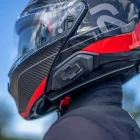
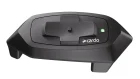
Cardo Systems has released Mesh Boost, a free software update that more than doubles the size of a Packtalk intercom group, from 15 riders to 31. The update also adds Public Mesh, which lets riders talk to nearby Cardo users they have never paired with, and Remote Grouping, which builds a riding group before anyone leaves the driveway.
Mesh Boost downloads over the air via the Cardo Connect App. It runs on all second-generation Dynamic Mesh Communication units, including the Packtalk Pro, Packtalk Edge, and Packtalk Neo.
For anyone still communicating via a Bluetooth intercom, here is why mesh matters. A Bluetooth intercom connects riders in a chain. Each headset talks to the one ahead of it and the one behind it. When a rider in the middle stops for fuel or drifts out of range, the chain breaks, and everyone behind the gap goes quiet until somebody re-pairs.
A mesh network works differently. Every headset is a node that connects to every other unit it can reach, and audio relays through the riders in between. If one rider drops out, the signal reroutes through the others automatically. When that rider comes back into range, the headset rejoins without a button press. Everybody can talk at once, as on a conference call, rather than taking turns.
That relay is also what stretches the range. Cardo quotes about a mile between any two units and up to 5 miles across a full group as the signal hops from bike to bike.
Cardo calls 31 the largest mesh group in the industry. For comparison, Sena’s Group Mesh, the closest equivalent, tops out at 24 riders. Sena’s Open Mesh channels have no practical user limit, and they are open to anyone in range, rather than being private to a group.
Public Mesh covers that same open-channel ground. Riders switch it on in the Cardo Connect app and can then talk to other Mesh Boost users nearby without setting anything up in advance. It fits the rides where a group forms on the spot, such as a rally, a poker run, or a gas stop full of riders headed in the same direction. Public Mesh allows you to speak briefly and spontaneously with riders coming in the opposite direction.
Remote Grouping solves a different problem: riders who do not start from the same place. One rider generates a link in the Cardo Connect app and sends it to the others. Once those riders come within range, their headsets automatically join the mesh, with no pairing routine at the meeting point.
“Mesh Boost has always been about making group communication simpler and more capable,” Cardo Chief Marketing Officer Dan Emodi said. “While this journey took longer than we originally planned, we made a conscious decision not to compromise on reliability.”
Two features Cardo previously announced, Private Chat+ and Cellular Intercom, are not part of this release. Both are still in development, and the company has not given a date for either one.
Riders on older headsets are not shut out. While a first-generation DMC Packtalk cannot install Mesh Boost, it can still talk to riders who have it, so nobody has to sit out the ride or buy a new unit. It just does not gain Public Mesh or Remote Grouping on its own end.
Two products are not included in this release. The Harley-Davidson and Schuberth SC-Edge units do not currently receive Mesh Boost; Cardo expects to release a version for them in the fourth quarter of this year.
Hello and welcome again to the Motos and Friends Podcast. This episode is brought to you by Leod Escapes.
* * * * *
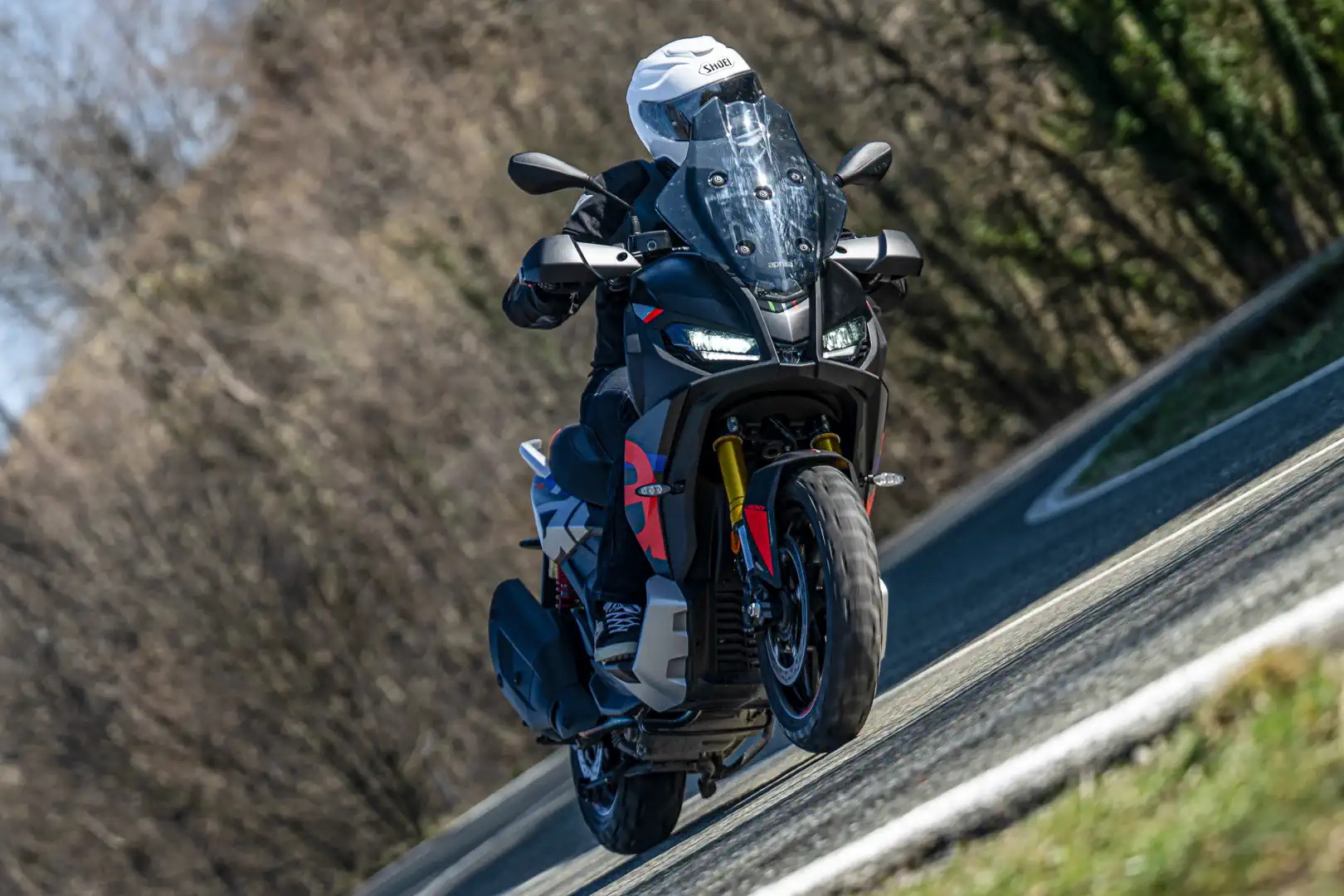
Aprilia is bringing a scooter to North America, and it’s one designed to appeal to adventure motorcyclists. The SR GT 400 is a mid-size scooter built around a steel motorcycle-style frame, a 399cc single, and off-road-ready hardware. It reaches US dealers as soon as this month. Don Williams and Kelly Callan spent some time riding the Aprilia and were surprised by what they discovered. Is this a real motorcycle or just a good-looking urban scooter?
* * * * *
Cat McLeod is founder and owner of Leod Escapes, the ultimate tour company for sport-minded motorcycle riders. Cat talks to us this segment about some of his amazing European experiences and tours that include of course, riding some amazing MotoGP tracks on new BMW S1000RRs. If you like what you hear, now is the time to book your trip of a lifetime, so visit LeodEscapes.com to find out more.
* * * * *
Our guest this episode is Terry Vance, the multiple Motorcycle and Motorsports Hall-of-Famer. Terry is of course the former professional motorcycle drag racer, team owner, and co-founder of the high-performance parts company Vance & Hines. Teejay Adams chats with Terry about his incredible career that includes being the first rider to hit 200 mph in the standing quarter-mile.
Having won this year’s MotoAmerica Mission King of the Baggers championship with Hayden Gillim riding the Vance & Hines factory Indian Challenger, and with Harley-Davidson’s recent withdrawal, Terry gives us his thoughts on where the series might go from here.
* * * * *
Here’s quick reminder to check out our monthly digital magazine. It’s filled with everything you want to read on motorcycling, including some things you’ve probably not seen elsewhere. It’s absolutely free and you will find it on the Apple App Store and of course on Google Play as well.
Don’t forget to leave us your comments on our social media—we’re on all the usual platforms at Ultimate Motorcycling. We love hearing your feedback… so good or bad, please let us know what you think. If there’s something you’d like us to cover, we’d love to hear those ideas too!
We use cookies and browser activity on this website
Functional
Always active
The technical storage or access is strictly necessary for the legitimate purpose of enabling the use of a specific service explicitly requested by the subscriber or user, or for the sole purpose of carrying out the transmission of a communication over an electronic communications network.
Preferences
The technical storage or access is necessary for the legitimate purpose of storing preferences that are not requested by the subscriber or user.
Statistics
The technical storage or access that is used exclusively for statistical purposes.The technical storage or access that is used exclusively for anonymous statistical purposes. Without a subpoena, voluntary compliance on the part of your Internet Service Provider, or additional records from a third party, information stored or retrieved for this purpose alone cannot usually be used to identify you.
Marketing
The technical storage or access is required to create user profiles to send advertising, or to track the user on a website or across several websites for similar marketing purposes.
Advertising helps us keep our content available for free, so adjusting your ad blocking settings will help us.
We appreciate your support!
i
How to Allow Ads on This Site
Depending on your setup, ads may be blocked by a browser extension, VPN, antivirus software, or other application. Here are some common ways to allow ads:
Browser Extensions (e.g., Adblock, uBlock, etc.)
Click the extension icon in your browser toolbar.
Look for an option like "Don't run on pages on this site" or "Pause on this site".
Save the change and refresh the page.
VPNs with Ad Blocking (e.g., NordVPN, Proton VPN, etc.)
Open your VPN app.
Go to settings or features.
Disable any ad blocking or tracking protection features.
Refresh the page.
Antivirus Software or Other Privacy Tools
Check for web protection, ad filtering, or browser privacy settings.
Click the power button to disable it for this site.
Refresh the page.
Not sure what's blocking ads? Look for tools with privacy or filtering features, or check your browser extensions. We only use respectful, non-intrusive advertising.