My heart races when I think back to the excitement of riding on track as a simple road rider. I admit there were some butterflies, but I didn’t need to be race-ready. I was at California Superbike School to brush up on my personal riding skills, and get professional direction regarding my long-honed bad habits.
I pulled up in my RV at The Ridge Motorsports Park the day before my two-day training. It couldn’t have been easier. I was directed to a large gravel area near the big CSS rigs emblazoned with California Superbike School. Known as CSS, the school operates nationwide and in various other countries, including Australia and the UK.
Ridge Motorsports Park in Shelton, Washington, is a 2.47-mile track with 16 turns, set in forested hills with more than 300 feet of elevation change per lap, including a notable 50-foot plunge. It’s a demanding layout with elevation changes, blind crests, sweepers, and technical sections that test your lines, braking, and vision.
We have recorded an in-depth conversation with Dylan Code, son of the famous Keith Code, for our Motos and Friends podcast, so I knew that CSS runs a structured program built around Keith Code’s approach: classroom briefings on specific skills, followed by 20-minute on-track sessions to apply them, with immediate feedback from coaches.
How the Two-Day Camp Works
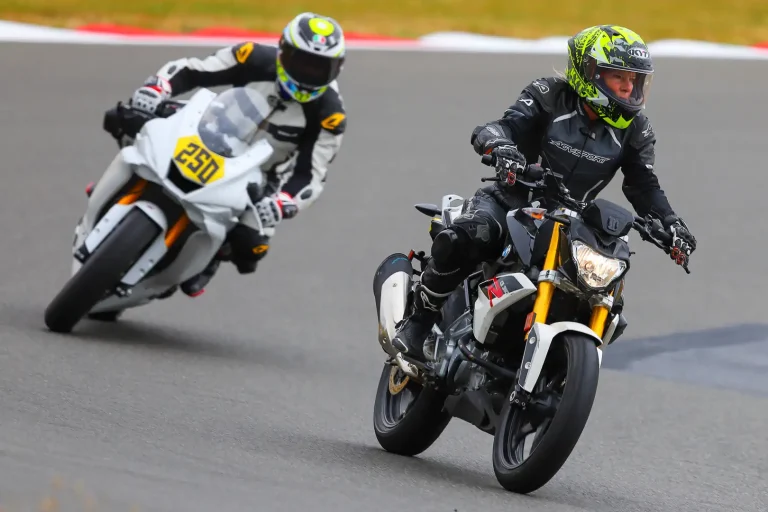
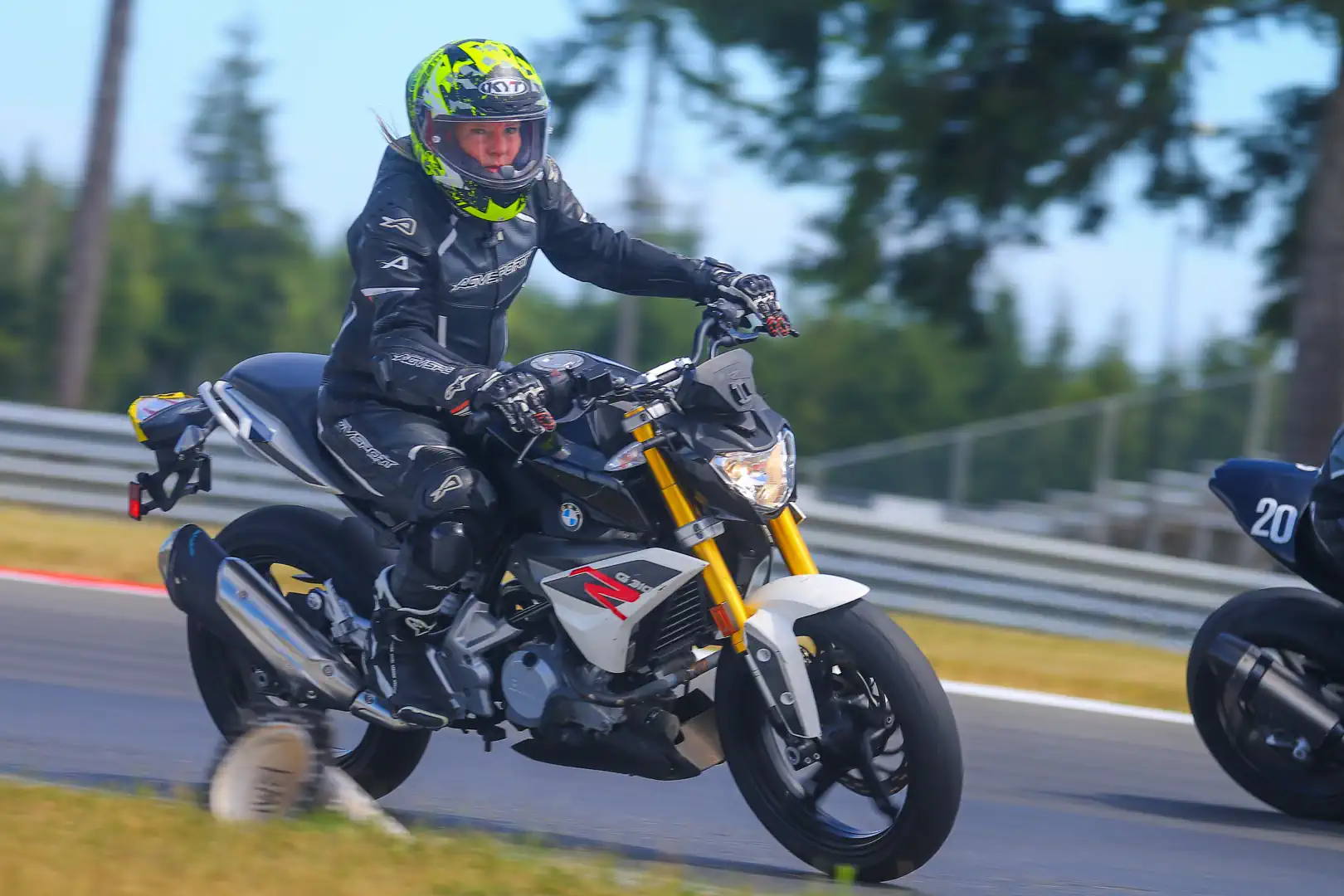
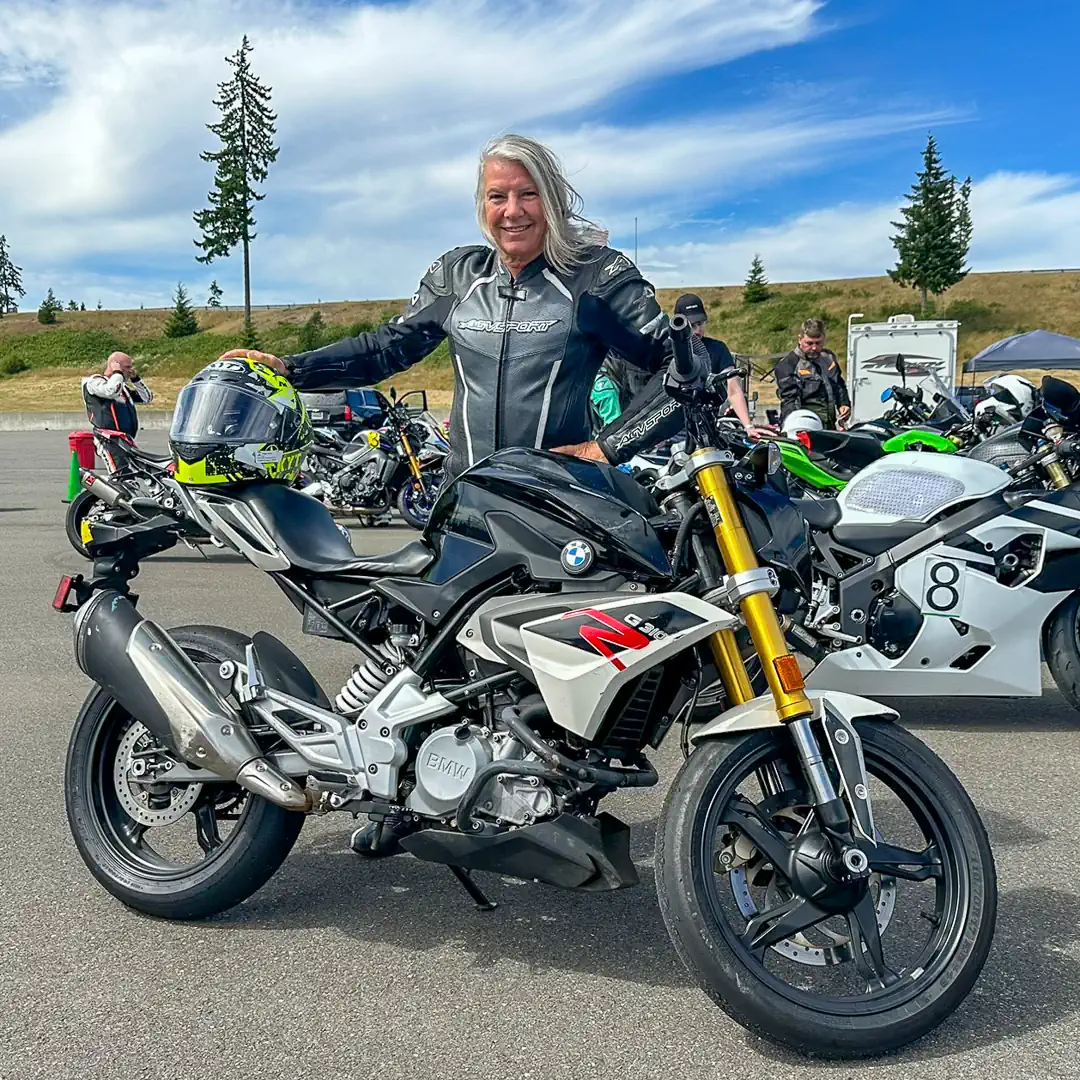
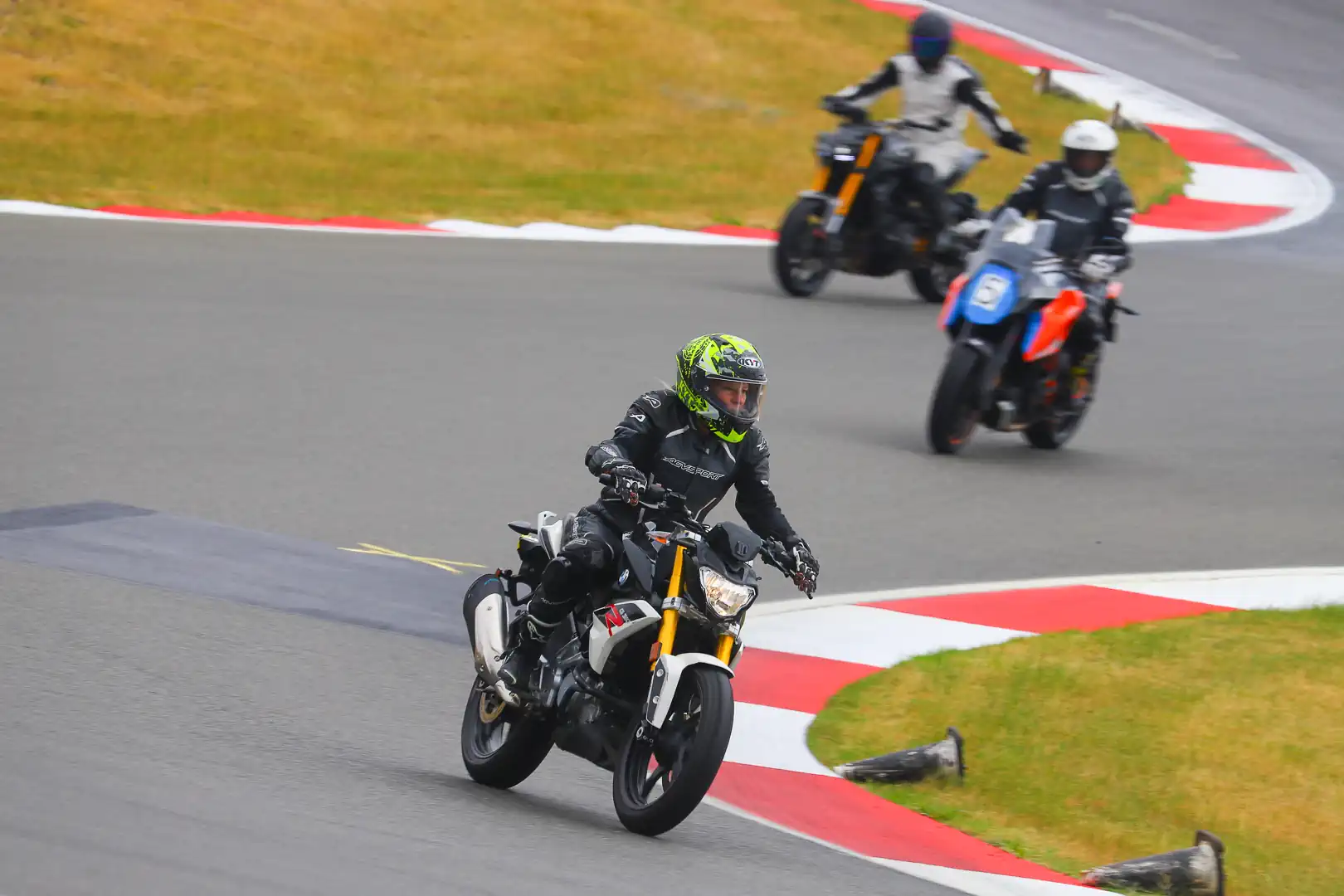
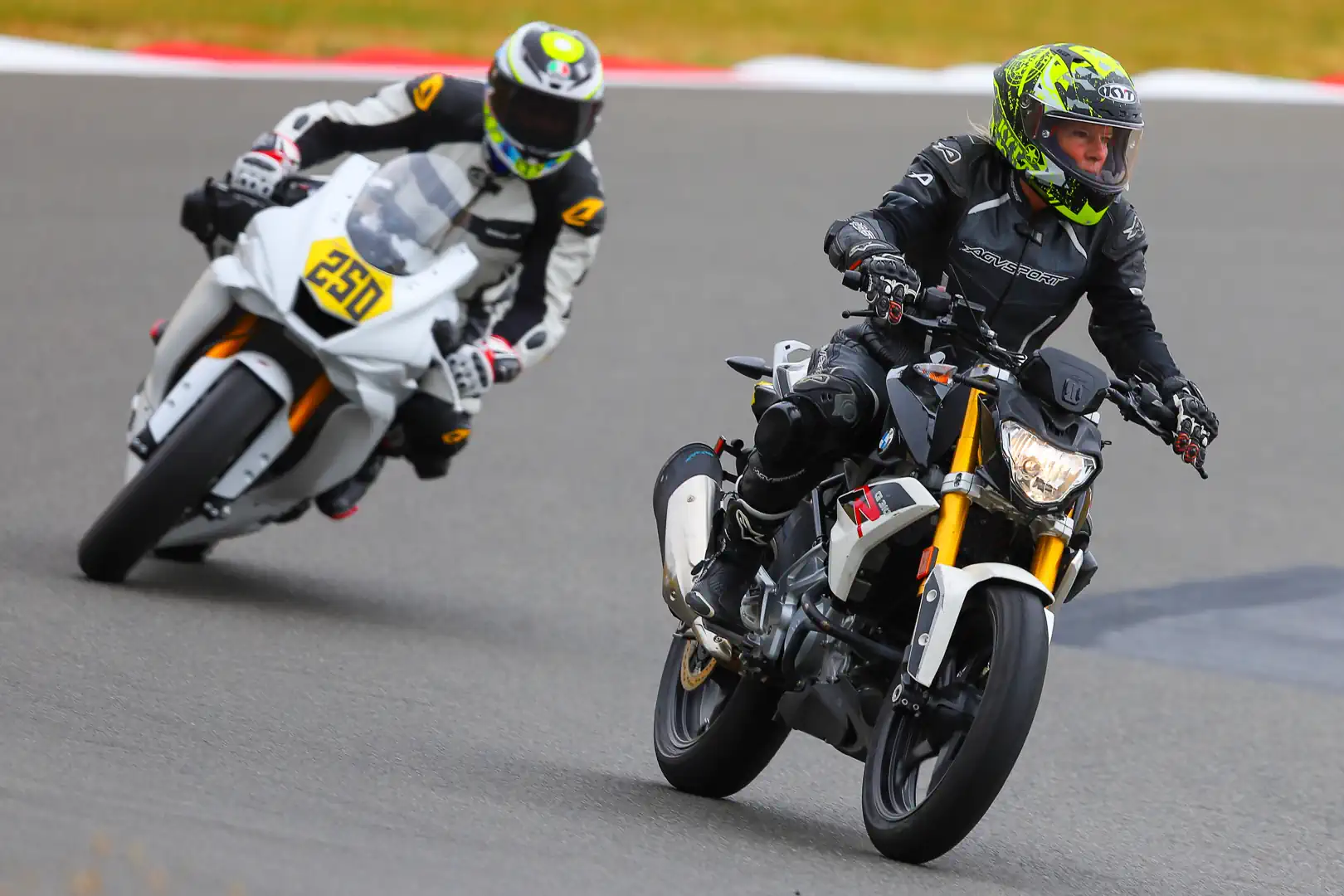
I attended the Two-Day Camp, which offers seven track riding sessions a day. The school provides BMW S 1000 RRs and safety gear, or you can ride your own bike and wear your own apparel. I rode a smaller bike they happened to have available. The BMW G 310 R lets me flat-foot when stopped. Check when you book if you have particular needs or requests.
The teaching and coaching focus on fundamentals that transfer to street riding rather than racing skills. Examples are smooth control, reduced errors, better decision-making, and breaking the repetition of bad habits. There is no racing or pressure. Your personal improvement is the aim. CSS focuses on progressive improvement in your riding rather than lap times, regardless of experience.
There are two school formats: Single Day Schools and Two-Day Camps. The Two-Day Camps offer a more premium experience, with seven track sessions per day, compared to five in the Single Day format. The student-to-coach ratio drops from 3:1 in the Single Day format to 2:1 in the Two-Day.
Check-In, Breakfast, and Gear
Bright-eyed and bushy-tailed for the 7 a.m. arrival time, I scooted over to welcoming, smiling faces and a busy, bustling atmosphere. I could see lines of BMWs, an area where the team fuels up and works on the bikes, and the huge CSS semis.
A few of us introduced ourselves, and I was impressed to discover that many of the riders were returning for more time with the CSS team. We chatted over a spread of cereals, boiled eggs, fruits, and numerous other selections. There was plenty of water, Skratch Labs drinks on tap, and steaming fresh coffee.
There were plenty of CSS staff on hand, so registration went quickly and smoothly. We were given a sticker displaying our group and name to be applied to the bottom-left of the helmet chin bar. The atmosphere was buoyant with friendly enthusiasm.
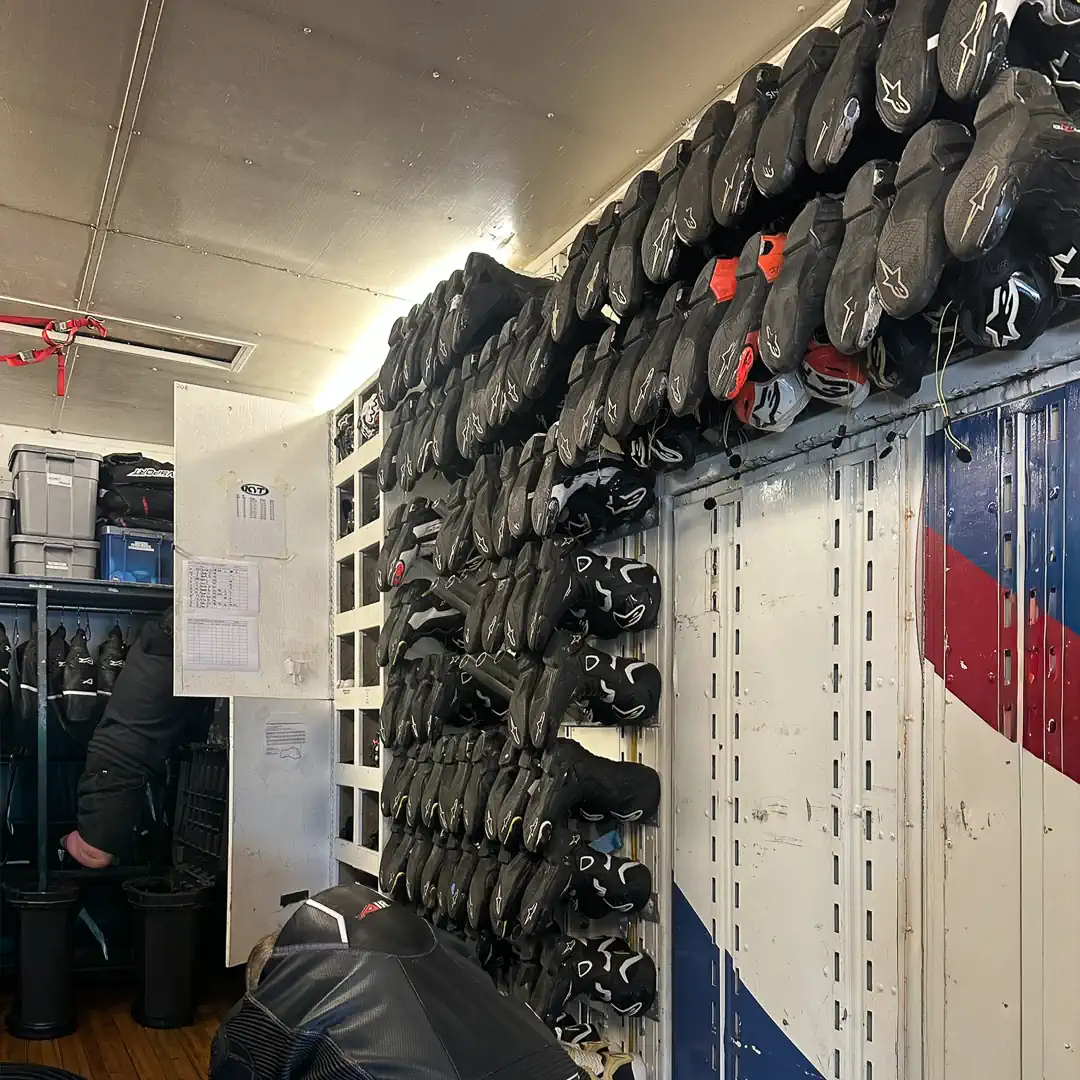
Those using CSS riding gear were directed to Connor, who made the process fun and smooth. He has a good knowledge of sizes and an eye for fit. Connor kept on top of sorting the AGV leathers, gloves, boots, and KYT helmets. He noted everything we’d been loaned to make the next day’s gear distribution easy. I must say the AGV leathers fit nicely, looked good, and were comfortable.
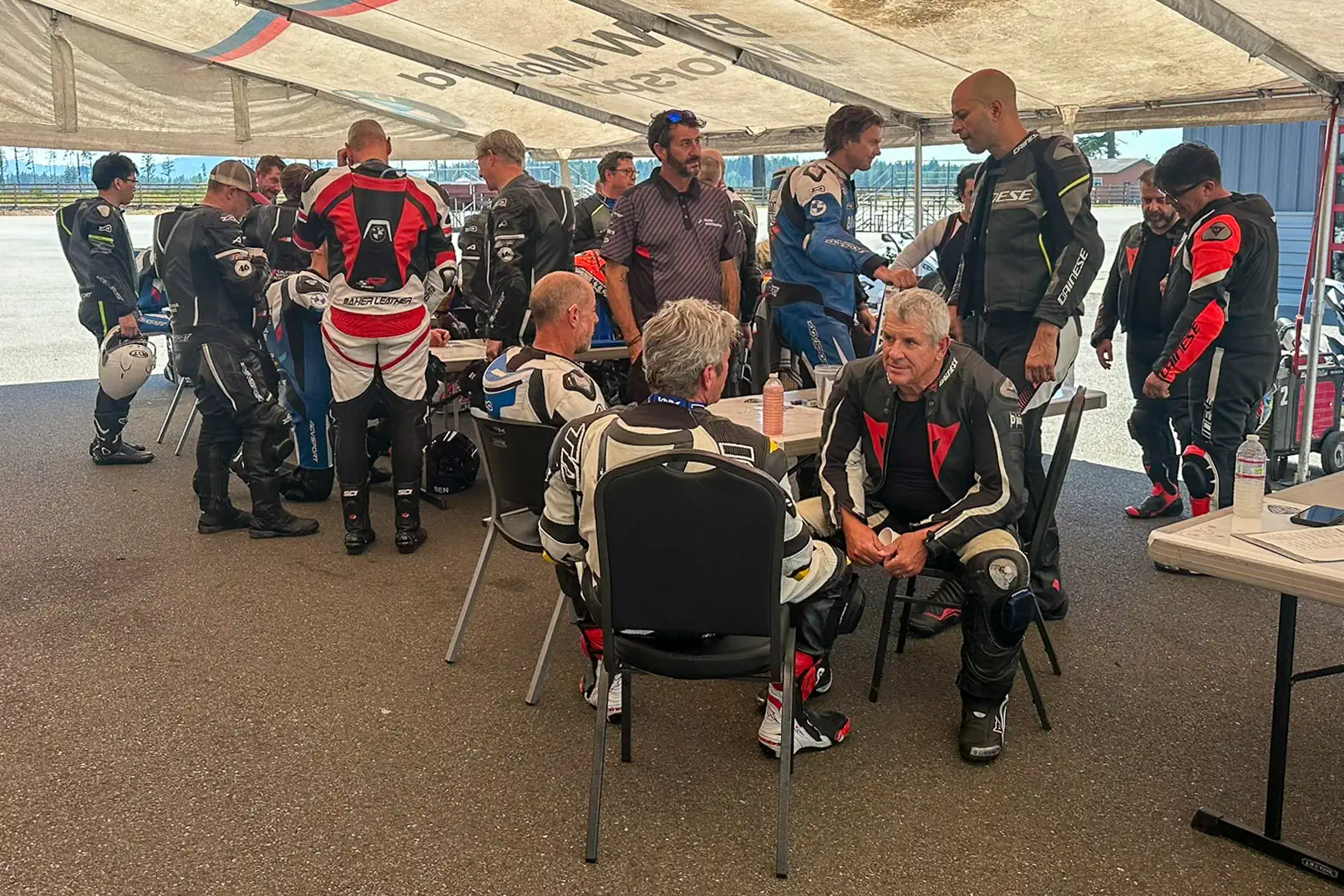
There was a mix of returning riders to the school and newbies like me with a little nervous anticipation. We chatted noisily and shared our motorcycle experiences and journeys. Dylan’s wife, Lara, is a big part of the company and attends as many of the school days as possible. Lara advised me to wear long, thin fabric undergarments, which she kindly supplied.
Classroom Briefing
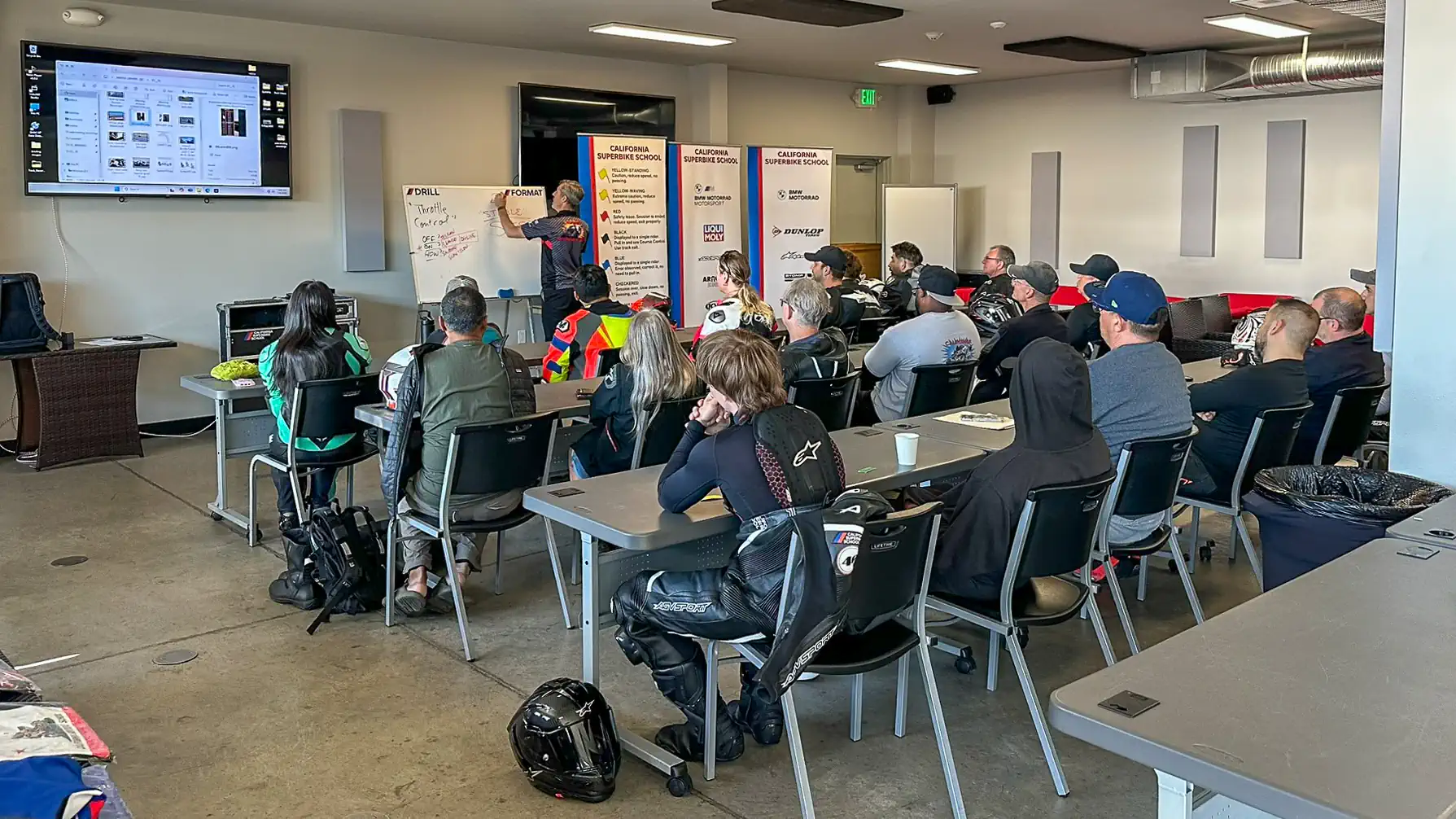
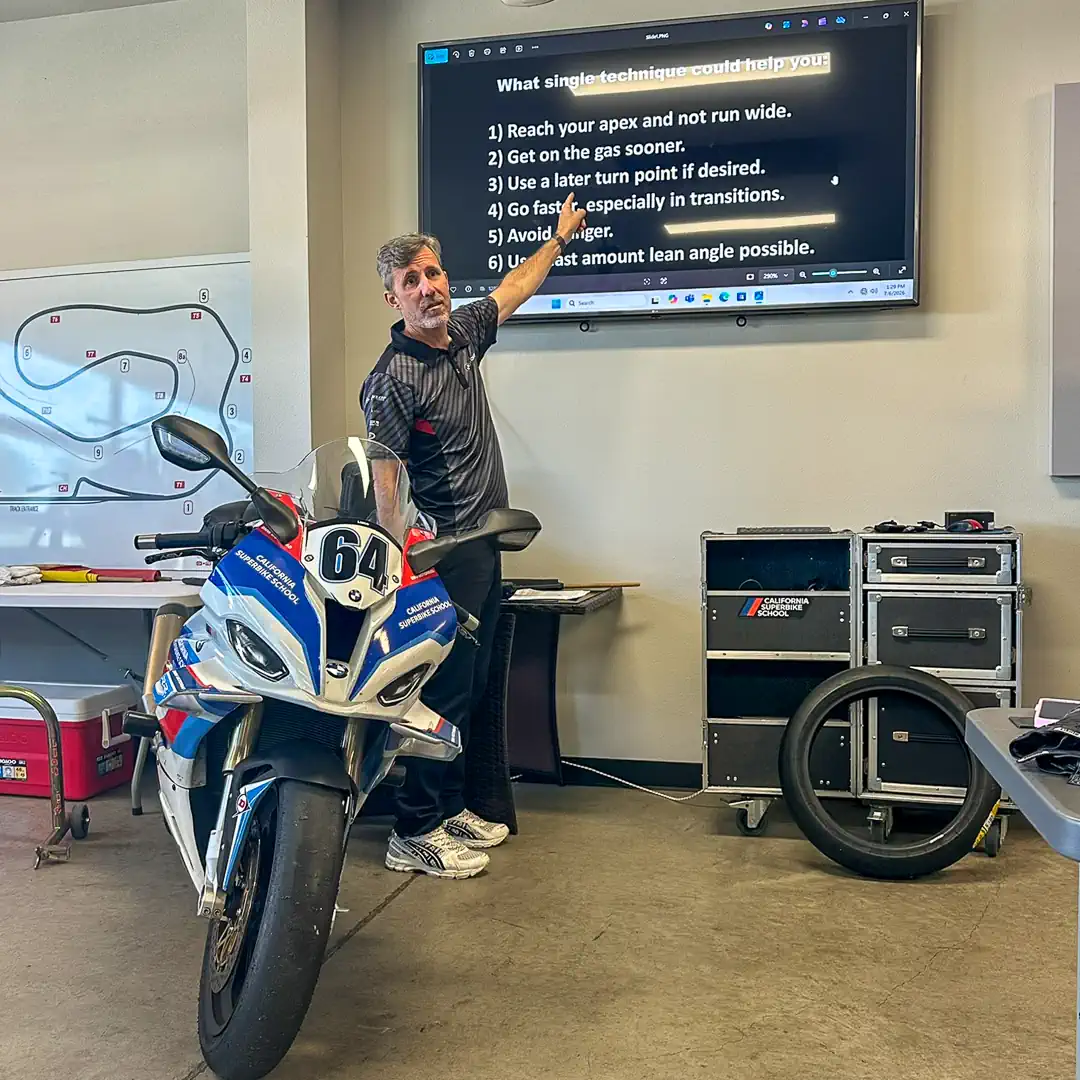
Once in the classroom, the layout of the day was explained. We were told where the bikes were for each of us and to park them back in the same cone-marked spot after each session. This keeps the fast-paced momentum going. All the staff members and coaches were there and introduced themselves, which gave me a good grasp of who was who straight away.
There were different levels of riders of all ages: an uncle with his 19-year-old nephew, someone who’d lost confidence after a big off, a new younger female rider, and a more mature lady just there to enjoy! I met some others who were brand new to CSS and some who’d been the day before. There were many happy, satisfied customers returning after previous training sessions. CSS would be at Ridge Motorsports Park for a week, so classes were rolling back-to-back.
With the agenda for the day set and clear instructions given, we all knew where to be when the bell rang or as soon as we came off track.
I hadn’t investigated how the day would go and was impressed and pleased that we got out onto the track for seven sessions per group. The entire day ran with military precision. The staff quickly learned who we were and chased up individuals who hadn’t made it to their next point of contact. If they were late for class or late for riding, they didn’t just miss out. Somebody always had your back to tell you where you should be if you were at all lost.
Nothing is assumed. Flags were covered in the safety briefing: standing yellow for caution ahead, waving yellow for immediate hazard (slow by about 30%, no passing), blue for rider-specific error correction, and others for session status.
No Failed Students, Only Failed Coaches
I grabbed a chat with Dylan Code and asked about coach selection and the attitude he looks for. Dylan explained the CSS mindset: “How am I gonna help this person out? When you’ve got that genuine point of view, which is basically everybody here at California Superbike School, it’s not a bunch of people standing around criticizing. Instead, it’s about how do we optimize the system? What can we do with this person? How can we help them overcome their individual barriers and so on?”
Dylan has a philosophy: there are no failed students, only failed coaches. That really flips things around. If you can’t get a result with a student, it’s then in the lap of the coach. Some people could be a little tied up because they have fears from maybe previous crashes, or maybe information that’s in conflict. The culture here is for the entire CSS team to take on full responsibility for the people they’re working with.
The coaches are user-friendly, competent, and focused on observing and correcting rather than vague praise. The student-to-coach ratio meant plenty of individual attention, which kept the day productive.
I met Andrew, who has been riding on track for two years. He’s been riding on the street since he was nine years old. He’s ridden several track days and been with other coaching schools. The reason he came to CSS was that he wanted it to make sense. He wants to understand what he is doing on the bike. He explained how he thought about getting an ugly track bike for about half the price of a CSS school, and that he could learn on his own. However, he concluded that the CSS experience is money well spent.
Theory, Then the Track
The day was a mixture of theory followed by practice, with drills to fix our corner entry speed or entry point. Now, I understand what I’m doing, and I’m going to have a plan when I’m entering a corner. I found that just because it feels right to you doesn’t mean that you are doing the right thing. Having your riding coaches on track means they are watching you and can give you the specific feedback needed to correct what you’re doing.
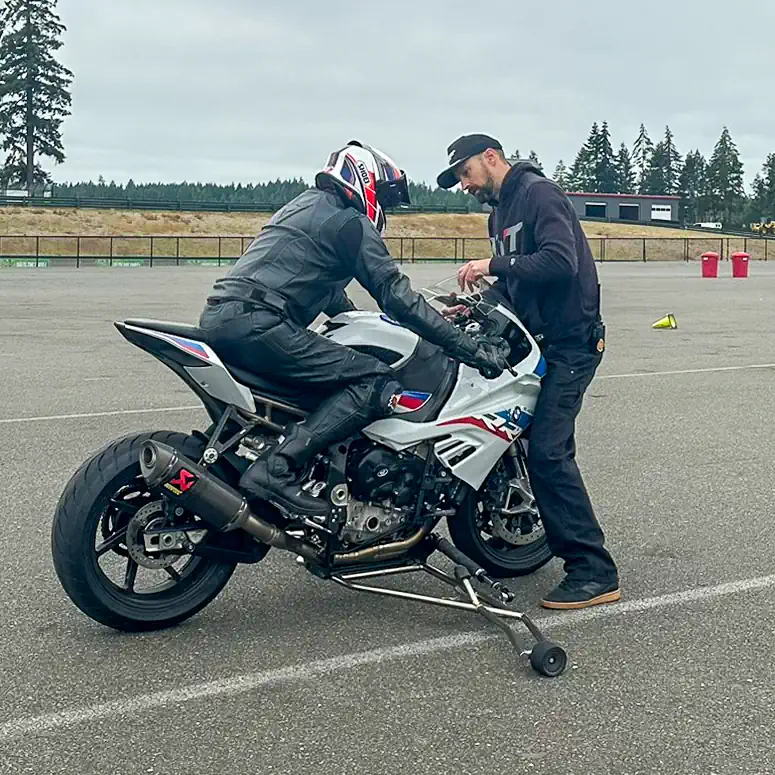
Neatly slotted between the class sessions and on-track drills, we were taken to a large asphalt area for countersteering drills with Eric. It’s all about lean increasing with speed, throttle control, body position, and comfortable positioning. They have an outrigger device on a bike so you can’t fall, which removes a barrier to learning.
In the classroom, Dylan broke things down scientifically. He had plenty of visuals that supported what he was telling us. This was especially helpful regarding vision. He put things in context, and now I understand why I need to look where I need to look, instead of just being given a blanket statement like “look through the corner” or “look ahead.” I had a light bulb moment and now have a full understanding from Dylan’s biology lesson, including foveal vision and what a saccade is, through to how to look and how to implement that for the track and on the street.
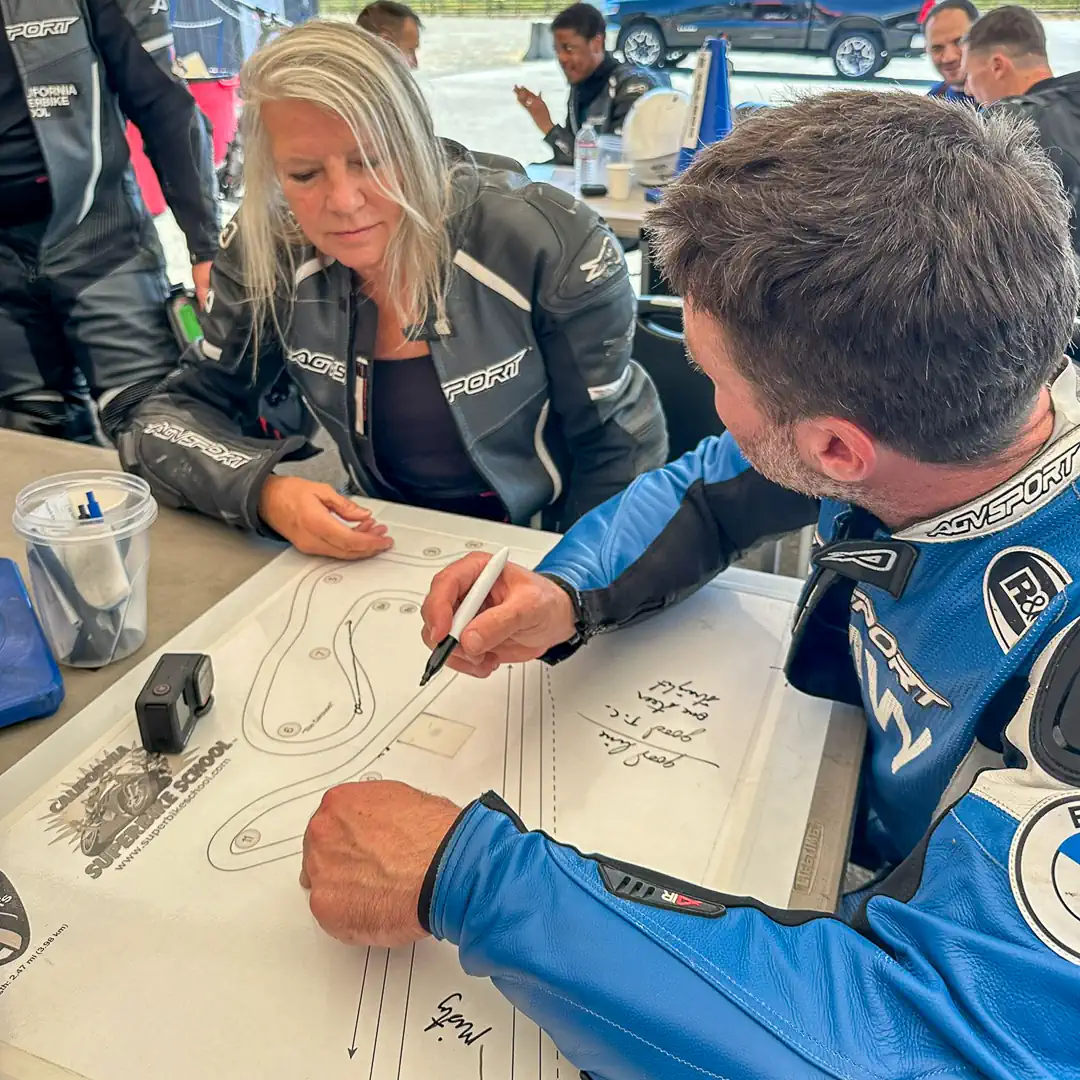
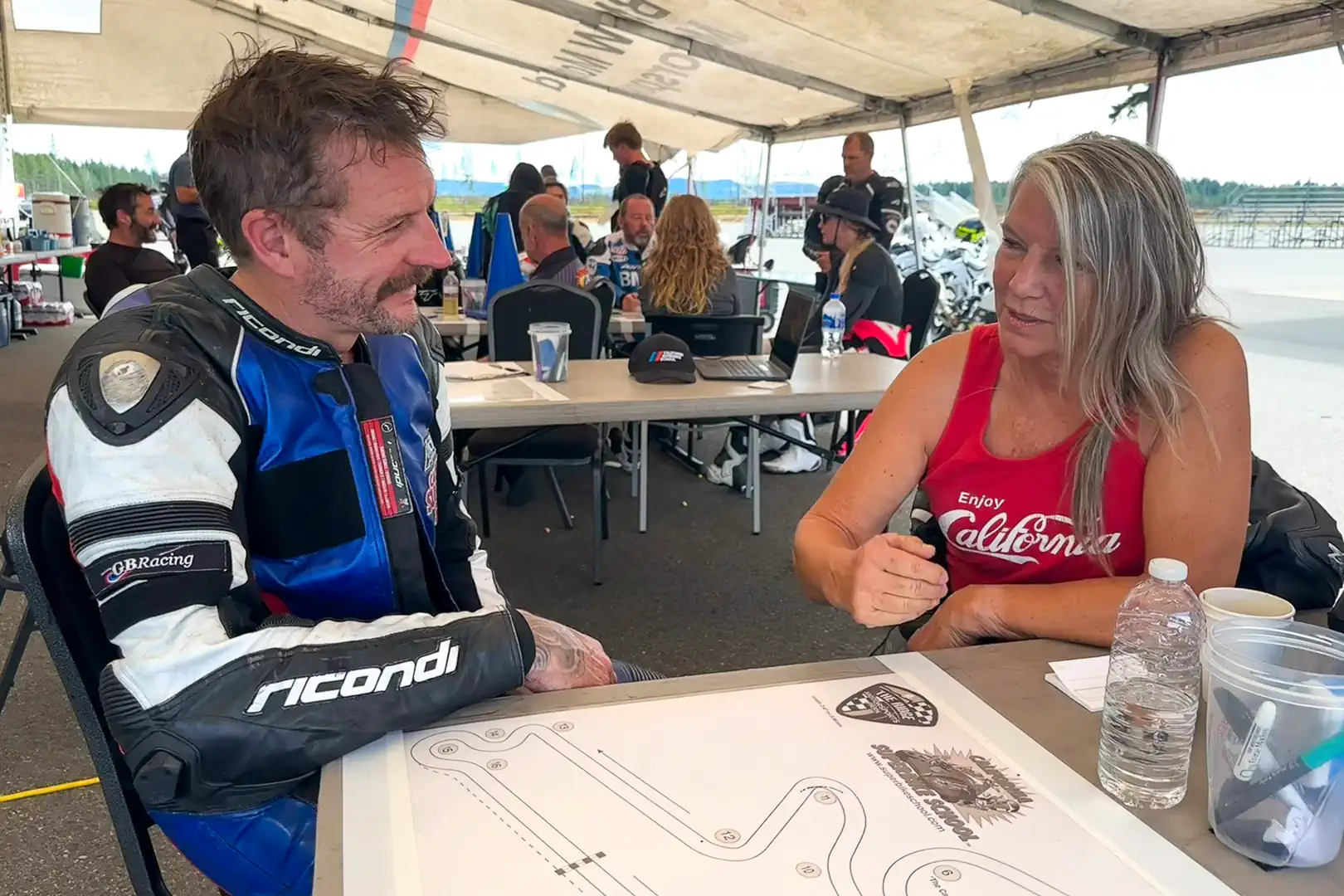
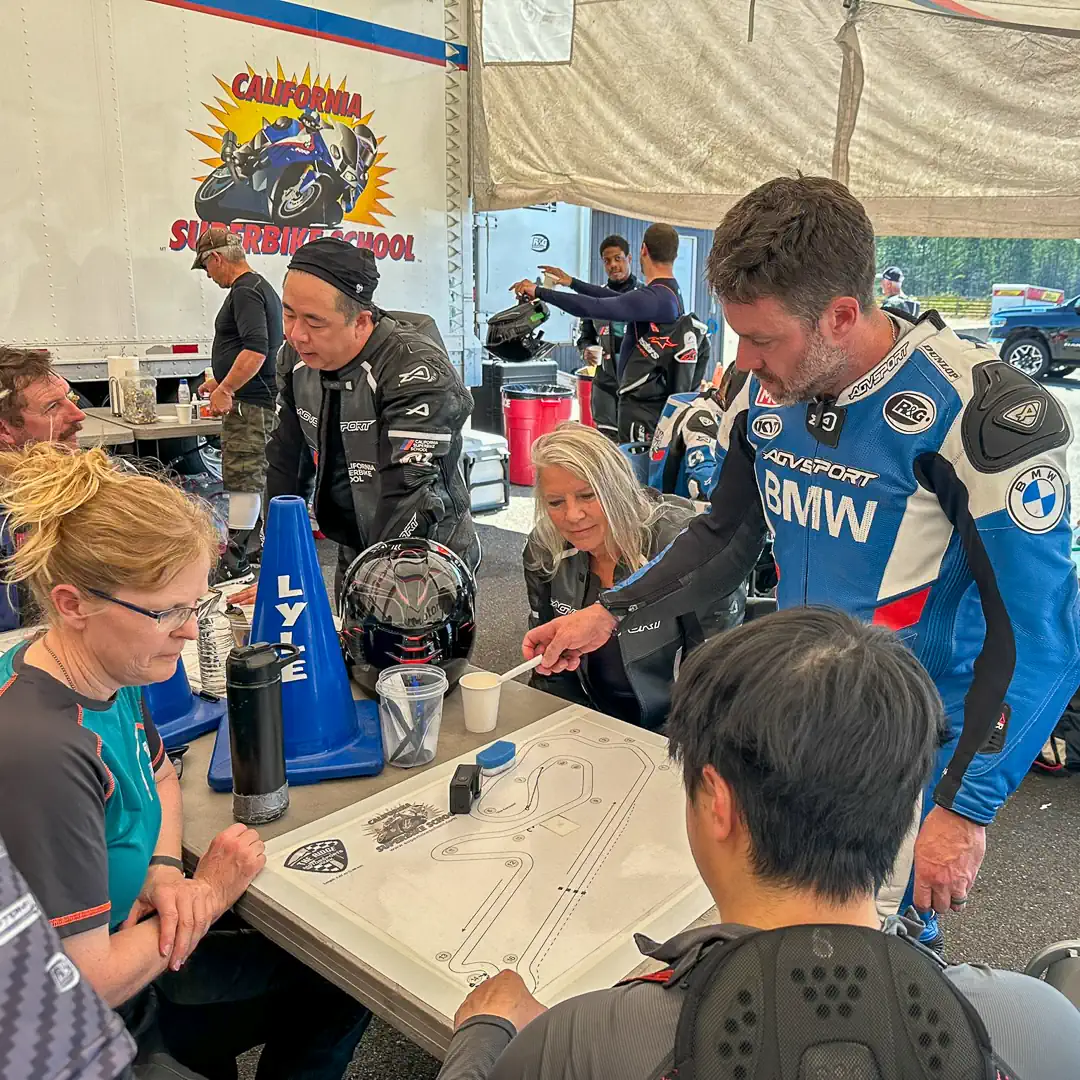
After every theory class, you’re out on track applying what you’ve been taught. We were given specific drills, and the ride coaches were out there with us. When that riding session ends, you park in your spot and find that ride coach for a breakdown. The atmosphere is great; you hear everyone else’s chat and pick up lots on top of your own one-on-one.
We were taught things that I hadn’t realized that I needed to know. We got detailed information about how and why we do things. Which way is best really made a difference. We covered heaps of subjects, even how tension on the motorcycle affects control. We learnt about choosing turning points and hitting them!
Everybody is taught differently. Somebody visual might be taking in different information than somebody who just needs to be told about something. I felt confident at CSS that the whole team truly knew how to spot what you were doing, identify what needed teaching, and explain it clearly. Probably most important of all, I felt comfortable rewording and asking a question in a different way if I hadn’t grasped the direction the coach was giving me.
What I Took Home
At the end of the Two-Day Camp, we all received certificates of completion for the Levels we’d been through, along with a folder with summary and quick-reference guides to key exercises and concepts we’d covered. We also left with a whole new group of friends, fond memories, and newly learnt riding techniques to apply.
After the Two-Day Camp, I was excited that I had acquired new skills that I could put to use on the streets and plenty of new techniques. The two full days were tiring. It takes high concentration to put new habits into practice, and integrating physical riding tips added to the effort. Now that my less-than-ideal habits have been identified and addressed, my street riding is more deliberate, and I make fewer unnecessary inputs. I’m not a racer. I simply want to enjoy my motorcycling and feel the full sense of freedom, and the Two-Day Camp at California Superbike School furthered that goal.
Action photography by Etech Photo Other photography by Arthur Coldwells
California Superbike School Two-Day Camp Review Photo Gallery
Benda motorcycles are beginning to make a ripple on US shores with four intriguing and competitive models, courtesy of its partnership with Keeway Group. We were impressed with the Napoleonbob 500 and have now gotten our gloves on the persuasive, entry-level 2026 Benda Chinchilla 300, with its modest MSRP of $4999. It would be difficult to design a more welcoming entry-level cruiser than this easy-handling, visually appealing boulevard bobber. Editor Don Williams and Associate Editor Kelly Callan discuss the Benda Chinchilla 300 and how it actually rode for them.
* * * * *
Our guest this episode is Jesse Merriman, Chief Technician for Jeremy McWilliams at the Arch Motorcycle racing project. Arch Racing was founded by Gard Hollinger and Keanu Reevs to compete in the Moto America Super Hooligan race series. Teejay Adams chats with Jesse about the Arch motorcycle and the challenges of extracting the absolute most from an air-cooled V-Twin racing engine and custom chassis.
* * * * *
Here’s quick reminder to check out our monthly digital magazine. It’s filled with everything you want to read on motorcycling, including some things you’ve probably not seen elsewhere. It’s absolutely free and you will find it on the Apple App Store and of course on Google Play as well.
Don’t forget to leave us your comments on our social media—we’re on all the usual platforms at Ultimate Motorcycling. We love hearing your feedback… so good or bad, please let us know what you think. If there’s something you’d like us to cover, we’d love to hear those ideas too!
We use cookies and browser activity on this website
Functional
Always active
The technical storage or access is strictly necessary for the legitimate purpose of enabling the use of a specific service explicitly requested by the subscriber or user, or for the sole purpose of carrying out the transmission of a communication over an electronic communications network.
Preferences
The technical storage or access is necessary for the legitimate purpose of storing preferences that are not requested by the subscriber or user.
Statistics
The technical storage or access that is used exclusively for statistical purposes.The technical storage or access that is used exclusively for anonymous statistical purposes. Without a subpoena, voluntary compliance on the part of your Internet Service Provider, or additional records from a third party, information stored or retrieved for this purpose alone cannot usually be used to identify you.
Marketing
The technical storage or access is required to create user profiles to send advertising, or to track the user on a website or across several websites for similar marketing purposes.
Advertising helps us keep our content available for free, so adjusting your ad blocking settings will help us.
We appreciate your support!
i
How to Allow Ads on This Site
Depending on your setup, ads may be blocked by a browser extension, VPN, antivirus software, or other application. Here are some common ways to allow ads:
Browser Extensions (e.g., Adblock, uBlock, etc.)
Click the extension icon in your browser toolbar.
Look for an option like "Don't run on pages on this site" or "Pause on this site".
Save the change and refresh the page.
VPNs with Ad Blocking (e.g., NordVPN, Proton VPN, etc.)
Open your VPN app.
Go to settings or features.
Disable any ad blocking or tracking protection features.
Refresh the page.
Antivirus Software or Other Privacy Tools
Check for web protection, ad filtering, or browser privacy settings.
Click the power button to disable it for this site.
Refresh the page.
Not sure what's blocking ads? Look for tools with privacy or filtering features, or check your browser extensions. We only use respectful, non-intrusive advertising.