It’s a perfect Saturday afternoon ride. The bike feels planted, with your tires gripping the asphalt like old friends. Then, you feel that wobble. It gets worse, so you pull over. You hear the heart-wrenching “hissssss” after you hit the kill switch. An errant screw found its way into the tread, and you’re staring at the slowly deflating tire. One phone call later, you’re at the shop, hoping for a quick fix so you can get back on two wheels.
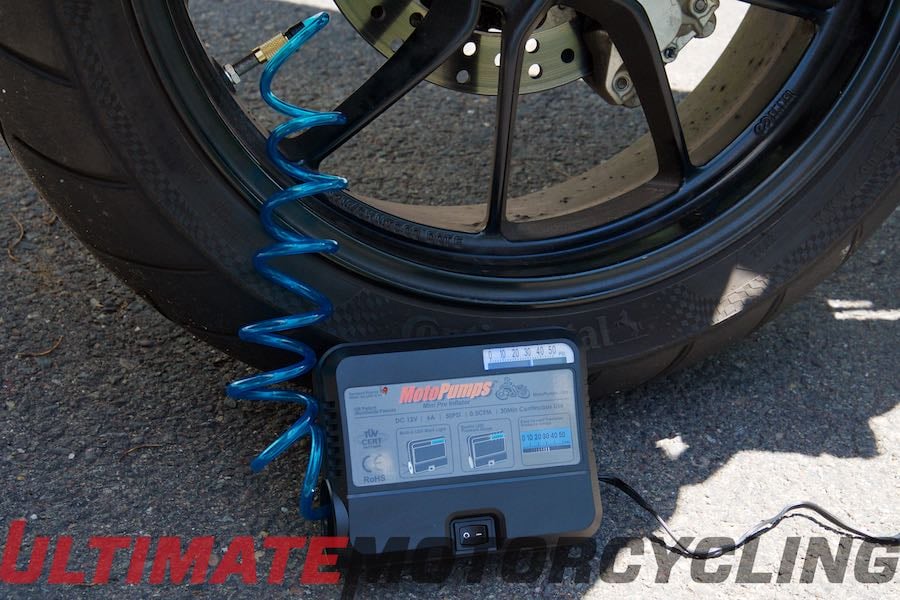
MotoPumps Mini Pro Inflator
However, what happens next isn’t just “plug it and go.” Every reputable motorcycle tire repair follows a strict rule: a proper fix requires both a plug and a patch. Anything less isn’t a repair; it’s a gamble with your life at highway speeds, when you’re leaned over in corners, or braking hard in traffic.
Here’s why standalone methods fall short, and why the combination is the only safe, permanent solution.
Flat Tire Repair Tech
The Problem with Plug-Only
A simple external string plug on the side of the road fills the hole from the outside. It’s fast and gets you home or to a shop in an emergency, and it may be your only practical option. However, according to the U.S. Tire Manufacturers Association (USTMA), “A rubber stem, or plug, must be applied to fill the puncture injury, and a patch must be applied to seal the inner liner. (A plug alone is an unacceptable repair.)”
Progressive Suspension Tire Repair Kit
Without removing the tire from the rim for inspection, you can’t see hidden damage to the inner liner or belts. Moisture and road debris eventually sneak in, corroding the steel belts and creating a slow leak or blowout risk. This is especially dangerous on a motorcycle, where heat buildup from cornering can turn a minor flaw into a major catastrophe.
The Problem with Patch-Only
An internal patch alone seals the liner well. However, it leaves the puncture channel empty. That void becomes a weak spot. Flexing, heat, and high speeds can work the hole open. The result is instability at best, and catastrophic air loss at worse. The Tire Industry Association (TIA) and major manufacturers align with the USTMA. Neither method, implemented independently, meets safety standards for permanent use.
The Power of the Combination Plug-Patch
This is the gold standard of motorcycle tire repair. The tire comes off the rim, and the puncture is reamed clean. A rubber stem/plug fills the channel from the inside, often as a one-piece “mushroom” unit, and a vulcanized patch seals the inner liner completely. This restores the tire’s full structural integrity and prevents corrosion.
Tech Tire Repair is a source for plug/patch combination units. The Ohio company offers its Uni-Seal combo for radial- and bias-ply motorcycle tires. Tech Tire Repair boasts that “Tech Uni-Seal Ultra repairs were the first repairs in the world to pass the FMVSS (Federal Motor Vehicle Safety Standards and Regulations) 139 Endurance Test!”
Dunlop’s official motorcycle tire repair guidelines state: “Dunlop recommends only permanent plug-patch repairs of small (maximum 1/4-inch diameter) tread-area punctures from within the dismounted tire by a qualified tire repair shop or motorcycle dealer. Never perform an exterior repair and never use an inner tube as a substitute for a proper repair.”
Bridgestone, Metzeler, and Avon align with this for tubeless motorcycle tires. A professional combo repair in the center tread area, within the belt package, is considered permanent when done correctly. Dunlop adds that you should never run a repaired tire at over 75 mph.
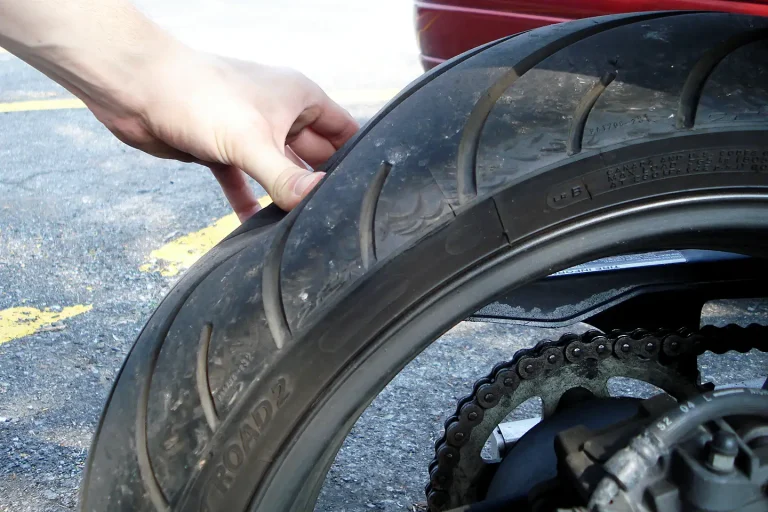
Do not attempt to repair this tire, as it is too worn.
When You Should Replace the Tire
Not every puncture can be repaired. These circumstances require tire replacement:
The damage is in the sidewall or shoulder (flexing here makes any repair unsafe).
The puncture is larger than a quarter-of-an-inch in diameter.
There are multiple punctures or overlapping repairs.
Tread depth is below 1/16 inch
The tire has been on your bike for five years.
The tire is over 10 years old.
Bulges, cuts, bead damage, or internal belt separation are observed during inspection.
Michelin is especially cautious regarding motorcycle tires: “If you get a flat tire, it should be replaced by a professional mechanic.”
We agree with Michelin. For maximum safety, if your tire gets punctured, replace it ASAP. However, if you want to prioritize expense over safety, the next time you get a flat, insist on a proper dismounted combination plug-patch by a trained tech. Your life depends on it, so never compromise on what keeps you connected to the road.
The modern superbike class is an arms race fought on several fronts. There’s still the battle for horsepower supremacy, that fuels endless spec-sheet skirmishes on internet forums. But what has caused more than a few designers to burn the midnight oil is the bold new frontier of MotoGP-inspired aerodynamics, and the challenge of integrating those into the already exceedingly complex superbike. Nic de Sena rode the new Kawasaki Ninja ZX-10R at a recent Laguna Seca track day with Volant Vivere and he tells us all about what he discovered and what it takes to go fast.
* * * * *
Now here’s a rally you absolutely cannot miss—yes, we’re rapidly approaching the 34th Annual Biketoberfest Rally in Daytona Beach, sunny Florida.Biketoberfest this year runs October 15th through the 18th. Biketoberfest is all about the beautiful Florida weather, live music, the industry’s top vendors, bike shows, and motorcycle racing at Daytona International Speedway. And don’t forget, there are miles of spectacular rides along the famous A1A, the historic Main Street and the Ormond Beach Scenic Loop. There really is something for everyone here, and almost every event and attraction is free to attend. So, if you want a fun few days out in the Florida sunshine, Biketoberfest really is the place to be. Make sure you download the Biketoberfest mobile App from Apple or Google Play or visit www.biketoberfest.orgfor more details.
* * * * *
Austin and Ellie got married in 2022 and recently returned from a four-year trip around the world riding their Ural sidecar. The epic trip is documented on their Instagram page @sidebysidecar. In this second segment, Teejay Adams chats with them about the challenges and effort it took to make it all happen, and some of the adventures they had along the way.
* * * * *
Here’s quick reminder to check out our monthly digital magazine. It’s filled with everything you want to read on motorcycling, including some things you’ve probably not seen elsewhere. It’s absolutely free and you will find it on the Apple App Store and of course on Google Play as well.
Don’t forget to leave us your comments on our social media—we’re on all the usual platforms at Ultimate Motorcycling. We love hearing your feedback… so good or bad, please let us know what you think. If there’s something you’d like us to cover, we’d love to hear those ideas too!
We use cookies and browser activity on this website
Functional
Always active
The technical storage or access is strictly necessary for the legitimate purpose of enabling the use of a specific service explicitly requested by the subscriber or user, or for the sole purpose of carrying out the transmission of a communication over an electronic communications network.
Preferences
The technical storage or access is necessary for the legitimate purpose of storing preferences that are not requested by the subscriber or user.
Statistics
The technical storage or access that is used exclusively for statistical purposes.The technical storage or access that is used exclusively for anonymous statistical purposes. Without a subpoena, voluntary compliance on the part of your Internet Service Provider, or additional records from a third party, information stored or retrieved for this purpose alone cannot usually be used to identify you.
Marketing
The technical storage or access is required to create user profiles to send advertising, or to track the user on a website or across several websites for similar marketing purposes.