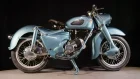
The Honda UL175 White Fox — ironically finished in orange — featured recumbent seating, rear-mounted two-stroke engine, and torque converter transmission.
0:00
▶
In the 1973 model year, Honda had 38 — yes, count ‘em — 38 motorcycle models on the market, ranging from the QA50K1 minibike for kids to the CB750K3 superbike, and that’s not including the automobiles, all-terrain cycles, and a range of other Honda products.
In the background, beginning in 1970, Honda was considering designs for a snowmobile. However, it was not to be another me-too sit-on-top snowmobile with a metal tunnel housing a rubber track, a pair of skis up front, and a two-stroke engine of some type on top of the tunnel in front of the rider. Nope. It was to be a radical, rear-engine design with a recumbent-rider seating position.
Honda’s first designs, shown to Honda motorcycle dealers in snowmobile country, initially called for four-stroke powerplants, starting with a rear-mounted inline-4, then a twin, and even a liquid-cooled automotive engine with an automotive-style automatic transmission, twin track, and a sit-in-style chassis. The initial designs were very heavy and more expensive than competing machines.
By 1973, Honda took input from its potential dealers to heart and made major design changes. The result was the little rig you see in my images taken of one of the very few surviving Honda White Fox snowmobiles. The one you’re looking at is owned by Joe Jones of Boyne City, Michigan, and on display at the Top of the Lake Snowmobile Museum in Naubinway, Michigan.
The 1973 Honda White Fox snowmobile turned out to be a unicorn. Virtually all of the 800 examples built were recalled and destroyed in their first year on the market.
The final product was light, weighing about 230 pounds. The weight reduction was due to its rear-mounted, single-cylinder, two-stroke, air-cooled engine displacing 178cc and producing 10 horsepower, with a CVT and enclosed roller-chain final drive.
The twin-track design was dropped in favor of a single 15-inch wide treaded rubber track. The front suspension was a transverse leaf spring with no damping, while the rear used spring-suspended bogie wheels riding on the inside aspect of the track. The whole thing was built on a tubular steel chassis with a fiberglass body.
The 1973 Honda White Fox used a seating position similar to that of a recumbent bicycle, limiting it to one passenger. This also restricted the rider’s ability to use body English to assist with control and cornering in deep snow. Rather than use motorcycle-style handlebars, the machine had vertical grips similar to those on some aircraft controls. The grips were the palm-eating awful-waffle style widely used on Honda motorcycles of the era. Motorcycle-style levers operated the throttle and brake.
The taillight appeared to have been sourced from a CB500 motorcycle, and the headlight was a rather ugly rectangularish thing in a black nacelle, clamped to the leading edge of the tubular-steel chassis.
In the early 1970s, well-groomed trails were not as widely available as they are today. Snowmobiles had to be able to break trail in deep snow. Never having read an in-snow review or seen the White Fox in action, it’s difficult to appraise its snow-worthiness.
However, having ridden snowmobiles since the late 1960s and a Sno-Runner snow bike for a decade, my guess is that the 1973 Honda White Fox performed poorly in deep snow. Likely, snow would load onto the rider and chassis from the front, resulting in poor floatation and drive due to the very short rubber track at the back.
Maneuverability was also probably poor due to the recumbent rider position, which limited the rider’s ability to shift and lean for cornering and control on uneven terrain. Those issues may have contributed to the quick demise of the Honda White Fox. Ironically, a machine similar to the White Fox could work these days thanks to the wide availability of groomed trails, making deep snow trail-breaking capability less essential.
Depending on the source, between 700 and 800 UL175 White Fox snowmobiles were built, with about 180 of them reaching dealers in Wisconsin and Michigan. Before 1973 ended, Honda issued a safety recall due to its exposed running gear. All but a few examples were hauled off to be destroyed. That abruptly ended Honda’s sole foray into the snowmobile market, though the Japanese juggernaut has made snowblowers since 1980.
From 1973 to 1975, AMF Harley-Davidson built beautiful snowmobiles, including this 400, which came standard with chrome-plated skis. It was a Harley, after all.
Not all snowmobiles built by motorcycle manufacturers were as radical in design or quite as short-lived. AMF Harley-Davidson built two models, both with air-cooled twin-cylinder two-stroke engines. They were sleek, well-styled sleds. The 440 had a black hood, and the 400 was Harley-Davidson red, white, and blue. Despite positive owner reviews, AMF H-D only produced the machines from 1973 to 1975.
Yamaha brought its motorcycle technology to snowmobiles, starting with the 1968 SL350.
Yamaha, capitalizing on its extensive experience with high-performance two-stroke engine design, entered the snowmobile market in 1968 with a well-designed snowmobile, unsurprisingly powered by its iconic air-cooled 350 twin two-stroke motor. Yamaha stayed in the snowmobile market until it announced its withdrawal last year. In the early years, Yamaha engines were featured in other brands such as Sno-Jet. Other manufacturers, including Kawasaki and Suzuki, got in the game with their own complete sleds, as well as building engines for other snowmobile brands.
If you’re poking around the barns of Wisconsin and Michigan, looking for a sought-after vintage motorcycle, keep an eye out for a snowmobile with a White Fox logo. You’ll have quite a find.
Hello and welcome again to the Motos and Friends Podcast. This episode is brought to you by Leod Escapes.
* * * * *
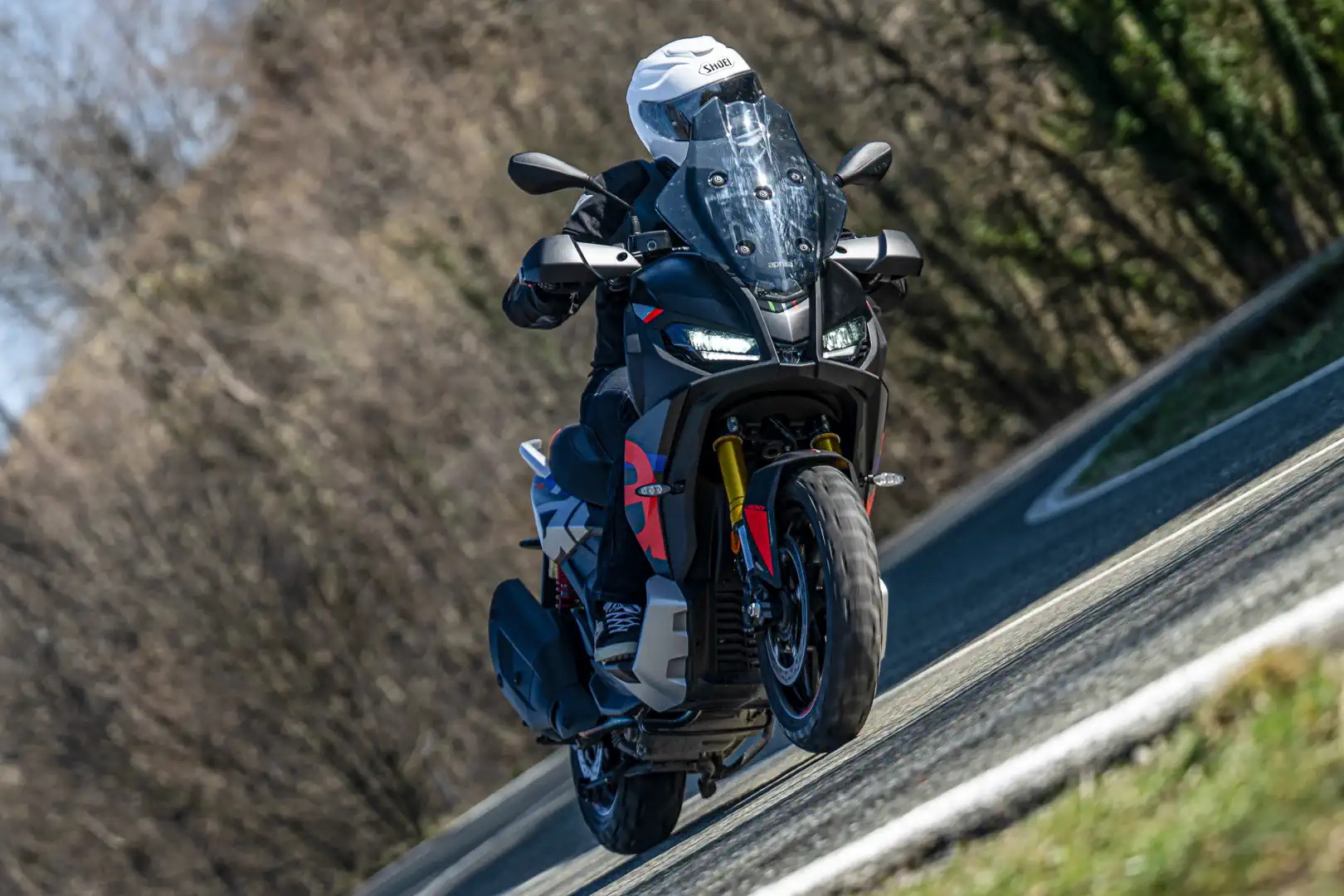
Aprilia is bringing a scooter to North America, and it’s one designed to appeal to adventure motorcyclists. The SR GT 400 is a mid-size scooter built around a steel motorcycle-style frame, a 399cc single, and off-road-ready hardware. It reaches US dealers as soon as this month. Don Williams and Kelly Callan spent some time riding the Aprilia and were surprised by what they discovered. Is this a real motorcycle or just a good-looking urban scooter?
* * * * *
Cat McLeod is founder and owner of Leod Escapes, the ultimate tour company for sport-minded motorcycle riders. Cat talks to us this segment about some of his amazing European experiences and tours that include of course, riding some amazing MotoGP tracks on new BMW S1000RRs. If you like what you hear, now is the time to book your trip of a lifetime, so visit LeodEscapes.com to find out more.
* * * * *
Our guest this episode is Terry Vance, the multiple Motorcycle and Motorsports Hall-of-Famer. Terry is of course the former professional motorcycle drag racer, team owner, and co-founder of the high-performance parts company Vance & Hines. Teejay Adams chats with Terry about his incredible career that includes being the first rider to hit 200 mph in the standing quarter-mile.
Having won this year’s MotoAmerica Mission King of the Baggers championship with Hayden Gillim riding the Vance & Hines factory Indian Challenger, and with Harley-Davidson’s recent withdrawal, Terry gives us his thoughts on where the series might go from here.
* * * * *
Here’s quick reminder to check out our monthly digital magazine. It’s filled with everything you want to read on motorcycling, including some things you’ve probably not seen elsewhere. It’s absolutely free and you will find it on the Apple App Store and of course on Google Play as well.
Don’t forget to leave us your comments on our social media—we’re on all the usual platforms at Ultimate Motorcycling. We love hearing your feedback… so good or bad, please let us know what you think. If there’s something you’d like us to cover, we’d love to hear those ideas too!
We use cookies and browser activity on this website
Functional
Always active
The technical storage or access is strictly necessary for the legitimate purpose of enabling the use of a specific service explicitly requested by the subscriber or user, or for the sole purpose of carrying out the transmission of a communication over an electronic communications network.
Preferences
The technical storage or access is necessary for the legitimate purpose of storing preferences that are not requested by the subscriber or user.
Statistics
The technical storage or access that is used exclusively for statistical purposes.The technical storage or access that is used exclusively for anonymous statistical purposes. Without a subpoena, voluntary compliance on the part of your Internet Service Provider, or additional records from a third party, information stored or retrieved for this purpose alone cannot usually be used to identify you.
Marketing
The technical storage or access is required to create user profiles to send advertising, or to track the user on a website or across several websites for similar marketing purposes.