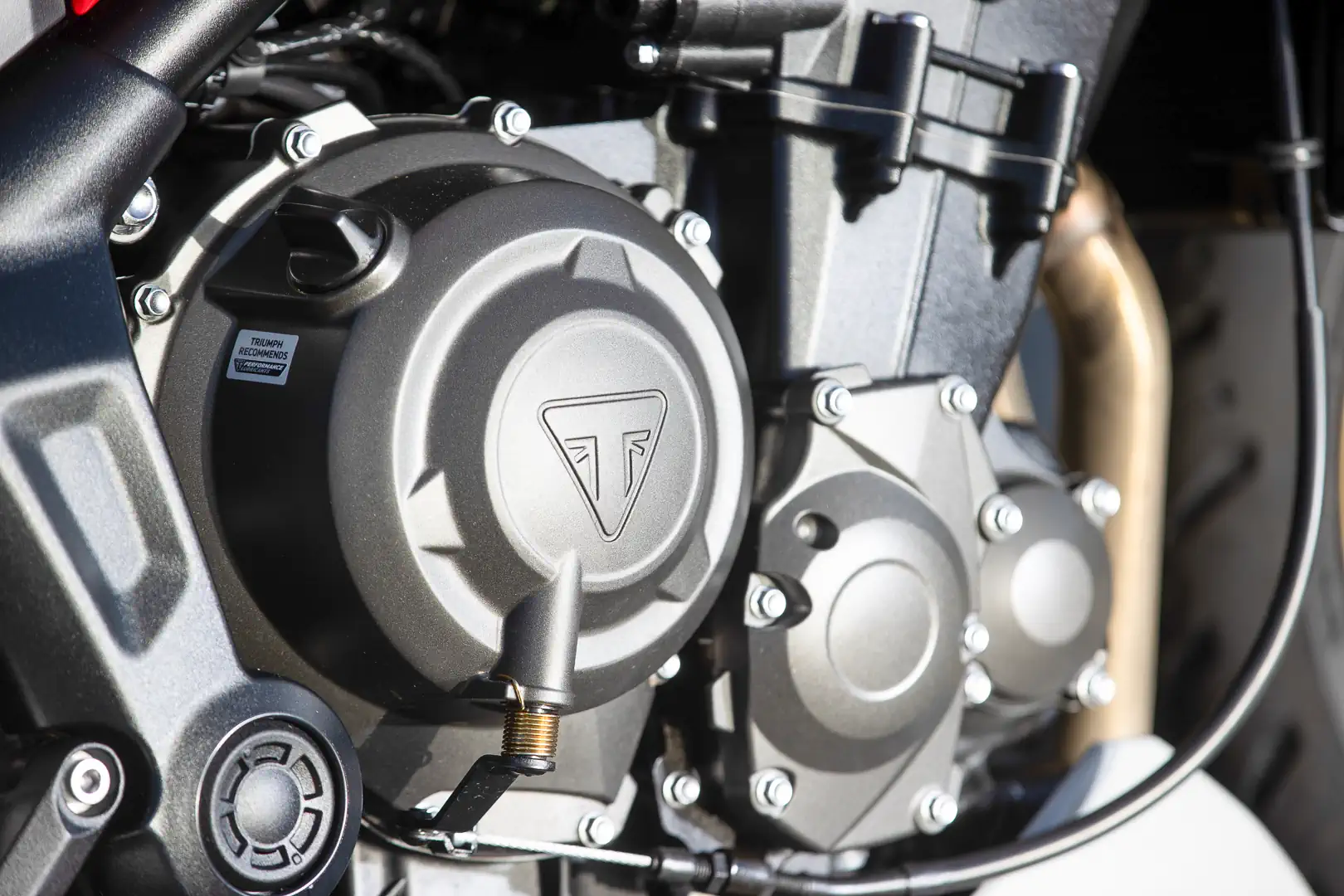
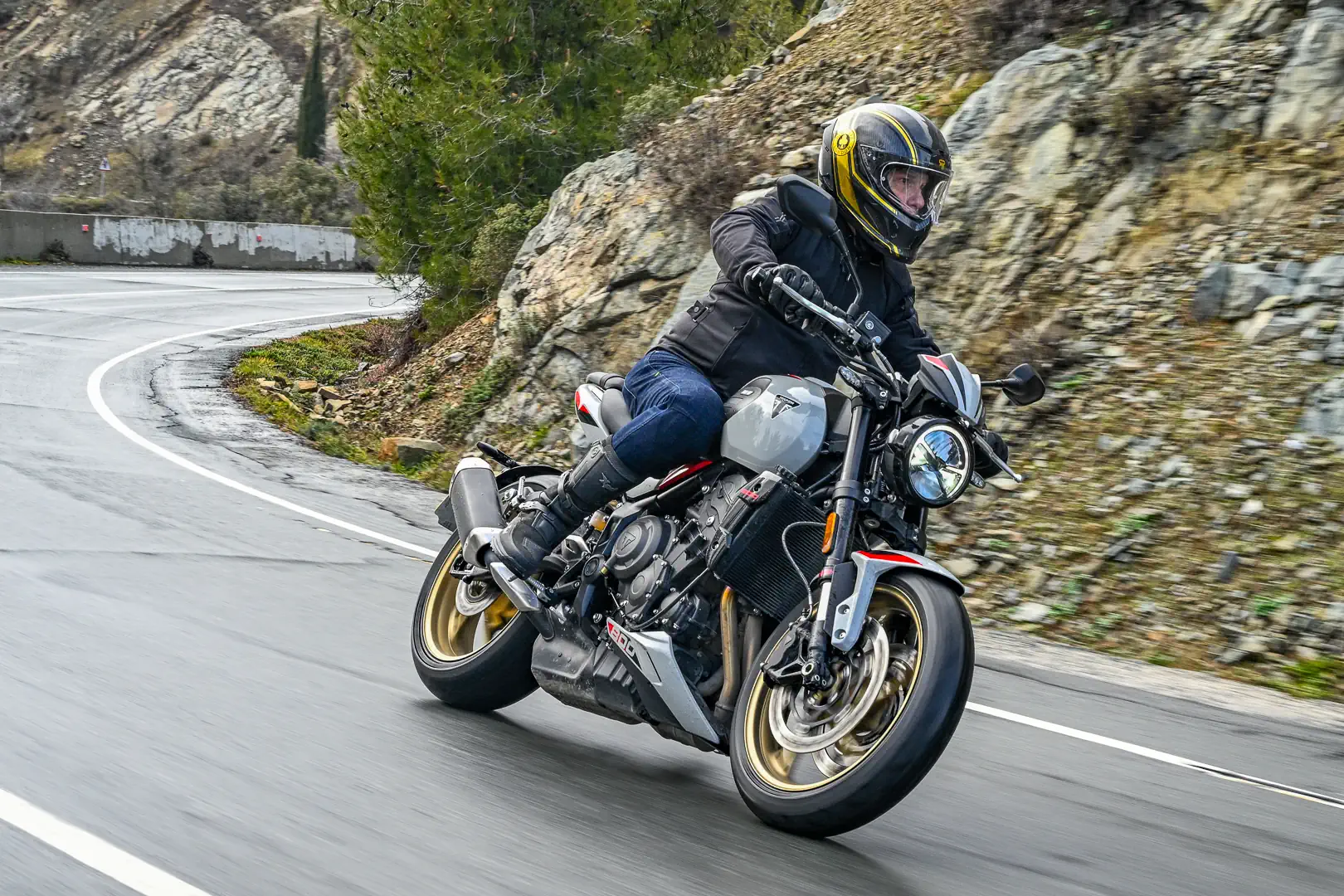
The concept behind the 2026 Triumph Trident 800 is a simple one: mount the Tiger Sport 800 motor in the updated Trident 660 frame and add some performance-oriented chassis upgrades. The result is a bike that sits in the marketplace between the Trident 660 and the outgoing Street Triple 765 R.
I tested the Tiger Sport 800 last year in Portugal. This time around, I headed off to the eastern Mediterranean Island of Cyprus to test its streetwise cousin, the 2026 Triumph Trident 800. The mythical birthplace of Aphrodite provided mixed weather, broadening our testing experience and ensuring we sampled the Trident 800 in both rain and shine.
With 138 more cubic centimeters on offer, the Trident 800 is absolutely a step up in power compared to the spritely 660. This works out to a boost of 19 horsepower that comes on 500 rpm earlier, and an additional 12 lb-ft of torque hitting 250 rpm later than on the 660. Without any doubt, the Trident 800 motor, derived from the 765, has a deliciously meaty midrange, even as it trades away some top end. If you liked the 660, the 800 offers more of a good thing, without any surprises along the way. The 800 builds power completely linearly and boasts a flat torque curve, ensuring acceleration is always a twist of the wrist away.
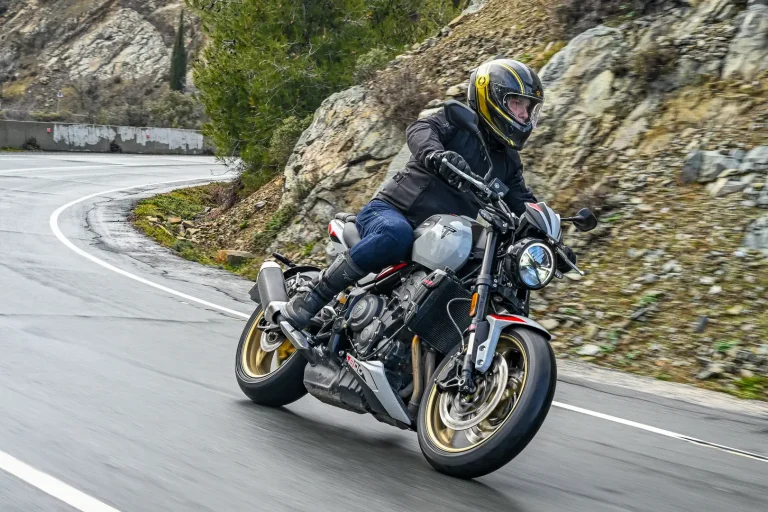
Triumph offers three power modes for the Trident 800, and they’re distinctive. You get the expected Sport, Road, and Rain modes, with each offering different throttle response and cornering-aware traction control intervention, while ABS remains untouched. Sport is snappy without being snatchy, while Road smooths things out by slowing down the throttle response, though not so much that it takes away the fun of riding. While they are noticeably different, you can successfully ride in the Sport mode in urban areas and Road mode in the canyons; your personality will pick the right one for you. Save Rain for the rain, and it provides quite a bit of confidence as the soft throttle response and maximum traction control make breaking loose the rear Michelin Road 6 highly unlikely. Despite my full-throttle attacks in the rain, the rubber and electronics acted as able sentries.
The dash and switchgear are standard-issue Triumph. Four arrowed buttons, a home button, and a dedicated mode button make it easy to navigate the round hybrid TFT/LCD dash. You can display your favorites, and the gear readout is prominent.
Additional smoothness is provided by the quickshifter for the six-speed transmission. Triumph engineers put a lot of work into the sophisticated quickshifter, and it shows. Engine speed, load, and other factors are fed into the ECU to ensure precise clutchless shifts in either direction. With ride-by-wire, you can downshift with the throttle on and upshift with the throttle off, which is occasionally convenient. Don’t worry about doing something foolish, like trying to downshift at high rpm or upshift at less than 1500 rpm; the electronics will collectively ignore your request. The only thing you have to do is keep a steady hand on the throttle, as mid-shift throttle position changes disrupt the process. Also, manual use of the clutch turns off the quickshifting mechanism.
Photograph by Don Williams.
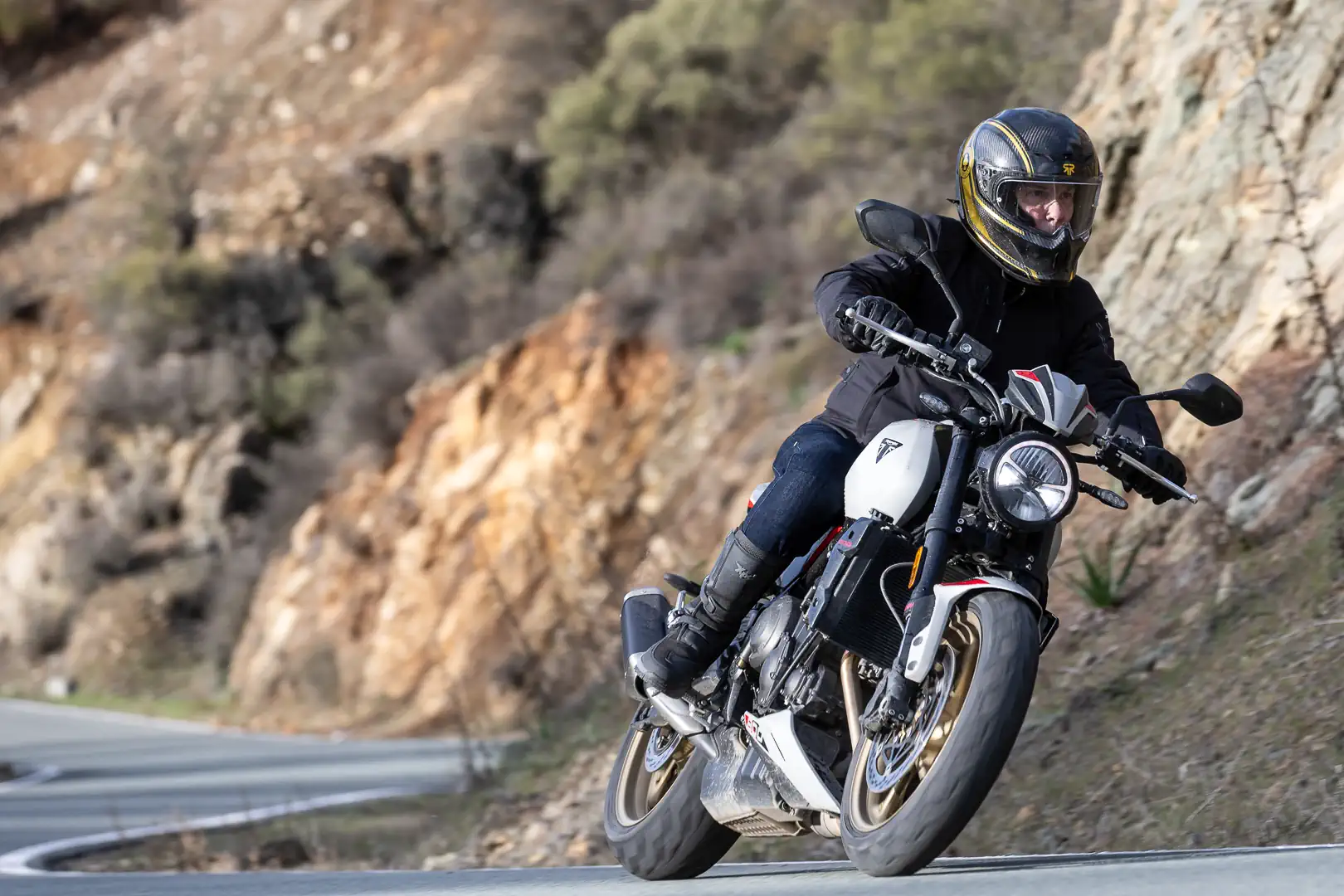
Sharing the same frame and geometry as the Trident 660, the new 800 feels happily familiar. Although Triumph outfitted the 660 with a new frame this year to accommodate triple throttle bodies, the geometry is unchanged. The 800 shows just how well-balanced the 660’s frame is, as the additional horsepower, torque, and seven pounds don’t introduce handling problems. Just as the 660 is an easy and intuitive ride, so is the 800. Ergonomically, the 800 is perfection for my 5-foot-9 proportions. Goldilocks would appreciate that it’s neither too aggressive nor too relaxed. You can go fast or cruise in comfort, thanks to the spot-on ergos.
It’s amazing how little work it takes to ride the 2026 Triumph Trident 800 at a good clip. The short 55.2-inch wheelbase matches up nicely to the 24.5 degrees of rake. The 800’s 437 pounds are distributed gracefully, making set-up and turn-in for corners naturally effortless. If you made a mistake, the 800’s chassis obliges any corrections. The Michelin Road 6 tires are flawless in this context, and I was able to confidently explore the cornering clearance limits now and again. Stability is excellent, as I nudged it into triple digits whenever the rare Cypriot straightaway appeared, and the wind blast wasn’t excessive. You can turn off the traction control, which also acts as unofficial wheelie control, to enjoy the wheelie-friendliness of the short wheelbase, if that’s on your to-do list. Otherwise, you’re well-served by leaving the TC on.
Upgraded Showa suspension helped smooth the transition from a 660 to an 800 powerplant. There’s nothing wrong with the Showa suspension on the 660 if you’re an average guy like me. While the Showa fork on the 800 is higher-spec, you’d probably need to ride the 800 and the 660 back-to-back to notice. Both are inverted 41mm SFF-BP designs. Still, if you’re an outlier, you’ll appreciate the fork’s adjustable damping and the shock’s rebound damping. Spring-preload adjustment is only available on the shock, though I wasn’t carrying a passenger, so I didn’t need to reestablish the proper ride height. Suffice to say, that Triumph’s 800 suspension upgrade helps ease the pain of losing the most-affordable iteration of the Street Triple 765 line.
Triumph upgraded the brakes to reflect the 800’s higher performance. Rather than the 660’s axial-mounted calipers, the Trident 800 features radially mounted Triumph-branded J.Juan calipers working on the same 310mm discs. The 800’s brakes engaged gently enough in the treacherous rain conditions to alleviate anxiety, while providing great feel and power in the varying canyons of the Troodos Mountains, home to Mount Όλυμπος (Olimbos). The cornering ABS is calibrated beautifully, making the most of the IMU’s information. I was able to trigger the ABS in the rain without much effort, though it treated me with respect in the dry. The front brakes work so well that the rear brake gets relegated to emergency duty, casual urban riding, or turning at a walking pace.
You don’t have to ride the twisties to have fun on the Trident 800. Riding through the streets of Limassol, the 800 behaves itself in either Sport or Standard modes. Working through traffic only requires making sure you don’t clip any mirrors. I rode in temperatures ranging from a sunny 76 degrees to a rainy 47 degrees, and the optional heated grips and well-chosen Spidi gear kept me comfortable throughout the 29-degree swing. Vibration is the wonderful triple rumble, so your hands, feet, and seat don’t suffer from fatigue on long rides; nothing is sore after a ride.
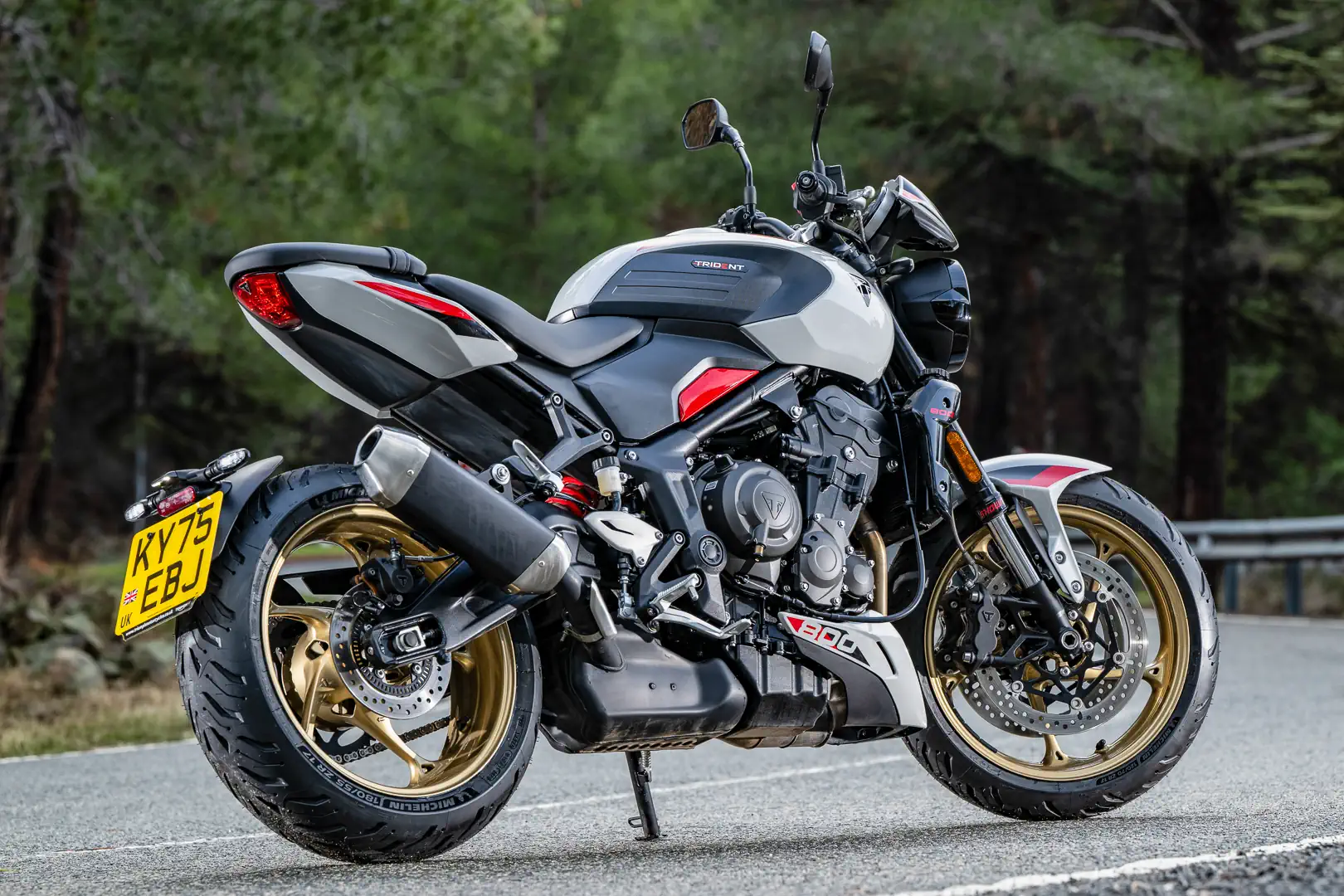
The Trident 800 sports its own retro look, blended with tasteful 2026 cues. The organic tank with the padded cutouts for your knees sets the mood, as does the traditional external muffler. While the seat subframe also has alluring curves, the front fender and chin fairing have an angular attitude. The round headlight has LED lighting, and the swingarm-mounted taillight/plate holder is also contemporary. The bar-end mirrors have a vintage feel, though their shape is fashionably modern. Suffice to say, it’s a mighty long way from the Streep Triple, though nowhere near as retro as the Bonneville Speed Twin 900.
The 2026 Triumph Trident 800 successfully establishes a style and performance niche between the Trident 660 and Street Triple 765 RS. Those who lament the loss of the Street Triple R have a choice: go with the track-sharpened Street Triple RS or admit they aren’t quite that dedicated to speed and enjoy the performance and road manners of the Trident 800. With an enticing list price of $9995, the Trident 800 makes a strong case for those committed to the street.
Our bike review this episode is the Yamaha MT-03. Do not underestimate this bike; you get a lot of motorcycle for your money! Associate Editor Kelly Callan rode the smallest MT for several weeks, and that included commuting on it. One of the things that impressed her, was how the MT-03 acted like a larger motorcycle. Kelly also spent some time chasing Editor Don Williams through the canyons when he was on the Yamaha MT-07—obviously a much larger machine. She tells us about how it all went.
* * * * *
We’re closing in fast on the 34th annual Biketoberfest, October 15–18, when all roads will lead to Teddy Morse’s Destination Daytona—the more than 100-acre motorcycle playground in Ormond Beach Florida. This week we get to hear all about it from Teddy Morse himself. With his trademark high energy and enthusiasm, he tells us all about his recently established Triketoberfest that happens the week before, and how the Destination Daytona complex turns into a full-throttle hub of demo rides, vendors, custom builds, live music, food trucks, shops, and nonstop pavilion energy. So, whether you’re on two wheels or three, whether you’re hunting parts or lining up a test ride; grab a cold one and soak up the energy and gorgeous Florida fall weather. This is one of the many Daytona Beach places where Biketoberfest feels like home. So don’t forget: make sure you download the Biketoberfest mobile App from Apple or Google Play or visit www.biketoberfest.org and we’ll see you there!
* * * * *
Our guest this episode is Greg Arnold, Mecum’s motorcycle auction director. He bought his first bike at eleven, joined the company in 2011, and has spent more than a decade helping turn this incredible event into the place collectors, consignors, and dreamers all show up. Next February 3rd through 6th, Mecum will—for the 36th time, bring the world’s largest vintage motorcycle auction back to South Point, Las Vegas. That’s over two thousand bikes over four days. Board-track racers, barn finds, customs, race iron, and especially, those incredible machines that make the room go quiet. Greg gives us insight into what it takes to make this event work so incredibly well, and if you’re interested in selling your pride and joy, what steps you have to take to make it happen.
* * * * *
Here’s quick reminder to check out our monthly digital magazine. It’s filled with everything you want to read on motorcycling, including some things you’ve probably not seen elsewhere. It’s absolutely free and you will find it on the Apple App Store and of course on Google Play as well.
Don’t forget to leave us your comments on our social media—we’re on all the usual platforms at Ultimate Motorcycling. We love hearing your feedback… so good or bad, please let us know what you think. If there’s something you’d like us to cover, we’d love to hear those ideas too!
We use cookies and browser activity on this website
Functional
Always active
The technical storage or access is strictly necessary for the legitimate purpose of enabling the use of a specific service explicitly requested by the subscriber or user, or for the sole purpose of carrying out the transmission of a communication over an electronic communications network.
Preferences
The technical storage or access is necessary for the legitimate purpose of storing preferences that are not requested by the subscriber or user.
Statistics
The technical storage or access that is used exclusively for statistical purposes.The technical storage or access that is used exclusively for anonymous statistical purposes. Without a subpoena, voluntary compliance on the part of your Internet Service Provider, or additional records from a third party, information stored or retrieved for this purpose alone cannot usually be used to identify you.
Marketing
The technical storage or access is required to create user profiles to send advertising, or to track the user on a website or across several websites for similar marketing purposes.