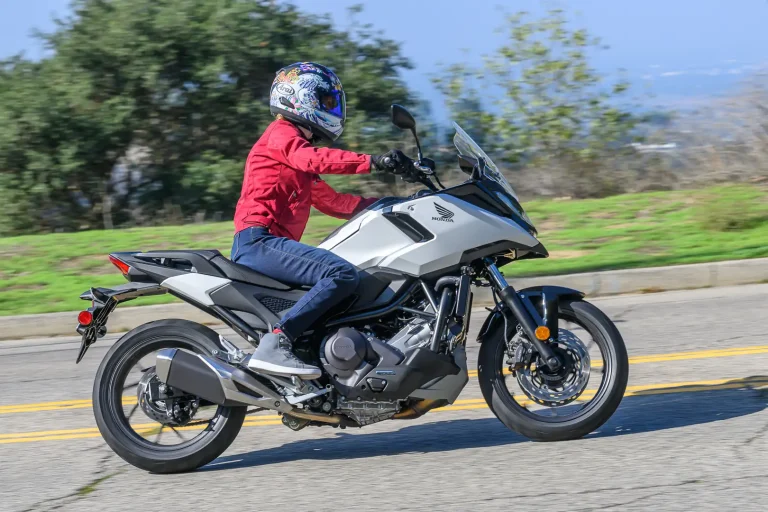
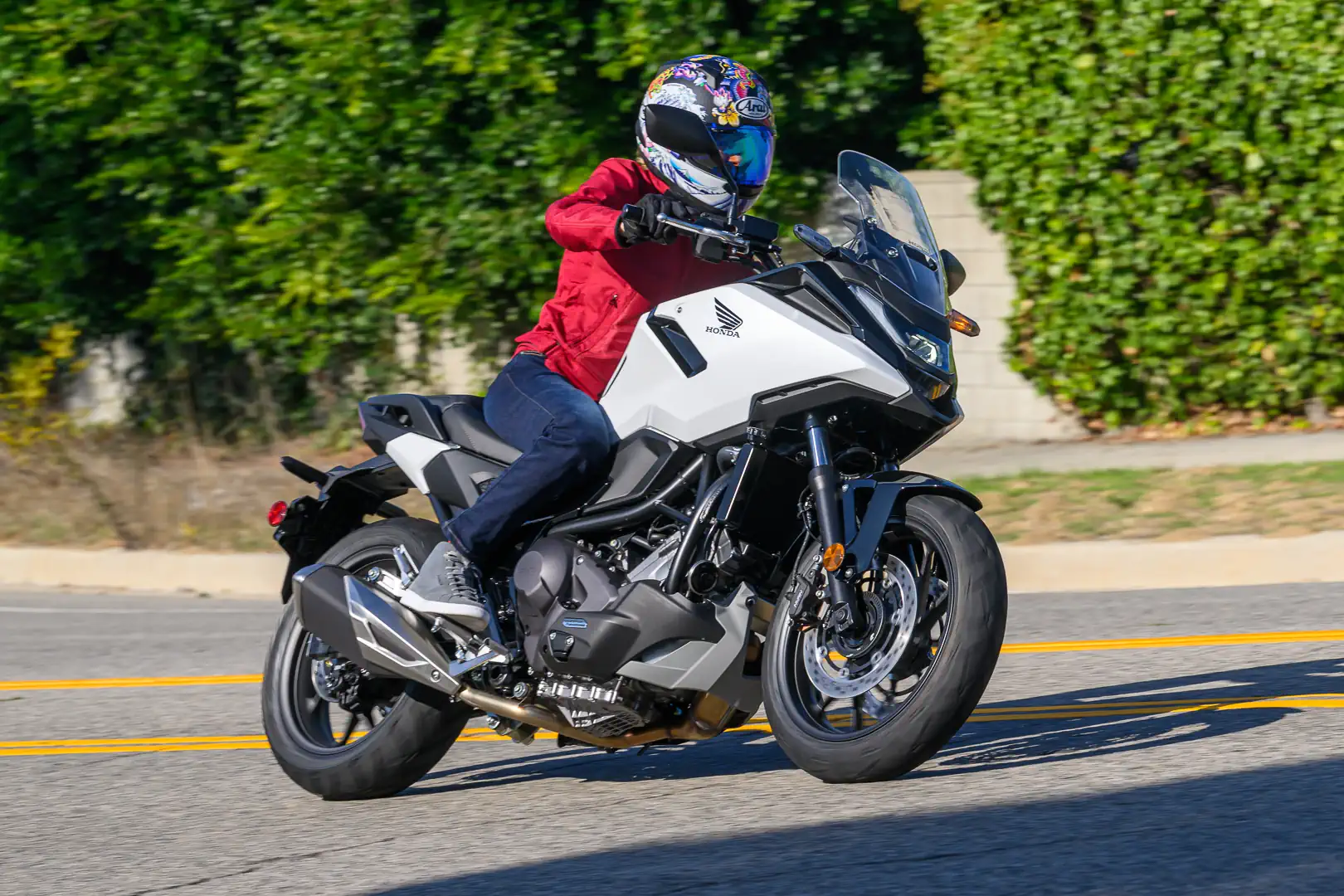
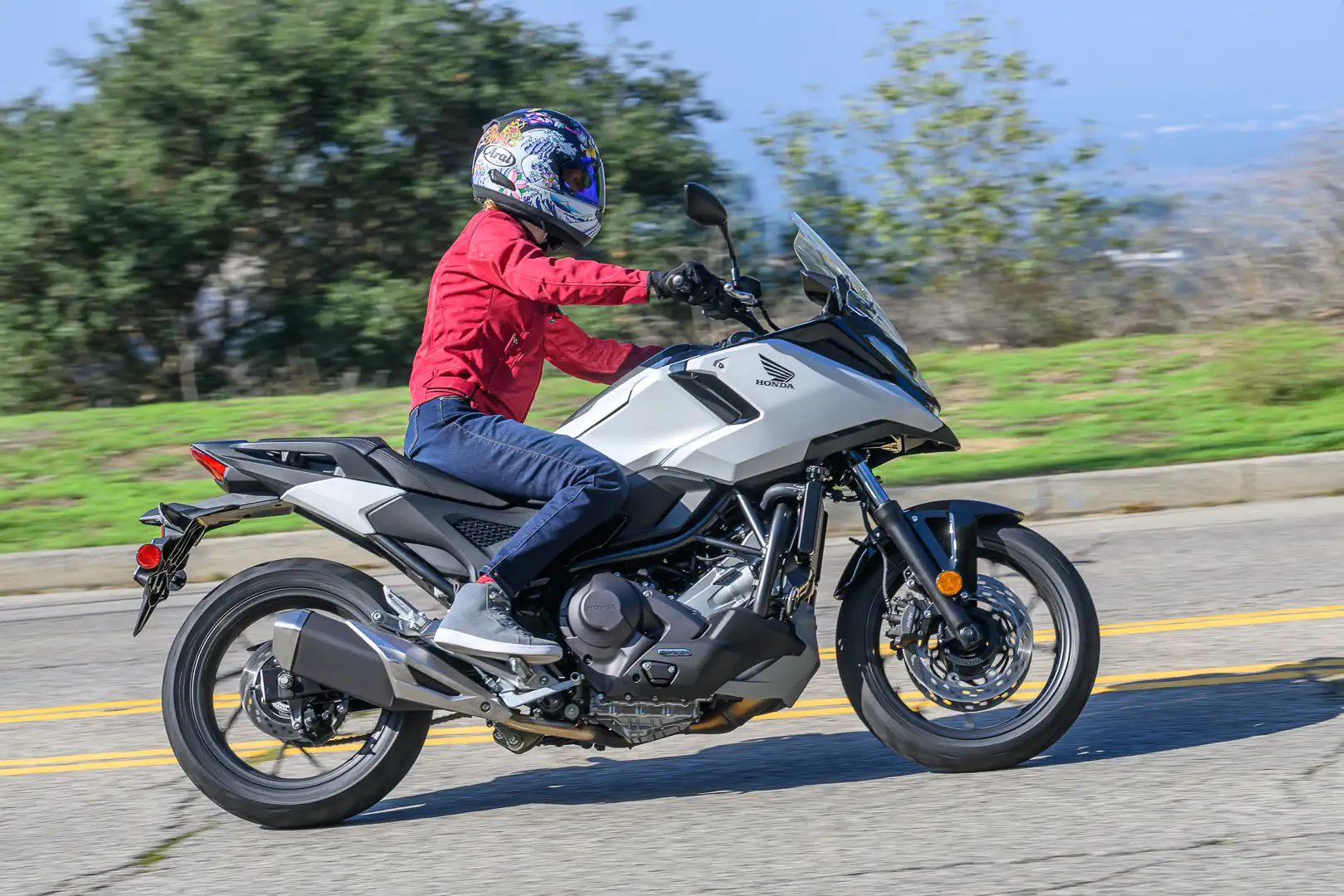
Honda’s NC750X DCT is one of those motorcycles that is hard to argue against. It does so many things right, whether welcoming newer riders to the fold with its automatic dual-clutch technology and approachable ergonomics, or delivering everyday capability for seasoned riders who need a reliable, resourceful mount for commuting, around-town errands, weekend touring, or relaxed canyon runs. The 2025 Honda NC750X is not looking to turn heads with its practical aesthetic, though the new styling is sharp, and Honda has given the bike several updates for 2025.
Before I get into the additional front disc, new wheels, TFT display, and improved low-speed DCT performance, let’s talk about what makes the 2025 Honda NC750X DCT special. At first look, the NC750X looks like your average mid-size, lightly ADV-styled standard motorcycle. Being a Honda, you know it’s reliable, and since the model dates to 2012 (2014 in the US as the NC700X), it’s also well-sorted. However, it’s the DCT that adds that extra appeal. It broadens the audience with its automatic transmission, and creative Honda engineers relocated the gas tank under the seat to create a cavernous, scooter-esque built-in storage space that makes the bike super practical. So, let’s dig into what’s new and how it works.
Honda has rethought the implementation of the DCT on the NC750X for 2025. Previously, you selected between four DCT shift modes—Drive, and three Sport modes. Now, you get multiple ride modes that change the shifting behavior, along with throttle response, engine braking, and traction control. So, when you hop on the bike, you simply choose between fully automatic (AT mode) and manual (MT). There are paddle shifters on the left switchgear, easily accessible by your thumb and index finger, for gearchanging in manual shift mode, or to override the automatic shifting. The latter is a great middle-ground use of the DCT technology and keeps veteran riders engaged even when selecting the AT mode.
You’ll find the usual Rain, Standard, and Sport ride modes to choose from, along with two customizable User modes. The riding modes are mapped for throttle response (three levels), engine braking (three levels), traction control (three levels), and shifting behavior (four levels), and the factory mixes all work as intended. However, feel free to adjust the settings to your personal preferences and save two of the custom mixes as User 1 or User 2, which are preciously displayed as a number in a heart on the dash. For my User 1 mode, I started with Sport mode settings and dialed up the engine compression braking. All five ride modes are selectable on the fly via the Mode button on the left switchgear.
The DCT keeps improving, especially at low speeds. Borrowing updates that the Africa Twin received in 2024, the NC750X DCT handles slow-speed situations more gracefully than ever. This has always been the Achilles heel of the DCT, as moving off idle can involve a bit of a lurch. There’s also the unexpected, seemingly freewheeling when slowing that can feel unsettling, especially to newer riders. Now, as traffic ebbs and flows or crawls to a stop, the DCT shifts up or down nearly seamlessly, and is certainly smoother than any novices who haven’t honed their clutch and throttle skills.
Around town, the NC750X DCT shines. On surface streets with constantly changing conditions—traffic lights, vehicles, pedestrians—an automatic transmission means you don’t have to pay attention to the clutch or the gear position. Even for a seasoned rider, where manual shifting is second nature, there’s always the possibility of a missed shift or neglecting to shift down when slowing down.
With the DCT, you’ll never stall the bike. Even when you’re riding in the manual-shift mode, the transmission auto-downshifts to prevent stalling. For most experienced riders, it’s hard not to automatically reach for a clutch lever when you get on a bike. However, it’s surprising how quickly you can get used to it when the automatic transmission is so good. AT quickly became my go-to mode on the NC750X DCT, and then overriding the DCT as necessary.
The NC750X’s DCT shifts early—get used to it! The bike is focused on economy, and lower revs deliver better mileage. You’ll see the bike move up through the gears very quickly in Standard mode, even at low speeds. Before I’ve gotten off my 25-mph neighborhood street, the NC has shifted to fourth gear, and will click up into fifth by 30 mph. Switching to Sport mode delivers a quicker throttle response, and the engine is allowed to rev higher before upshifting. Still, with a 6500 redline, the bike’s DNA points to economy over performance.
The 745cc parallel twin has plenty of low and mid-range torque, making it easy to ride and control. It has a perfectly agreeable engine personality, is non-intimidating, and ready to take on everyday riding chores. Wait! Is riding ever a chore? It’s certainly not when you have a dependable two-wheeled companion prepared to commute, run errands, or sprint into the canyons. The 2025 Honda NC750X is happy to match your mood or agenda.
Last year’s LCD screen is gone, replaced by a five-inch TFT display. The dash is crisp, easy to read, offers several display styles, and is customizable for various data. Navigating the menu takes some work initially, but it makes sense after you’ve run through it a few times. To access turn-by-turn navigation and play music through a linked headset, download Honda’s RoadSync app and connect to your smartphone and helmet headset. The dash helpfully warns you if you have set the parking brake, which you will want to get in the habit of doing. If the motor is off, the transmission is in neutral.
The NC750X’s ergonomics are a standout, making it accessible to a broad range of riders. The bike inexplicably sits in Honda’s Adventure/Dual Sport marketing category. However, its 4.7 inches of wheel travel, 17-inch wheels, and 31.6-inch seat height put it firmly in the urban/sport-touring world and with a focus on new riders. A wide handlebar and upright seating position provide confident control of the bike, along with a good vantage point for surveying surrounding conditions. Slide a leg over the bike and settle onto the comfortable seat, knees against the slender smooth bodywork, and immediately feel in charge. The nicely padded seat is all-day comfy and wide enough in the rear for good support, narrowing as it meets the storage compartment where there is usually a fuel tank.
Just shy of 500 pounds, the NC750X is not a handful. The NC is surprisingly easy to handle thanks to its 55-degree forward-tilted engine and under-seat fuel tank. This keeps the weight low and central, contributing to easy, confident maneuverability at slow speeds. The NC has a 3.7-gallon fuel capacity and a claimed 60 mpg, so it should get you 200 miles between fuel stops.
Freeway commuting is comfortable and convenient on the NC750X DCT. Whether you’re riding with the flow of traffic in Standard mode or keeping things lively in Sport, the 750 feels planted and secure. The mirrors are well-positioned and perfectly sharp at all rpm. The new fairing offers plenty of wind protection, and gives the NC a more sport-touring look than the ADV-tinged previous iteration. The non-adjustable, low-profile windscreen diverts much of the windblast from my upper body, but doesn’t send it over my helmet. Even at low, neighborhood speeds, the windshield creates noticeably irritating noise in my helmet—a problem I also had on the new NX500. I would upgrade to an adjustable windscreen if it were my bike—Honda Accessories offers one for the princely price of $404. In the meantime, my EarPeace Moto Pro earplugs are essential.
Yes, you can enjoy a sporty ride on the sensible NC750X DCT. The DCT does a good job on its own in Sport, but if you’re feeling really frisky, overriding the programmed upshifts by utilizing the plus/minus paddle shifters allows you to keep a tauter feel, and thus ride the quarter-ton NC750X confidently. Depending on your speed and the tightness of the corners, full manual mode may be an even better choice, as the DCT will revert to its early-upshifting mission within about 5 seconds of your intervention. Despite the bike’s weight, its low center of gravity gives it a nimble feel, and it corners well. The more I rode the NC750X DCT, the more I appreciated the different ways you can ride the bike; it’s great having options.
The Dunlop Trailmax D609 tires are heavily street-biased and perfectly capable for canyon duty. These are 90/10 street/dirt rubber, which aligns with the NC750X’s functionality. The tires never caused me a moment of concern in urban canyons or on faster rural twisties, whether cornering or braking. A big plus of the D609s for commuting is that they aren’t bothered by the rain grooves on concrete portions of the freeway. Still, there are plenty of upgrade paths to pure-street rubber when the Dunlops wear out.
The non-adjustable suspension on the NC750X DCT is adequate. There are 4.7 inches of wheel travel at both ends to work with, and while the Showa fork does a decent job, the shock is a bit abrupt over Los Angeles’ urban asphalt. The suspension’s firmness translates well to riding through the twisties. However, the smoother the road, the better. Between the suspension, wheel sizes, and tires, forget any ADV pretensions on the NC.
The NC750X gets dual 296mm discs for 2025. While the single 340mm disc from last year’s model could slow the almost 500-pound bike competently, you had to squeeze with authority to stop quickly. Now, with two discs being grasped by traditionally mounted Nissin two-piston calipers, there’s plenty of braking power in your right hand; a gentle squeeze gets it done. While the additional disc and caliper add weight, it’s offset by new aluminum wheels, so the NC’s curb weight remains the same. Two-channel ABS is standard.
An IMU would improve DCT performance in sporty conditions. The DCT still lags when the bike is slowing down or leaned over. Whether leaning into tight corners in the canyons where you’re dropping into 2nd gear before accelerating out, or simply negotiating the downhill corners of suburban Chevy Chase Canyon at a lady-like pace, the DCT doesn’t recognize the need to downshift. As a result, I’m either on the brakes when I shouldn’t need to be, or I’m constantly overriding with the paddle shifters. That’s fine when I’m pushing a fast pace, but distracting when I’m having a casual ride.
The 21-liter lockable storage space makes the NC750X your best errand companion. It’s hard to beat the convenience of being able to swing by Trader Joe’s on your way home from work to grab a half-gallon of milk, a loaf of sourdough, and a pound-plus bar of dark chocolate. Or you can skip the backpack if you’re commuting and put your lunch, iPad, change of shoes, whatever you typically carry to work, into the handy compartment. Some helmets will fit; an XS-size Arai Contour-X, for example, is snug.
With storage where the fuel tank is, you pop up the passenger seat to access the filler cap. The same key you use for ignition goes into another keyhole assembly at the top of the storage box. Turn it one way to open the passenger seat and the other to unlock the storage box.
Panniers and two top boxes are available from Honda Accessories, should you want to turn the NC750X into a light-duty sport-tourer. The panniers and the mounting kit run $1000. After installing a $400 rear carrier, you have a choice of two top boxes—a utilitarian 35-liter version for $106 or a good-looking 50-liter tourer-style box for $426. Locks are extra all around. Other touring goodies from Honda Accessories include heated grips ($236), hand guards ($123), a centerstand ($128), and comfort seats ($140 each for rider and passenger). Just running over all this makes me want to go on a trip!
The new fairing on the NC750X is more than a look—the bodywork is made of a plant-based material called Durabio. The durable material has pigment added during molding. So, without paint, it is scratch and UV-resistant, and as strong as plastic. Also, the new LED headlight throws a bright beam on my after-dark rides home from the office.
While the 2025 Honda NC750X isn’t a head-turner, there are a lot of reasons to own this highly functional motorcycle. With its highly sophisticated DCT, it successfully targets everyday riders who need utility, reliability, basic comfort, and all-around capability. It’s easy to ride, ergonomically approachable, gets good mileage, and is good-looking in its singular Matte Pearl White color option.
Hello and welcome again to the Motos and Friends Podcast. This episode is brought to you by Leod Escapes.
* * * * *
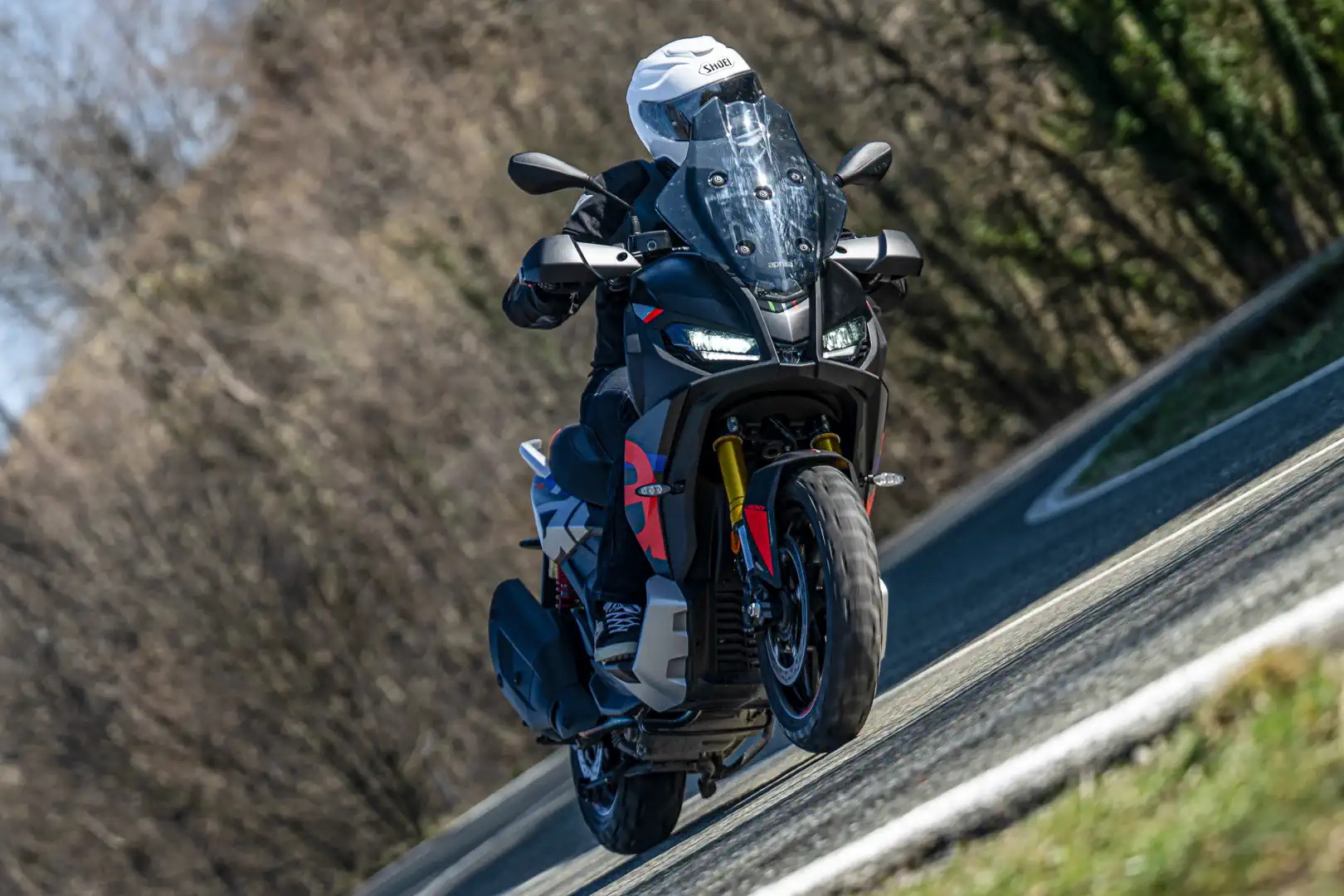
Aprilia is bringing a scooter to North America, and it’s one designed to appeal to adventure motorcyclists. The SR GT 400 is a mid-size scooter built around a steel motorcycle-style frame, a 399cc single, and off-road-ready hardware. It reaches US dealers as soon as this month. Don Williams and Kelly Callan spent some time riding the Aprilia and were surprised by what they discovered. Is this a real motorcycle or just a good-looking urban scooter?
* * * * *
Cat McLeod is founder and owner of Leod Escapes, the ultimate tour company for sport-minded motorcycle riders. Cat talks to us this segment about some of his amazing European experiences and tours that include of course, riding some amazing MotoGP tracks on new BMW S1000RRs. If you like what you hear, now is the time to book your trip of a lifetime, so visit LeodEscapes.com to find out more.
* * * * *
Our guest this episode is Terry Vance, the multiple Motorcycle and Motorsports Hall-of-Famer. Terry is of course the former professional motorcycle drag racer, team owner, and co-founder of the high-performance parts company Vance & Hines. Teejay Adams chats with Terry about his incredible career that includes being the first rider to hit 200 mph in the standing quarter-mile.
Having won this year’s MotoAmerica Mission King of the Baggers championship with Hayden Gillim riding the Vance & Hines factory Indian Challenger, and with Harley-Davidson’s recent withdrawal, Terry gives us his thoughts on where the series might go from here.
* * * * *
Here’s quick reminder to check out our monthly digital magazine. It’s filled with everything you want to read on motorcycling, including some things you’ve probably not seen elsewhere. It’s absolutely free and you will find it on the Apple App Store and of course on Google Play as well.
Don’t forget to leave us your comments on our social media—we’re on all the usual platforms at Ultimate Motorcycling. We love hearing your feedback… so good or bad, please let us know what you think. If there’s something you’d like us to cover, we’d love to hear those ideas too!
We use cookies and browser activity on this website
Functional
Always active
The technical storage or access is strictly necessary for the legitimate purpose of enabling the use of a specific service explicitly requested by the subscriber or user, or for the sole purpose of carrying out the transmission of a communication over an electronic communications network.
Preferences
The technical storage or access is necessary for the legitimate purpose of storing preferences that are not requested by the subscriber or user.
Statistics
The technical storage or access that is used exclusively for statistical purposes.The technical storage or access that is used exclusively for anonymous statistical purposes. Without a subpoena, voluntary compliance on the part of your Internet Service Provider, or additional records from a third party, information stored or retrieved for this purpose alone cannot usually be used to identify you.
Marketing
The technical storage or access is required to create user profiles to send advertising, or to track the user on a website or across several websites for similar marketing purposes.
Advertising helps us keep our content available for free, so adjusting your ad blocking settings will help us.
We appreciate your support!
i
How to Allow Ads on This Site
Depending on your setup, ads may be blocked by a browser extension, VPN, antivirus software, or other application. Here are some common ways to allow ads:
Browser Extensions (e.g., Adblock, uBlock, etc.)
Click the extension icon in your browser toolbar.
Look for an option like "Don't run on pages on this site" or "Pause on this site".
Save the change and refresh the page.
VPNs with Ad Blocking (e.g., NordVPN, Proton VPN, etc.)
Open your VPN app.
Go to settings or features.
Disable any ad blocking or tracking protection features.
Refresh the page.
Antivirus Software or Other Privacy Tools
Check for web protection, ad filtering, or browser privacy settings.
Click the power button to disable it for this site.
Refresh the page.
Not sure what's blocking ads? Look for tools with privacy or filtering features, or check your browser extensions. We only use respectful, non-intrusive advertising.