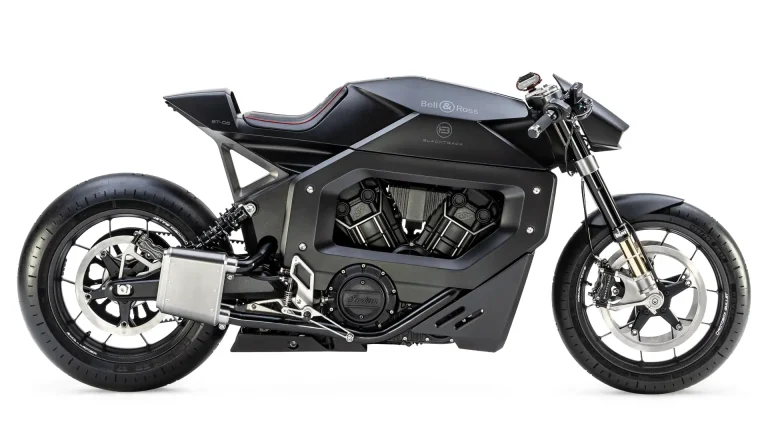
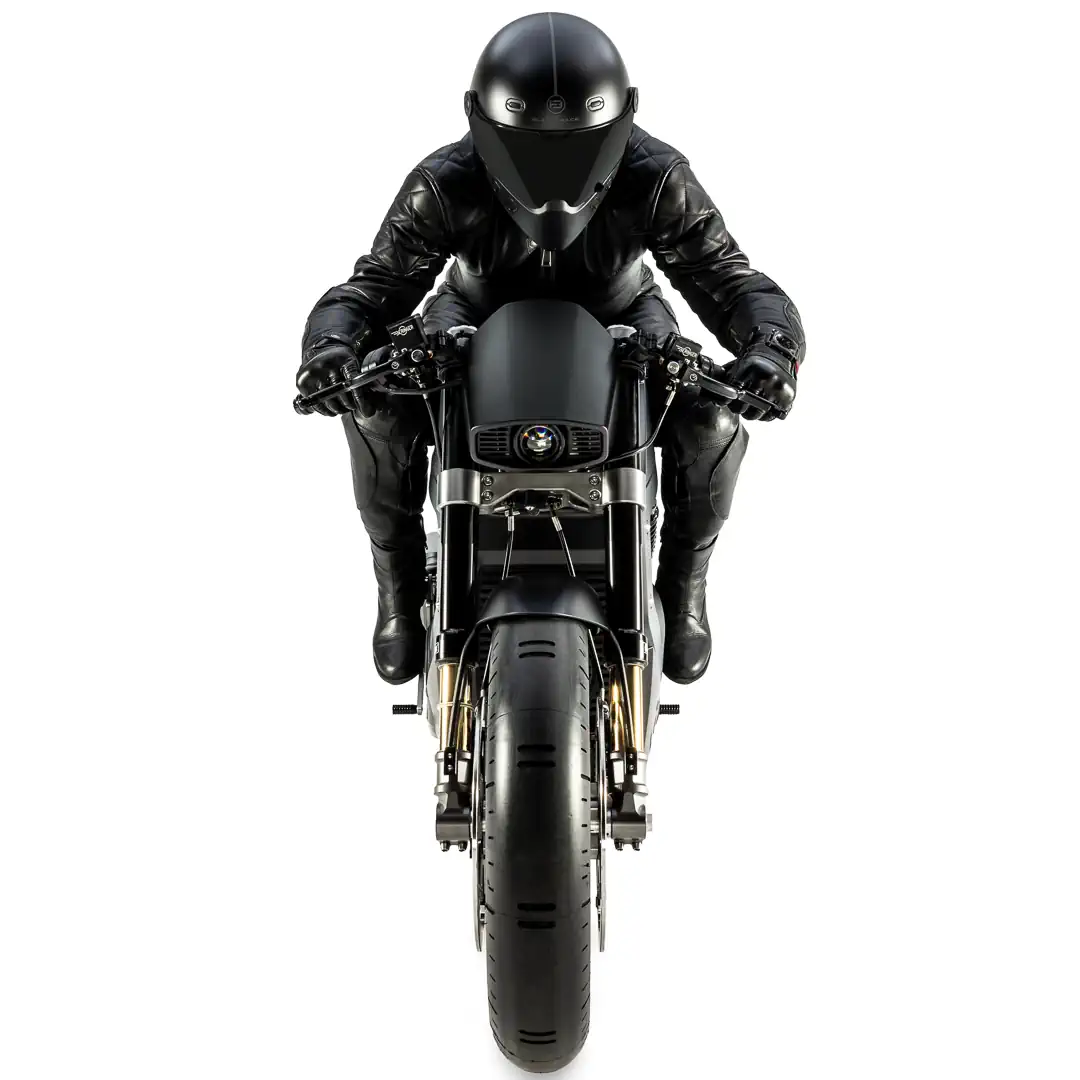
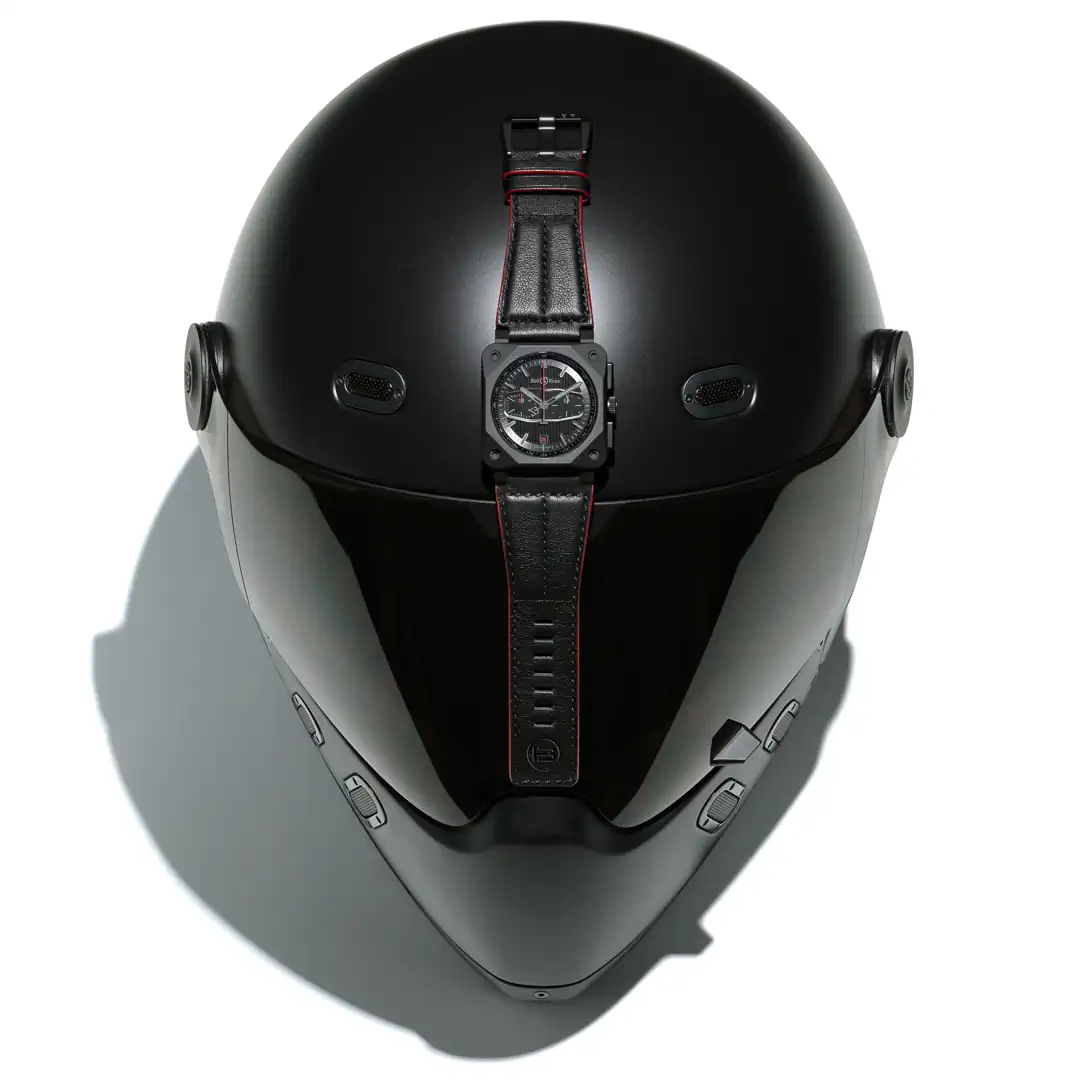
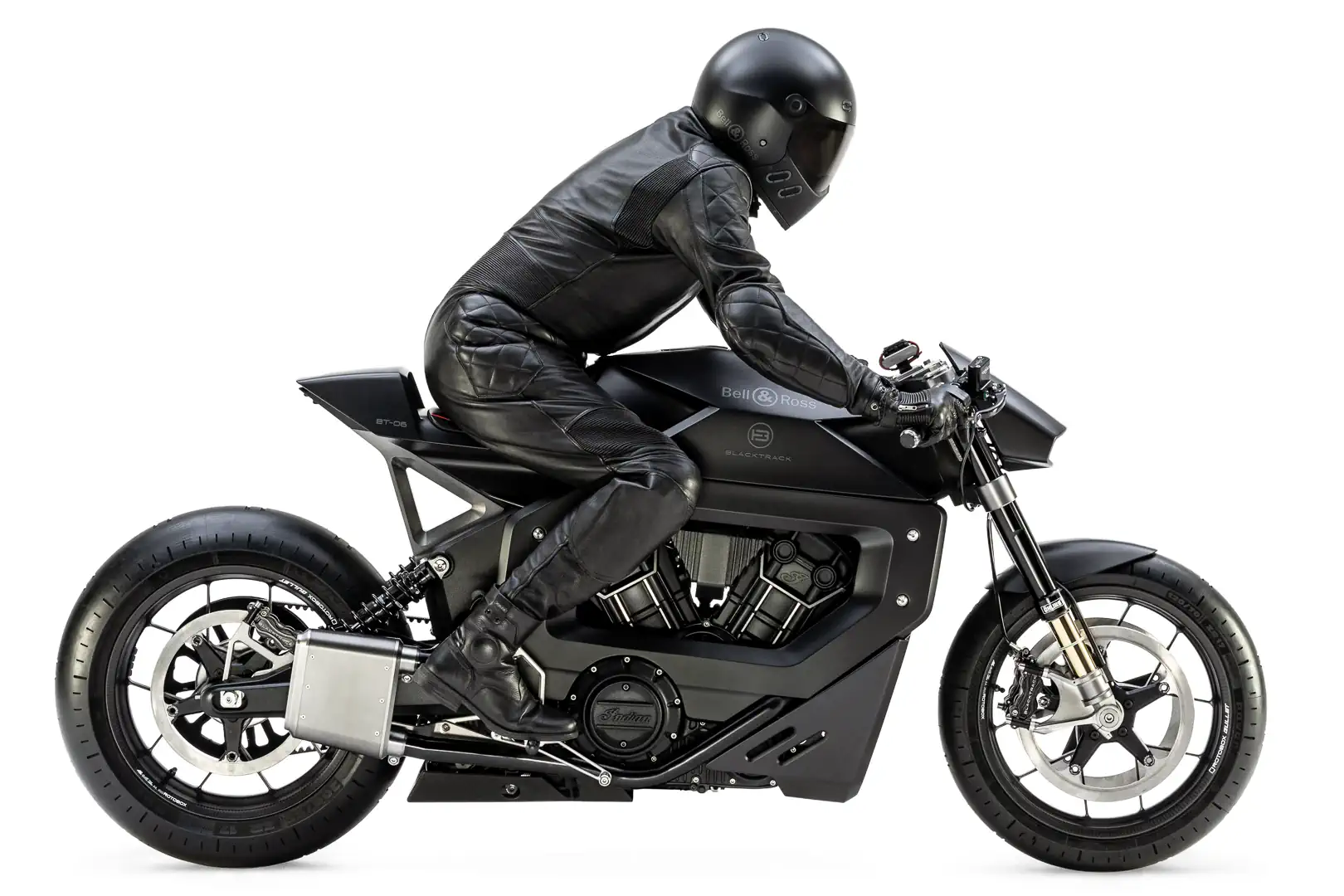
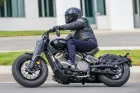
When you first gaze at the Sacha Lakic Design Blacktrack BT-06, your perception is challenged. The machine is plainly a motorcycle. There are two wheels, a seat, and an Indian Scout V-twin in plain sight. However, it has been chiseled into shapes that the eye, trained on the soft-shouldered curves of most production bikes, does not quite know what to do with. Light catches on flat planes. Shadow gathers in long, deliberate triangles. The fairing wears facets the way a cut diamond does, except the gem in question is matte and unrepentantly black. The BT-06 is a reminder that, in certain hands, the word design still means something close to its old Latin sense: to mark out, to ordain.
To fully appreciate the BT-06, you must understand its creator, Sacha Lakic. He was born in Belgrade in 1964, into a household where he learned the discipline of design first-hand. His father was a fashion designer who worked for Givenchy, Nina Ricci, and Pierre Cardin. He taught his son the mechanics of color and proportion before either knew it would become a career for Sacha.
Along the way, the family relocated to Paris while Lakic was still a boy. The City of Lights proved transformative.
Lakic never went to design school. Instead, by 17, he was already working on his career. At 21, he was an intern at Peugeot, and the following year, he was apprenticed to the French automotive designer Alain Carré. By 1988, at the still tender age of 24, he had been hired to head motorcycle design at MBK-Yamaha. There, he was responsible for concepts, production models, and show bikes alike.
In 1994, he opened his own studio in Paris. Lakic’s work since has been the work of a polymath who refuses to be boxed in by category. His Onda furniture line for Roche Bobois won the Compasso d’Oro, the world’s most prestigious industrial design prize. He shaped the Bubble sofa for the same house, an object that added domestic furniture to the vocabulary of inflatable architecture. It has since become a permanent fixture of the Roche Bobois catalog.
Lakic conjured street furniture under the banner of Stay Concrete. He co-founded Bogarel, turning to designing furniture for dogs and cats. In lesser hands, it would have been a vanity project. Instead, it became a study of negative space and of how small bodies inhabit it.
He gave the Venturi electric supercars their undeniable physiognomy, drawing the lines of the exotic 2004 Fétish, the first all-electric sports car sold to the public. 2006 brought the Eclectic, a solar-powered runabout that Time magazine named the second-most-intelligent product of 2007, immediately after the iPhone. He directed the silhouettes of Voxan motorcycles for the better part of a decade.
Then, in 2016, he founded his own marque: Blacktrack. He began producing the small numbered series of bespoke café racers for which he is now best known. “The goal,” he has said of the work, “is to create functional products full of passion that give their owners pleasure and stir up emotion.” Designers say this kind of thing all the time; Lakic delivered it.
His biography matters because it explains the BT-06. The motorcycle is a product of his accumulated knowledge, skill, and determination.
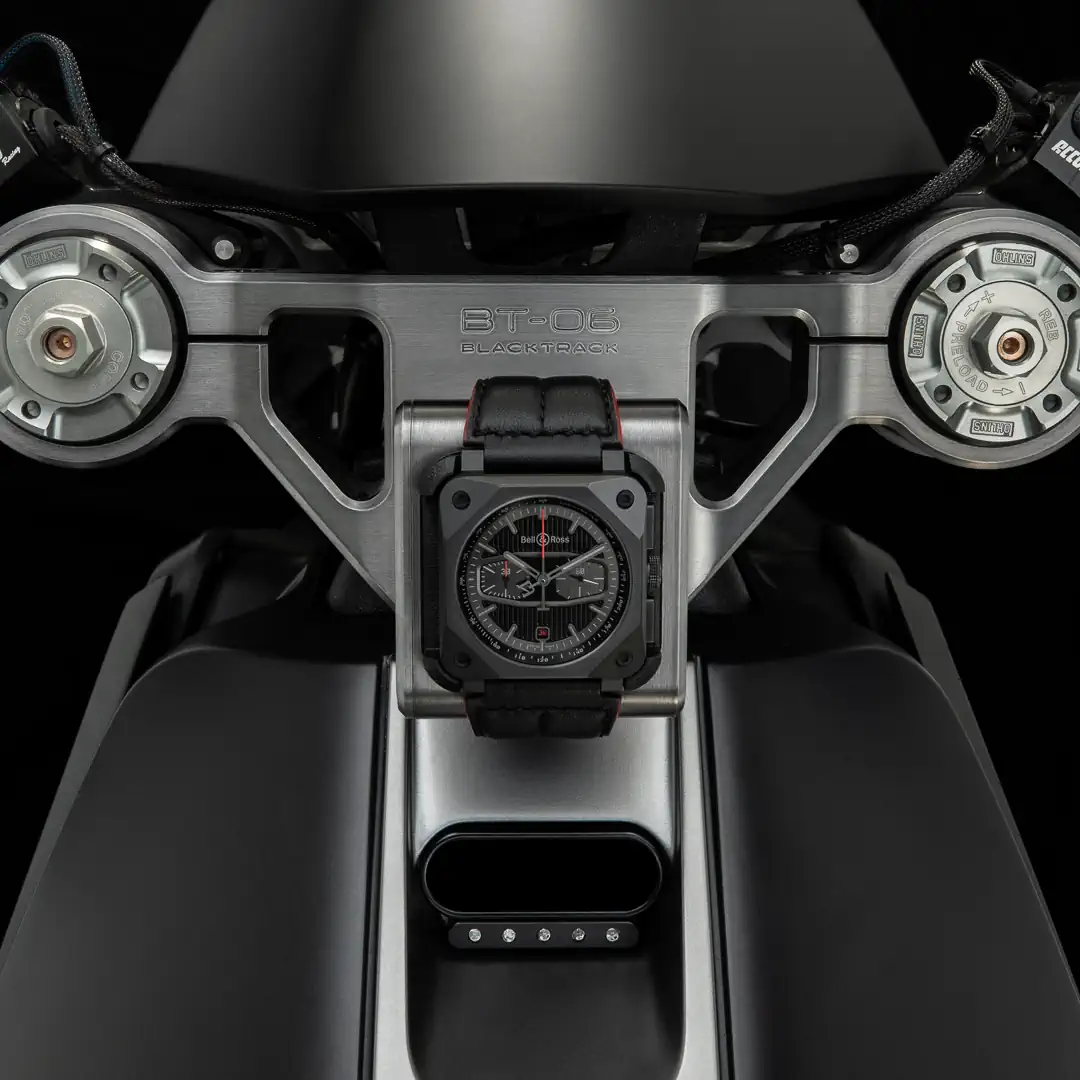
The BT-06 is a motorcycle that braids together the lines of a couture house, the discipline of a Yamaha factory drawing, and the formal severity of a Venturi electric sports coupé into a single machine. Details such as the dashboard and a small ceramic chronograph as its onboard instrument stand as evidence.
The BT-06 is also Lakic’s first formal joint venture with Bell & Ross, the French watchmaker known for translating cockpit instruments into artistic, functional wristwear. Since the early 2000s, Bell & Ross has built its visual reputation on the square case. Both the designer and the brand share the same core conviction: beauty is the shadow that purposeful structure casts.
What Lakic has done with the BT-06 is take that principle and lean it hard into the stealth aircraft aesthetic. The bodywork is not merely tinted dark; it is faceted. Long, angled planes meet at sharp ridges. Surfaces that on most motorcycles would flow into one another are here interrupted. The visual debt to the first generation of stealth jets is openly acknowledged, even celebrated. But the more interesting comparison is closer to home.
The BT-06’s influences reflect Cubist sculpture and Brutalist architecture. It is a canvas for matte, demanding the full spectrum of light, presenting a specular reflection on the windshield, scattered shimmer along the cast wheels, and deep velvet absorption everywhere a flat panel is illuminated.
Despite its dedication to art, the BT-06 remains a motorcycle. The V-twin is exposed in plain view and a piece of mechanical sculpture in its own right. It’s deliberately uncovered, as if to remind the rider that no amount of geometry will move it down the road without propulsion.
The café racer ergonomics are unmistakable. The seat is single-perched, lonely in the best sense. The exhaust header is camouflaged, yet the muffler is prominent. The history-aware cantilevered twin shocks are at odds with the modern inverted Öhlins fork. This is a motorcycle whose discipline of form has been pushed to an inescapably logical extreme.
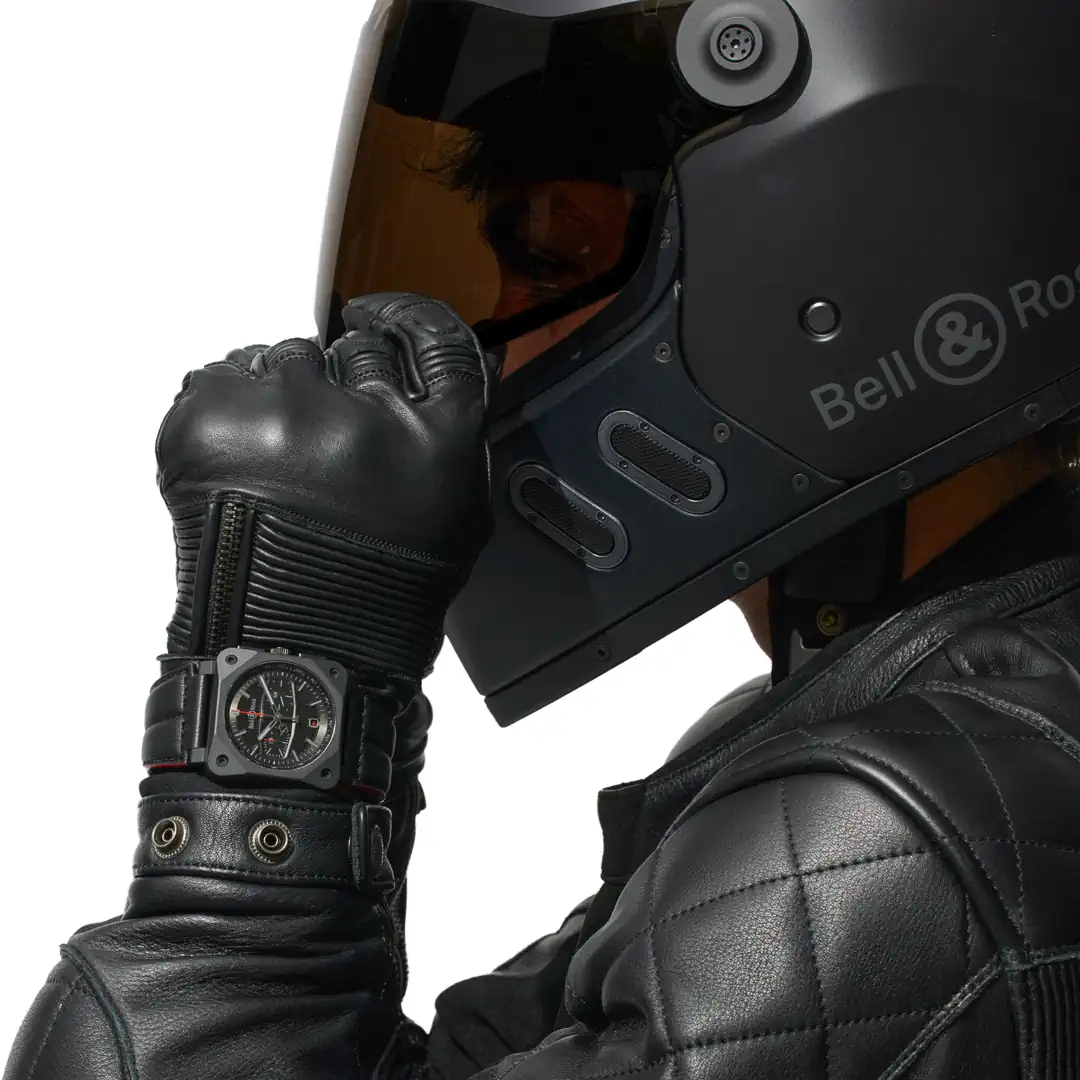
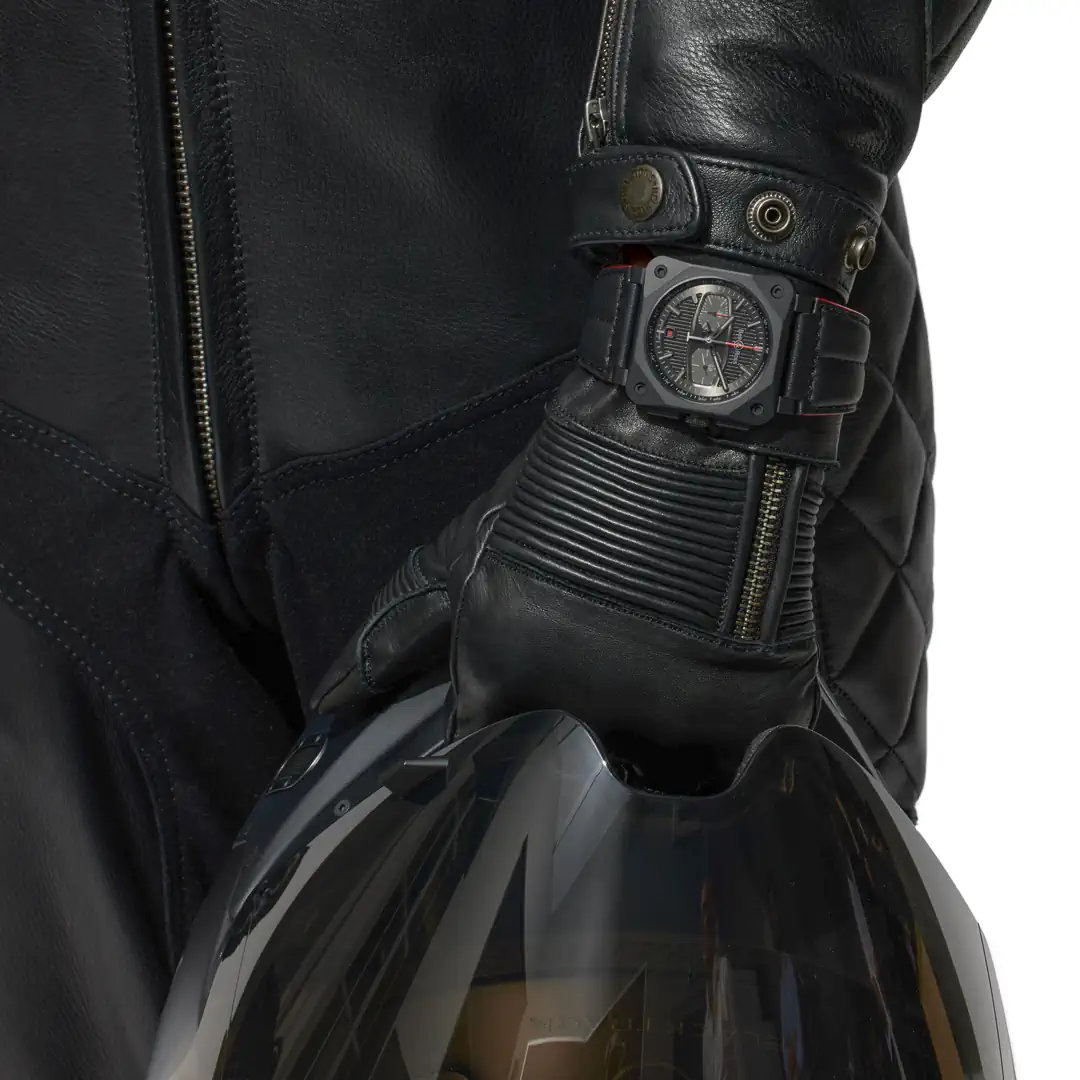
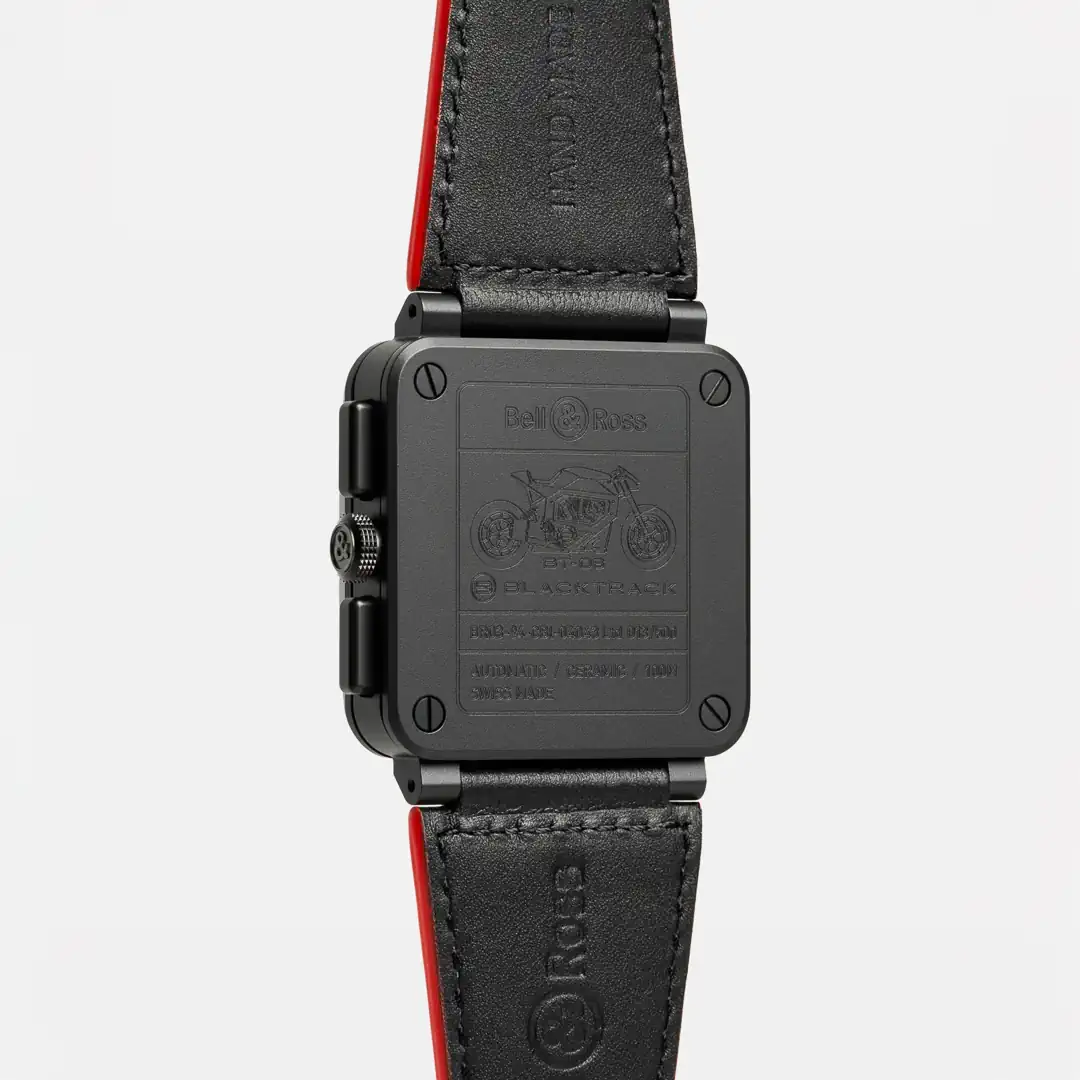
It is on the BT-06’s stripped and sculpted body that one finds the project’s raison d’être. There is a small, recessed, 42mm square bay machined into the central console on the upper triple clamp. It is sized precisely to receive a Bell & Ross BR 03-94 Blacktrack. There, it functions as an onboard instrument, only to be plucked back out and re-strapped on the rider’s wrist at the end of the ride. Remember, the motorcycle and the watch were developed simultaneously, creating a permanent relationship.
The conceit is not new to Bell & Ross. The Nascafe Racer we covered in our July 2011 issue was a unique build with Shaw Harley-Davidson that accepted a BR 01 Carbon in much the same way. In 2014, the B-Rocket concept bike took the silhouettes of the first American jet planes and laid them over a motorcycle’s mechanical bones. That machine, in turn, gave Bruno Belamich, the Bell & Ross creative director, the impulse to create a pair of instrument watches: the BR 01 chronograph and its smaller sibling, the BR 03 B-Rocket.
Each of these collaborations hinges on the same idea: a motorcycle and a wristwatch share a deep kinship as intimate, worn mechanical objects. They rely on fine calibration of forces, either by dedicated individuals or a single-minded team.
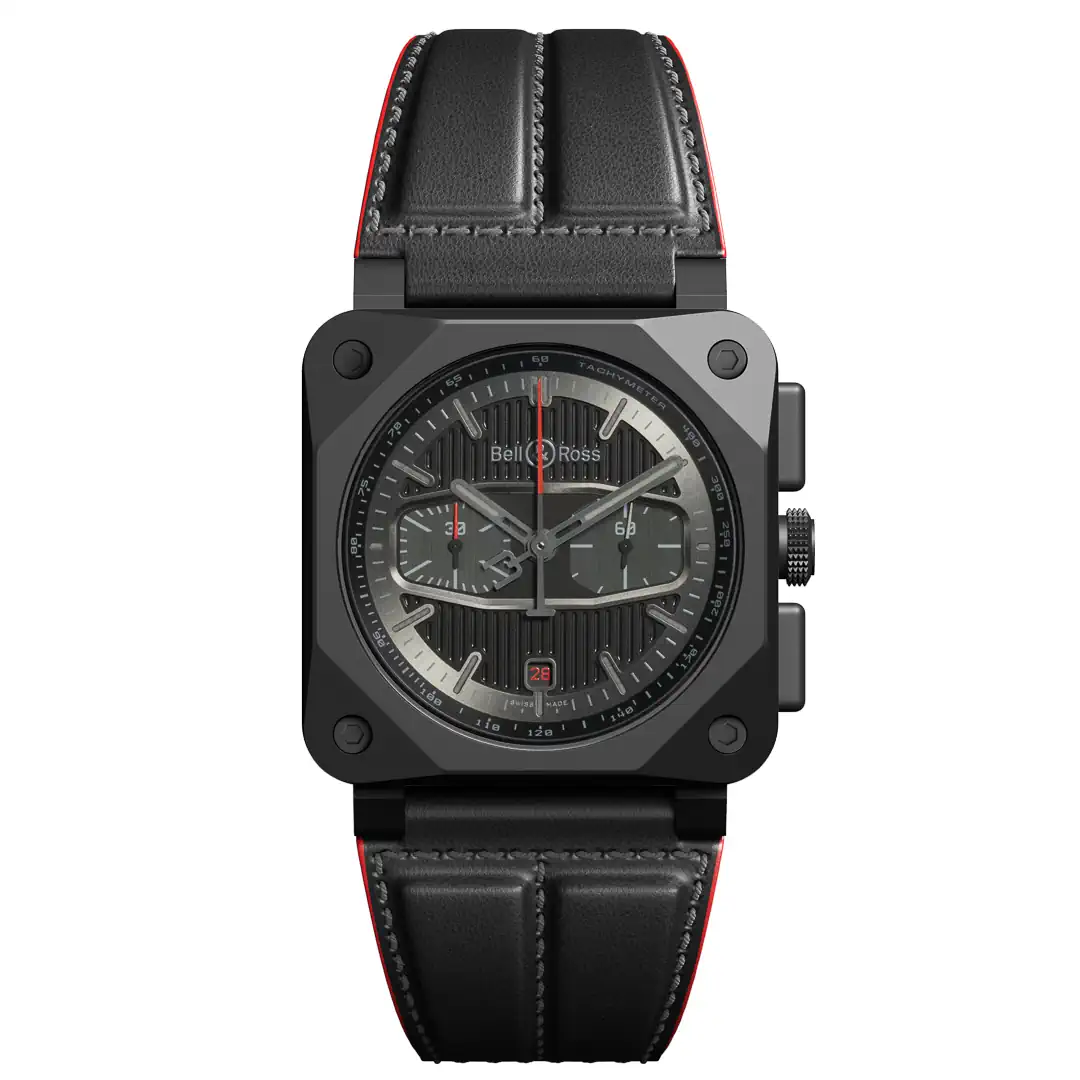
The BT-06 has been refined into something genuinely architectural. The Bell & Ross BR 03-94 Blacktrack is an integrated component rather than an ornament.
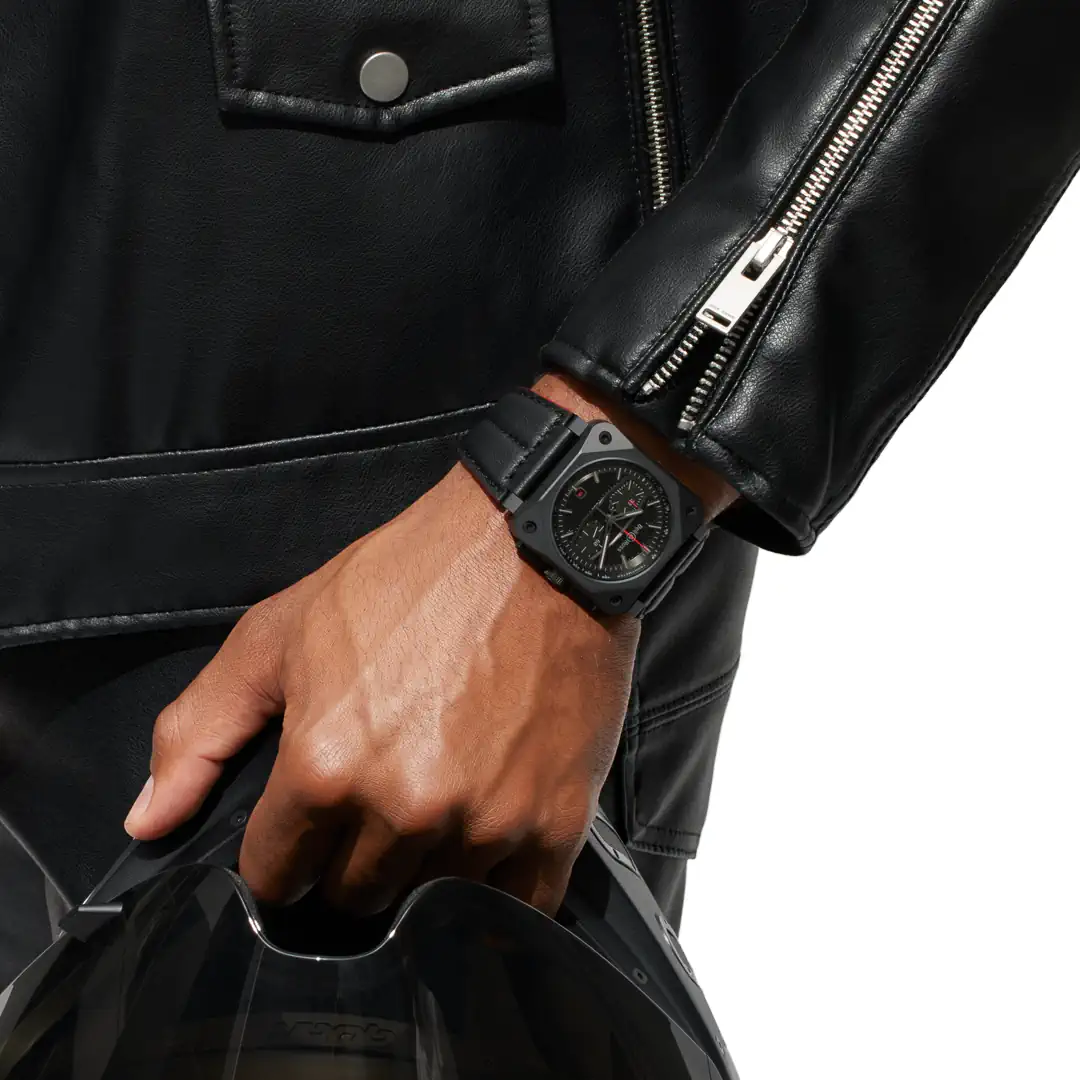
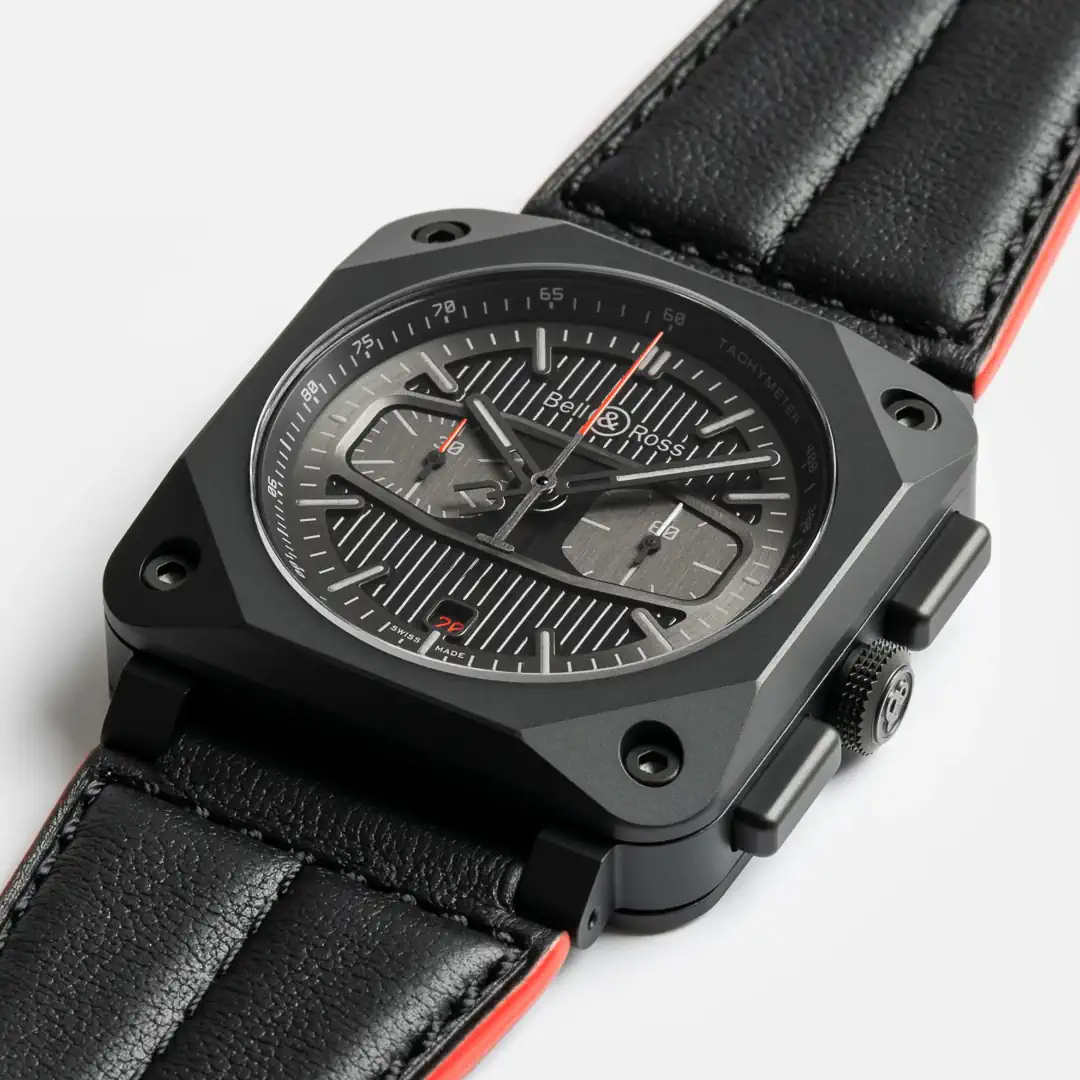
Viewed straight on, the case reads as a square. Examined from above, the bezel reveals its other identity: an octagon faceted in the same idiom as the BT-06’s bodywork.
The dial is where the chronograph most explicitly converses with the motorcycle. The counters are drawn in the manner of motorcycle handlebar gauges. They are small, businesslike, and framed by chrome-grey rings that recall the bezels around a classic speedometer. The 30-minute chronograph totalizer at nine o’clock is washed in the red of a warning gauge, a single saturated note in an otherwise nocturnal palette. There is an openwork lattice running across the lower face, called a “cooling grid” by Bell & Ross. It is a piece of visual engineering that suggests this dial has been calibrated for a hot machine. The hands are skeletonized in metal, and filled with Super-LumiNova so that they continue to speak to the user after the sun goes down.
The BR 03-94 Blacktrack and the BT-06 are the most fully developed expressions of that affinity that Bell & Ross has yet produced. The watch will reach no more than 500 wrists. The motorcycle will be available to a much smaller number, as it is a bespoke production from a small atelier.
The buyer is not presented with an objet à la mode. Lakic and Bell & Ross have aimed at something more permanent. They have produced two objects that act as one. They make the argument that geometry, at high enough discipline, is its own kind of luxury, and that black, at high enough refinement, is its own kind of color. They have made a motorcycle that shows as a sculpture and a watch that, when docked on the dashboard of that sculpture, completes the composition. They have understood that the well-heeled motorcyclist is, increasingly, also a connoisseur of the smaller arts.
Few collaborations get the proportions right. This one does. The BT-06 has top billing, as it is a kinetic sculpture that occupies a room while offering an escape from the ordinary, indoors and out. Together, they remind us that the most serious objects, in any medium, are made by people who have learned to listen to each other’s voices before performing as one.
The Bell & Ross BR 03-94 Blacktrack is available with a purchase price of $7300. Contact Sacha Lakic Design directly to acquire a Blacktrack BT-06.
In our first segment this episode Don Williams tries out his first e-clutch motorcycle: the new Honda CB750 Hornet. The Honda 750 is already an excellent motorcycle in its own right; it’s fast, and it handles beautifully. So, does adding the E-Clutch system to an already fabulous motorcycle really make any difference, or is this just an engineering exercise for the sake of it? Don Williams explains how the system works, and whether the E-Clutch is actually an upgrade.
* * * * *
We’ve talked recently about the upcoming Biketoberfest in a few weeks time, and for sure it’s a great party and social event for motorcycle riders everywhere. But we don’t want to leave you with the impression that’s all it is. So Brian Bentley—born and raised in Daytona Beach—takes us through a sample itinerary of how you could spend your four days plus at Biketoberfest. Truth is, there are a ton of things to do in the October sunshine, and Brian’s example itinerary will give you a lot of ideas. And don’t forget: make sure you download the Biketoberfest mobile App from Apple or Google Play or visit www.biketoberfest.org.
* * * * *
In our second segment this episode Arthur Coldwells chats with Tony Bracalente, founder of Ryder-Gear. Tony is a Navy veteran and was a nuclear engineer on submarines; he’s also a frequent track rider and racer. He founded Ryder-Gear as a result of his own track riding needs, and after friends kept asking him to help them out with what they needed, he eventually started the company. Tony’s interesting background and story-telling ability gives some insight into what it takes to improve motorcycle safety both on the track, and on the street.
* * * * *
Here’s quick reminder to check out our monthly digital magazine. It’s filled with everything you want to read on motorcycling, including some things you’ve probably not seen elsewhere. It’s absolutely free and you will find it on the Apple App Store and of course on Google Play as well.
Don’t forget to leave us your comments on our social media—we’re on all the usual platforms at Ultimate Motorcycling. We love hearing your feedback… so good or bad, please let us know what you think. If there’s something you’d like us to cover, we’d love to hear those ideas too!
We use cookies and browser activity on this website
Functional
Always active
The technical storage or access is strictly necessary for the legitimate purpose of enabling the use of a specific service explicitly requested by the subscriber or user, or for the sole purpose of carrying out the transmission of a communication over an electronic communications network.
Preferences
The technical storage or access is necessary for the legitimate purpose of storing preferences that are not requested by the subscriber or user.
Statistics
The technical storage or access that is used exclusively for statistical purposes.The technical storage or access that is used exclusively for anonymous statistical purposes. Without a subpoena, voluntary compliance on the part of your Internet Service Provider, or additional records from a third party, information stored or retrieved for this purpose alone cannot usually be used to identify you.
Marketing
The technical storage or access is required to create user profiles to send advertising, or to track the user on a website or across several websites for similar marketing purposes.