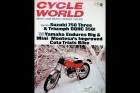
The cover story of Editor/publisher Floyd Clymer’s November 1956 issue of Cycle magazine is the story of the world motorcycle land speed record set with a normally aspirated, fuel-burning (80/20 methanol/nitromethane) Triumph streamliner piloted by Texan Johnny Allen at the Bonneville Salt Flats.
In fact, the salt racing team from Dalio’s Triumph in Fort Worth set a total of six class records that September day in Utah nearly 70 years ago. Their record haul included:
FIM World Records
650cc, 750cc, and 1000cc streamlined: One kilometer (214.17 mph) and for one mile (214.40 mph) in a Triumph Thunderbird by Johnny Allen.
AMA National records
30.5 cubic inch Class A streamlined over one mile: 198.020 mph in a Triumph Tiger 100 by Johnny Allen.
40 cubic inch Class A streamlined over one mile: 214.40 mph in a Triumph Thunderbird by Johnny Allen.
30.5 cubic inch Class C non-streamlined over one measured mile: 128.91 mph on a Triumph Tiger 100 by 16-year-old Jess Thomas.
Allen’s records erased the world record of 210 mph by Wilhelm Herz, piloting a supercharged NSU only a month earlier at Bonneville. At the time, there was no class distinction between forced-induction and normally aspirated piston-powered machines. Jess Thomas’ Class C record displaced the AMA National record speed set only days earlier by 18-year-old Phillip Fagan, also of Fort Worth, on a Norton 88. Fagan’s two-way average speed for the measured mile was 127.32 mph.
Though he held the 30.5 c.i. AMA national record for only a few days, 18-year-old Phil Fagan and his Norton 88 (lower-right image) did get some ink in Cycle.
Cycle’s coverage explains an oft-repeated story about the FIM not recognizing Allen’s 1956 record because no FIM representatives were present when the record was set. However, based on the information Cycle provided, it was the 192 mph record that Allen had set in 1955 that was not witnessed by FIM representatives and disallowed; the FIM had representatives on hand for the 1956 meet.
Nonetheless, according to author Peter Carrick, writing in the Encyclopaedia of Motor-Cycle Sport, the FIM investigated the assertion of Allen’s 1956 world record claim at NSU’s. It wasn’t until April 1957 that the FIM denied the recognition of Allen’s record run. For reasons not explained by Carrick, the FIM reopened an investigation into the issue two months later, and again decided against recognition in October 1957.
Cycle noted that, while the Triumph streamliner dubbed the “Texas Cee-gar” copped the magazine’s cover and headlines with runs over 200 mph, it wasn’t the only machine that broke the 200-mph barrier at Bonneville Salt Flats in 1956.
Even though it was not a record-setting effort, according to the Cycle coverage, C.B. Clausen/Bud Hood’s Harley-Davidson-powered, fuel-burning streamliner was the first motorcycle with an engine built in the U.S. to break the 200 mph barrier, reaching 207.37 mph on its down run. Unfortunately, that remarkable performance couldn’t be followed up in the opposite direction due to engine failure, so no record was set.
By the time this ad for the Ariel Square Four Mark II appeared in the November 1956 issue of Cycle, the liter bike had already been in production for 20 years!
Another interesting bit of motorcycle history in the November issue of Cycle was a full-page advertisement for the Ariel Square Four Mark II. That advert included mention of the results of the road test: “This motorcycle repeatedly ran the ¼ mile drag in 12.9 seconds!” Also, the ad’s subhead proudly boasts that the Ariel Square Four is “The ONLY 4 cylinder motorcycle available in America.” Sadly, before the 1950s ended, the Ariel Square Four was no more. The next four-cylinder motorcycle imported into the U.S. was the NSU Prinz-powered Münch Mammoth, brought into this country in 1967 by none other than Floyd Clymer.
Hello and welcome again to the Motos and Friends Podcast. This episode is brought to you by Leod Escapes.
* * * * *
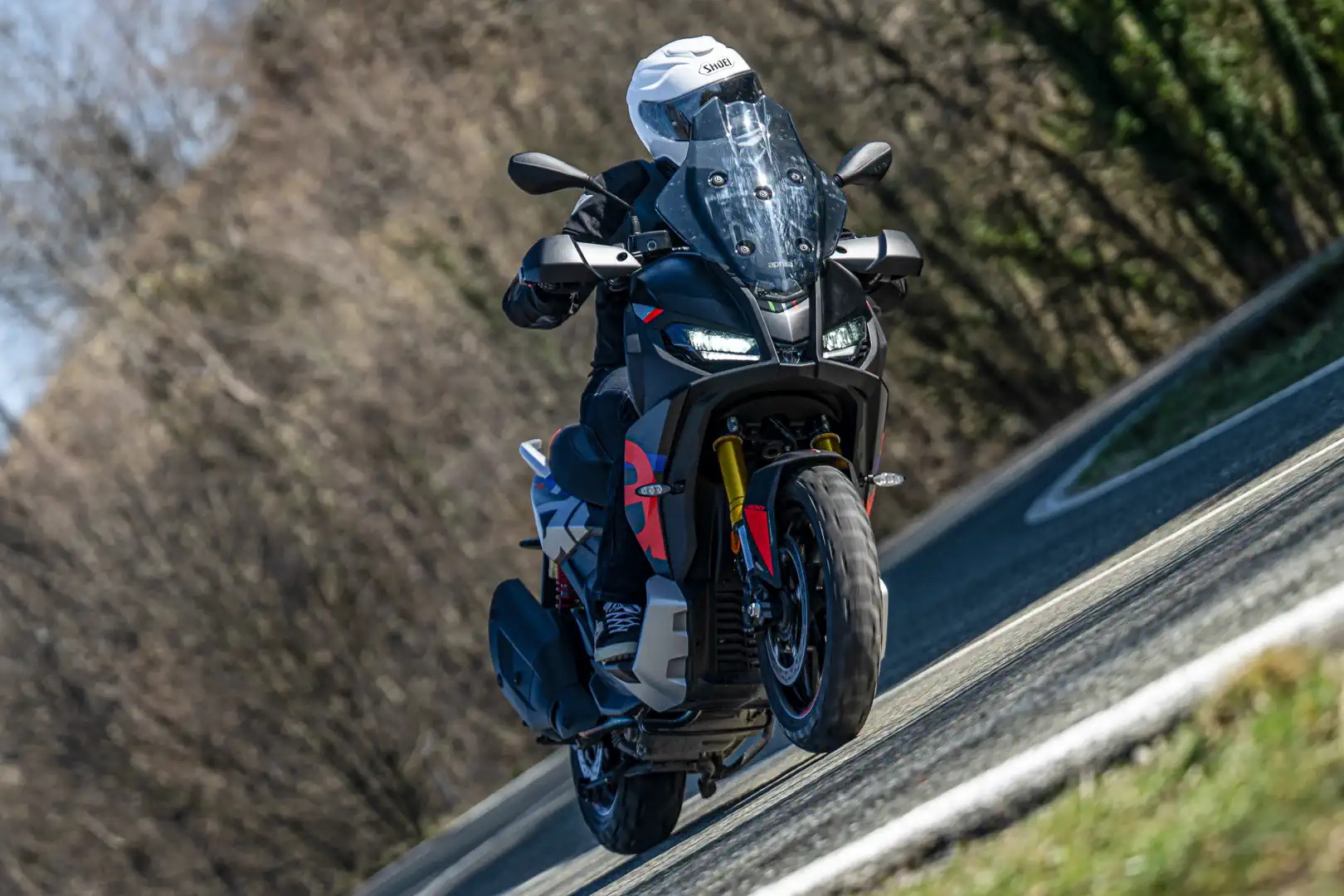
Aprilia is bringing a scooter to North America, and it’s one designed to appeal to adventure motorcyclists. The SR GT 400 is a mid-size scooter built around a steel motorcycle-style frame, a 399cc single, and off-road-ready hardware. It reaches US dealers as soon as this month. Don Williams and Kelly Callan spent some time riding the Aprilia and were surprised by what they discovered. Is this a real motorcycle or just a good-looking urban scooter?
* * * * *
Cat McLeod is founder and owner of Leod Escapes, the ultimate tour company for sport-minded motorcycle riders. Cat talks to us this segment about some of his amazing European experiences and tours that include of course, riding some amazing MotoGP tracks on new BMW S1000RRs. If you like what you hear, now is the time to book your trip of a lifetime, so visit LeodEscapes.com to find out more.
* * * * *
Our guest this episode is Terry Vance, the multiple Motorcycle and Motorsports Hall-of-Famer. Terry is of course the former professional motorcycle drag racer, team owner, and co-founder of the high-performance parts company Vance & Hines. Teejay Adams chats with Terry about his incredible career that includes being the first rider to hit 200 mph in the standing quarter-mile.
Having won this year’s MotoAmerica Mission King of the Baggers championship with Hayden Gillim riding the Vance & Hines factory Indian Challenger, and with Harley-Davidson’s recent withdrawal, Terry gives us his thoughts on where the series might go from here.
* * * * *
Here’s quick reminder to check out our monthly digital magazine. It’s filled with everything you want to read on motorcycling, including some things you’ve probably not seen elsewhere. It’s absolutely free and you will find it on the Apple App Store and of course on Google Play as well.
Don’t forget to leave us your comments on our social media—we’re on all the usual platforms at Ultimate Motorcycling. We love hearing your feedback… so good or bad, please let us know what you think. If there’s something you’d like us to cover, we’d love to hear those ideas too!
We use cookies and browser activity on this website
Functional
Always active
The technical storage or access is strictly necessary for the legitimate purpose of enabling the use of a specific service explicitly requested by the subscriber or user, or for the sole purpose of carrying out the transmission of a communication over an electronic communications network.
Preferences
The technical storage or access is necessary for the legitimate purpose of storing preferences that are not requested by the subscriber or user.
Statistics
The technical storage or access that is used exclusively for statistical purposes.The technical storage or access that is used exclusively for anonymous statistical purposes. Without a subpoena, voluntary compliance on the part of your Internet Service Provider, or additional records from a third party, information stored or retrieved for this purpose alone cannot usually be used to identify you.
Marketing
The technical storage or access is required to create user profiles to send advertising, or to track the user on a website or across several websites for similar marketing purposes.