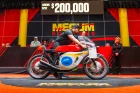
Nearly 60 years after it disappeared from the marketplace, Matchless motorcycles still stand as one of the most respected names in British motorcycling history. Founded in London at the close of the 19th century, the brand earned its reputation through solid engineering, practical design, and impressive racing achievements.
The company began when Henry Herbert Collier, a bicycle manufacturer in Plumstead, Southeast London, registered the name “Matchless” in 1899 for his firm, H. Collier & Sons. The ambitious name implied a machine without equal. His sons, Charlie and Harry, soon joined the business, experimenting with motorized cycles around 1901. They fitted 2.75-horsepower MMC engines to reinforced bicycle frames, relying on belt drive and pedal assistance for the earliest rides.
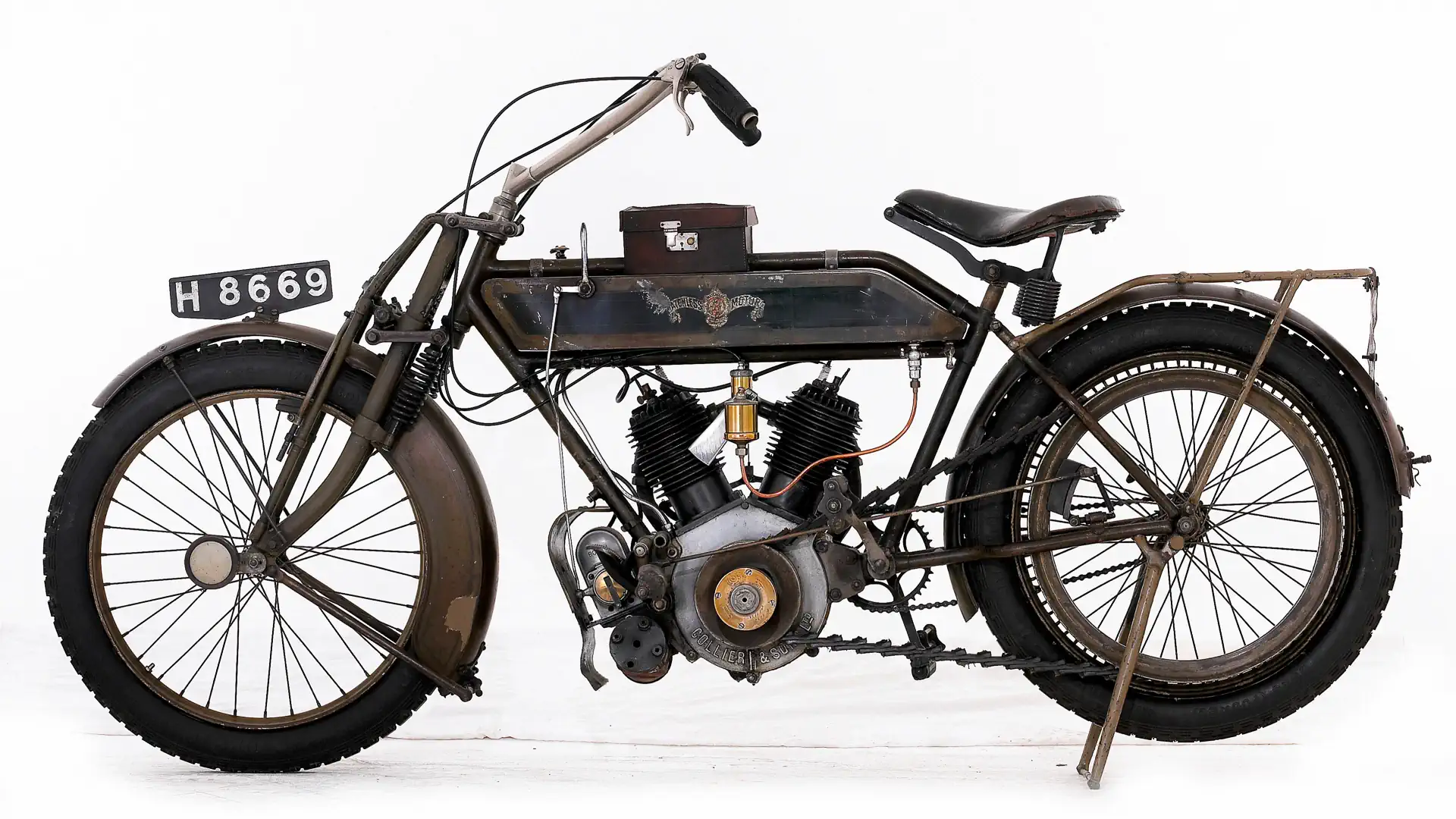
1912 Matchless.By 1905, the Colliers had progressed from moped to more sophisticated machines. The Matchless motorcycles were powered by John Alfred Prestwich’s J.A.P. V-twin engines and pioneering features, including early versions of swinging-arm rear suspension and leading-link front forks. These advances were well ahead of most competitors, befitting of the Matchless name, and reflected the family’s focus on durable, rideable motorcycles rather than flashy novelty.
1923 Matchless L/2 with Watsonia tourist sidecar.
Racing success quickly elevated Matchless from a local workshop to a nationally recognized marque. The inaugural Isle of Man Tourist Trophy races in 1907 provided the perfect stage.
Charlie Collier entered a single-cylinder Matchless in the single-cylinder class and won outright, averaging 38.21 mph over 10 laps of the demanding St. John’s Short Course, and finishing the 158-mile race in just over four hours. Harry Collier claimed victory in 1909 at nearly 49 mph, and Charlie returned to the winner’s circle in 1910.
1930 Matchless Silver Arrow.
Three consecutive TT wins generated widespread publicity, driving demand for production replicas of the winning machines, complete with similar J.A.P. engines and two-speed gearboxes.
By 1912, Matchless had begun producing its own engines based on proven J.A.P. designs. The motorcycle line expanded to include 998cc V-twins, which proved ideal for the heavy sidecar outfits favored by British families and commercial users.
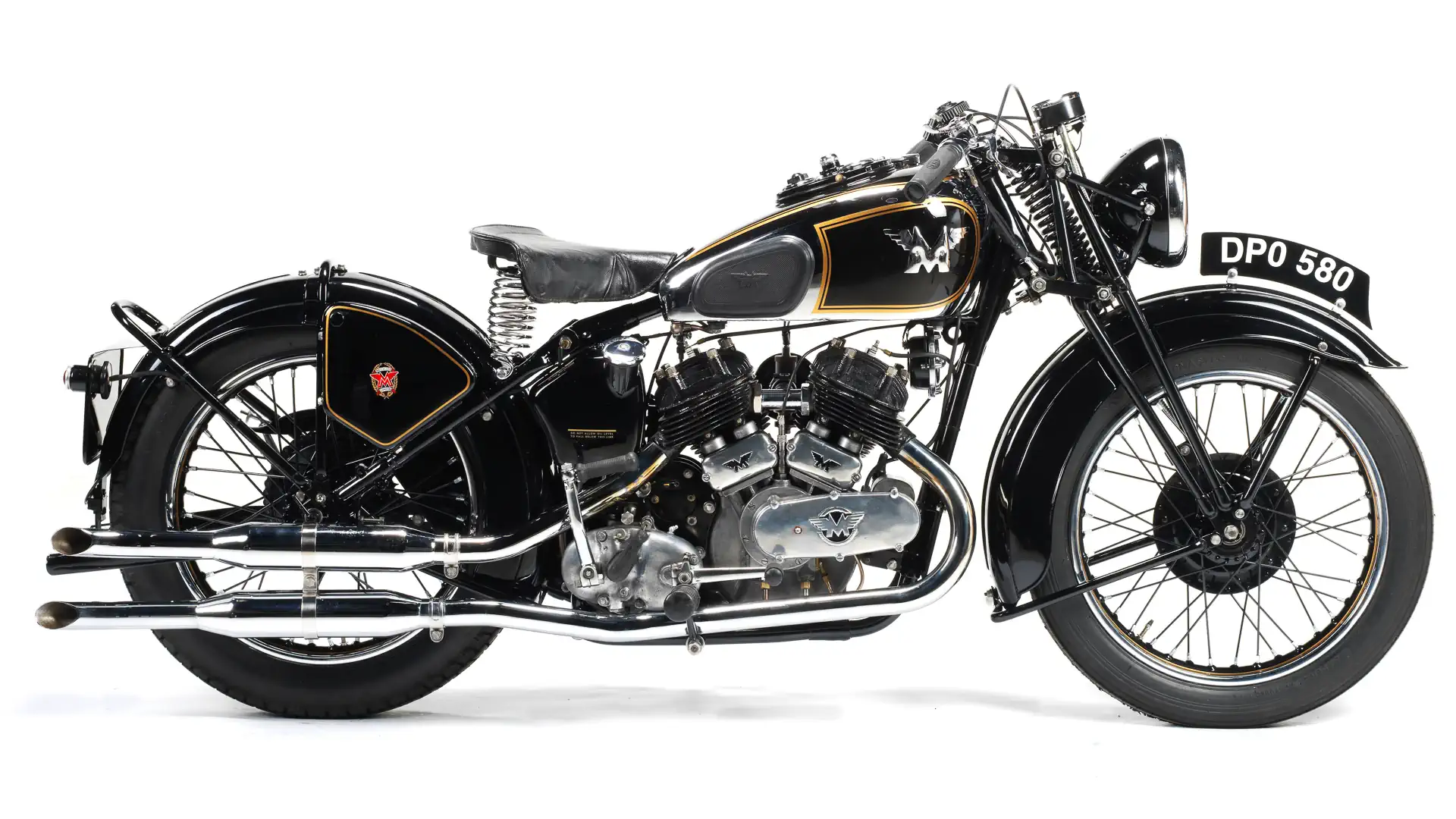
1937 Matchless Model X. This example brought £50,600 at a Bonhams auction in 2017.
During the interwar period, Matchless continued to innovate while maintaining its reputation for reliability. The 1920s saw the introduction of overhead-valve singles and refined V-twins. At the 1930 Olympia Show, the company displayed the Silver Arrow, a compact 394cc side-valve V-twin with cylinders cast in a single block to improve smoothness and reduce vibration.
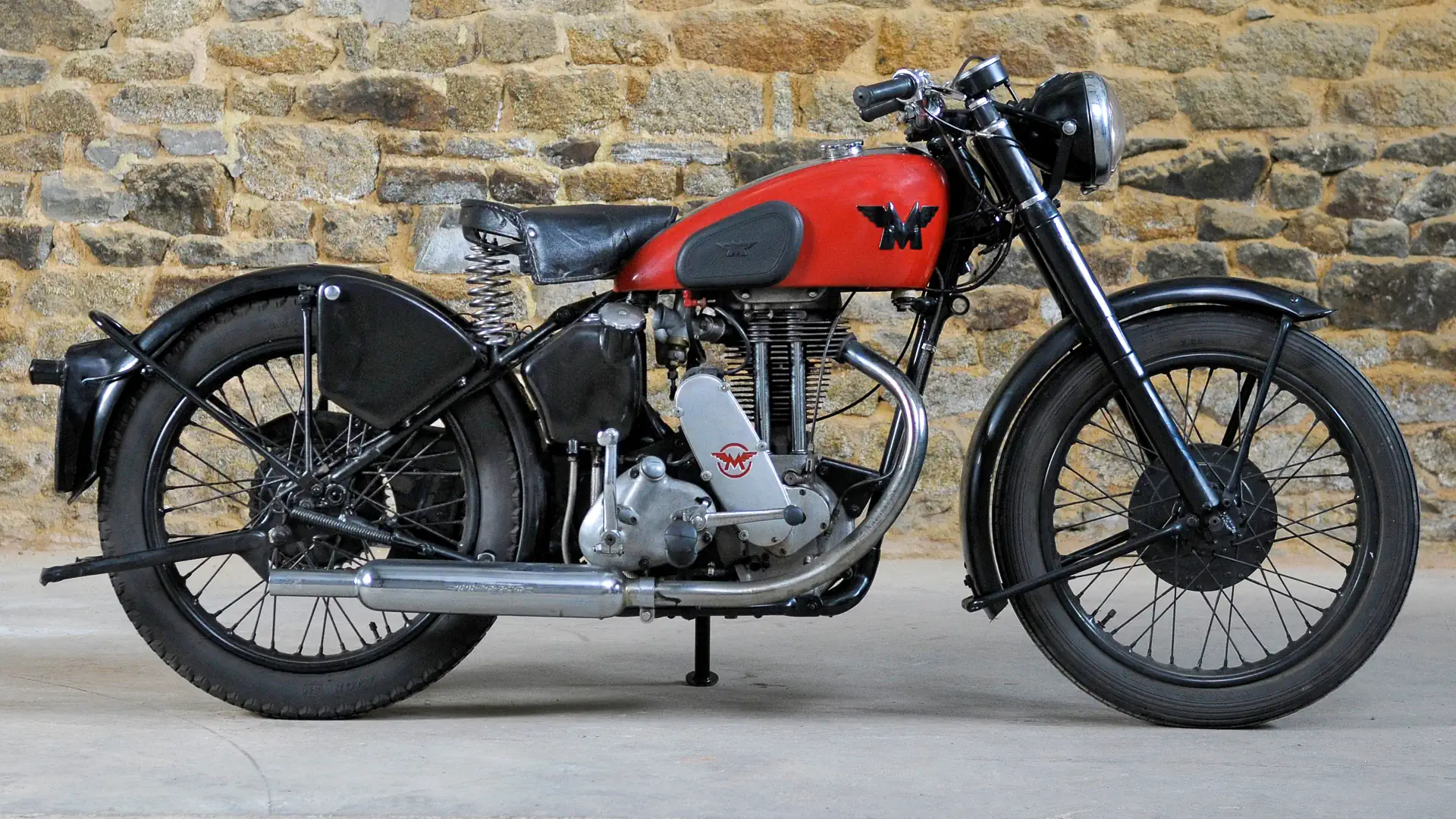
1948 Matchless 3GL.
The following year brought the even more ambitious Silver Hawk, a 593cc SOHC V-4 with a shaft-driven cam gear and premium alloy castings. Though technically advanced and luxurious, the Hawk was costly to produce and never achieved high volume; roughly 500 units were built before production ceased in 1935.
1959 Matchless G9 café racer.
The Matchless Model X was one of the marque’s flagship big V-twins during the 1930s. It was a robust motorcycle that epitomized British engineering of the pre-WWII era. Produced from 1929 through 1940, it was powered by a heavy-duty side-valve V-twin designed primarily for reliability and torque. While particularly suited for sidecar use, the bike also impressed solo riders with its performance and styling. Brough Superior used a variant of the motor for its SS80 model from 1935 on.
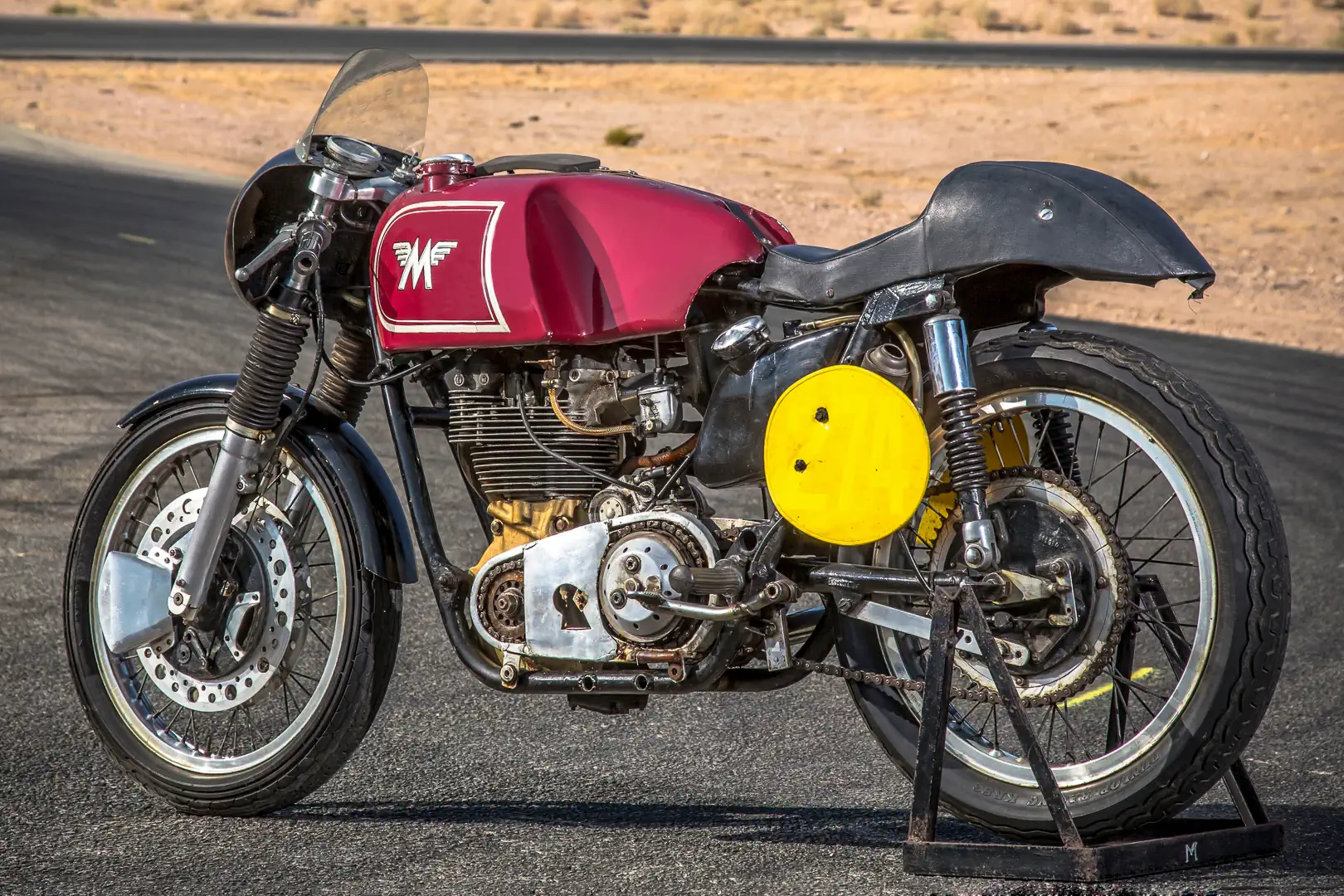
The 1960 Matchless G50 racer sold for $58,000 at a 2013 Bonhams auction at Bally’s Hotel & Casino in Las Vegas.
In 1931, Matchless acquired the struggling AJS brand, with the two marques sharing components and engineering resources. This merger laid the groundwork for the formation of Associated Motor Cycles (AMC) in 1938, which later included Norton, Francis-Barnett, and James brands.
After World War II broke out, Matchless became part of the Allied effort. The 348cc overhead-valve G3 single proved well-suited to dispatch and reconnaissance duties. In 1941, the new G3L (“L” for lightweight) was fitted with telescopic Teledraulic forks, the first significant British advance in front suspension in more than two decades. These rugged, maneuverable singles performed reliably in North African deserts and on European battlefields. In total, Matchless and its AMC partners supplied approximately 80,000 G3 and G3L motorcycles to Allied forces. Many servicemen who rode them during the war became loyal civilian customers afterward.
Matchless G45 production racer.
Postwar civilian production drew heavily on that military experience. The G3 and the 498cc G80 carried forward the wartime singles’ DNA features, including heavy flywheels for strong low-end torque, robust iron engines that ran cool even under hard use, and the proven Teledraulic forks. Riders appreciated their exceptional reliability and low maintenance needs.
The G80 earned a loyal following among police departments, farmers, and long-distance tourers. In 1949, the G80S variant reintroduced swinging-arm rear suspension for improved comfort. Clubman-tuned versions arrived in 1953, offering higher compression and sportier cam profiles for amateur racing and spirited road use. Countless restored G80s remain roadworthy today, a testament to their enduring build quality.
1962 Matchless G5.
Matchless ventured into parallel twins after the war, joining its early British rivals. The 498cc G9 vertical twin debuted in 1949, followed by the 593cc G11 and 646cc G12 in the mid-1950s. While these models provided smooth, comfortable performance for everyday riding, they never matched the sales volume of competitive BSAs or Triumphs.
Racing continued to be an integral part of the Matchless identity in the 1950s. The 1952 G45 production racer mounted Matchless engines in AJS 7R frames, while the 1959 G50 racer featured a 497cc SOHC engine that delivered around 50 horsepower in race tune and a top speed approaching 135 mph. Lighter and more nimble than the Norton Manx, the G50 became a favorite among privateers and club racers. Although the factory ended official road racing support after 1954, G50s continued to score notable victories well into the 1960s.
By the early 1960s, Matchless, along with the entire British motorcycle industry, faced mounting pressure. Japanese manufacturers flooded the market with affordable, technically advanced machines that offered superior reliability, electric starting, and modern styling. Matchless held on as best it could with models such as the 745cc G15 twin and 348cc G5 single.
1962 Matchless G15.
AMC was never a large or highly profitable group, and its earnings declined sharply after modest profits in 1960. Management responded by closing the Norton factory in Birmingham and consolidating all production at Plumstead. They shifted emphasis toward Norton twins for the performance segment and Matchless/AJS singles for the traditional market. However, the strategy could not stem the tide of imports.
In 1966, AMC entered receivership. The assets were acquired by Manganese Bronze Holdings and reorganized as Norton-Villiers. Matchless-badged singles continued in limited production into 1967, when the Plumstead line finally shut down.
A revival effort by Les Harris in the late 1980s produced new G80 models powered by Rotax engines and Italian components. However, that venture ended in 1993 and was unrelated to the original Collier enterprise. They were Matchless motorcycles in name only.
Today, surviving Matchless motorcycles are sought after by collectors and ridden by classic enthusiasts. Clubs around the world maintain the marque’s heritage. The deep, distinctive exhaust note of a well-tuned G80 or G50 evokes the Golden Age of British Motorcycling whenever one appears at a vintage meet.
Hello and welcome again to the Motos and Friends Podcast. This episode is brought to you by Leod Escapes.
* * * * *
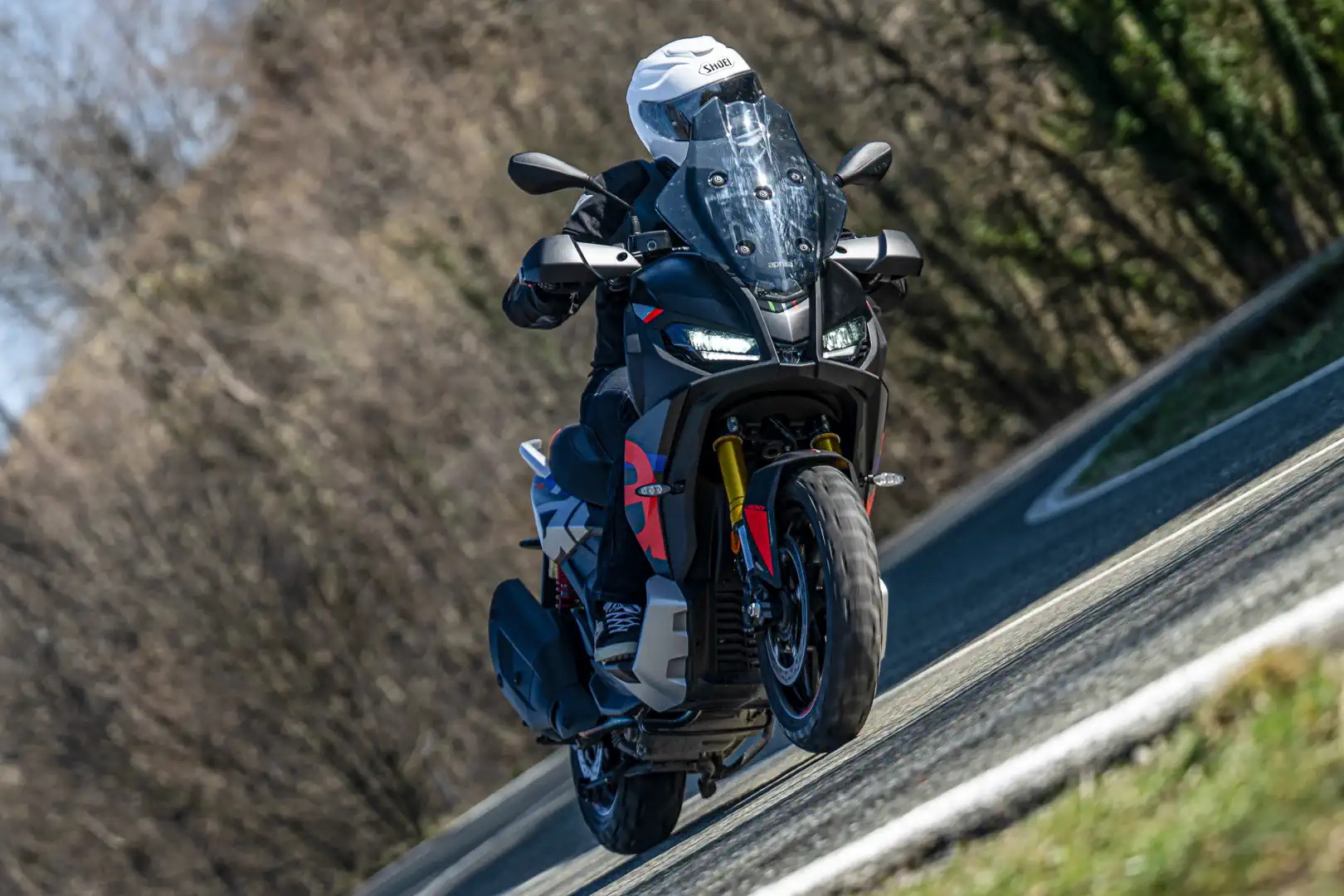
Aprilia is bringing a scooter to North America, and it’s one designed to appeal to adventure motorcyclists. The SR GT 400 is a mid-size scooter built around a steel motorcycle-style frame, a 399cc single, and off-road-ready hardware. It reaches US dealers as soon as this month. Don Williams and Kelly Callan spent some time riding the Aprilia and were surprised by what they discovered. Is this a real motorcycle or just a good-looking urban scooter?
* * * * *
Cat McLeod is founder and owner of Leod Escapes, the ultimate tour company for sport-minded motorcycle riders. Cat talks to us this segment about some of his amazing European experiences and tours that include of course, riding some amazing MotoGP tracks on new BMW S1000RRs. If you like what you hear, now is the time to book your trip of a lifetime, so visit LeodEscapes.com to find out more.
* * * * *
Our guest this episode is Terry Vance, the multiple Motorcycle and Motorsports Hall-of-Famer. Terry is of course the former professional motorcycle drag racer, team owner, and co-founder of the high-performance parts company Vance & Hines. Teejay Adams chats with Terry about his incredible career that includes being the first rider to hit 200 mph in the standing quarter-mile.
Having won this year’s MotoAmerica Mission King of the Baggers championship with Hayden Gillim riding the Vance & Hines factory Indian Challenger, and with Harley-Davidson’s recent withdrawal, Terry gives us his thoughts on where the series might go from here.
* * * * *
Here’s quick reminder to check out our monthly digital magazine. It’s filled with everything you want to read on motorcycling, including some things you’ve probably not seen elsewhere. It’s absolutely free and you will find it on the Apple App Store and of course on Google Play as well.
Don’t forget to leave us your comments on our social media—we’re on all the usual platforms at Ultimate Motorcycling. We love hearing your feedback… so good or bad, please let us know what you think. If there’s something you’d like us to cover, we’d love to hear those ideas too!
We use cookies and browser activity on this website
Functional
Always active
The technical storage or access is strictly necessary for the legitimate purpose of enabling the use of a specific service explicitly requested by the subscriber or user, or for the sole purpose of carrying out the transmission of a communication over an electronic communications network.
Preferences
The technical storage or access is necessary for the legitimate purpose of storing preferences that are not requested by the subscriber or user.
Statistics
The technical storage or access that is used exclusively for statistical purposes.The technical storage or access that is used exclusively for anonymous statistical purposes. Without a subpoena, voluntary compliance on the part of your Internet Service Provider, or additional records from a third party, information stored or retrieved for this purpose alone cannot usually be used to identify you.
Marketing
The technical storage or access is required to create user profiles to send advertising, or to track the user on a website or across several websites for similar marketing purposes.