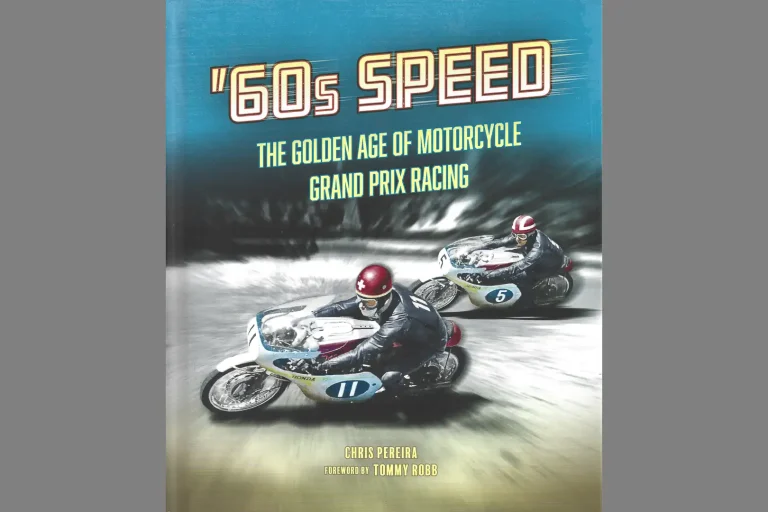
If you are a motorcycle enthusiast with an interest in motorcycle design, development, racing history, and how the intersection of the three contributes to the motorcycles we ride today, the release of a new edition of Chris Pereira’s definitive history of motorcycle grand prix racing of the 1960s is a superb read.
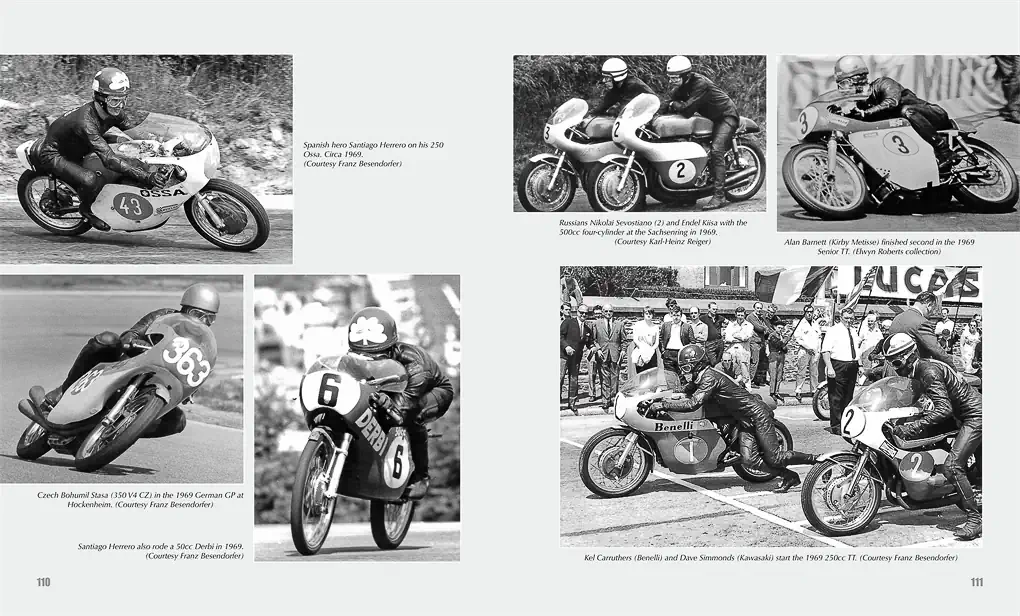
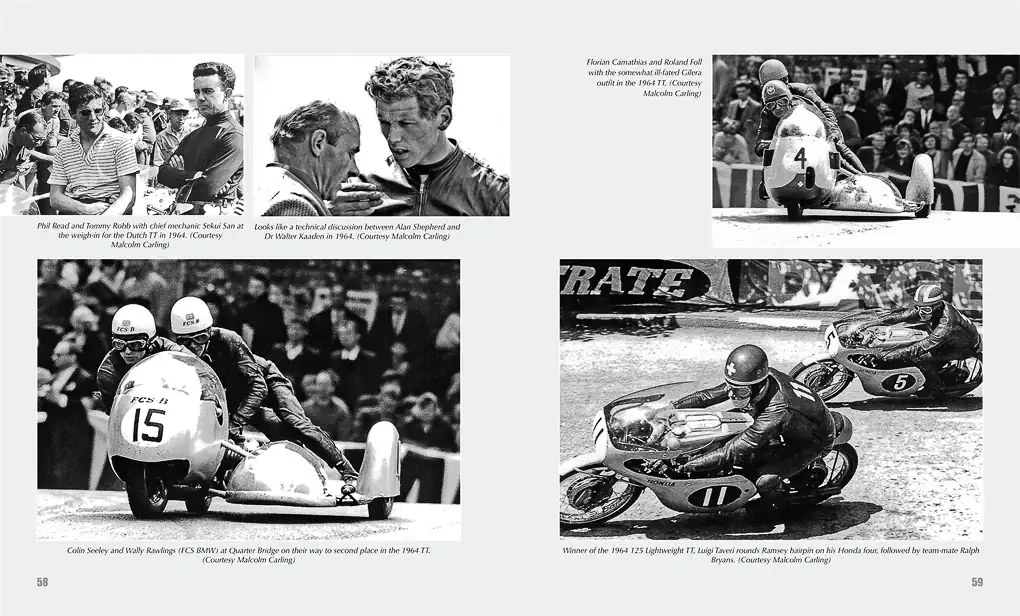
’60s Speed: The Golden Age of Motorcycle Grand Prix Racing owes its insights, superb images, and narrative quality to Pereira’s personal experience as a racer in the 1950s and ’60s, as well as his skill as a historian and writer. The era is brought to life in lavish detail through racing-action images, race bike stills, and portraits of the many people who shaped the period’s events.
Those remarkable period photographs are the contributions of professionals Malcolm Carling, Franz Besendorfer, Karl-Heinz Reiger, Luigi Taveri, Elwin Roberts, Karl-Gunter Peters, and Martyn Harris. Pereira also brought along Roger Oliver’s historical research resources to enrich the narrative.
In addition to the images, the book includes detailed tables of individual Grand Prix race results, World Championship results by displacement class, and Grand Prix statistics across the five displacement classes then being run: 50cc, 125cc, 250cc, 350cc and 500cc, as well as images of key Grand Prix race bikes, and layout diagrams of the 26 Grand Prix circuits in 14 countries. Pereira also details the top six riders in each displacement class for each year of the 1960s, and the top six finishers and winning top speed for each class in each GP event in the decade.
Pereira explains how transformative the 1960s were for motorcycle GP racing, offering remarkable insight into how tough economic conditions nearly ended GP road racing altogether in the 1950s. Major manufacturers such as Norton, AJS, Velocette, NSU, DKW, Gilera, Moto Guzzi, and Mondial, which had made GP racing the venue for fierce competition between brands and riders, saw their revenues fall, leading to the termination of their expensive factory racing efforts. He goes on to explain how the arrival of one new competitor on the international road racing scene in 1959 reversed the downward spiral.
One event, which took place in 1959, proved to be of much greater significance than anyone realized at the time. The arrival of a team of Japanese riders and machines at the TT races only caused mild curiosity, mingled with skepticism and even derision. With the benefit of hindsight, the European debut of the virtually unknown Honda team in 1959 must now be regarded as the defining moment in the postwar history of motorcycle racing. One that proved crucial to the recovery of World Championship grand prix racing. The return of the Honda team to participate in the World Championships in 1960 marked the beginning of a new era.
The subsequent arrival of Suzuki and Yamaha in the fray spurred more brands to follow, new riders to emerge, and the technological battle between two-stroke and four-stroke machines to boil over.
The ’60s spawned legends, including the names of men as well as the machines that carried them to victories and world GP championships. Giacomo Agostini, Mike “The Bike” Hailwood, Gary Hocking, Jim Redman, Phil Read, Bill Ivy, John Surtees, Luigi Taveri, Helmut Fath, Tom Phillis, Ernst Degner, Tommy Robb — who also penned the book’s foreword — and many more.
Their machines, too, etched their names—or designations—into GP racing history. Some because they contributed exotic technology and performance, others because of the number of races they won, and some for their impact in redefining the motorcycle industry.
For example, perhaps no GP bikes live on more vividly than Honda’s six-cylinder screamers, such as the Honda 3RC164 DOHC 24-valve 250cc racer of 1964 and the RC174 for the 350cc class. These machines and their stunning success on the track paved the way for Honda’s groundbreaking four-cylinder CB750 in 1969, followed by the 350, 400, 500, 550, and 900-class fours. In 1979, the six-cylinder liter-class CBX debuted.
In the book’s ten chapters, Pereira gives a year-by-year drill-down into the history made each year. For example, the second chapter covers the evolving war for GP dominance between Honda’s four-strokes and everyone else, including the ever-more-sophisticated two-strokes. It highlights the roles of Dr. Walter Kaaden, who pioneered innovations in two-stroke engine performance, and Frantisek Stastny, who was successful aboard Jawa two-strokes of the day.
Chapter Five details the sensational rivalry between Honda’s Jim Redman and Yamaha’s Phil Read in the battle for the 1964 250cc class World Championship. Read hammered out the World Championship over runner-up Redman, and the story of how he got there is told with stirring detail. Indeed, that is the case for every year of the decade.
The book is set for its official roll-out in October 2026, but it is in stock now, and you can get your copy of ‘60s Speed: The Golden Age of Motorcycle Grand Prix Racing ahead of the release date by ordering directly from the Veloce website.
‘60s Speed Fast Facts
Title:’60s Speed: The Golden Age of Motorcycle Grand Prix Racing
Hello and welcome again to the Motos and Friends Podcast. This episode is brought to you by Leod Escapes.
* * * * *
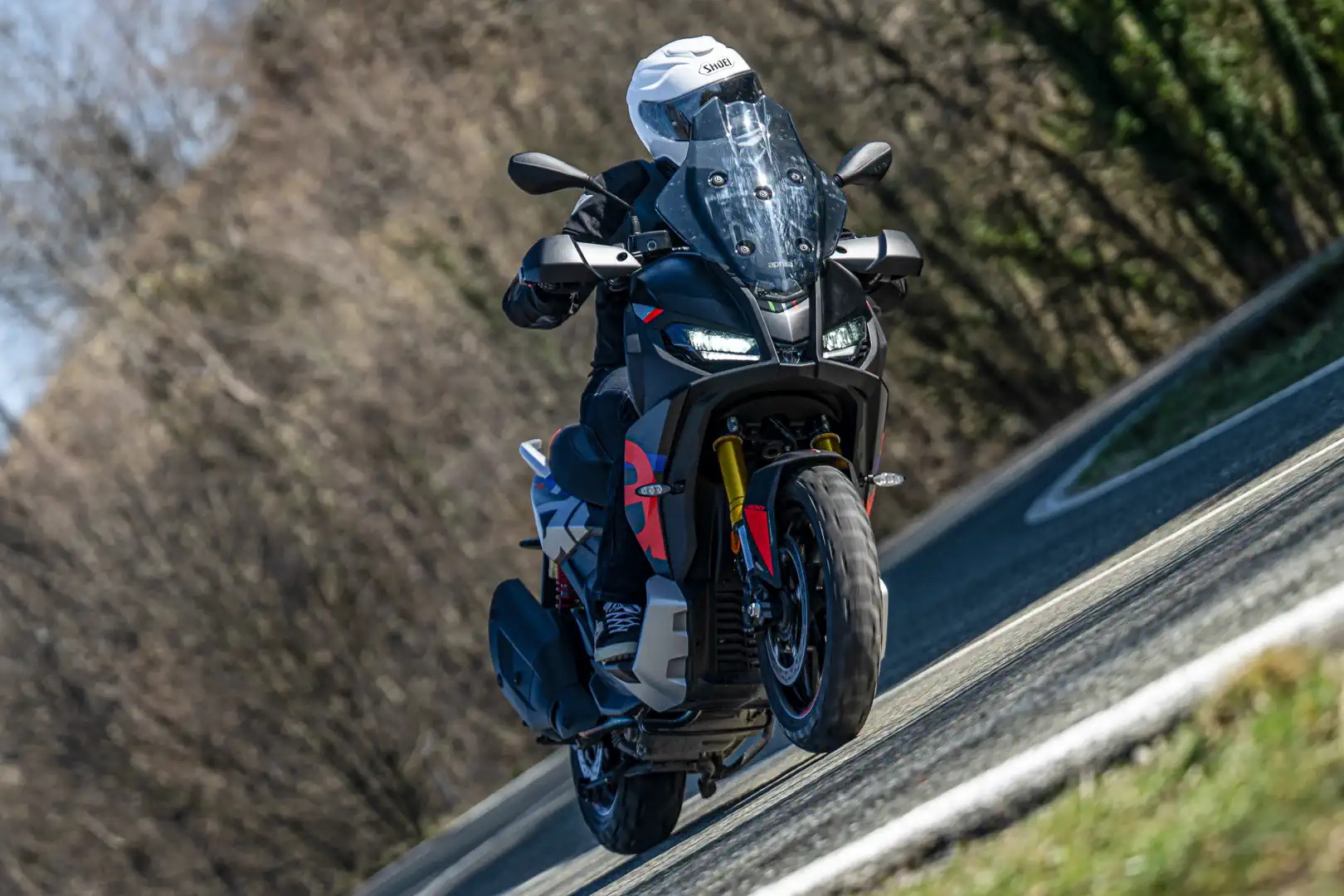
Aprilia is bringing a scooter to North America, and it’s one designed to appeal to adventure motorcyclists. The SR GT 400 is a mid-size scooter built around a steel motorcycle-style frame, a 399cc single, and off-road-ready hardware. It reaches US dealers as soon as this month. Don Williams and Kelly Callan spent some time riding the Aprilia and were surprised by what they discovered. Is this a real motorcycle or just a good-looking urban scooter?
* * * * *
Cat McLeod is founder and owner of Leod Escapes, the ultimate tour company for sport-minded motorcycle riders. Cat talks to us this segment about some of his amazing European experiences and tours that include of course, riding some amazing MotoGP tracks on new BMW S1000RRs. If you like what you hear, now is the time to book your trip of a lifetime, so visit LeodEscapes.com to find out more.
* * * * *
Our guest this episode is Terry Vance, the multiple Motorcycle and Motorsports Hall-of-Famer. Terry is of course the former professional motorcycle drag racer, team owner, and co-founder of the high-performance parts company Vance & Hines. Teejay Adams chats with Terry about his incredible career that includes being the first rider to hit 200 mph in the standing quarter-mile.
Having won this year’s MotoAmerica Mission King of the Baggers championship with Hayden Gillim riding the Vance & Hines factory Indian Challenger, and with Harley-Davidson’s recent withdrawal, Terry gives us his thoughts on where the series might go from here.
* * * * *
Here’s quick reminder to check out our monthly digital magazine. It’s filled with everything you want to read on motorcycling, including some things you’ve probably not seen elsewhere. It’s absolutely free and you will find it on the Apple App Store and of course on Google Play as well.
Don’t forget to leave us your comments on our social media—we’re on all the usual platforms at Ultimate Motorcycling. We love hearing your feedback… so good or bad, please let us know what you think. If there’s something you’d like us to cover, we’d love to hear those ideas too!
We use cookies and browser activity on this website
Functional
Always active
The technical storage or access is strictly necessary for the legitimate purpose of enabling the use of a specific service explicitly requested by the subscriber or user, or for the sole purpose of carrying out the transmission of a communication over an electronic communications network.
Preferences
The technical storage or access is necessary for the legitimate purpose of storing preferences that are not requested by the subscriber or user.
Statistics
The technical storage or access that is used exclusively for statistical purposes.The technical storage or access that is used exclusively for anonymous statistical purposes. Without a subpoena, voluntary compliance on the part of your Internet Service Provider, or additional records from a third party, information stored or retrieved for this purpose alone cannot usually be used to identify you.
Marketing
The technical storage or access is required to create user profiles to send advertising, or to track the user on a website or across several websites for similar marketing purposes.