Editor’s Note: We were digging through our archives and realized that this 2010 Star VMax vs. Triumph Rocket III Roadster comparison had never made it to the website. We hope you enjoy this Battle of the Titans as much as we did. Coram Publishing President Arthur Coldwells and Associate Editor Jess McKinley took care of the words, while Editor Don Williams took the photos of the beasts (men and machines).
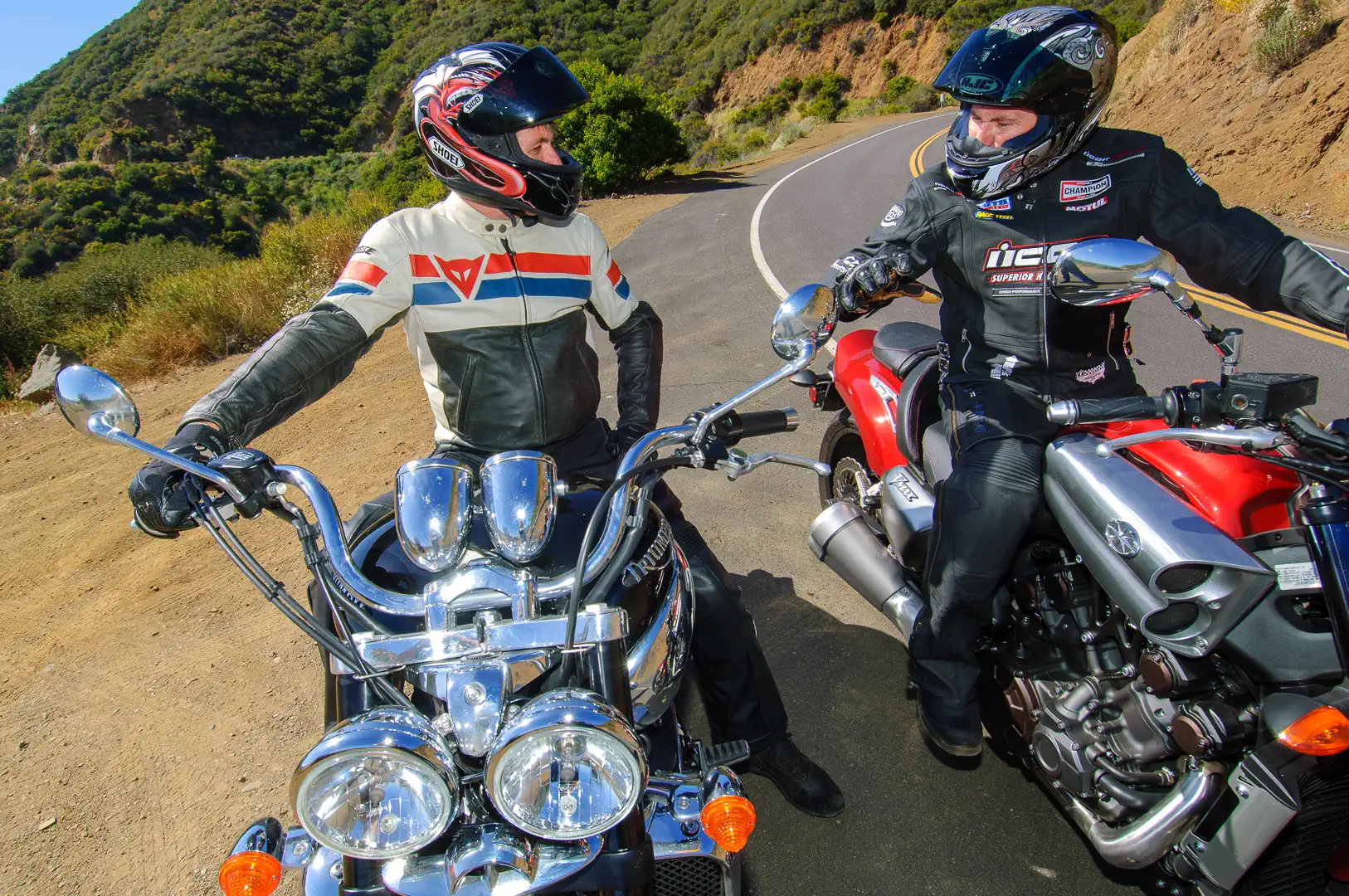
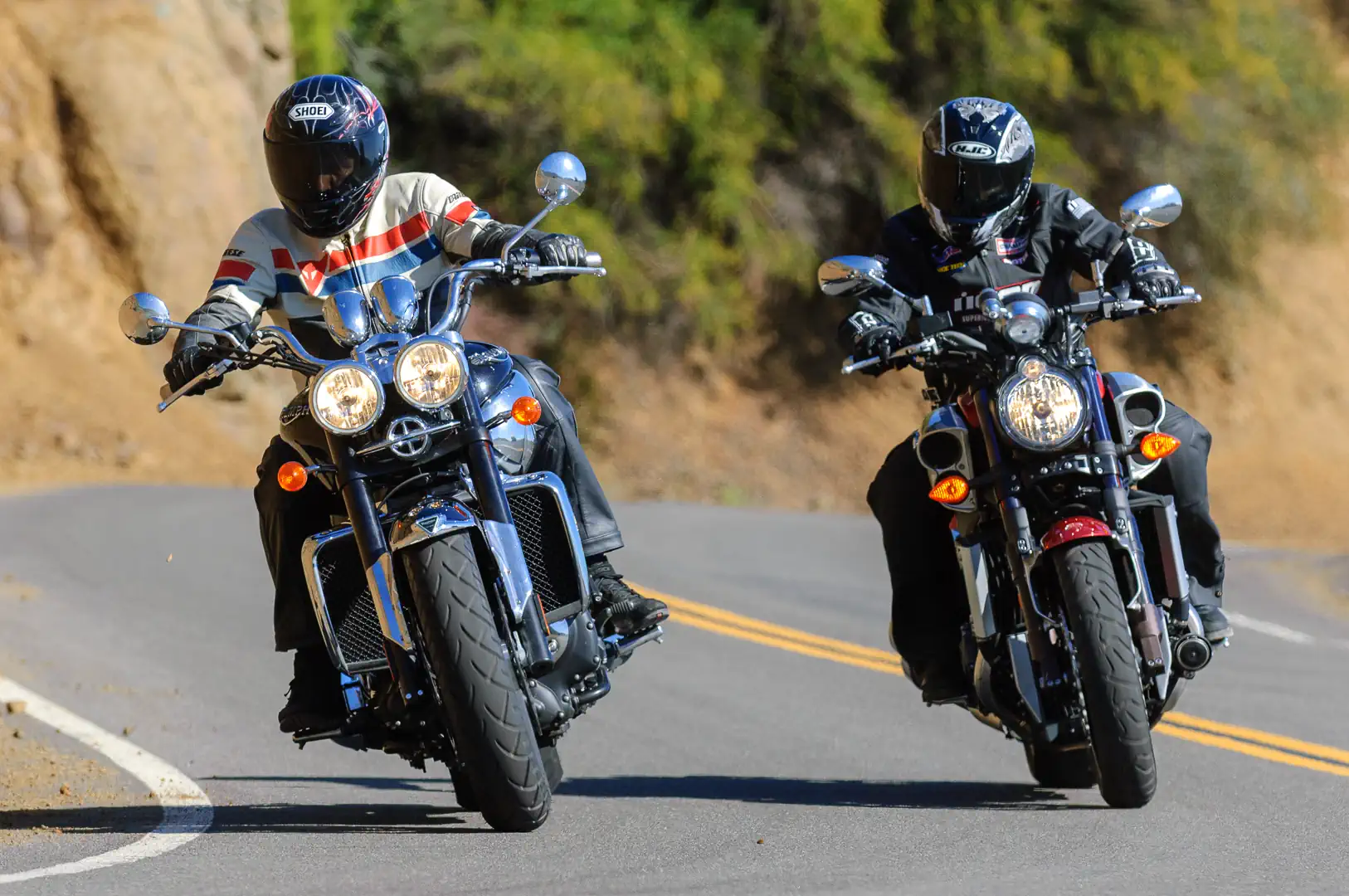
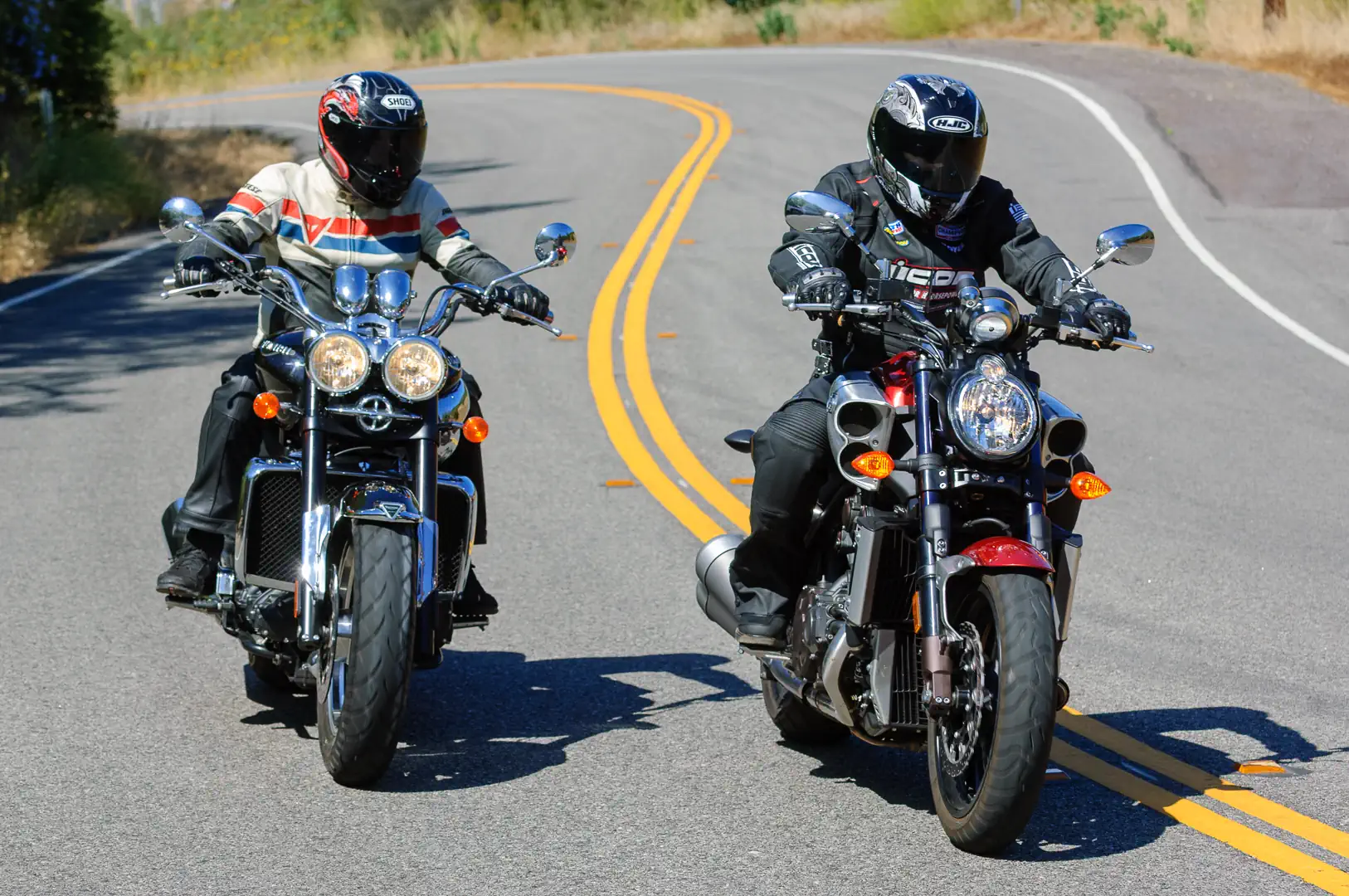
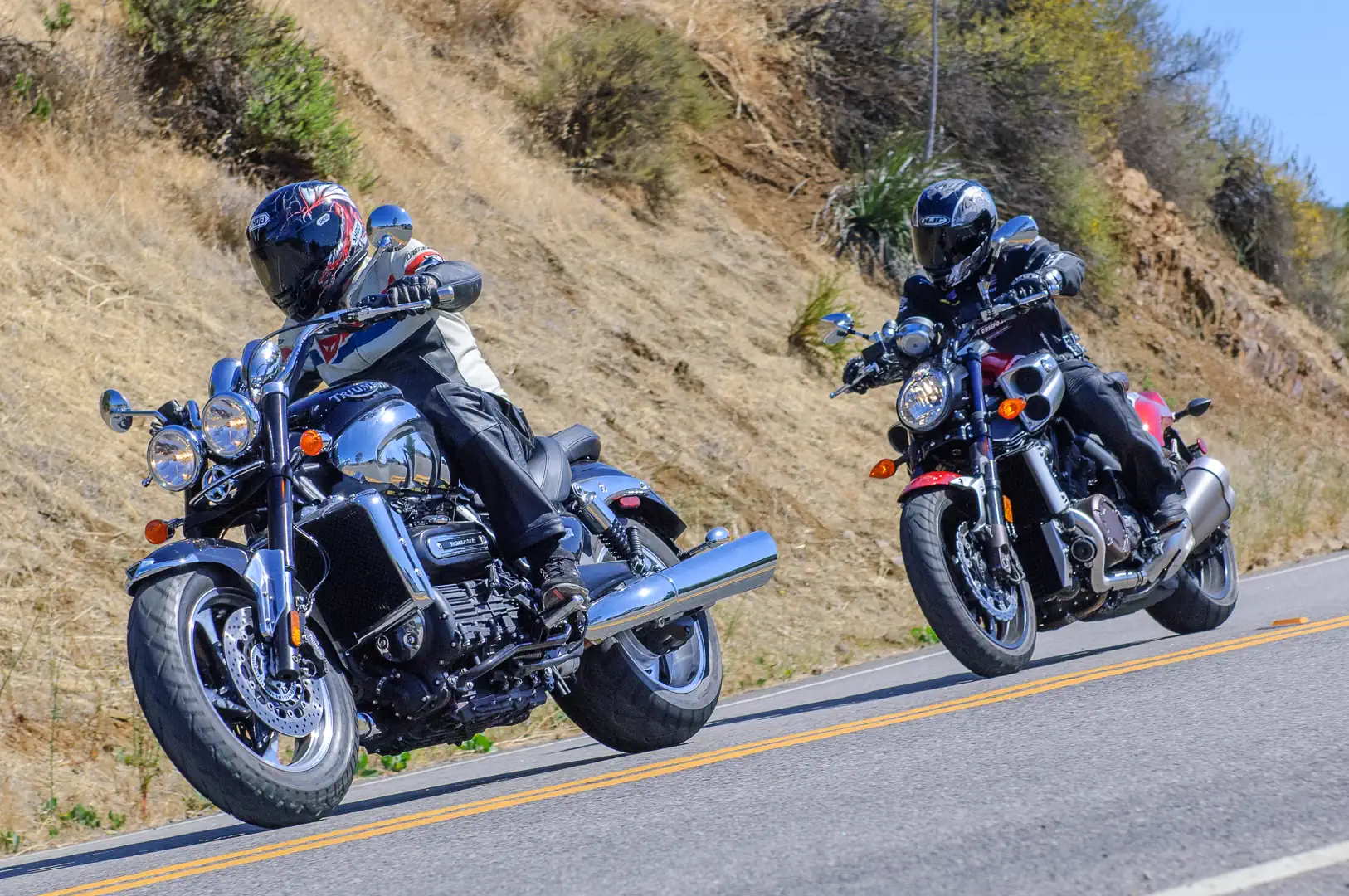
Coram Publishing President Arthur Coldwells (left) on the Triumph Rocket III Roadster talks things over with Associate Editor Jess McKinley on the Star VMax in the hills of Malibu.
In these ecologically sensitive times, we are starting to see alternative-fueled transport and the dawn of electrically powered motorcycles. Although we applaud this emergence of new technologies, we can’t help but think that in a few years hence—as we silently glide along on whirring electric bikes—we will reflect nostalgically on these golden years of the internal combustion engine.
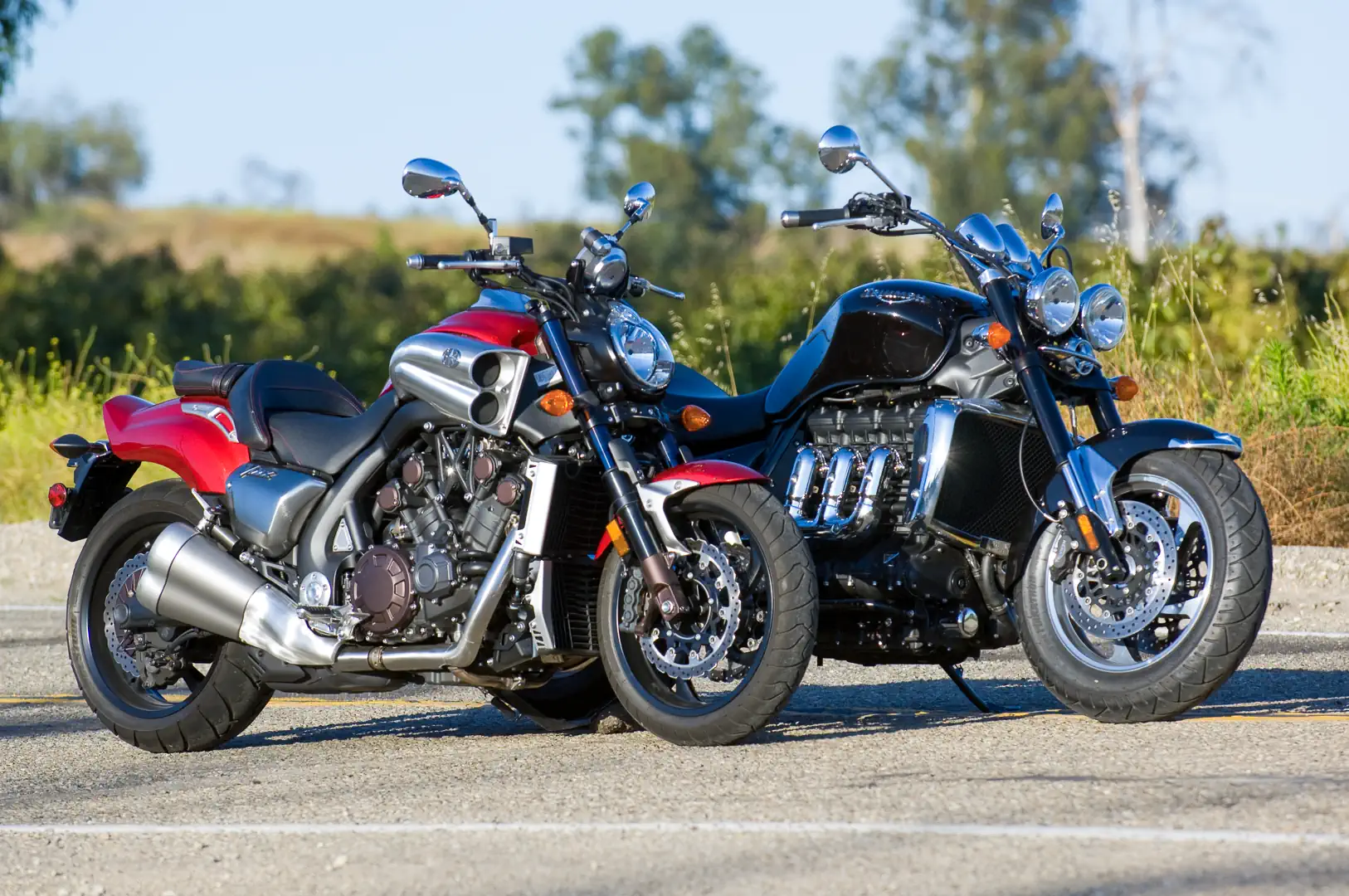
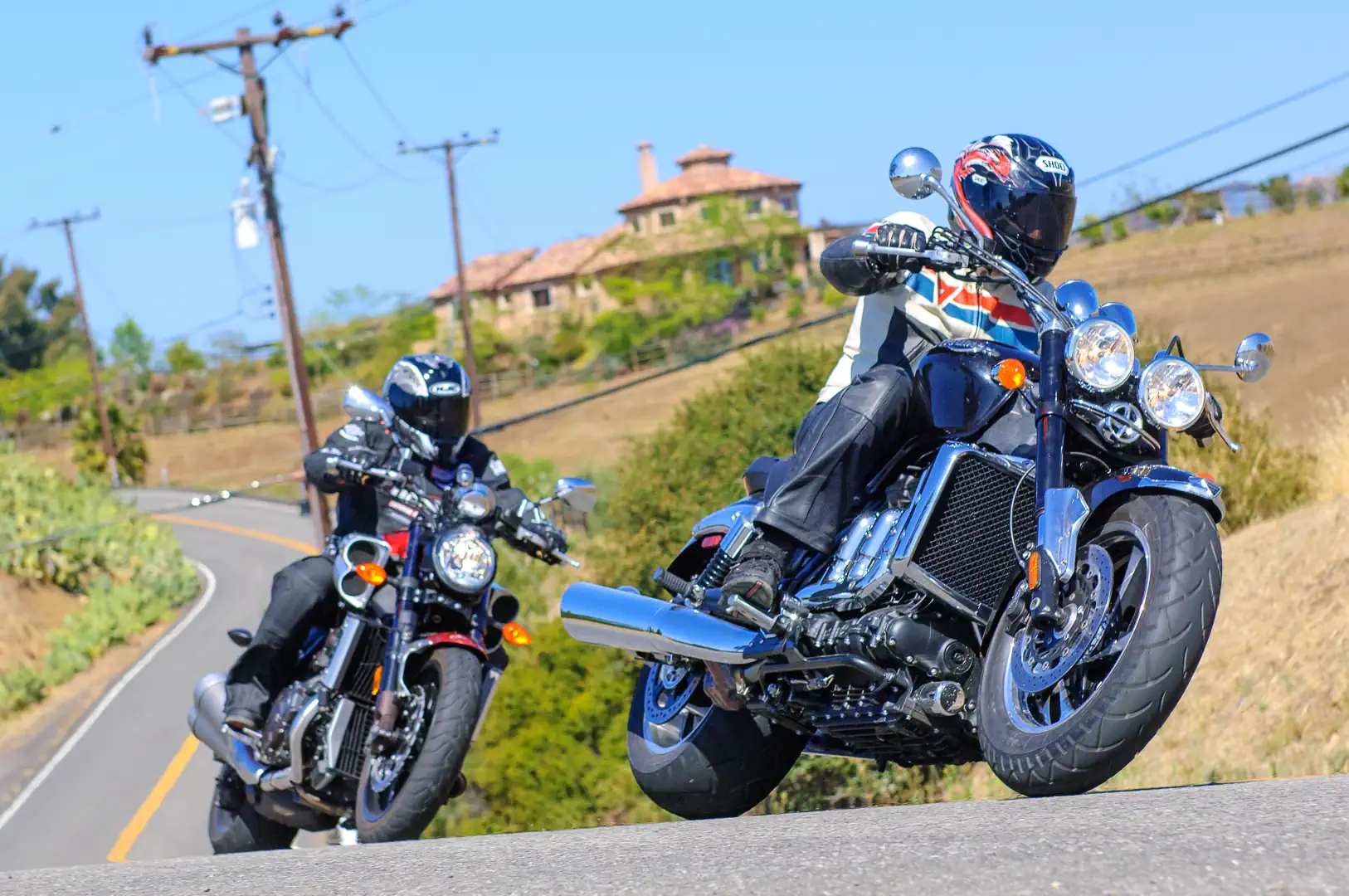
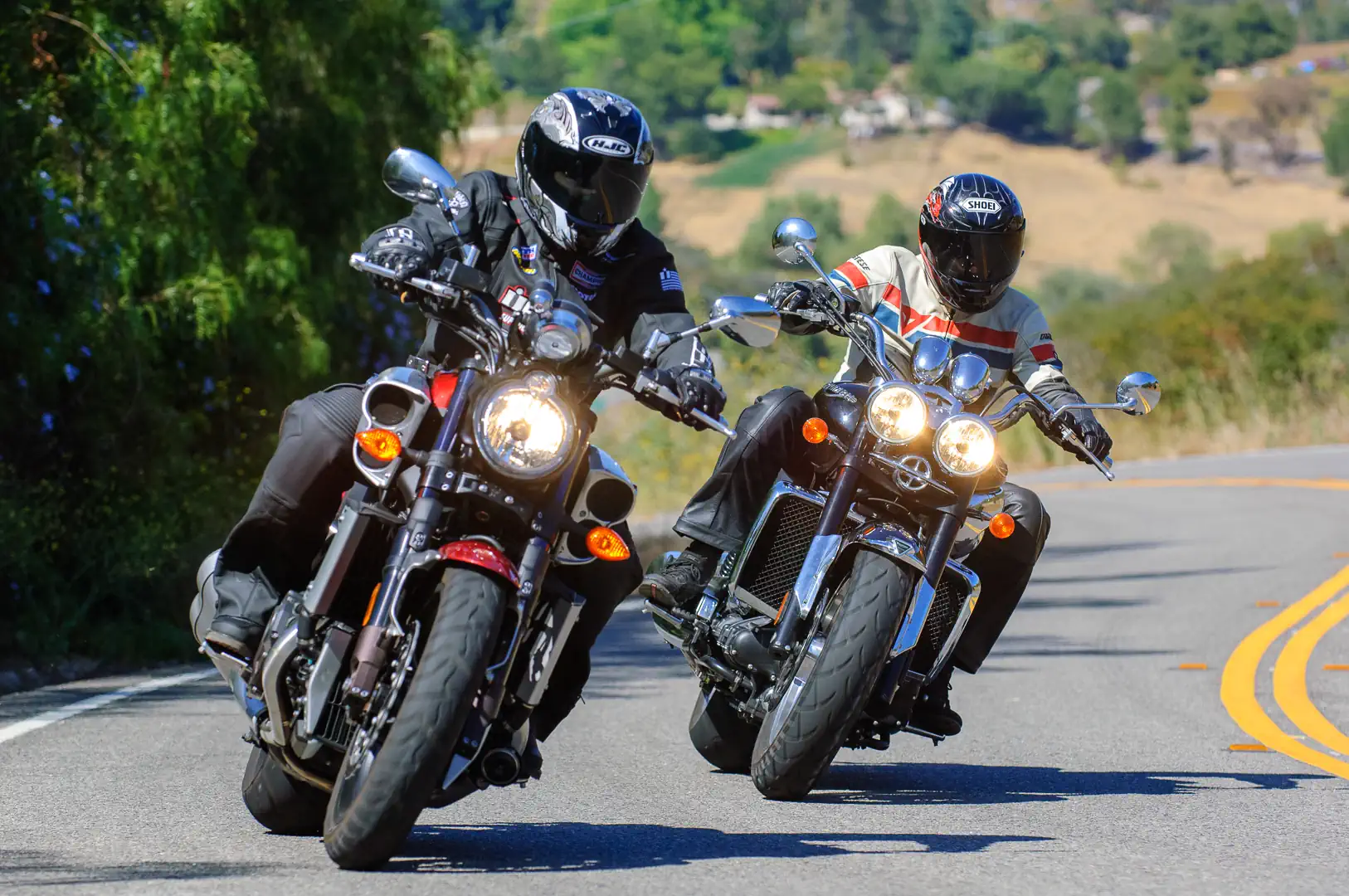
2010 Star VMax (left) and Triumph Rocket III Roadster.
Whether it is the howling shriek of a Formula 1 car, a thundering pack of Harleys, or the growling and popping of a Superbike hard on the brakes, the truth of it is, the sound of a well-tuned gasoline engine has a positive impact on my psyche. As aurally evocative as they are, however, there is more to an engine than just its sound. There is the feeling of being in sync as the power is unleashed; the adrenalin rush as it floods in, and the bike takes off.
But just as the world has started to detune everything it can, both Triumph and Star have decided to extend the deadline a little longer and have launched considerably more powerful versions of both the Rocket III and the VMax, and we are very happy about that. Although the two machines approach from opposite ends of the motorcycle spectrum, they do meet in the middle, and their goals are the same—to give you a two-wheeler-fueled endorphin rush that you will remember with a grin until your dying day.
“The attempt to combine wisdom and power has only rarely been successful.” — Albert Einstein
TRIUMPH ROCKET III ROADSTER
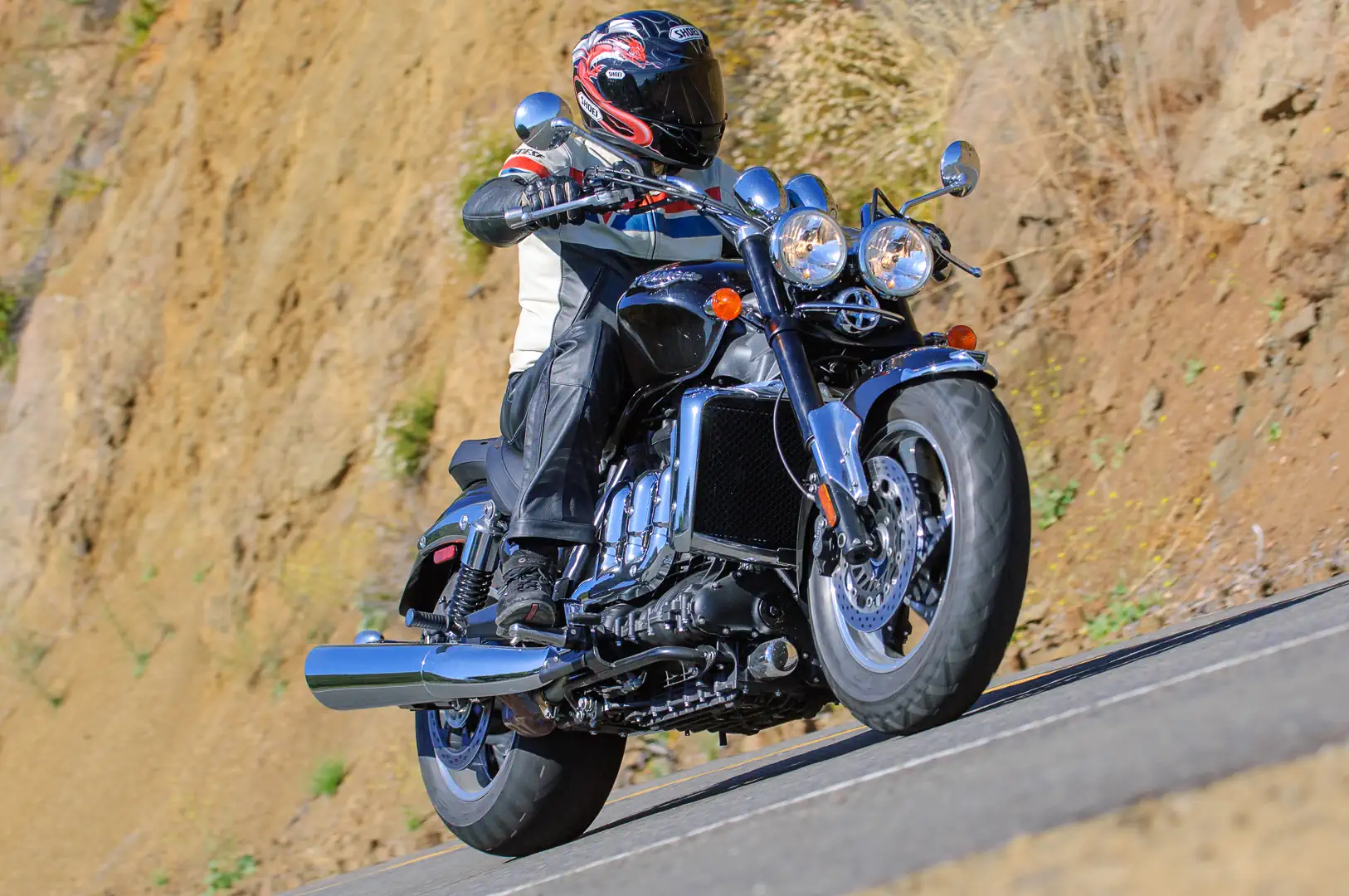
The Triumph Rocket III Roadster is a big machine and, although the weight is carried low, at a claimed 807 pounds wet, it is also heavy. However, the long pullback handlebars make for comfortable, upright ergonomics. The low-slung seat and huge gas tank rising in front give the rider a solid, seated-in impression, and that’s just as well, because you will need to be securely attached if you plan on opening the throttle. Folding footpegs mounted amidships give the Rocket Roadster more-than-adequate ground-clearance in the turns; it is possible to scrape them, but you have to be trying fairly hard to do it.
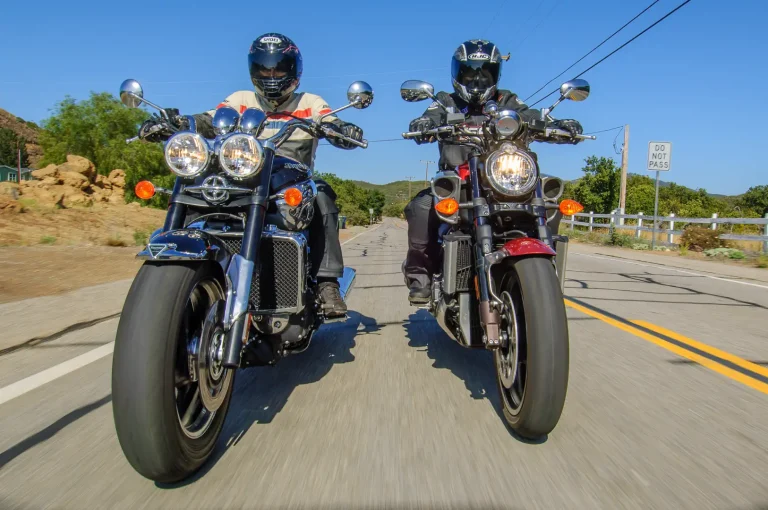
2010 Triumph Rocket III Roadster with Arthur Coldwells aboard.
Although the 43mm male-slider forks and twin Kayaba shocks offer no damping adjustability, the Roadster’s overall handling is a revelation. A porcine motorcycle with a 240mm rear tire and shaft drive would not normally make for an agile performer; however, the Roadster’s low-slung weight and wide handlebar mean the machine responds enthusiastically and predictably through corners. The big 150mm front footprint boosted my confidence, and I found myself pushing the Roadster more than it was probably designed for.
The Roaster handled my abuse on twisty canyon roads far better than I expected; it is an enjoyable motorcycle to ride hard. The Nissin four-pot brakes are non-radial, so the twin drilled rotors require a decent squeeze to slow everything down at high speed. However, they do have plenty of feel and work well enough, and the standard ABS is nice insurance to carry when trying to slow down a behemoth like the Roadster.
But the Triumph’s raison d’être is, of course, the motor. At 2294cc, it is the largest-displacement production motorcycle engine available, and although the longitudinally mounted triple looks suspiciously like a refugee from the John Deere catalog, Triumph has succeeded, to some degree, in making it look good. But ultimately, that’s not the point.
Claiming a 15-percent power increase over the Classic (now-discontinued) and Touring Rocket III models, and despite a seemingly modest 122 peak horsepower, the Roadster’s incredible 147 lb-ft of rear wheel torque gives this cruiser its staggering level of thrust. Considering Harley’s Twin Cam 96 motor—itself a strong, torquey performer—churns out a healthy 85 lb-ft of torque at the rear wheel, it rather puts the Triumph’s astonishing motor in perspective. Even more remarkable still, the Rocket III Roadster cranks out some 130 lb-ft of torque just off idle at a mere 1500 rpm! By 2000 rpm, the torque has moved to 142 lb-ft, and then peaks only 500 rpm later, staying strong through to the modest redline.
With its jaw-dropping acceleration, my Roadster rides became a series of freeway on-ramp experiments that were purely self-indulgent fun. The big triple’s flywheel inertia means that it revs more deliberately than the VMax, but the motor builds momentum rapidly irrespective of which gear you are in; it’s intoxicating and highly addictive. Paradoxically, despite all this amazing power, the throttle connection is smooth and intuitive, and the Roadster is docile enough that it is easy to ride. The motor’s vibes are well contained, and the fuel injection is precisely mapped so that lurching is kept to a minimum; I was very impressed at how smoothly the Roadster attacked tight and twisty canyon roads almost as capably as it blasted along arrow-straight highways. —Arthur Coldwells
STAR VMAX
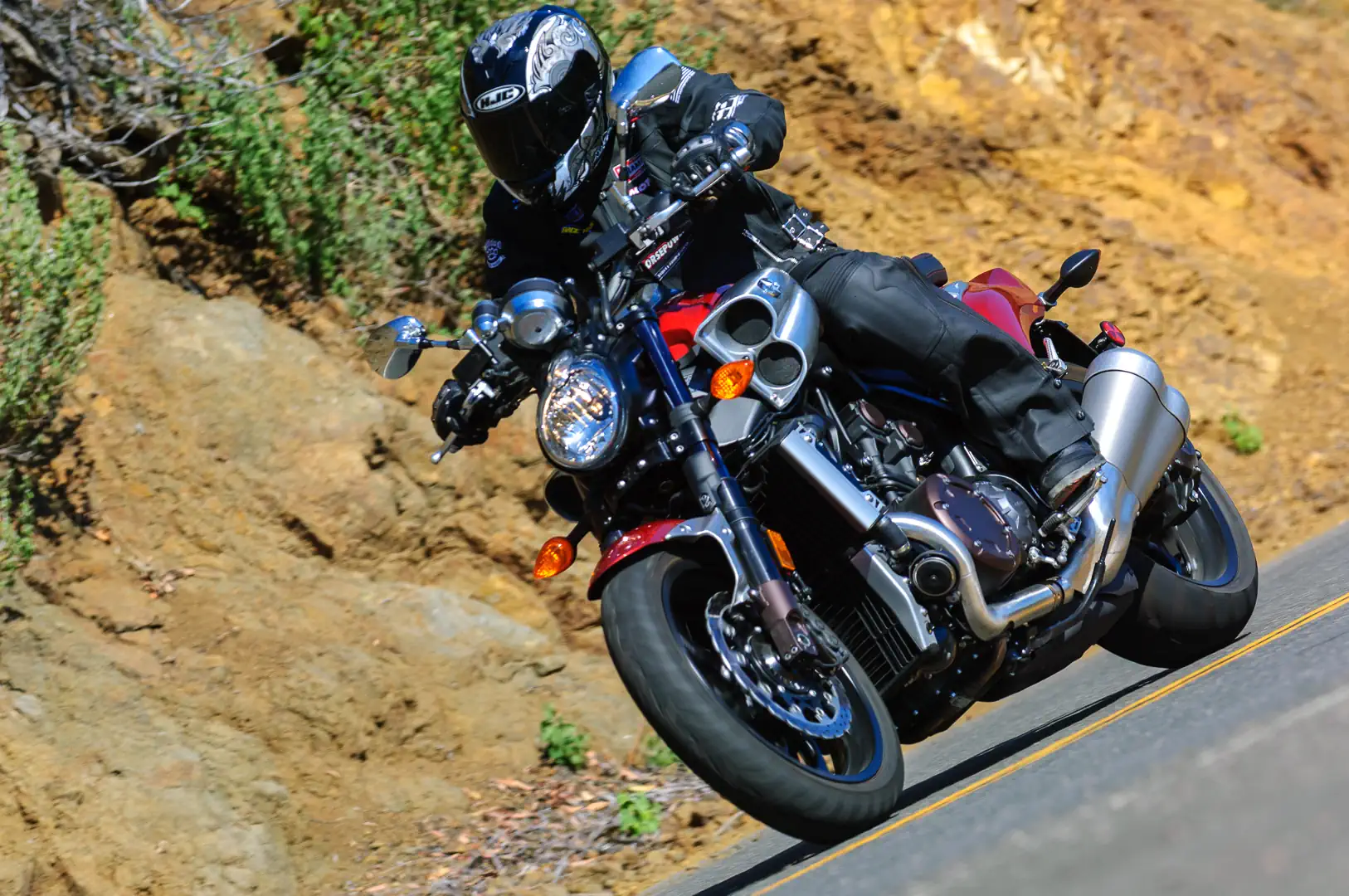
The VMax is more of a street hooligan than the Rocket III, and its futuristic looks promise a muscular, belligerent demeanor. The bike is long, so it is not a wheelie machine. From the cockpit, its shoulder-width bars and aggressive lean-forward riding stance give it a decidedly sporting feel. With a claimed wet weight of 685 pounds, the VMax is some 122 pounds lighter than the Roadster, and with adjustable 52mm forks and shock and a 190mm rear tire, it is therefore considerably nimbler.
2010 Star VMax ridden by Jess McKinley
The VMax engine needs a few revs and doesn’t even hit its torque peak until 5000 rpm, but because the motor has much less flywheel effect than the Roadster, it spins up quickly and keeps building its ferocious power until its 9500 rpm redline. The light switch nature of the VMax’s fueling and low-inertia engine can make for a jerky ride, particularly in first gear at low rpm, so you have to finesse the throttle.
Artfully sculpted aluminum air ducts feed the 1679cc V4 power plant, which, on the Peak Performance Factory Pro dynamometer, developed an astounding 176 bhp and 114 lb-ft of torque at the rear wheel. At 2500 rpm, the VMax is already putting out a respectable 85 lb-ft of torque, which gets the beast off the line efficiently. The light-feeling motor revs freely and feels like a secret turbo suddenly comes online, and at that point, there is no alternative but to dig deep and hang on. By 5000 rpm, 109 horses and 114 lb-ft torque are coursing through the VMax and things get very interesting, very quickly. The 9000 rpm redline arrives far sooner than you would imagine.
By then, the VMax is shoving out every bit of its 176 horsepower thrust—your arms are bent, your muscles are tightened, and you are hunched into the howling windblast in a near futile attempt to stay aboard. With big eyes focused on the large shift-light waiting for it to flash, the G-forces thrusting you rearward are so strong that grabbing for a positive upshift is a real challenge. Fortunately, the seat is deeply cupped and helps hold you in place—the passenger isn’t so lucky.
Once the initial shock and awe of the VMax’s brute power subside, it becomes apparent that the machine is about more than just neck-snapping acceleration. The conventional 43mm forks and single rear shock are fully adjustable, though the standard settings work well for a wide variety of riders and conditions. Whether riding hard on smooth or bumpy tar-snaked pavement, the suspension feels relatively soft and comfortable, and yet firm enough to make the VMax handle well.
Stopping a vehicle that can do freeway speeds in second gear is vitally important, and the VMax is impressively equipped with a massive front ABS braking combo, beginning with a Brembo radially mounted master cylinder up top and matched with six-piston calipers and 320mm rotors down on the wheel.
As different as the VMax is, it is not designed to be a freakish carnival piece or simply a radical display of kinetic energy; it has a unique motorcycling experience to offer. In the final scene of Dr. Strangelove, actor Slim Pickens straddles an atom bomb, hooting, hollering, and flailing his cowboy hat overhead as he hurtles through Earth’s atmosphere. This sums up the VMax experience: truly ballistic. —Jess McKinley
2010 Star VMax vs. Triumph Rocket III Roadster Comparison Conclusion
The Triumph Rocket III Roadster is a big, heavy, bruiser that, counter-intuitively, is also somewhat agile and easy to handle. Although it takes some muscle to ride hard in the twisties, the Roadster impresses with its excellent balance and docile, comfortable nature.
Its cruiser-informed ergonomics and bulky appearance will lull people into underestimating the Rocket III Roadster. There is a Mr. Hyde lurking just below Dr. Jekyll’s pleasant bedside manner, and cracking hard on the throttle instantly unleashes a level of low-rpm grunt that shocks at first, but then simply delights. It feels as though the Rocket III is capable of blasting past anything, anywhere, at any time, such is the effortless, colossal power available in every gear. The ability to consign any car driver to a small dot in your rear view mirror in the blink of an eye is an appealing safety feature—and fun, too. The Triumph is an executive express wrapped in a classy package.
The VMax is the undisputed horsepower king of this particular comparison, with a mind-fogging 176 rear-wheel horsepower. The VMax’s easy-to-read, big, bright instrument pod and giant shift-light constantly entice you into exploring the motor’s breathtaking power. The motor spins up quickly and produces a level of acceleration that will leave you gasping for breath if you insist on waiting for the shift light to appear before each gear change—you will also probably be arrested.
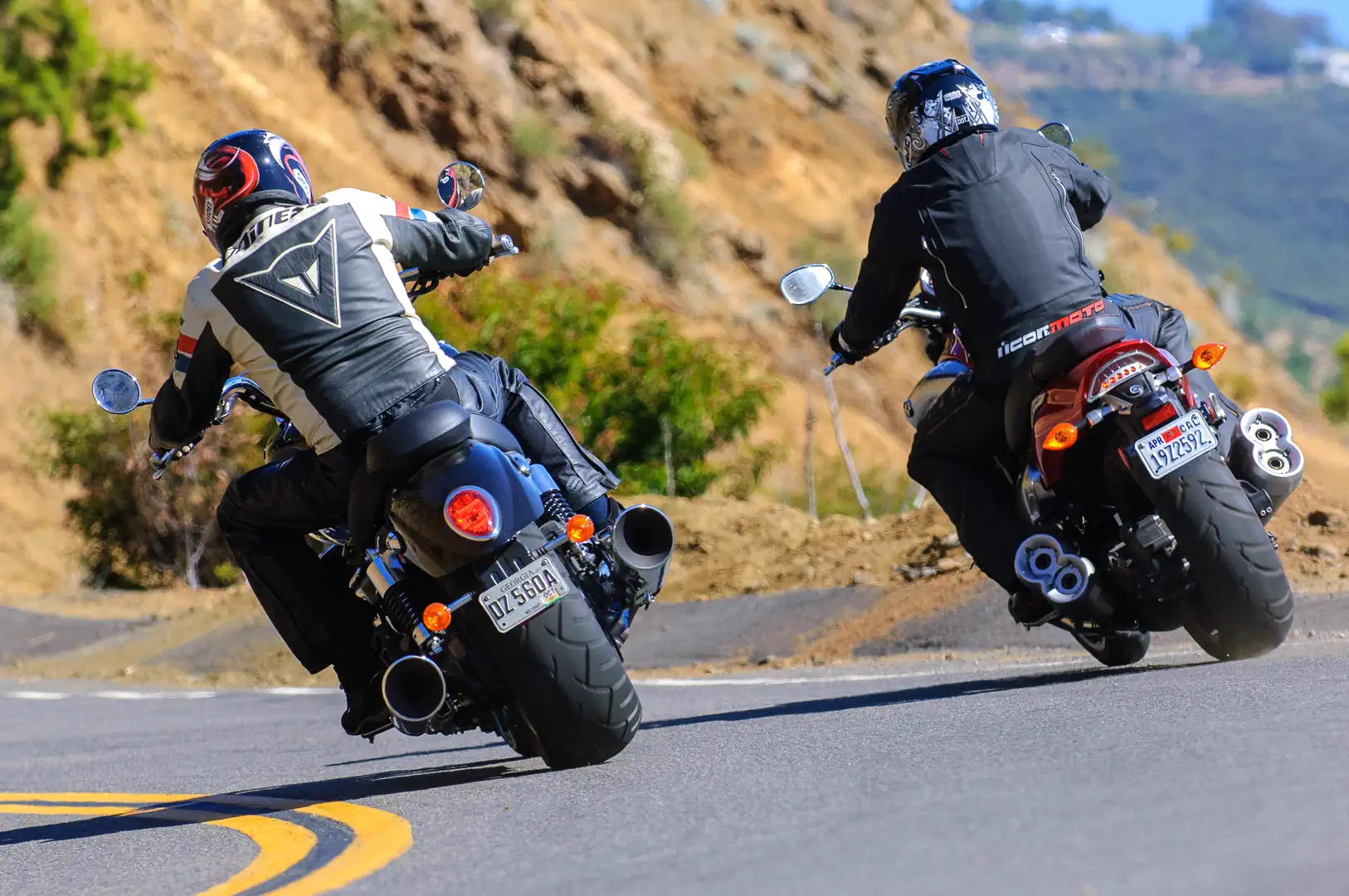
The VMax feels more urgent and instant than the Roadster, but the Triumph seems to smile back, secure in the knowledge that it is carrying the big 2300-caliber gun. The Rocket III puts out considerably more torque just off idle than the VMax does at its peak, and its monstrous maximum 147 lb-ft of pulling power could raise the Titanic, if you found a chain strong enough.
The machine you end up buying will largely depend on which side of motorcycling you come from. A sportbike enthusiast looking for a cruiser-like experience will gravitate towards the VMax, thanks to quicker revving and lighter handling. A power cruiser guy will head straight towards the Rocket III and be happily satisfied with its canyon capabilities, should they bother to investigate that side of its personality. Neither buyer will be disappointed.
Our bike review this episode is the Yamaha MT-03. Do not underestimate this bike; you get a lot of motorcycle for your money! Associate Editor Kelly Callan rode the smallest MT for several weeks, and that included commuting on it. One of the things that impressed her, was how the MT-03 acted like a larger motorcycle. Kelly also spent some time chasing Editor Don Williams through the canyons when he was on the Yamaha MT-07—obviously a much larger machine. She tells us about how it all went.
* * * * *
We’re closing in fast on the 34th annual Biketoberfest, October 15–18, when all roads will lead to Teddy Morse’s Destination Daytona—the more than 100-acre motorcycle playground in Ormond Beach Florida. This week we get to hear all about it from Teddy Morse himself. With his trademark high energy and enthusiasm, he tells us all about his recently established Triketoberfest that happens the week before, and how the Destination Daytona complex turns into a full-throttle hub of demo rides, vendors, custom builds, live music, food trucks, shops, and nonstop pavilion energy. So, whether you’re on two wheels or three, whether you’re hunting parts or lining up a test ride; grab a cold one and soak up the energy and gorgeous Florida fall weather. This is one of the many Daytona Beach places where Biketoberfest feels like home. So don’t forget: make sure you download the Biketoberfest mobile App from Apple or Google Play or visit www.biketoberfest.org and we’ll see you there!
* * * * *
Our guest this episode is Greg Arnold, Mecum’s motorcycle auction director. He bought his first bike at eleven, joined the company in 2011, and has spent more than a decade helping turn this incredible event into the place collectors, consignors, and dreamers all show up. Next February 3rd through 6th, Mecum will—for the 36th time, bring the world’s largest vintage motorcycle auction back to South Point, Las Vegas. That’s over two thousand bikes over four days. Board-track racers, barn finds, customs, race iron, and especially, those incredible machines that make the room go quiet. Greg gives us insight into what it takes to make this event work so incredibly well, and if you’re interested in selling your pride and joy, what steps you have to take to make it happen.
* * * * *
Here’s quick reminder to check out our monthly digital magazine. It’s filled with everything you want to read on motorcycling, including some things you’ve probably not seen elsewhere. It’s absolutely free and you will find it on the Apple App Store and of course on Google Play as well.
Don’t forget to leave us your comments on our social media—we’re on all the usual platforms at Ultimate Motorcycling. We love hearing your feedback… so good or bad, please let us know what you think. If there’s something you’d like us to cover, we’d love to hear those ideas too!
We use cookies and browser activity on this website
Functional
Always active
The technical storage or access is strictly necessary for the legitimate purpose of enabling the use of a specific service explicitly requested by the subscriber or user, or for the sole purpose of carrying out the transmission of a communication over an electronic communications network.
Preferences
The technical storage or access is necessary for the legitimate purpose of storing preferences that are not requested by the subscriber or user.
Statistics
The technical storage or access that is used exclusively for statistical purposes.The technical storage or access that is used exclusively for anonymous statistical purposes. Without a subpoena, voluntary compliance on the part of your Internet Service Provider, or additional records from a third party, information stored or retrieved for this purpose alone cannot usually be used to identify you.
Marketing
The technical storage or access is required to create user profiles to send advertising, or to track the user on a website or across several websites for similar marketing purposes.


 Stopping a vehicle that can do freeway speeds in second gear is vitally important, and the VMax is impressively equipped with a massive front ABS braking combo, beginning with a Brembo radially mounted master cylinder up top and matched with six-piston calipers and 320mm rotors down on the wheel.
 Its cruiser-informed ergonomics and bulky appearance will lull people into underestimating the Rocket III Roadster. There is a Mr. Hyde lurking just below Dr. Jekyll’s pleasant bedside manner, and cracking hard on the throttle instantly unleashes a level of low-rpm grunt that shocks at first, but then simply delights. It feels as though the Rocket III is capable of blasting past anything, anywhere, at any time, such is the effortless, colossal power available in every gear. The ability to consign any car driver to a small dot in your rear view mirror in the blink of an eye is an appealing safety feature—and fun, too. The Triumph is an executive express wrapped in a classy package.
 The VMax feels more urgent and instant than the Roadster, but the Triumph seems to smile back, secure in the knowledge that it is carrying the big 2300-caliber gun. The Rocket III puts out considerably more torque just off idle than the VMax does at its peak, and its monstrous maximum 147 lb-ft of pulling power could raise the Titanic, if you found a chain strong enough.