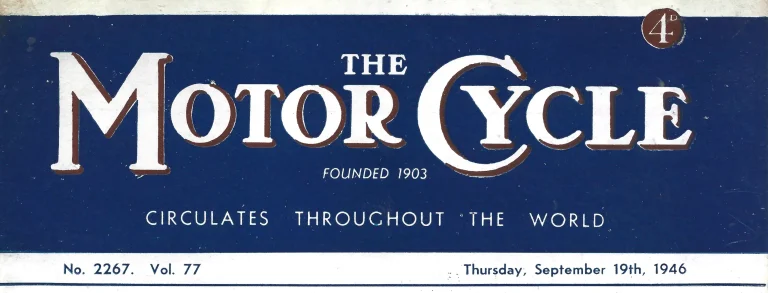
A lot can happen in 80 years. A fascinating way to see that in detail is to read the yellowing pages of a motorcycle magazine published in the 1940s. It’s even more interesting when the magazine is The Motor Cycle, an English weekly dated September 19, 1946.
It was less than two years after VE Day. Europe and the U.K. were still in a post-war swoon. Gasoline, motor oil, tires, metals, and machine tools, among many other things, were either in short supply, restricted, or rationed.
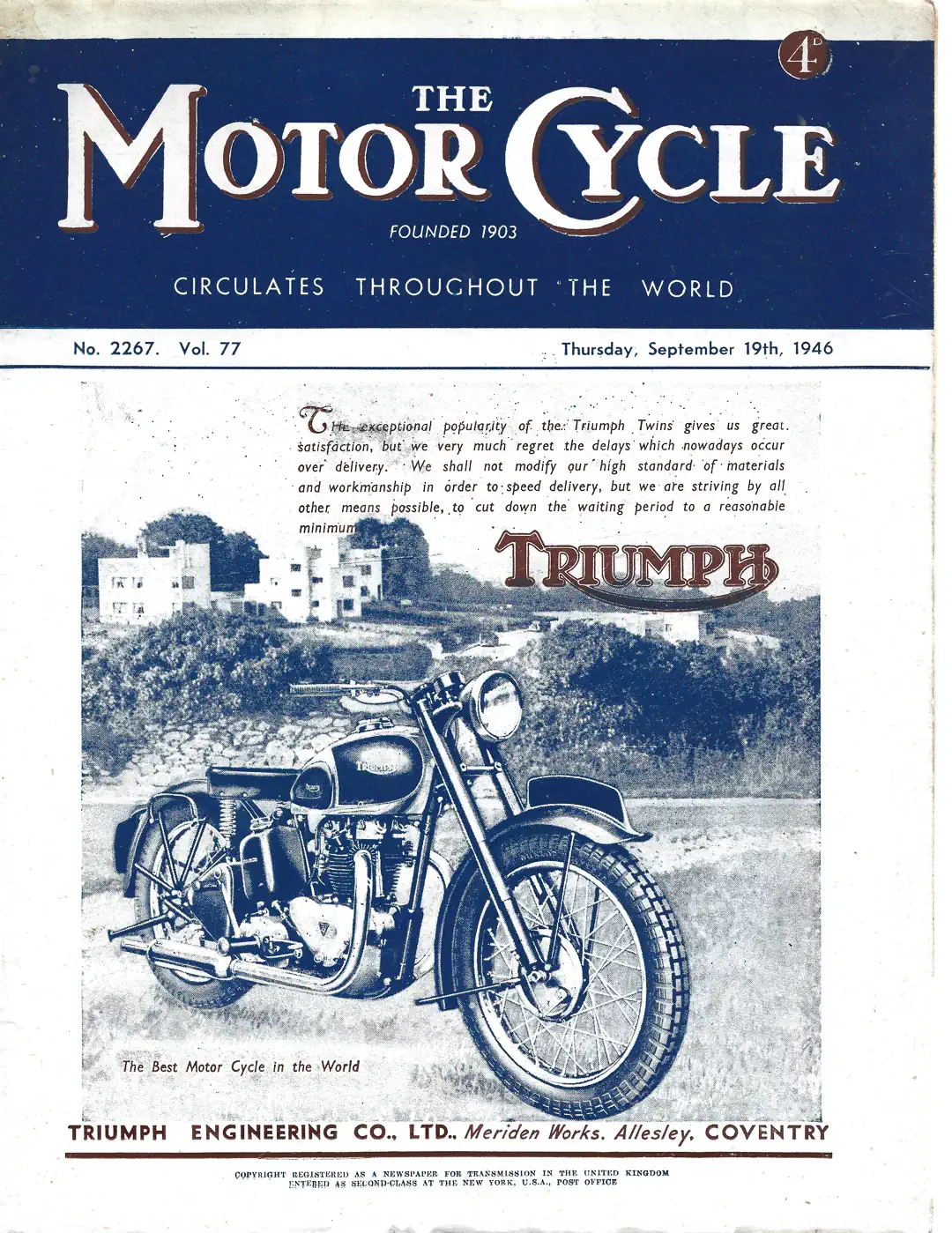
The cover of the U.K.’s “The Motor Cycle” magazine from September 19, 1946 featured the new 500cc Triumph 5T Speed Twin twin-cylinder model—and an apology!
Indeed, a full year after this issue of The Motor Cycle, the September 4, 1947, issue of Motor Cycling magazine ran an editorial complaining about the British government’s announcement of new fuel austerity measures that effectively banned “pleasure” motoring and limited vehicle use to “essential” transportation. Taking a ride for enjoyment was not to be tolerated.
That said, Birmingham Small Arms, known worldwide as BSA Motorcycles, managed to overcome all the obstacles of the post-war period to forge ahead with a new model for 1946 — the A7. It was worthy of a five-page feature in The Motor Cycle. Not only was it a new model, but it was powered by the first twin-cylinder engine built by BSA since the 1940 G14, which sported a 986cc sidevalve V-twin that produced 25 horsepower.
“The Motor Cycle” magazine’s coverage of the 1946 BSA A7 was technically detailed and well-illustrated. In the effort to keep page count down, the print was tiny!
Meanwhile, Triumph was ramping up its production with the reintroduction of two parallel twin-cylinder 500cc OHV models, the 5T Speed Twin and the T100 Tiger. Much the same motorcycle as the 5T, the T100 shared the 5T’s 498cc four-stroke overhead-valve engine. However, the T100’s twin had a 7.8:1 compression ratio and produced 30 bhp at 6500 rpm. The slight detuned 5T’s engine had a compression ratio of 6.5:1 and was good for 28 bph at 6000 rpm. The T100 also benefited from a one-inch-diameter Amal carburetor compared to the 15/16-inch Amal on the 5T.
As with BSA, most of the motorcycles built by Triumph during the war years were single-cylinder, small-displacement four-strokes. What new production was available at the outbreak of the war was redirected to military purposes. Edward Turner’s 3T 349cc twin, which had just begun production when war broke out, was put on hold until after the war. With production shifted to a war footing, the Triumph Priory factory in Coventry was destroyed by German bombing on November 14, 1940.
Remarkably, Edward Turner negotiated a deal for a 22-acre site in Meriden, and Triumph resumed limited production by July 1942.
Though the BSA A7 was featured in the early September issue, it was the Triumph 5T that was on the cover. In those days, it was a common practice for motorcycle magazines to use the front cover as advertising space.
In this instance, not only did Triumph have the space to promote the 5T, it did something unusual. It included an apology to potential buyers! The apology stated, in part, “…we very much regret the delays which nowadays occur over delivery. We shall not modify our high standards of materials and workmanship in order to speed delivery, but we are striving by all other means possible to cut down the waiting period to a reasonable minimum.” Under the circumstances, it was not unexpected.
Returning to the manufacture of twin-cylinder powered models wasn’t the only sign of change in post-war motorcycles.
The article revealed the new A7 included unit construction, with the four-speed transmission and engine bolted together to form a common case. The engine used a hemispherical-head combustion chamber design, with the four pushrods operating from a single camshaft.
There was an unusual vertical prop stand that extended from the seat support tube under the center of the double cradle frame.
A hydraulic telescopic fork provided the suspension, and ergonomics included adjustable oval-section footrests, handlebars, and seat.
In a broader sense, the September issue covered the rise of the twin-cylinder, or “multi” type engine as a major trend in motorcycle design. In his Editorial Opinion on the first page, Editor Arthur B. Bourne led with the headline, “The Swing to Multis—It is Now Really Underway: Racing and Trials Successes: A Most Interesting Newcomer.”
Bourne goes on to say, “Twin-cylinder motorcycles were first and second in the last Senior TT, that of June, 1939; and a twin has won the first post-war Senior Manx Grand Prix. So much is known to all, but what are the implications? Has the multi ‘arrived’? Is there at this very moment the death knell of the single-cylinder other than in small sizes?”
The rest, as they say, is history. The single-cylinder soldiers on to this day, and not just in tiddler displacement classes. Mr. Bourne would probably have been stunned by the 1970s emergence of three and four-cylinder street bikes down to the 250 class, along with the 1960s Honda six-cylinder RC166 250, the five-cylinder RC149 125, and RC116 50cc twin used for GP racing. The cylinders in the RC149 and RC116 shared the same 35.5mm bore and 24.14mm stroke.
This advertisement from 1946 has a cool look and shows that co-branded advertising has been around a long time, such as this one featuring a BSA motorcycle and Champion spark plug.
The advertising is fun to look at and can be surprising. For example, I had thought co-branding ads for related products was a relatively recent thing. Not so, it turns out. In this issue of The Motor Cycle, there was a full-page advertisement that was primarily a plug for Champion spark plugs that also prominently featured BSA motorcycles. Both brands continue to this day, with BSA being revived in October 2016 by Classic Legends, a subsidiary of the Mahindra Group, after going out of business in 1973.
Of course, there was advertising for competing brands in the same product line. An interesting example is Lodge spark plugs with platinum-tipped electrodes, a feature I recall other companies promoting as an innovation in the 1970s. Lodge has been in business in the U.K. since 1904, when it began manufacturing spark plugs, and continues in the automotive space to this day.
Champion wasn’t the only spark plug manufacturer promoting its product in 1946. By that year, the U.K. firm Lodge had already been in business for 42 years!
The other content included fascinating letters to the editor, along with coverage of diverse events, including trials, scrambles, road races, TT, and club events, many of which included remarkably good action photographs. It’s true that much has changed over the past 80 years, yet some things in motorcycling remain timeless.
Hello and welcome again to the Motos and Friends Podcast. This episode is brought to you by Leod Escapes.
* * * * *
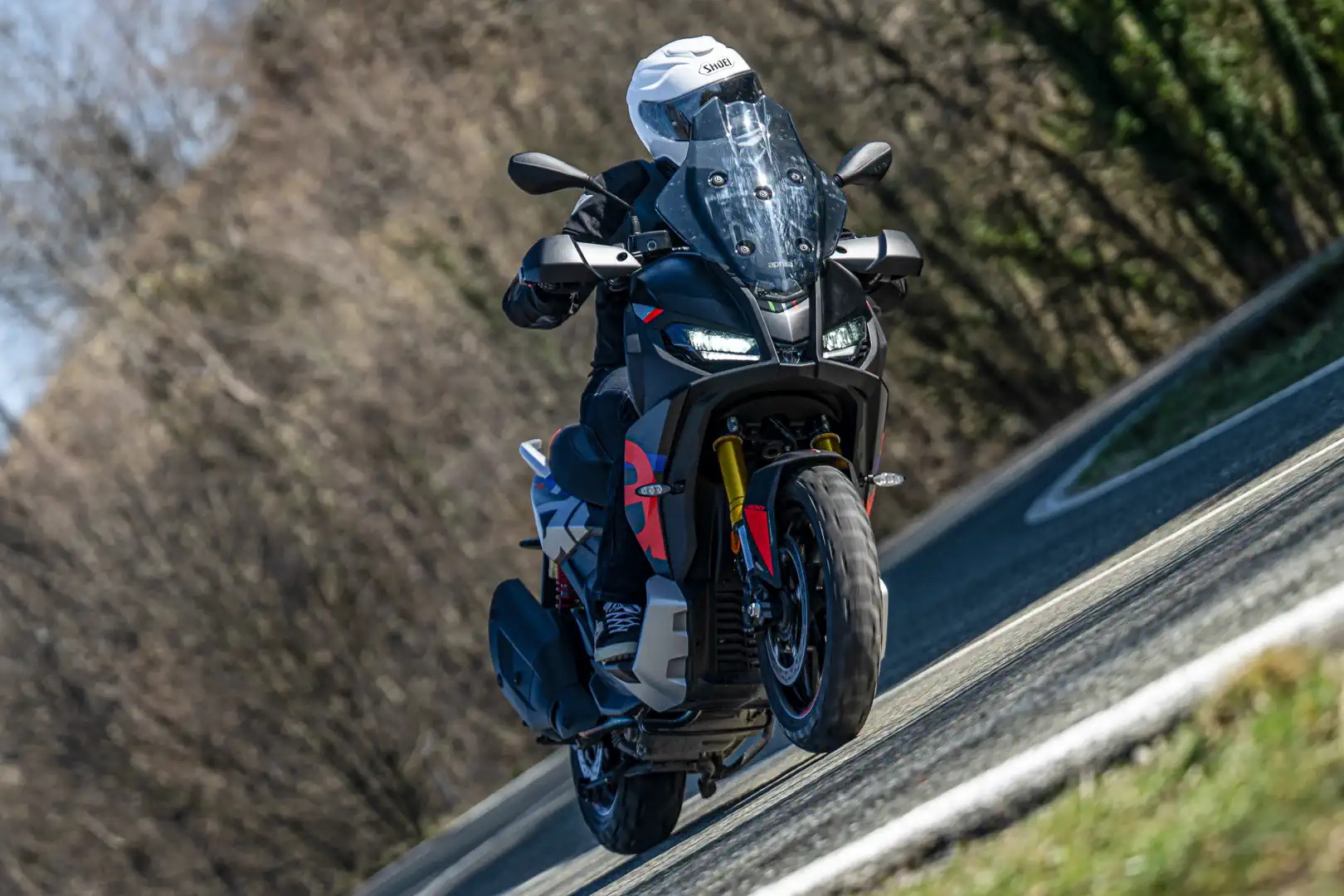
Aprilia is bringing a scooter to North America, and it’s one designed to appeal to adventure motorcyclists. The SR GT 400 is a mid-size scooter built around a steel motorcycle-style frame, a 399cc single, and off-road-ready hardware. It reaches US dealers as soon as this month. Don Williams and Kelly Callan spent some time riding the Aprilia and were surprised by what they discovered. Is this a real motorcycle or just a good-looking urban scooter?
* * * * *
Cat McLeod is founder and owner of Leod Escapes, the ultimate tour company for sport-minded motorcycle riders. Cat talks to us this segment about some of his amazing European experiences and tours that include of course, riding some amazing MotoGP tracks on new BMW S1000RRs. If you like what you hear, now is the time to book your trip of a lifetime, so visit LeodEscapes.com to find out more.
* * * * *
Our guest this episode is Terry Vance, the multiple Motorcycle and Motorsports Hall-of-Famer. Terry is of course the former professional motorcycle drag racer, team owner, and co-founder of the high-performance parts company Vance & Hines. Teejay Adams chats with Terry about his incredible career that includes being the first rider to hit 200 mph in the standing quarter-mile.
Having won this year’s MotoAmerica Mission King of the Baggers championship with Hayden Gillim riding the Vance & Hines factory Indian Challenger, and with Harley-Davidson’s recent withdrawal, Terry gives us his thoughts on where the series might go from here.
* * * * *
Here’s quick reminder to check out our monthly digital magazine. It’s filled with everything you want to read on motorcycling, including some things you’ve probably not seen elsewhere. It’s absolutely free and you will find it on the Apple App Store and of course on Google Play as well.
Don’t forget to leave us your comments on our social media—we’re on all the usual platforms at Ultimate Motorcycling. We love hearing your feedback… so good or bad, please let us know what you think. If there’s something you’d like us to cover, we’d love to hear those ideas too!
We use cookies and browser activity on this website
Functional
Always active
The technical storage or access is strictly necessary for the legitimate purpose of enabling the use of a specific service explicitly requested by the subscriber or user, or for the sole purpose of carrying out the transmission of a communication over an electronic communications network.
Preferences
The technical storage or access is necessary for the legitimate purpose of storing preferences that are not requested by the subscriber or user.
Statistics
The technical storage or access that is used exclusively for statistical purposes.The technical storage or access that is used exclusively for anonymous statistical purposes. Without a subpoena, voluntary compliance on the part of your Internet Service Provider, or additional records from a third party, information stored or retrieved for this purpose alone cannot usually be used to identify you.
Marketing
The technical storage or access is required to create user profiles to send advertising, or to track the user on a website or across several websites for similar marketing purposes.
Advertising helps us keep our content available for free, so adjusting your ad blocking settings will help us.
We appreciate your support!
i
How to Allow Ads on This Site
Depending on your setup, ads may be blocked by a browser extension, VPN, antivirus software, or other application. Here are some common ways to allow ads:
Browser Extensions (e.g., Adblock, uBlock, etc.)
Click the extension icon in your browser toolbar.
Look for an option like "Don't run on pages on this site" or "Pause on this site".
Save the change and refresh the page.
VPNs with Ad Blocking (e.g., NordVPN, Proton VPN, etc.)
Open your VPN app.
Go to settings or features.
Disable any ad blocking or tracking protection features.
Refresh the page.
Antivirus Software or Other Privacy Tools
Check for web protection, ad filtering, or browser privacy settings.
Click the power button to disable it for this site.
Refresh the page.
Not sure what's blocking ads? Look for tools with privacy or filtering features, or check your browser extensions. We only use respectful, non-intrusive advertising.