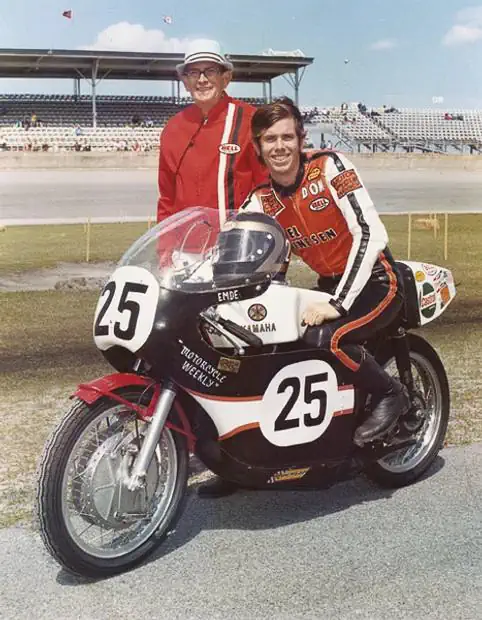
In 1972, young Don Emde made history in more ways than one by winning the Daytona 200. His victory marked the first time in the race’s long history that a machine powered by a two-stroke engine won. Also, the Yamaha TR3 twin displaced only 350cc, making it the smallest-displacement Daytona 200 winner. But perhaps the most remarkable aspect of the victory was the fact that it made Don and his father Floyd the only father-and-son duo to have taken Daytona 200 victories. That’s right, Floyd Emde won the Daytona 200 in 1948 on an Indian.
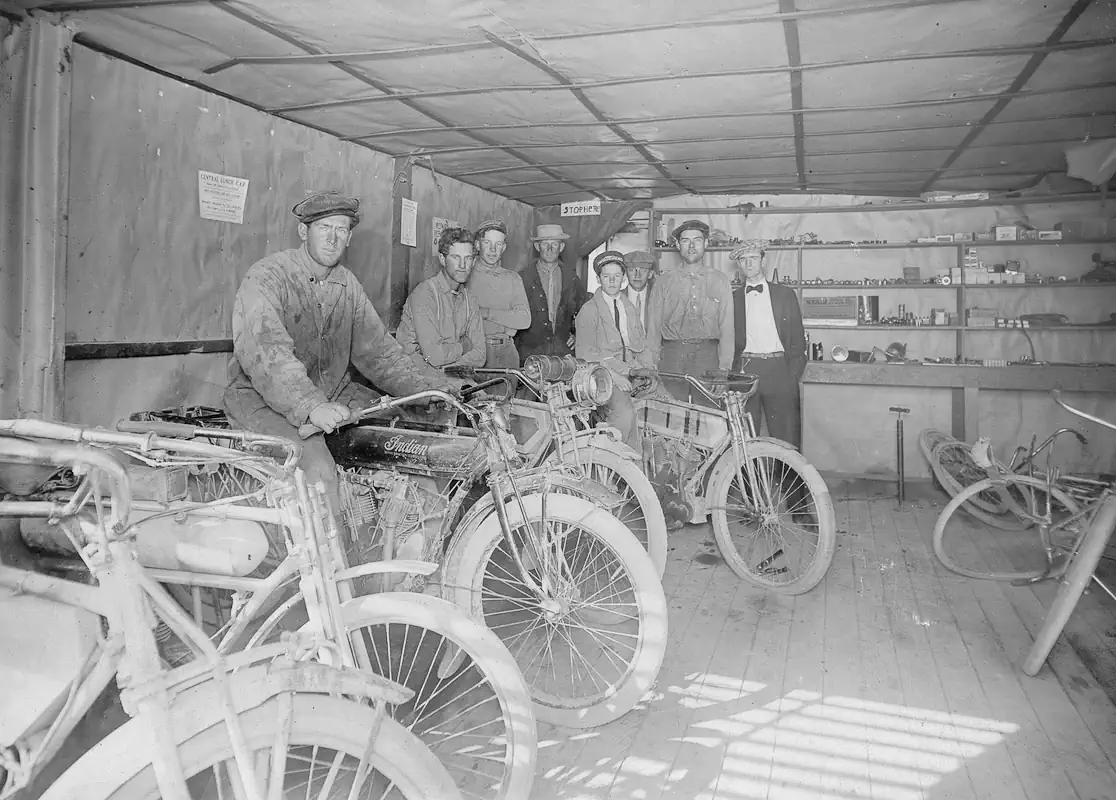
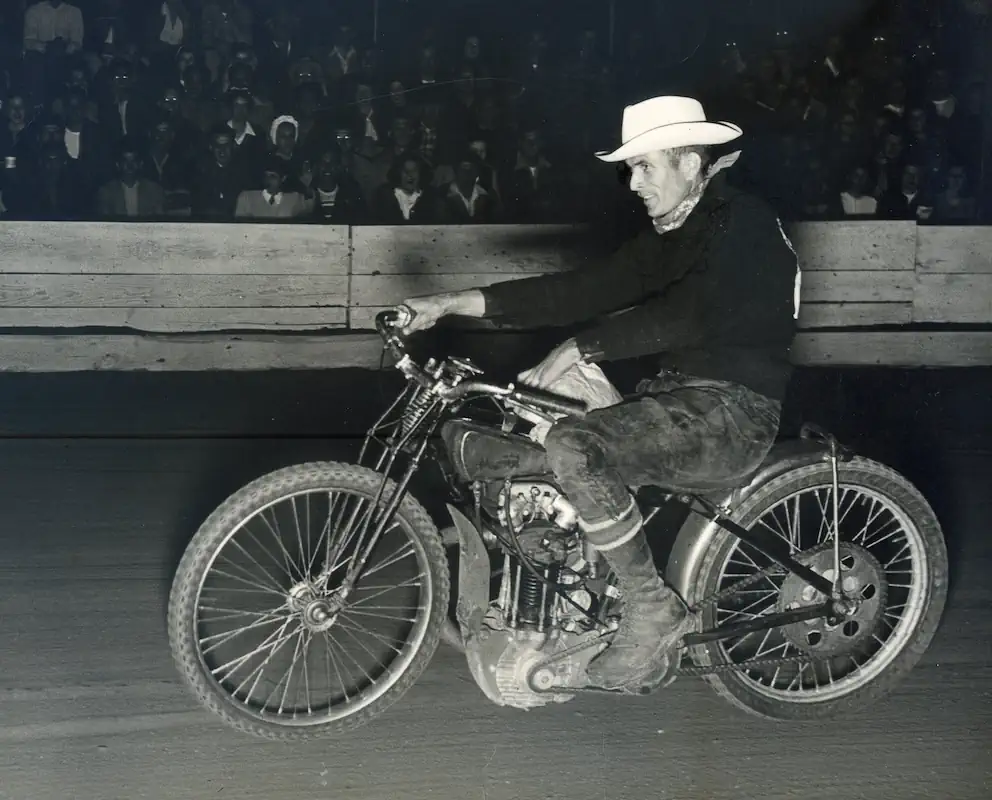
Joe Emde, on the bike in the foreground, Floyd Emde’s father, is shown in his garage in El Centro, California, where he repaired customer vehicles and tuned his own racing motorcycles. All images from the Don Emde Collection.
When I learned that, I thought Floyd Emde must have had a remarkable story in his own right. Now, Don Emde, an accomplished author and publisher, has written Flying Floyd: The Motorcycling Life of Floyd Emde, a book that tells his father’s incredible story.
To create a true-to-life, as-it-happened narrative, Don Emde used the trove of documents Floyd Emde had collected during his career, including Floyd’s competition notebooks, souvenir race programs, newspaper and magazine article clippings, correspondence, and more.
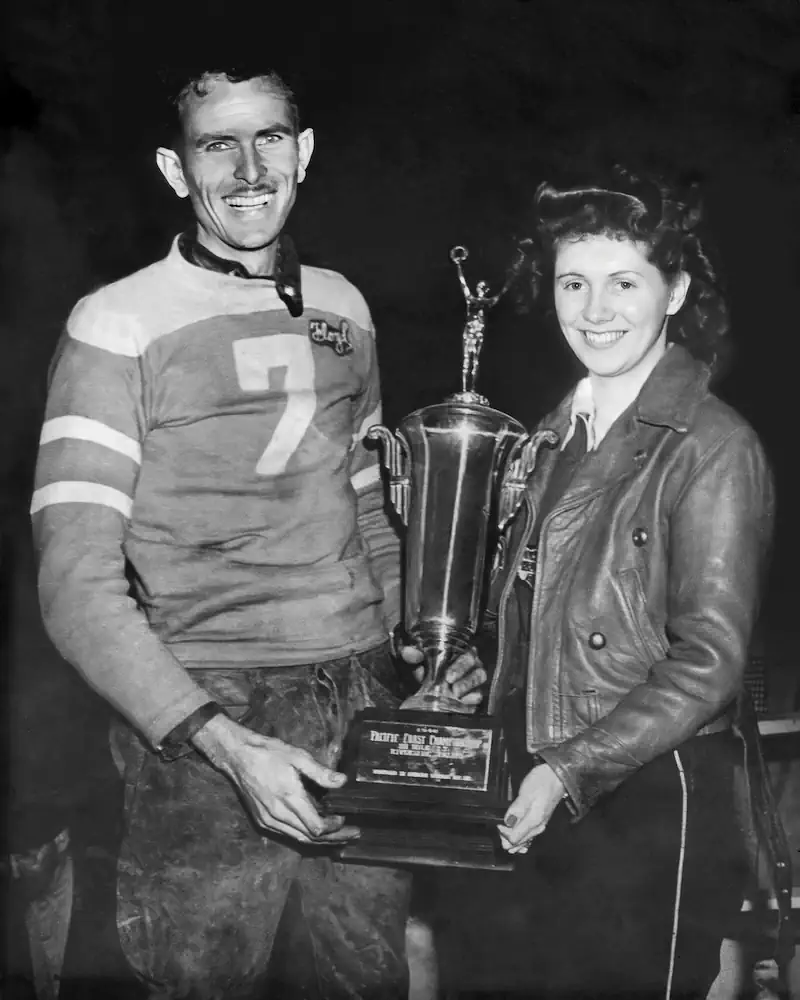
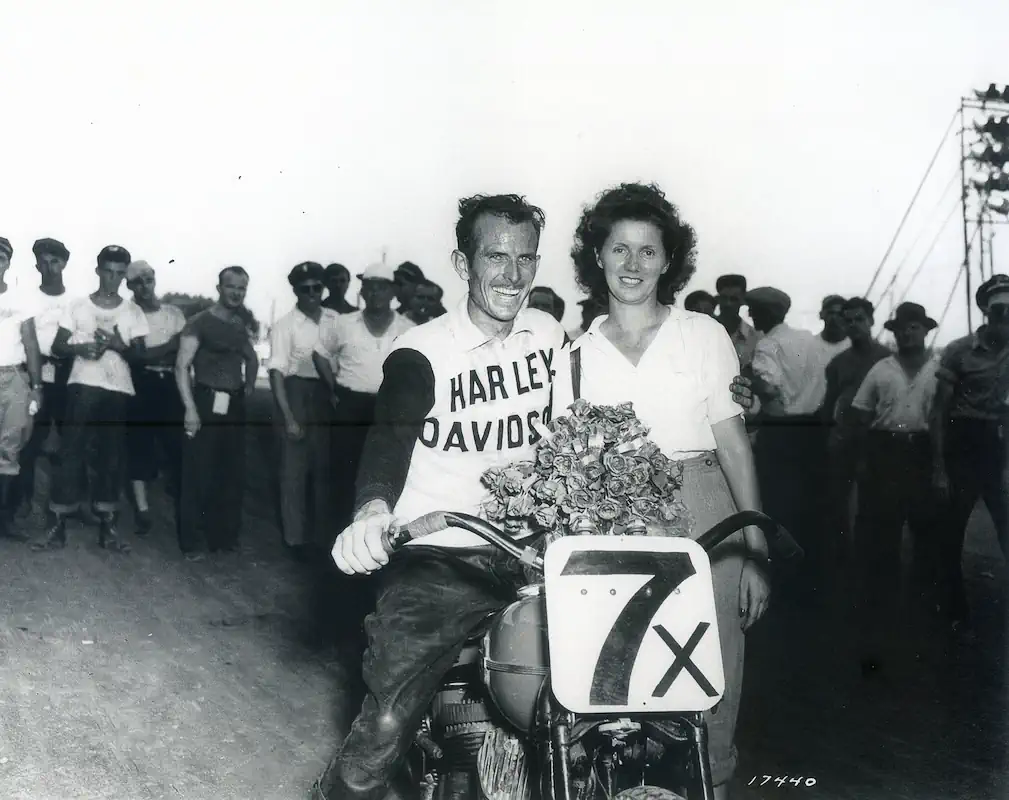
Floyd Emde receives the trophy for winning the 50-mile Pacific Coast TT Championship from his wife, Florence, in December 1946.
Flying Floyd is packed with superb period race images, including 82 shot by photographer Bob Magill. Magill—who provided many race images for books published by Motorbooks and periodicals—left his entire photo collection to Don Emde in his will, making it possible to tell the story with vivid visuals.
What I didn’t anticipate was that the book reveals the Emde family is something of a dynasty in motorcycle racing, spanning multiple generations. Indeed, the Emde family shares the distinction of having three members in the American Motorcyclist Association Hall of Fame: Floyd, and sons Don and David. The only other families that have accomplished that are those of John Penton and William A. Davidson, both founders of motorcycle companies.
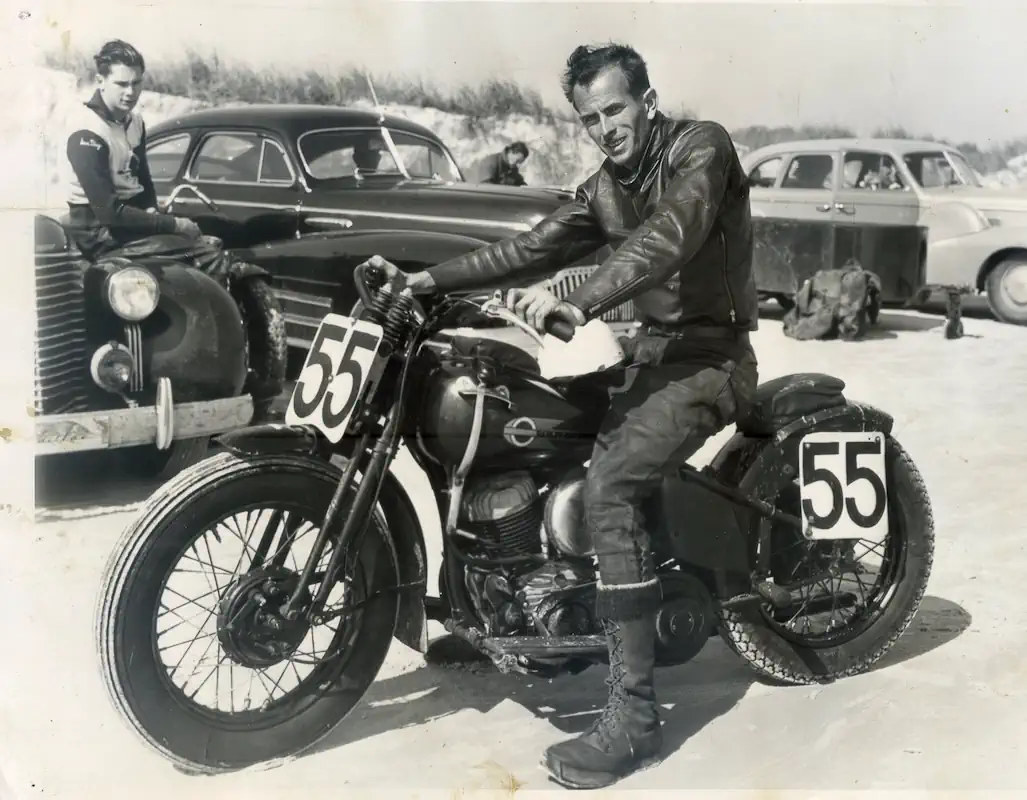
Emde aboard the Bill Ruhle-sponsored Harley-Davidson WRTT pre-race at the Daytona 200 in February 1947. He did not finish that year, but learned important lessons for future Daytona events.
Don Emde crafts more than an in-depth look at motorcycle racing history; it is also a personal account of family history dating back to the 1800s, and earlier. Indeed, Floyd’s maternal great-grandparents’ line included ancestors who arrived in North America on the Mayflower. In 1876, Emde’s great-grandfather, Ira Floyd, moved his family from Massachusetts to National City, California, just south of San Diego. That started the Emde legacy in Southern California.
The motorcycle tradition in the Emde family began with Joe Emde, Floyd’s father. On Memorial Day, 1914, Joe Emde competed in his first-ever motorcycle race held in the desert town of El Centro, California. That year, Joe opened Emde’s Garage, where he serviced both cars and motorcycles, including his own racing bikes.
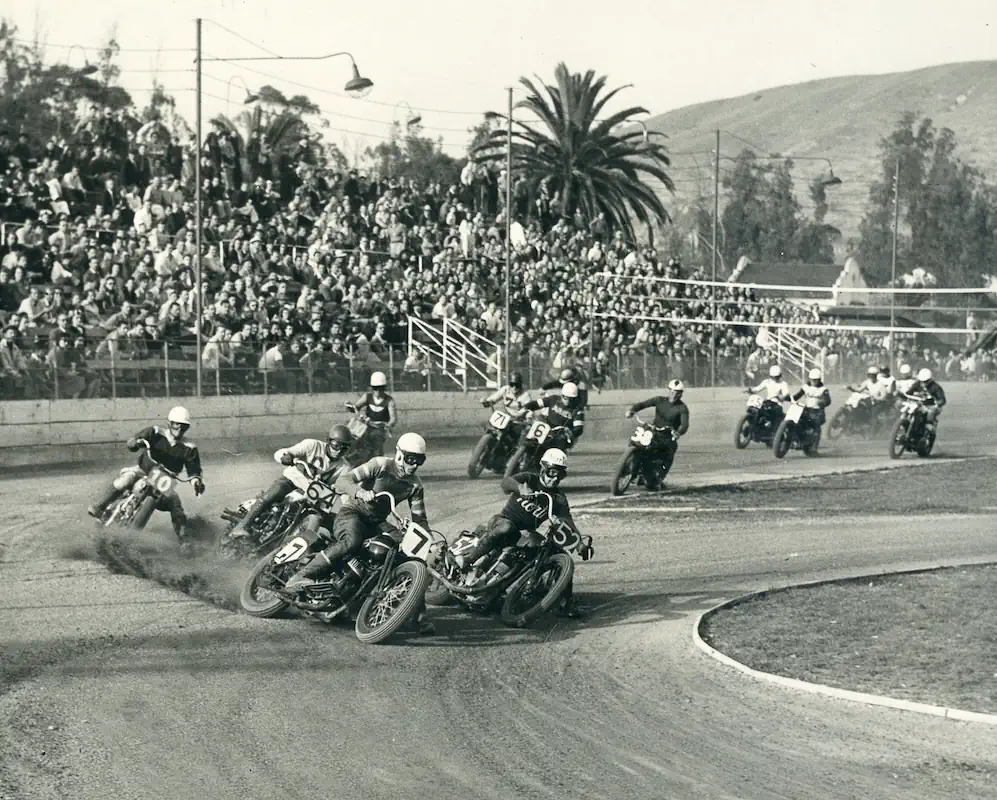
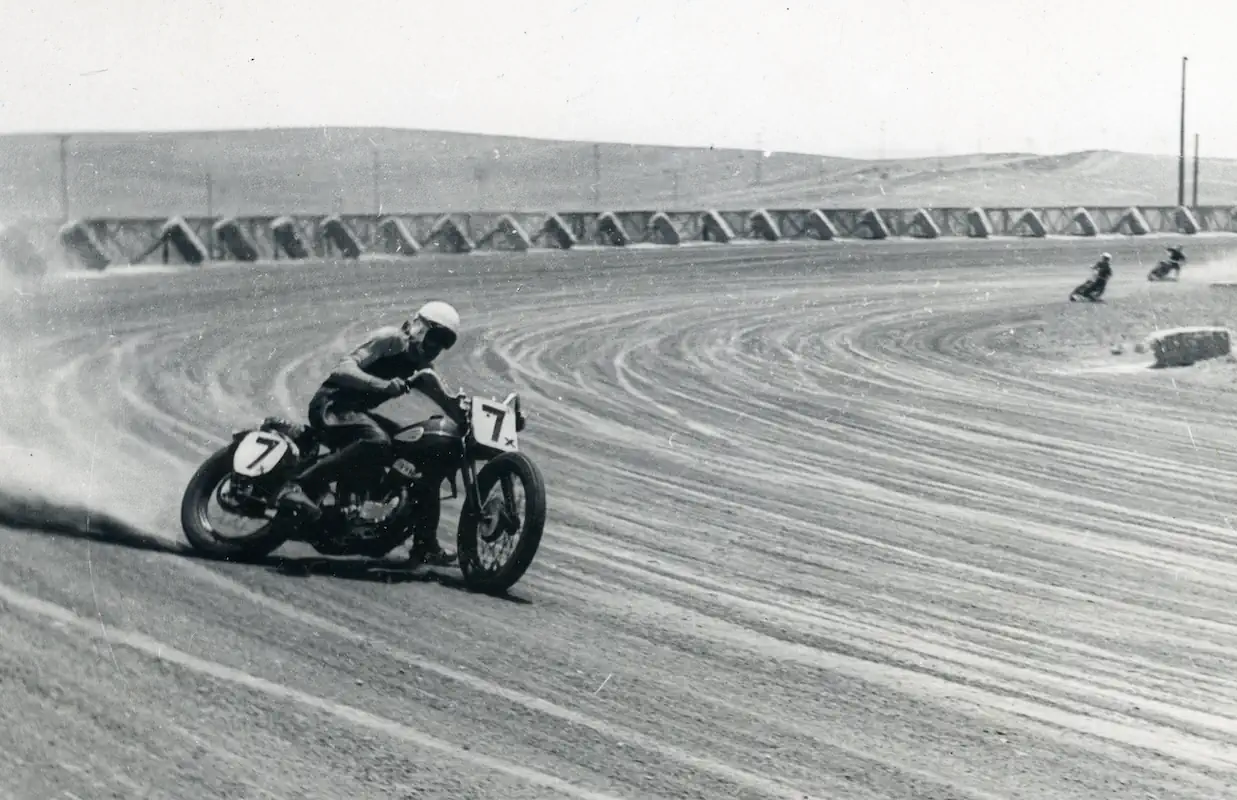
Emde, #7, leads the pack into turn one on his way to victory in the over/under figure eight TT event at Lincoln Park in northeast Los Angeles, March 1947.
On June 1, 1918, Joe married Mary Harbison. Nine months later, Floyd, the first of their family of six children, was born. By 1923, with a growing family and a unique opportunity on offer, Joe Emde closed his garage operation to become the first motorcycle patrol officer for the Imperial County Sheriff’s Office. In the ensuing years, he would serve as a motorcycle patrol officer in the National City Police Department, and later in the next-door Chula Vista Police Department.
The irony of Floyd’s father being a recently retired motorcycle cop would become apparent when, at the age of 19, Floyd made the papers as the result of his leading police on a high-speed chase on his Harley-Davidson WLD motorcycle around Chula Vista and National City. Adding to Floyd’s problem was the fact that his uncle, an unsympathetic Judge Ira Harbison, presided over his appearance in court.
AMA Class A Speedway night racing also happened at the Lincoln Park track. Emde won the Straw Hat Handicap race in May 1947.
In September 1939, Floyd turned his need for speed loose on the racetrack for the first time. He competed in the Southern California Motorcycle Rally and Convention TT at San Pedro. His riding skill was already evident as he took second place in his qualifying heat and fourth in the final of the AMA Unlimited Class C Novice event.
In the pre-World War II years, Floyd established himself as one of the top pro racers in Southern California. He was sponsored by Harley-Davidson and Indian motorcycle dealers at different times. He competed successfully with top riders at the national level, including Ed Kretz, Buck Brigance, Ben Campanale, Sam Arena, Jimmy Kelly, Ted Evans, Dick Milligan, and many more.
Floyd with friend, mentor, and tough competitor, Ed Kretz.
In the midst of an ever-growing racing schedule, Floyd married Florence Gavett on April 13, 1941. They met at a motorcycle event two years before, and their mutual passion for motorcycles drew them together for life. As big a year as 1941 already was for the new couple, world events would overtake their lives with the Japanese attack on Pearl Harbor.
Professional motorcycle racing wound down in 1942, with the AMA canceling most events. It was three years from his last race on June 21, 1942, before Floyd raced again. In the intervening years, Floyd put his mechanical skills to work in the wartime defense industry at Consolidated Aircraft Corp. in San Diego.
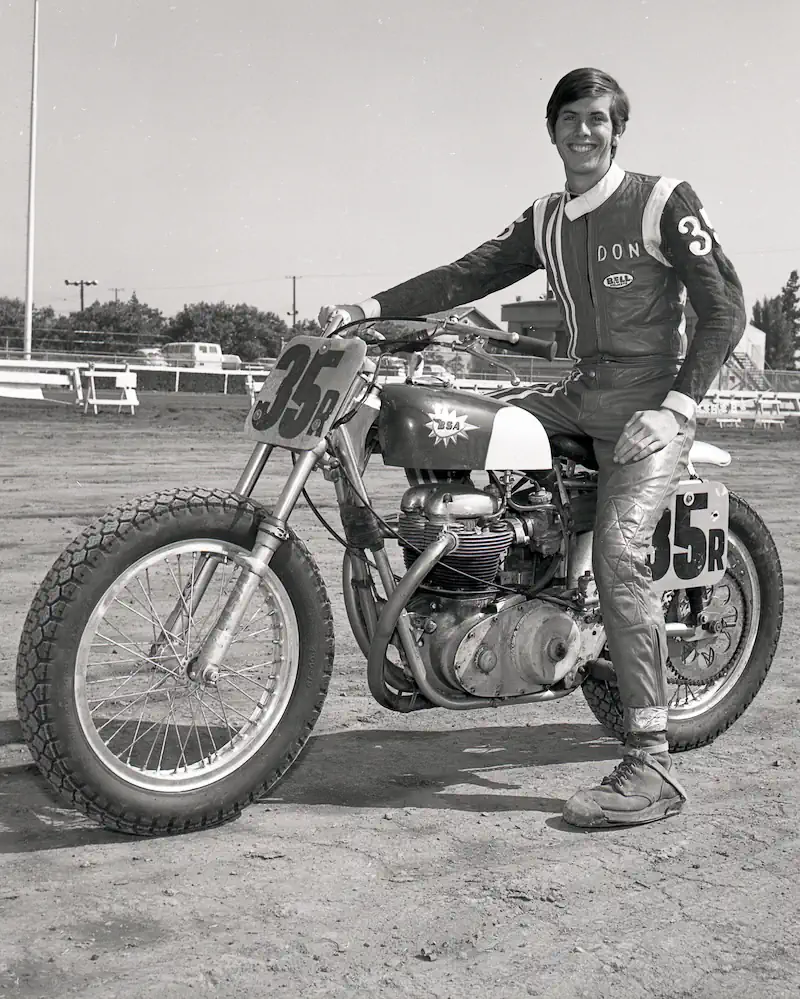
Floyd’s son and the book’s author, Don Emde, on his BSA flat tracker at Columbus, Ohio, in 1970. Don qualified with a lap of 28.65 seconds—less than a second faster than Floyd’s 1947 record of 28.71 seconds.
The chapter covering the war years is a surprising and fascinating bonus, particularly for fans of World War II aviation history. It provides insights not only into the Emdes’ lives during those turbulent years but also into the incredible growth and change in the San Diego area and into operations within war-era Consolidated Aircraft. The company built the B-24 Liberator bomber, the PBY Catalina seaplane, the larger PB2Y, and served as a backup builder of the Boeing B-17 Flying Fortress.
Building aircraft wasn’t the only building going on in those years. The Emde family was under construction with the arrival of the first of their five children, son Robert, in April 1943.
Floyd Emde low-sided in the Four Star Flat Track event at Lakeside, California, in July 1947. However, he remounted quickly enough to finish 4th in the main event.
At the end of the war in 1945, the Emdes made a bold decision. With Florence’s strong support, Floyd left his steady job at Consolidated to become a full-time professional motorcycle racer. Floyd brought his riding skills to AMA Class C flat track, TT races, and Class A Speedway.
By 1946, despite frequent success, Floyd’s racing income left money tight. With another child on the way, he took a job as a mechanic at Guy Urquhart’s Indian dealership. His first event in 1946 was a Hare & Hound that ran from San Diego to National City. Floyd’s daughter, JoAnn Marie, was born at a local hospital during the event, which he won.
In the Two Star Benefit flat track event in Corona in July 1947, Emde blew the field away, winning the 20-lap main event on his new Harley-Davidson WR race bike.
Not long after, Floyd left Urquhart’s Indian dealership and got both a job and racer support from Richards’ Motorcycles in San Diego. Richards was a dealer for British brands Ariel and BSA, so Floyd was soon competing on 500cc OHV single-cylinder bikes, as well as the V-twin Indian racing bike built and tuned by Noel McIntyre. By mid-year, that relationship ended as Floyd expanded his racing schedule to include more AMA national events nationwide.
By August 1946, Emde had secured the backing of San Diego Harley-Davidson dealer Bill Ruhle. The agreement got Floyd one of H-D’s new WRTT race bikes, with a fresh race-prepped engine for each event. Emde would keep all his winnings—he was splitting his winnings 50/50 with Noel McIntyre from races he competed in on McIntyre’s Indian—and cover his own expenses.
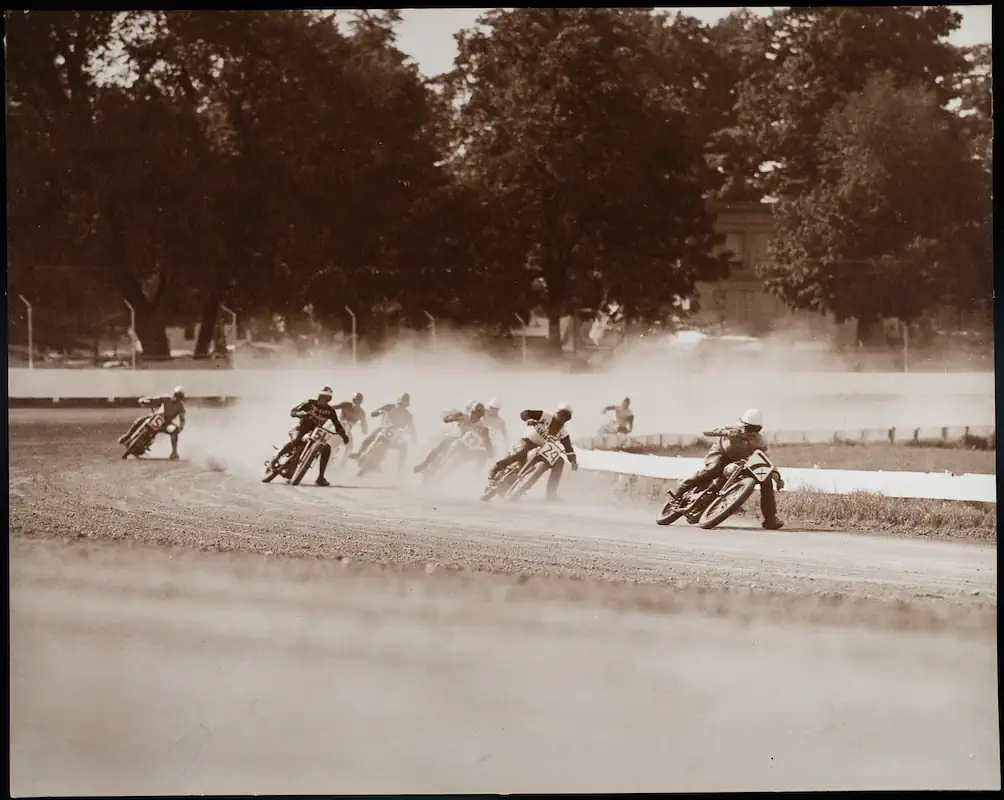
Emde leads the first five-lap Expert heat race at the AMA 10-mile National Flat Track Championship race at Milwaukee. Buck Brigance (#24), Leo Anthony (#23), and Bill Tuman (#51) gave chase and qualified for the final, which Emde won. It was his first AMA National Championship.
Ruhle’s confidence in Floyd was rewarded in 1946 with many victories and podium finishes. One of the biggest wins came in early December when Emde topped a high-powered field to win the 50-mile Pacific Coast TT Championship at Box Springs Race Track in Riverside, California. Indeed, Emde won the Motorcycle Competition Riders & Owners Association High Point Rider award for the year.
Emde had a rigorous schedule of many regional events in southern California and 10 AMA National Championship races in 1947, starting with the Daytona 200 in February—the race’s return after World War II.
Floyd and his wife, Florence, savor his victory in Milwaukee.
Daytona got the season off to an inauspicious start. Floyd dropped his WRTT on its left side in the deep sand in a corner of the beach section of the track. The engine ingested some sand, ending his race after only six or seven laps. By mid-summer, Floyd had resumed his winning ways.
However, the unexpected death of his sponsor Ruhle in July threatened to upend his season. In addition, a tragedy at the 25-mile National Championship in Springfield, Illinois, in August cast a pall over the 1947 season. With Emde running fourth in the second qualifying heat, a spectator held a newspaper out into the track. Emde struck it, and it blocked his view at 80 mph, causing Emde and the three riders behind him to crash. Ken Ingles was killed, and the other three riders involved were injured.
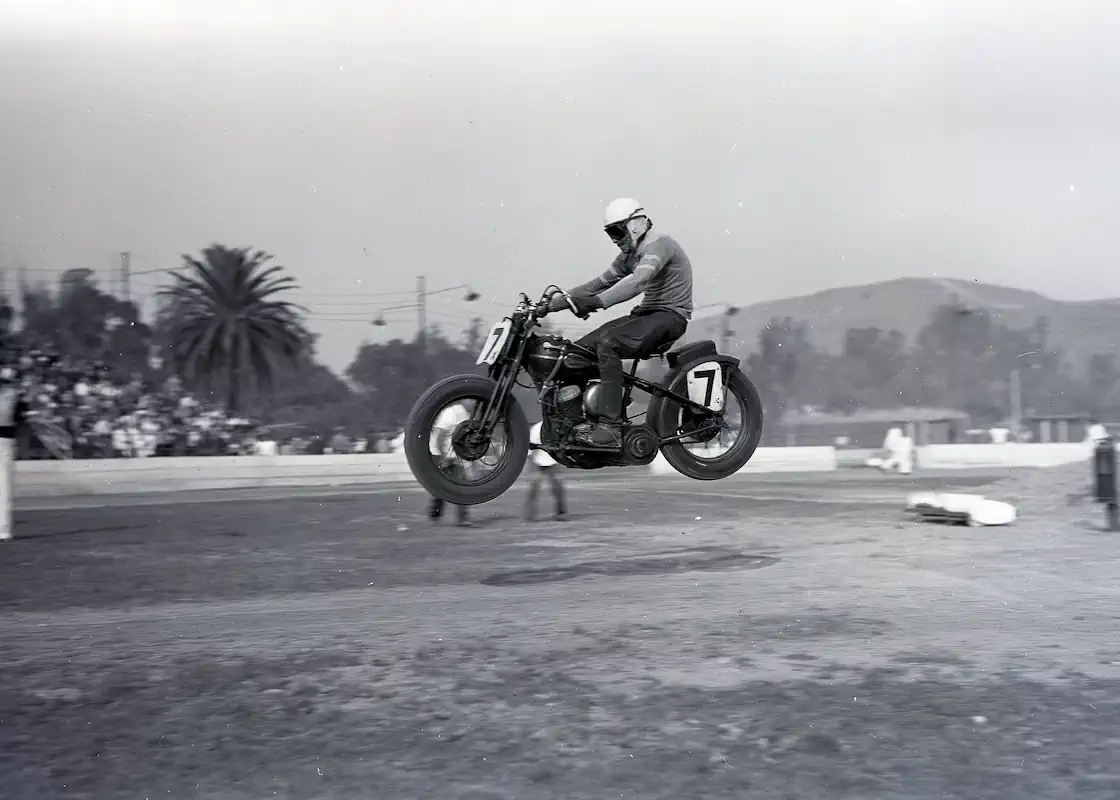
Floyd Emde airborne on the way to victory in the last TT of the 1947 season. It was Floyd’s final race sponsored by Bill Ruhle’s Harley-Davidson dealership.
Emde managed to put the disaster behind him, get to Milwaukee, get his wrecked Harley-Davidson rebuilt, and be ready to race in the AMA 10-mile Flat Track National Championship. On a very hot August day, and facing intense competition in the Expert final, Floyd captured his first AMA National title. Less than a month later, at Pomona, California, Emde won the eight-mile Pacific Coast Flat Track Championship.
Despite a very successful season, Emde was confronted with an unexpected shock in December. The new owners of San Diego Harley-Davidson informed him that they would not support his racing in 1948. However, as was his habit, he landed on his feet, regaining sponsorship through Guy Urquhart’s Indian dealership.
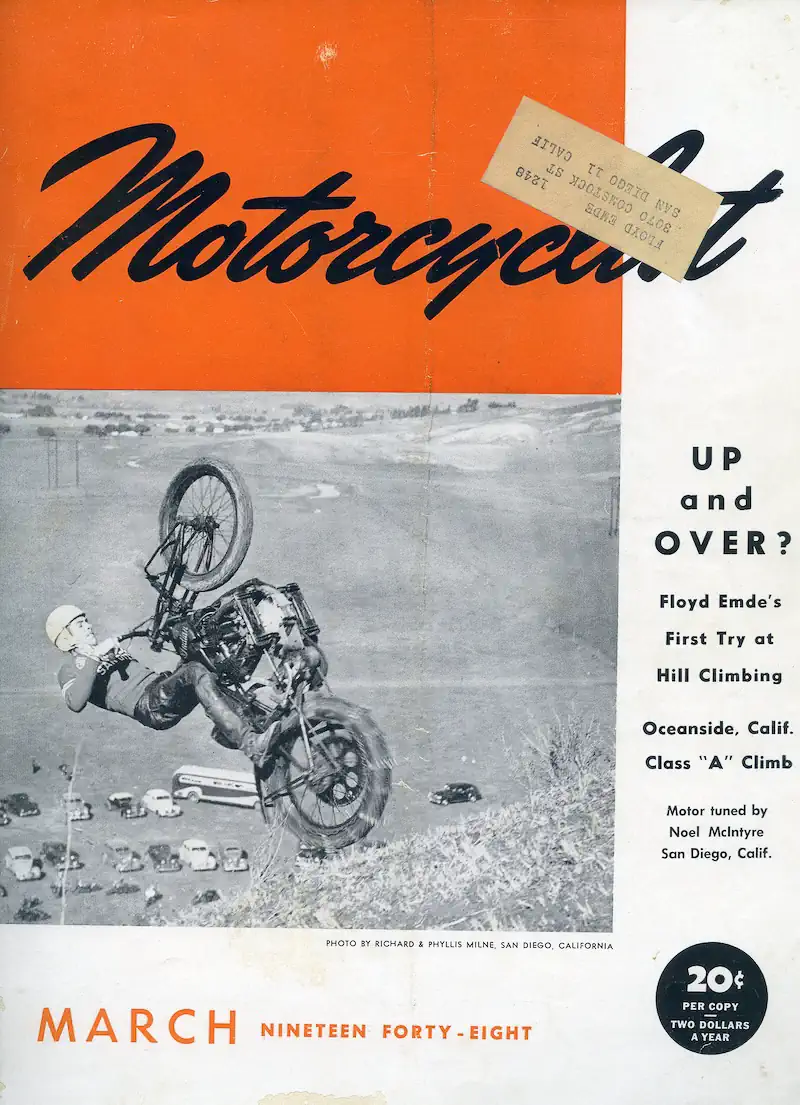
Emde launches his 1928 Indian Altoona in Oceanside, California, at the first hill climb event he competed in, as shown on the cover of the March 1948 issue of Motorcyclist magazine. Photograph by Richard & Phyllis Milne.
The change was opportune in ways not even Floyd would have imagined. It enabled him to ride Indian’s newest high-performance bike, the 648 Big Base Scout V-twin. What’s more, he had race-prep done by his friend and experienced tuner, Noel McIntyre, from his prior Indian racing days.
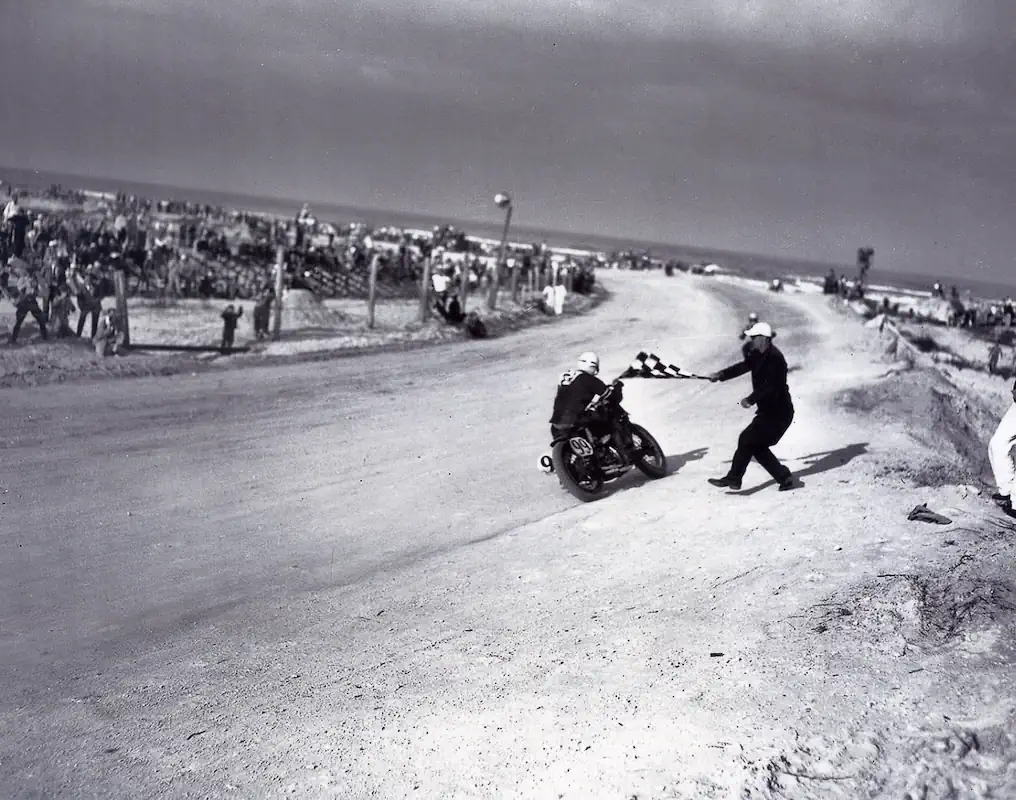
Those factors combined to set the stage for his greatest career victory in March when he led the Daytona 200-mile race from start to finish and set a new average record speed of 84.01 mph! It also gave him his largest-ever prize money, $2,000 (about $27,000 in today’s dollars).
Floyd Emde takes the checkered flag as he wins the 1948 Daytona 200, setting a new average speed record of 84.01 mph.
Floyd Emde’s Daytona victory almost immediately led to yet another major event in his career. Hap Alzina, Indian Motorcycle distributor for every dealer west of the Mississippi, approached Floyd about becoming an Indian dealer. Armed with the cash windfall from Daytona and considering the example of racer Ed Kretz, who had successfully combined being a dealer with also being a racer, Floyd and Florence decided to give it a go.
By May, the Emdes had their new Indian Motorcycle dealership up and running. They were successful in the motorcycle business for more than 30 years, though not with Indian for very long.
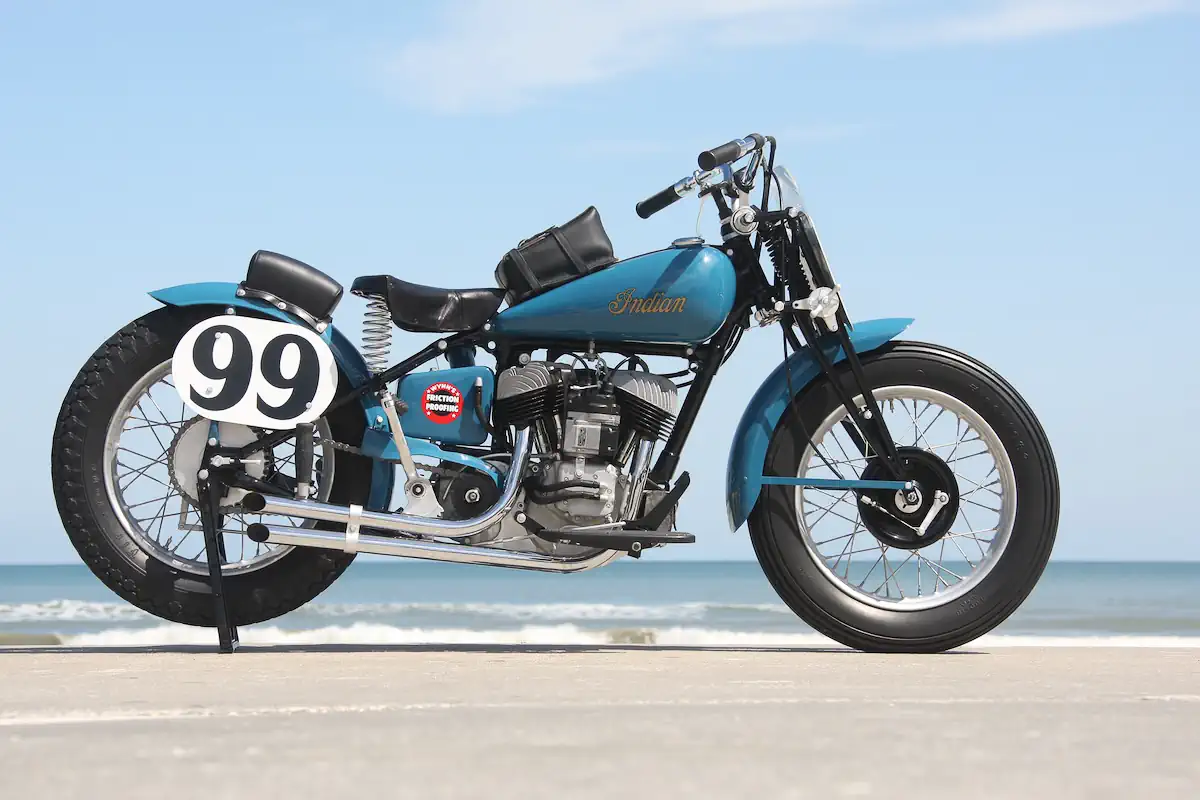
An exact replica of the Indian 648 Big Base Scout that Emde rode to victory at Daytona.
Despite his hopes to the contrary, running a business forced Floyd to cut back on racing. Floyd dropped Class A Speedway to focus on Class C events exclusively. Things weren’t working out in other ways. Only about eight months after becoming Indian dealers, the Emde family joined in creating the Floyd Emde Company and became a Harley-Davidson dealership.
In July, a three-bike crash in the races held at Carrell Speedway in Gardena, California, caused the most serious injuries Emde had experienced in his career and ended his 1950 racing season. In the incident, Floyd was thrown against a wooden retaining wall and suffered a broken shoulder, loss of numerous teeth, and injuries requiring surgery. He spent three weeks in the hospital.
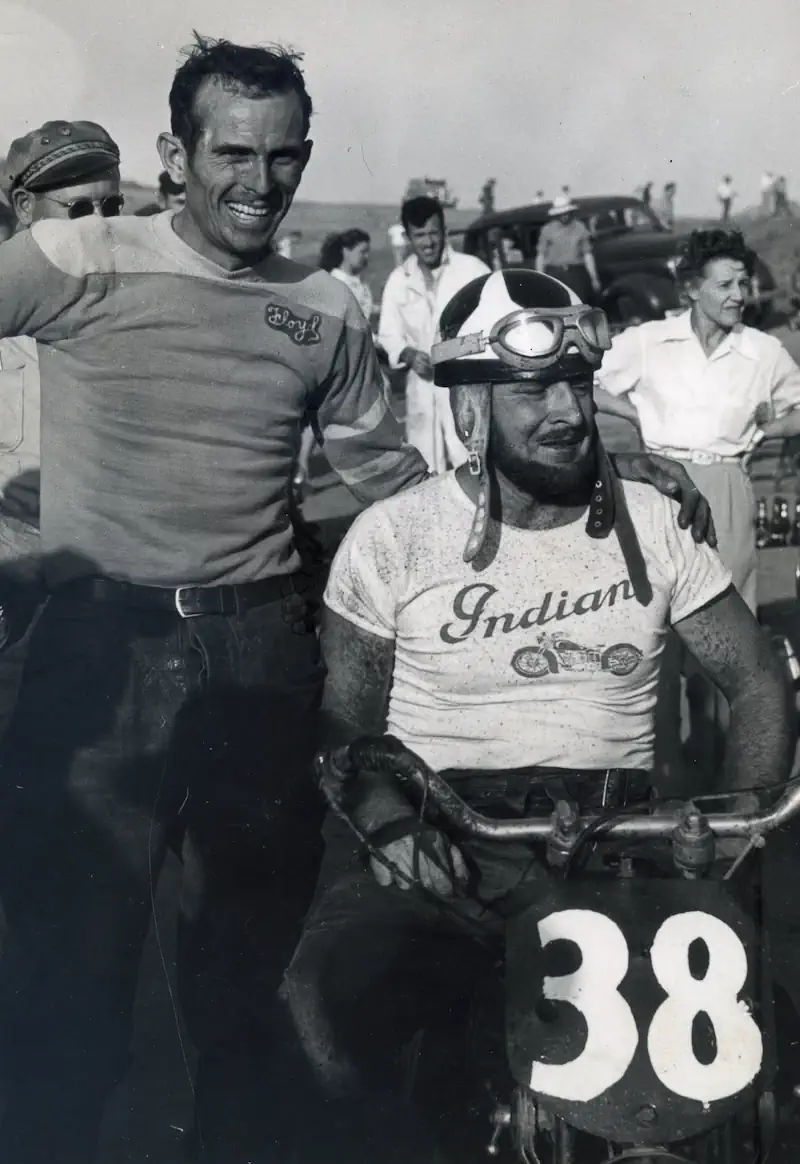
1948 Daytona 200 winner Floyd Emde joins son, Don, at Daytona after Don’s 1972 victory.
The aftermath of the accident marked a turning point; Floyd’s involvement in his family and business expanded while his racing was reduced. The 1950s saw three more children arrive—Don, Nancy, and David. As his business evolved, by the 1970s, he found himself the sponsor and patriarch of a motorcycle racing family with Bob, Don, David, and Nancy all finding success on the track. Perhaps no event was more remarkable in that time than Don Emde’s stunning victory at the 1972 Daytona 200.
Flying Floyd: The Motorcycling Life of Floyd Emde is another remarkable achievement for author/publisher Don Emde. Written with a clear, conversational style, yet packed with insight and detail, and brought to life with more than 1,000 period images and illustrations, the book is a masterpiece of motorcycle history and skillful storytelling.
Flying Floyd Fast Facts
Title: Flying Floyd: The Motorcycling Life of Floyd Emde
Hello and welcome again to the Motos and Friends Podcast. This episode is brought to you by Leod Escapes.
* * * * *
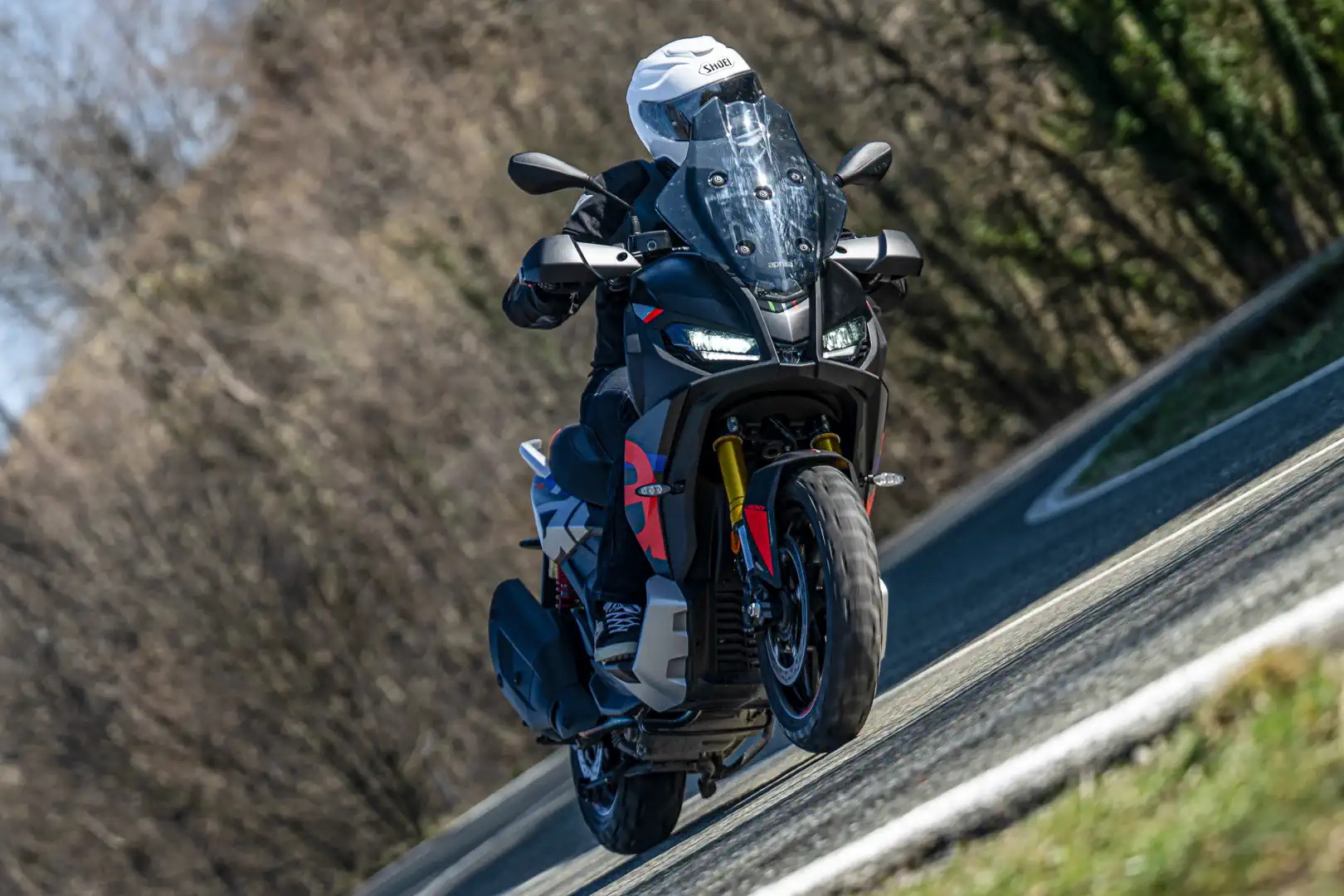
Aprilia is bringing a scooter to North America, and it’s one designed to appeal to adventure motorcyclists. The SR GT 400 is a mid-size scooter built around a steel motorcycle-style frame, a 399cc single, and off-road-ready hardware. It reaches US dealers as soon as this month. Don Williams and Kelly Callan spent some time riding the Aprilia and were surprised by what they discovered. Is this a real motorcycle or just a good-looking urban scooter?
* * * * *
Cat McLeod is founder and owner of Leod Escapes, the ultimate tour company for sport-minded motorcycle riders. Cat talks to us this segment about some of his amazing European experiences and tours that include of course, riding some amazing MotoGP tracks on new BMW S1000RRs. If you like what you hear, now is the time to book your trip of a lifetime, so visit LeodEscapes.com to find out more.
* * * * *
Our guest this episode is Terry Vance, the multiple Motorcycle and Motorsports Hall-of-Famer. Terry is of course the former professional motorcycle drag racer, team owner, and co-founder of the high-performance parts company Vance & Hines. Teejay Adams chats with Terry about his incredible career that includes being the first rider to hit 200 mph in the standing quarter-mile.
Having won this year’s MotoAmerica Mission King of the Baggers championship with Hayden Gillim riding the Vance & Hines factory Indian Challenger, and with Harley-Davidson’s recent withdrawal, Terry gives us his thoughts on where the series might go from here.
* * * * *
Here’s quick reminder to check out our monthly digital magazine. It’s filled with everything you want to read on motorcycling, including some things you’ve probably not seen elsewhere. It’s absolutely free and you will find it on the Apple App Store and of course on Google Play as well.
Don’t forget to leave us your comments on our social media—we’re on all the usual platforms at Ultimate Motorcycling. We love hearing your feedback… so good or bad, please let us know what you think. If there’s something you’d like us to cover, we’d love to hear those ideas too!
We use cookies and browser activity on this website
Functional
Always active
The technical storage or access is strictly necessary for the legitimate purpose of enabling the use of a specific service explicitly requested by the subscriber or user, or for the sole purpose of carrying out the transmission of a communication over an electronic communications network.
Preferences
The technical storage or access is necessary for the legitimate purpose of storing preferences that are not requested by the subscriber or user.
Statistics
The technical storage or access that is used exclusively for statistical purposes.The technical storage or access that is used exclusively for anonymous statistical purposes. Without a subpoena, voluntary compliance on the part of your Internet Service Provider, or additional records from a third party, information stored or retrieved for this purpose alone cannot usually be used to identify you.
Marketing
The technical storage or access is required to create user profiles to send advertising, or to track the user on a website or across several websites for similar marketing purposes.
Advertising helps us keep our content available for free, so adjusting your ad blocking settings will help us.
We appreciate your support!
i
How to Allow Ads on This Site
Depending on your setup, ads may be blocked by a browser extension, VPN, antivirus software, or other application. Here are some common ways to allow ads:
Browser Extensions (e.g., Adblock, uBlock, etc.)
Click the extension icon in your browser toolbar.
Look for an option like "Don't run on pages on this site" or "Pause on this site".
Save the change and refresh the page.
VPNs with Ad Blocking (e.g., NordVPN, Proton VPN, etc.)
Open your VPN app.
Go to settings or features.
Disable any ad blocking or tracking protection features.
Refresh the page.
Antivirus Software or Other Privacy Tools
Check for web protection, ad filtering, or browser privacy settings.
Click the power button to disable it for this site.
Refresh the page.
Not sure what's blocking ads? Look for tools with privacy or filtering features, or check your browser extensions. We only use respectful, non-intrusive advertising.