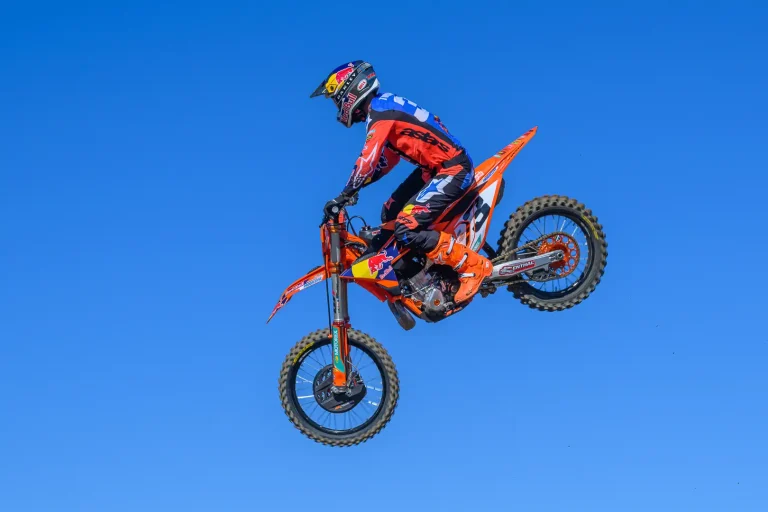
Red Bull KTM Factory Racing's Eli Tomac. Photograph by Don Williams.
0:00
▶
International finance can be confusing. We write about motorcycles and try to stay away from the business end as much as possible. Regardless, sometimes we can’t ignore the business world, and that’s the case with Bajaj Auto’s acquisition of KTM. We talked with various experts, so we’re going to try to keep it simple with some Fast Facts. Settle in, as this won’t be as much fun as reading about the Bajaj-built 2026 KTM 390 Adventure X that we just reviewed.
Bajaj Auto headquarters in India.
Bajaj Auto has completed its acquisition of a controlling stake in KTM AG, closing the transaction on November 18, following final European Commission approval on November 10. The €800 million deal (approximately $920 million) transforms Bajaj from a long-term partner to the majority owner of KTM. As a reminder, AG stands for Aktiengesellschaft, which is the German equivalent of Inc.
Through its Dutch subsidiary, Bajaj Auto International Holdings BV, Bajaj has acquired the1 percent stake in Pierer Bajaj AG that it did not already own. Pierer Bajaj AG has been renamed Bajaj Auto International Holdings AG and holds 74.9 percent of the listed KTM parent company, which has been rebranded as Bajaj Mobility AG. With the Pierer Group fully divested, KTM, Husqvarna, and GasGas are now consolidated under Bajaj’s global umbrella.
Bajaj Gogo.
The acquisition of KTM comes at a time when Bajaj Auto is posting its strongest financial performance ever. In the quarter ended September 30, 2025, Bajaj Auto delivered record revenue of $1.7 billion, up 14 percent year-on-year.
Earnings Before Interest, Taxes, Depreciation, and Amortization (EBITDA) hit $342 million, yielding an enviable 20.5 percent margin. Profit after tax reached an all-time quarterly high of $279 million, a 24 percent increase. A high or rising EBITDA means the core business is healthy. The EBITDA margin (EBITDA ÷ revenue) tells you how efficient the company is. Bajaj’s 20.5 percent margin means that for every $100 of revenue, roughly $20.50 appears on the bottom line as operating profit, before the other deductions. That’s considered very strong in the motorcycle industry, as most manufacturers live in the 10 to 16 percent range.
KTM 390 Duke manufactured by Bajaj Auto in India.
Baja Auto’s export momentum was robust in the last quarter. Over 550,000 two- and three-wheelers were shipped, a 24 percent rise, with commercial-vehicle exports surging 67 percent. The premium motorcycle segment, including KTM, Husqvarna, and Triumph models sold through the same network, totaled over 30,000 units domestically. That’s up 30 percent, while billing value in the segment jumped roughly 70 percent. Electric vehicles now account for 20 percent of domestic revenue and have moved into double-digit EBITDA territory. The company also recorded its best-ever three-wheeler quarter with 145,000 units sold.
Bajaj generated over a half-billion dollars of free cash flow in the first half of the fiscal year and closed the quarter with surplus cash exceeding $1.6 billion. This financial strength allowed the KTM acquisition to be funded entirely through debt without straining liquidity or balance-sheet ratios. The $920 million capital injection earlier this year already stabilized KTM’s operations, funded creditor settlements, and prevented production interruptions during restructuring.
Mattighofen remains the global center for R&D, design, racing, and large-displacement model production. Small- and mid-displacement KTMs will continue to be built in India for worldwide export. This business model has driven 20 percent year-on-year growth in KTM-branded exports for 2025.
Bajaj Pulsar N125.
Bajaj Auto is eyeing a 50 percent reduction in overhead at KTM. “This is really low-hanging fruit,” Bajaj Auto Managing Director and Chief Executive Officer Rajiv Bajaj told CNBC-TV18, India’s leading English-language news channel. “We observe an opportunity to reduce overheads by more than 50 percent, including R&D, marketing, operations, and general administration. Interestingly, of the 4,000 people currently employed, only about 1,000 are blue-collar. Three thousand are white-collar, which is perplexing because the blue-collar employees make the motorcycles.” The son of the late Rahul Bajaj, who was Chairman Emeritus of Baja Auto, Rajiv was behind the Pulsar range of Bajaj motorcycles in 2001, which established the company as a leader in India. More recently, Baja Auto was named CNBC-TV18’s Outstanding Company of the Year at its India Business Leader Awards.
Part of the marketing cuts will include racing, though where the cuts will come remains to be seen. The racing department operates as a semi-autonomous entity within KTM, with its own revenue streams from sponsors, but Bajaj’s restructuring has put non-core expenses under scrutiny. KTM was spending approximately $70 million on racing last year—expect that to be cut by as much as half moving forward. KTM’s MotoGP presence may see a dramatic change in 2027 when its contract is due to be renewed. Red Bull and CFMoto have established relationships with KTM, and their involvement in MotoGP may be enhanced. Supercross and motocross teams seem safe, as they’re cheaper and boost brand prestige in key markets, including the United States. Rally teams help sell adventure bikes, and Bajaj’s global export focus could enhance support in that discipline.
Red Bull KTM Factory Racing’s Pedro Acosta. Photo courtesy of MotoGP.
With a track record of profitable premium partnerships—Triumph sales in India are up 70 percent this year on the same platform—Bajaj is positioning KTM for sustainable growth. The combination of Indian manufacturing efficiencies, Austrian engineering, and one of the strongest balance sheets in the industry, bodes well for the future of the KTM brand.
We aren’t experts on global finance. However, we have endeavored to provide you with a reasonably easy-to-understand overview of the Bajaj Auto takeover of KTM. We’re staying optimistic, and KTM may thrive as never before. The motorcycling world will be watching.
Hello and welcome again to the Motos and Friends Podcast. This episode is brought to you by Leod Escapes.
* * * * *
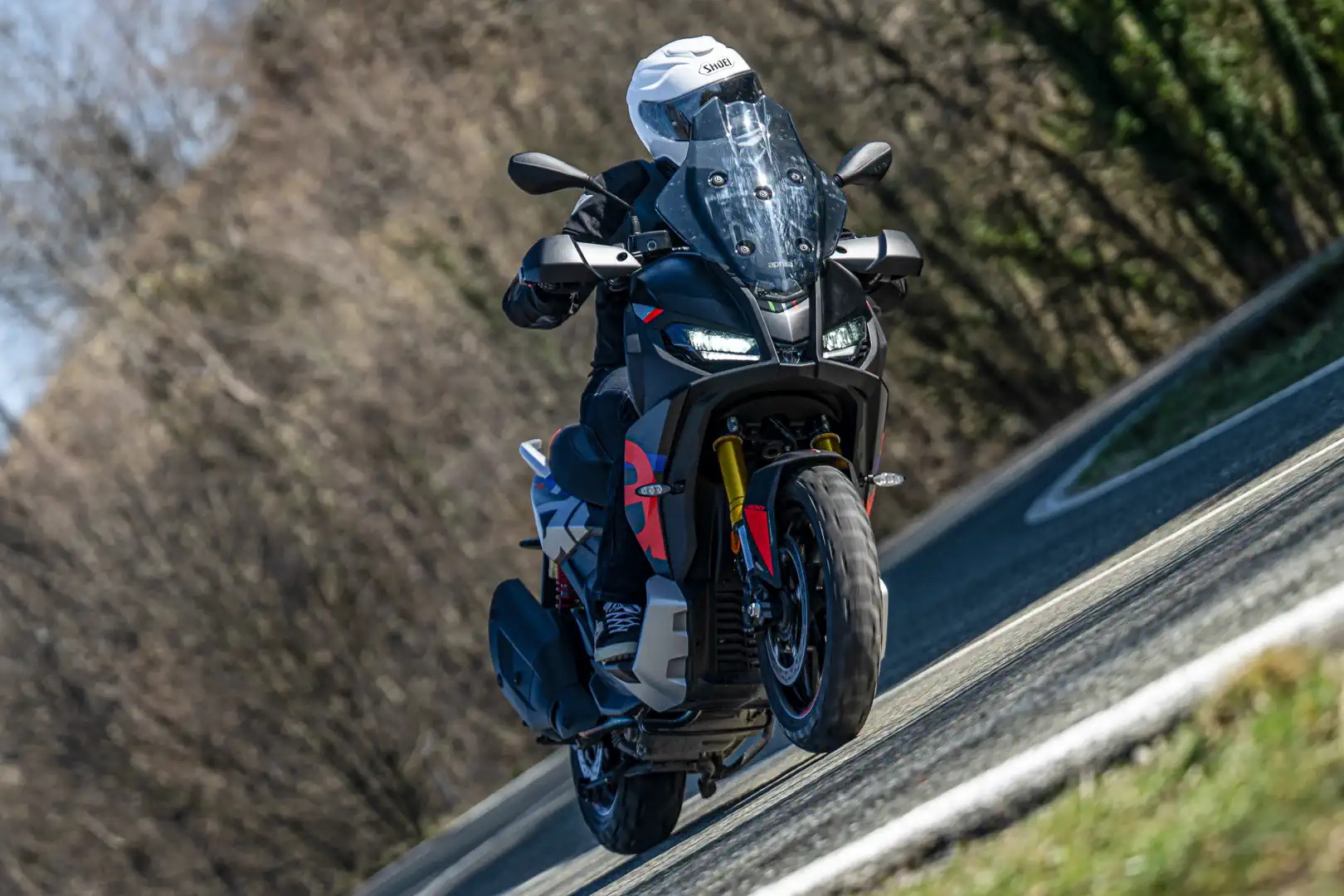
Aprilia is bringing a scooter to North America, and it’s one designed to appeal to adventure motorcyclists. The SR GT 400 is a mid-size scooter built around a steel motorcycle-style frame, a 399cc single, and off-road-ready hardware. It reaches US dealers as soon as this month. Don Williams and Kelly Callan spent some time riding the Aprilia and were surprised by what they discovered. Is this a real motorcycle or just a good-looking urban scooter?
* * * * *
Cat McLeod is founder and owner of Leod Escapes, the ultimate tour company for sport-minded motorcycle riders. Cat talks to us this segment about some of his amazing European experiences and tours that include of course, riding some amazing MotoGP tracks on new BMW S1000RRs. If you like what you hear, now is the time to book your trip of a lifetime, so visit LeodEscapes.com to find out more.
* * * * *
Our guest this episode is Terry Vance, the multiple Motorcycle and Motorsports Hall-of-Famer. Terry is of course the former professional motorcycle drag racer, team owner, and co-founder of the high-performance parts company Vance & Hines. Teejay Adams chats with Terry about his incredible career that includes being the first rider to hit 200 mph in the standing quarter-mile.
Having won this year’s MotoAmerica Mission King of the Baggers championship with Hayden Gillim riding the Vance & Hines factory Indian Challenger, and with Harley-Davidson’s recent withdrawal, Terry gives us his thoughts on where the series might go from here.
* * * * *
Here’s quick reminder to check out our monthly digital magazine. It’s filled with everything you want to read on motorcycling, including some things you’ve probably not seen elsewhere. It’s absolutely free and you will find it on the Apple App Store and of course on Google Play as well.
Don’t forget to leave us your comments on our social media—we’re on all the usual platforms at Ultimate Motorcycling. We love hearing your feedback… so good or bad, please let us know what you think. If there’s something you’d like us to cover, we’d love to hear those ideas too!
We use cookies and browser activity on this website
Functional
Always active
The technical storage or access is strictly necessary for the legitimate purpose of enabling the use of a specific service explicitly requested by the subscriber or user, or for the sole purpose of carrying out the transmission of a communication over an electronic communications network.
Preferences
The technical storage or access is necessary for the legitimate purpose of storing preferences that are not requested by the subscriber or user.
Statistics
The technical storage or access that is used exclusively for statistical purposes.The technical storage or access that is used exclusively for anonymous statistical purposes. Without a subpoena, voluntary compliance on the part of your Internet Service Provider, or additional records from a third party, information stored or retrieved for this purpose alone cannot usually be used to identify you.
Marketing
The technical storage or access is required to create user profiles to send advertising, or to track the user on a website or across several websites for similar marketing purposes.