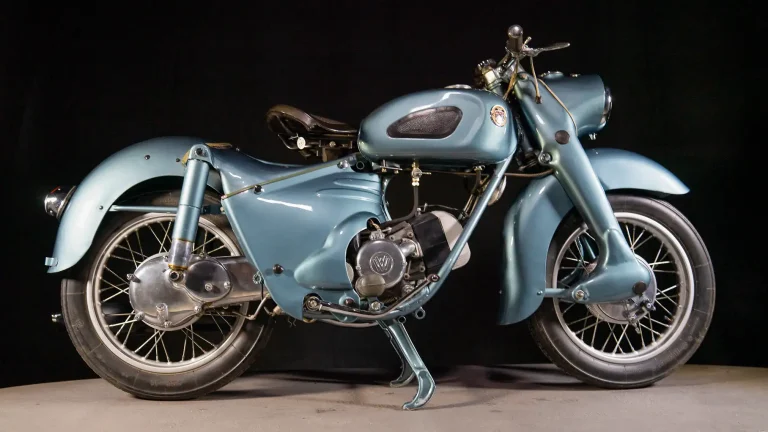
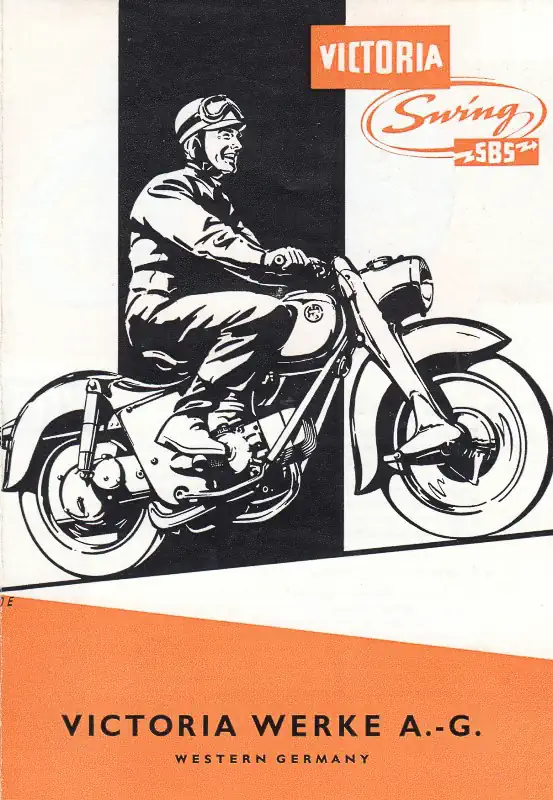
A 1955 Victoria KR 21 Swing is displayed at the Zweiradmuseum Neckarsulm in Baden-Württemberg, Germany. Photograph courtesy of Zweiradmuseum Neckarsulm.
Back in the 1950s, some American automakers were trying to compete on Buck Rogers-inspired high-tech features and aerodynamic styling. For example, my dad had a big 1957 Mercury Turnpike Cruiser, part of the Big M line. Mercury called it a “dream-car design” that featured self-adjusting memory seats and the Merc-0-Matic push-button automatic transmission.
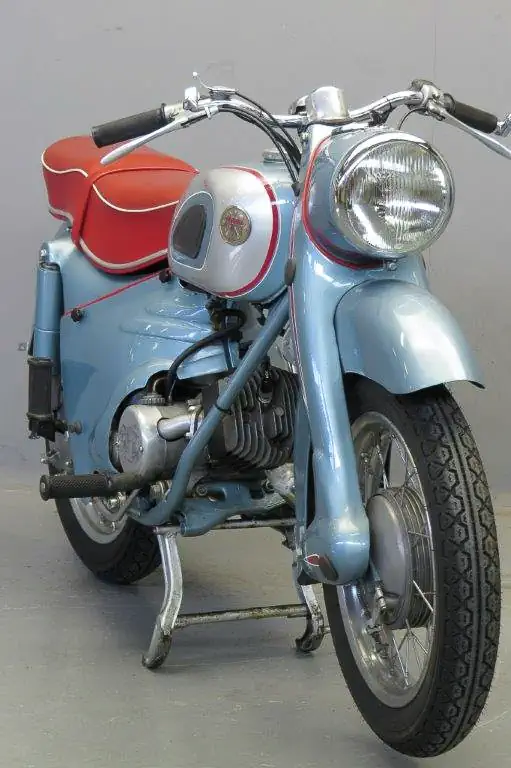
The 1955 KR 21 Victoria Swing motorcycle has a sleek, purposeful appearance that understates its many advanced technical features. Photograph courtesy of Peter Kisgen.
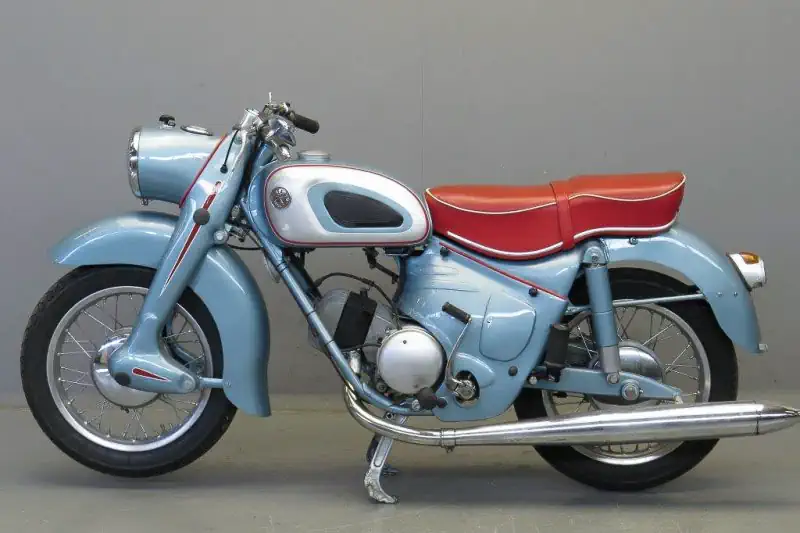
Similar efforts to innovate were underway in the motorcycle industry, including the 1955 Victoria KR 21 Swing, designed by German engineer Norbert Riedel. At first glance, it resembles many motorcycle models of its time; it had deeply valanced fenders, a pressed-steel frame, cantilevered spring-loaded girder front suspension, internal expanding drum brakes, and so on. In general, it is relatively conventional overall appearance.
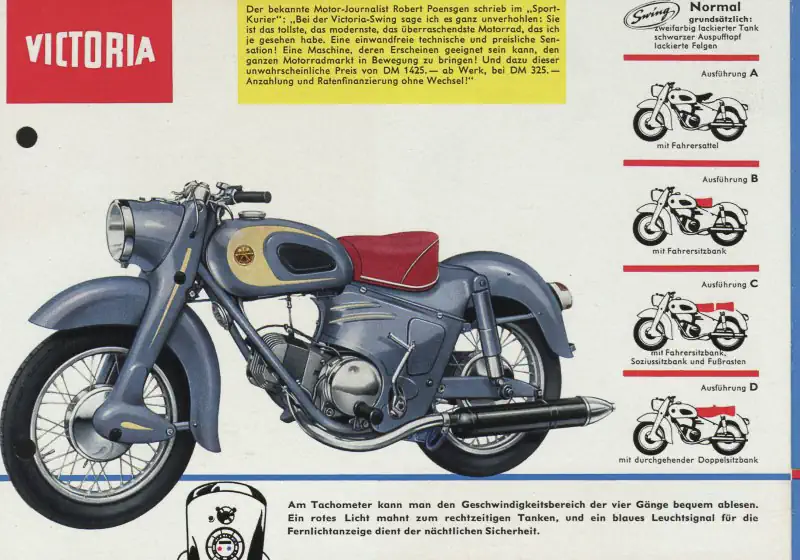
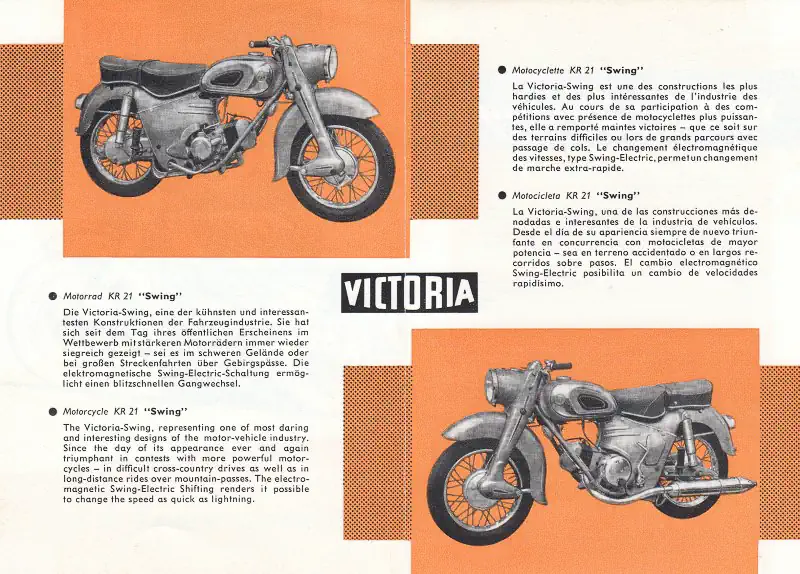
But the Swing had some advanced features for its day. The most unusual was its four-speed electromagnetic push-button gear change Getrag transmission, which Victoria also employed on its Peggy scooter. The Swing’s optional electric starter was uncommon in the 1950s, even on large-displacement motorcycles, let alone on a 197cc single-cylinder two-stroke.
Gear shifting was done with a small panel mounted on the left handlebar adjacent to the clutch lever. Four buttons controlled gear changes, while pushing the first- and second-gear buttons simultaneously put the transmission into neutral. Each gear was engaged by one of four ring-shaped electromagnets when energized by the corresponding push-button switch on the handlebar. Though advanced in concept, the system could be a little tricky to use, according to period road tests.
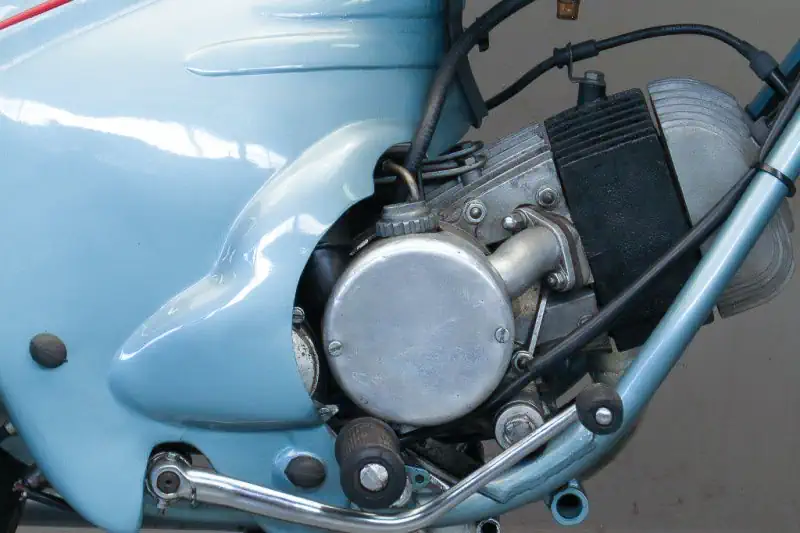
The right-side location of the Bing carburetor and intake manifold, with the exhaust correspondingly located on the left side, makes for a clean frame front. Photography courtesy of Peter Kisgen.
The 65mm x 60mm piston-port motor was an advanced design, riding nearly horizontal in the frame. It had a cast-iron barrel and an alloy head, with a 7.2:1 compression ratio. Premixed oil/fuel made its way to the combustion chamber via a Bing carburetor operated with a conventional twist-grip throttle. Claimed output was 11 hp at 5300 rpm. Ignition was a 6-volt battery-and-coil system with a 60-watt generator.
The Swing’s cast aluminum chaincase/swingarm is visible in this view. Photograph courtesy of Peter Kisgen.
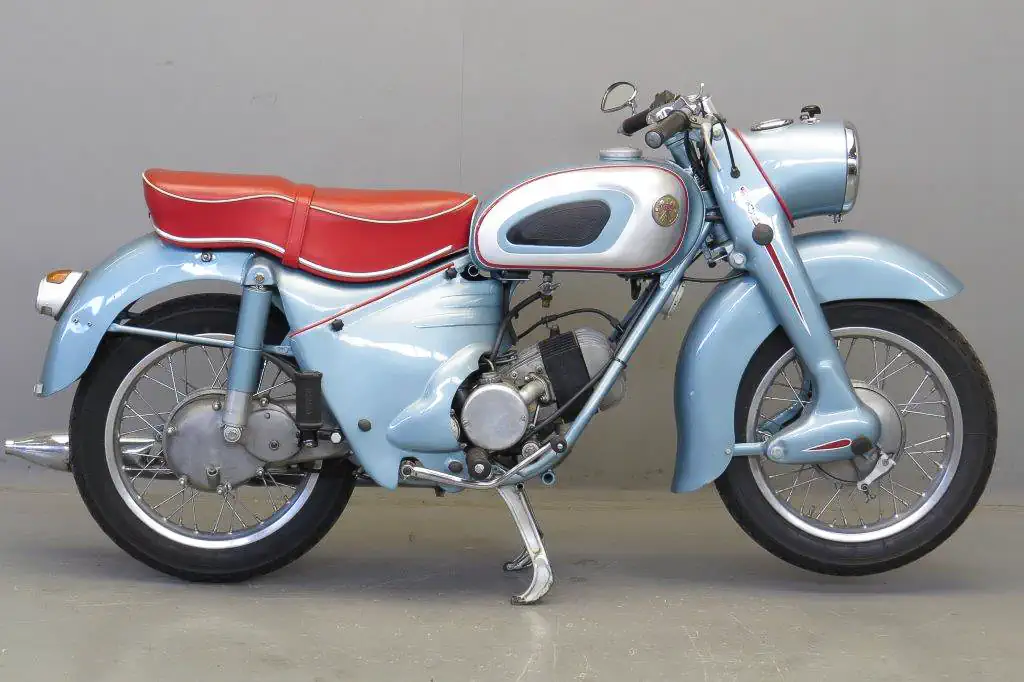
The chassis is another area where the Swing departed from standard practice. The unit construction, drivetrain, and swingarm were integrated into a single assembly that pivoted together. It was this feature that inspired the name of the Swing model. The enclosed final drive chain had an automatic tensioner, ran in an oil bath, and was housed in a cast-alloy housing that doubled as part of the rear swingarm.
This view shows the Swing’s clean lines and the near-horizontal position of its two-stroke engine. Photograph courtesy of Peter Kisgen.
The remainder of the chassis was a more traditional duplex steel tube frame. The front suspension was a pressed-steel girder with a cantilevered, hydraulically damped spring unit ahead of the steering head. Seven-inch mechanical single-leading-shoe internal expanding drum brakes handled stopping duties on both wheels. Dual hydraulically damped, coil-spring shocks provided the rear suspension with spring-preload adjustment. The Swing rode on 16-inch wheels with 3.25-inch-wide tires, had a compact 50.5-inch wheelbase, and weighed 288 pounds, so it was nimble.
The 1955 Victoria KR 21 Spring earned praise for its handling from The Motor Cycle road tester Alan Baker in his August 1958 review:
Thanks to its short wheelbase and good handling characteristics, the Swing was an entertaining machine to ride on twisty roads. It could be banked over or picked up very quickly and considerable enthusiasm was needed on corners before anything grounded. Steering could be criticized only in respect of slight low-speed heaviness.
Baker also made observations about the Swing’s push-button transmission:
And what of the gear-box operation? First, let me doff my helmet to the Getrag organization for having produced a box which is dead quiet in all ratios and can give virtually instantaneous, clean changes in either direction.
So far, so good. However, there was a fly in the transmission ointment:
In the earlier stages, I was caught out once or twice because, although neutral can be obtained from any gear, it must be selected while the machine is still rolling. If not, one is left at rest in gear—usually third or top in the case of an emergency stop—with no response to button pushing.
Well, nothing is perfect; push-button shifting would still be pretty keen.
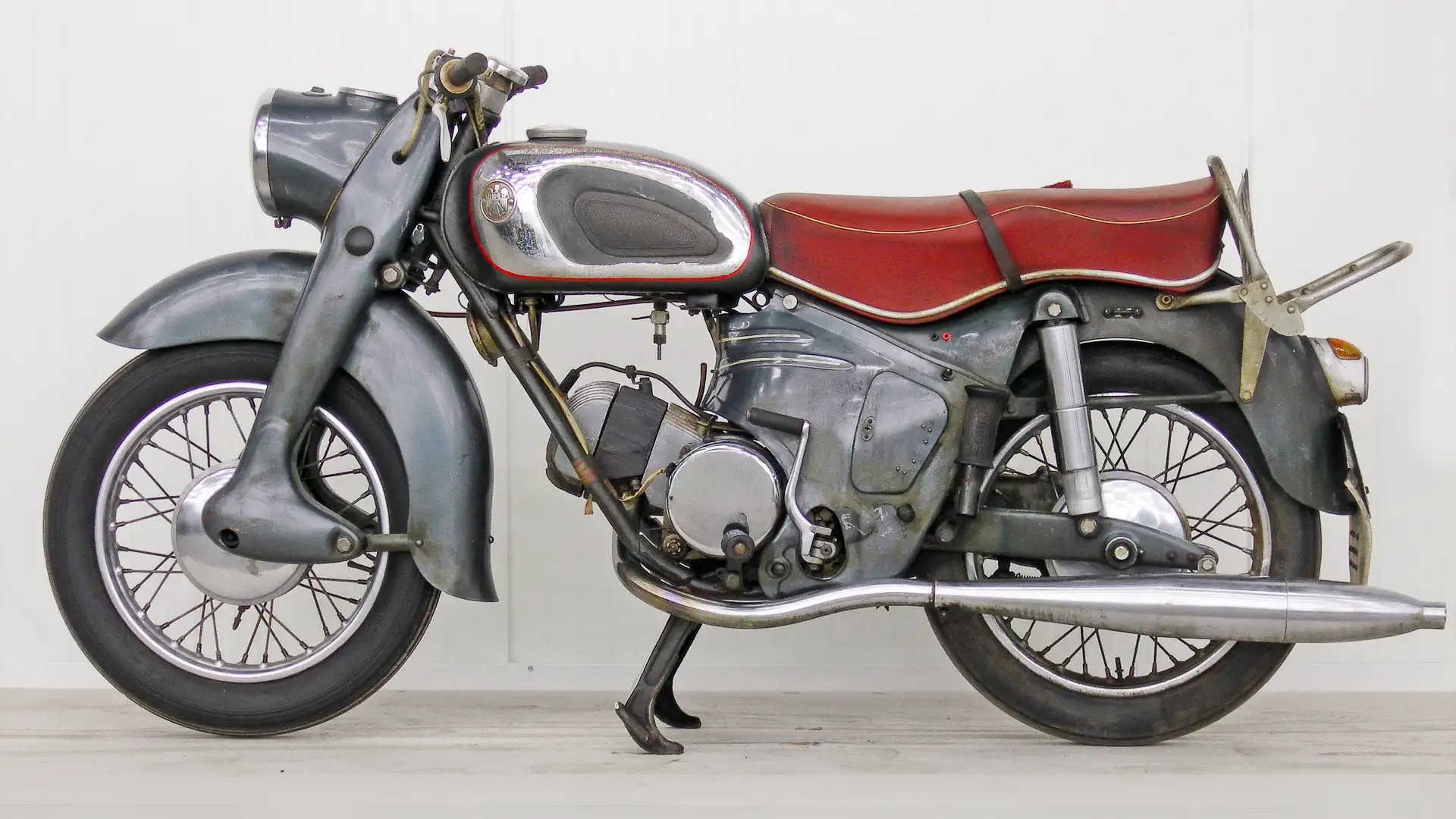
This Swing sold for $3680 at Bonhams’ Las Vegas Motorcycle Auction in 2013. Photograph courtesy of Bonhams.
The fiberglass panels below the seat evoke the Triumph “bathtub” designs of the late 1950s. The panels, which protect the air filter, electrics, and other essentials, are easily removed for maintenance. Matching fiberglass leg shields and a fairing could be added as options.
All this accurately suggests that the Victoria brand was not run by rookies. Indeed, the German company was launched in 1886 as a bicycle manufacturer. The company switched to building motorcycles in 1899. By 1926, one of Victoria’s supercharged 498cc flat-twin four-stroke motorcycles set the German land speed record.
Despite adroit engineering and manufacturing, economic headwinds depressed sales, and in 1958, Victoria merged with DKW and Express. Production of the Victoria Swing ended in 1962, and the Victoria brand disappeared after the formation of the Zweirad Union in 1966.
Have you ever wanted to ride a real MotoGP track? Well, here’s your chance! Leod Escapes does all sorts of incredible touring experiences with the very best that Europe has to offer. Fabulous accommodation, incredible food, and motorcycles what more can you ask for! So for the trip of a lifetime, visit LeodEscapes.com and check out your dream vacation.
* * * * *
The 2026 Aprilia Tuono V4 Factory 1100 remains one of the purest expressions of excess in motorcycling, standing proudly as an example of two-wheeled wish fulfillment done right. There are no gimmicks, pangs of guilt, or disappointment in the Tuono V4 Factory; it is simply a damn good bike. Nic de Sena tells us all about why you need this exceptional motorcycle in your garage.
* * * * *
This year, ARCH Motorcycle shocked the MotoAmerica Mission Super Hooligan series by capturing their first historic race win. To explore the massive behind-the-scenes effort that fueled this success, we sit down with Executive Producers John Stevens and Chance Wright, of the new six-part docuseries, Hooligans: The ARCH Racing Project with Keanu Reeves & Gard Hollinger. In this segment, they give us an inside look at the show, which follows ARCH as they transition from building custom bikes to entering the high-stakes world of professional racing. Joining us alongside is Brad Knight from technical partner BDO. BDO USA serves as the official race tech and consulting advisor for ARCH Racing. Their technology partnership centers around a bespoke, AI-powered race intelligence platform designed to drastically optimize the team’s track performance. The AI side of this project focuses on taking raw race and telemetry data and transforming it into immediate, actionable insights for the crew. It’s a fascinating insight into the new technology that helps make them faster on track.
* * * * *
Our guest this episode is Paul Puma, President of the United States Motorcycle Coaching Association (USMCA) and a Relationship Manager for Wells Fargo Motorsports Division. He leads the organization in connecting riders with certified coaches to promote nationwide safety, skill development, and sport growth.
* * * * *
Here’s quick reminder to check out our monthly digital magazine. It’s filled with everything you want to read on motorcycling, including some things you’ve probably not seen elsewhere. It’s absolutely free and you will find it on the Apple App Store and of course on Google Play as well.
Don’t forget to leave us your comments on our social media—we’re on all the usual platforms at Ultimate Motorcycling. We love hearing your feedback… so good or bad, please let us know what you think. If there’s something you’d like us to cover, we’d love to hear those ideas too!
We use cookies and browser activity on this website
Functional
Always active
The technical storage or access is strictly necessary for the legitimate purpose of enabling the use of a specific service explicitly requested by the subscriber or user, or for the sole purpose of carrying out the transmission of a communication over an electronic communications network.
Preferences
The technical storage or access is necessary for the legitimate purpose of storing preferences that are not requested by the subscriber or user.
Statistics
The technical storage or access that is used exclusively for statistical purposes.The technical storage or access that is used exclusively for anonymous statistical purposes. Without a subpoena, voluntary compliance on the part of your Internet Service Provider, or additional records from a third party, information stored or retrieved for this purpose alone cannot usually be used to identify you.
Marketing
The technical storage or access is required to create user profiles to send advertising, or to track the user on a website or across several websites for similar marketing purposes.